

If you haven’t been paying attention to what’s been happening in the stenographic court reporting industry in the past decade, then you are about to be hit by the proverbial bus that threatens to destroy the stenographic court reporting profession, but more like an atomic bomb extinction-level event.
Yes, I’m being an alarmist, because nothing else stenographers have done in the past decade seems to be working to have judges and attorneys wake the fuck up!
We are at Defcon Level 1, to use the military term to indicate how close we are to an extinction-level event, unless something is done soon to stop it.
Much of what’s transpired in the past decade has been memorialized by prolific blogger, Stenonymous, who gives an concise timeline of a lot of the significant events.
But this story starts thirty years ago.


“Only skilled court reporters can be trusted to create a reliable record of trial court proceedings.”
In 2012, there was a layoff of more than 80 official court reporters in Los Angeles County Superior Court and the privatization of court reporters in civil courtrooms began. The justification for this move was nothing less than a budge shortfall of $20 million. The first county’s move had a domino effect on the other 58 counties in California over the next decade.
Family law courtrooms were included in the departure of official court reporters in 2013, but shortly thereafter reneged after backlash from the legal community resulting in legislation to compel courts to staff family law courts with stenographers. But in 2023, Family Law courtrooms were once again left without a guaranteed official court reporter. Official court reporters were assigned on some days, but not others, and private court reporters would show up, hired by the attorneys, only to find that there was an official court reporter covering that day. The complete lack of communication contributed to the freelance reporters avoiding family law courtroom jobs, if at all possible. I’ll get back to more on this a little later, because this becomes pivotal in the storyline.

In 2013-2014, Ducker Worldwide was commissioned by the National Court Reporters Association, and their Court Reporting Industry Outlook 2013-2014 was published. Jim Cudahy is Executive Director of NCRA at this point and instrumental in getting the shortage forecasted. California’s shortage of court reporters was forecasted to be 5x to 20x worse than the rest of the country. The study predicted a shortage of 5,500 reporters nationwide by 2018. In California, where they were expected to experience a third of the shortage, it meant that by 2018, if the prediction were to come to fruition, would mean that the over 7,100 court reporters in CA in 2012, would be reduced to only 2,900 court reporters in California by 2018. THAT NEVER HAPPENED! It was like the big 1999 Y2K dud! And in 2024, a decade after the study, and six years after the shortage doomsday prediction, California still has over 6,580 active, licensed stenographic (and now voice) court reporters working in our state. CA lost roughly 900 reporters in that decade, but gained over 700 reporters, resulting in an almost equilibrium state to the pre-study days.
Let’s talk about the motivation of some of the players for a second. After Jim Cudahy left the NCRA, court reporter Kathy Di Lorenzo was appointed President of the NCRA. Her acceptance speech hinted at a “method agnostic” future for the reporting profession, which got her ostracized and shunned in the reporting circles. Kathy, most likely motivated by revenge, joined forces with Jim and was one of the leaders who started and chaired the STTI, Speech to Text Institute. Joining them were a host of industry leaders, including our 800-pound gorilla vendor of our stenograph machines, Stenograph, itself, and a host of the largest agencies in the country and the leading disruptors like For the Record, Verbit, vTestify, and more.

These leaders considered themselves pioneers and visionaries, and expected this new path to pave their way to riches. They conspired and colluded and plotted of ways to have their new “method agnostic” approach accepted. Once met with resistance, they went underground and took back channels, carving their own path through the jungles in the dead of night.
One of the most egregious things they (collectively) did was take the Ducker study, which was inherently flawed from the beginning, and used it to falsify their projections of an exaggerated shortage beyond 2018.
The Ducker Worldwide Court Reporting Industry Outlook flawed research methodology only consisted of 120 interviews, and none of those interviewees included an actual court reporter. Their prediction of a shortage never came true, as I could have told them it wouldn’t in 2014. For one thing, reporters don’t simply retire at 65 like the rest of the workforce. The average reporter works for an average of 48-plus years, which pushes the age of retirement out to 70-78. There are 100 active CSR licensees in California that have been working between 53-66 years. So their prediction could be 10 or more years off, pushing their shortage prediction to 2028. Those ten extra years bought us all just the right amount of time to recruit and replenish our numbers, which we have done in spades.

Here are snippets taken from a PowerPoint presentation given on July 19, 2021 by Kathy DiLorenzo of PlanetDepos to court reporters they were trying to recruit to do the transcription for them after they hired digital reporters to appear at their deposition and recorded the proceedings. PlanetDepos learned that their supply of “Digital Reporters” that they recruited “off the street,” were not going to cut it and they needed stenographic court reporters. The turnover rate of their new digital recorder employees was reportedly over 320% according to one source, which is probably why we’re constantly seeing ads recruiting “digital reporters” all over the country. They have to keep recruiting and training them because it’s a revolving door.
Planet Depos simply took the Ducker predicted shortage number of 5,500 reporters by 2018, and just drew the red down-curve line down the graph in a consistent downward line and then made up the figures of 11,345 and 23,100 by 2023. It’s now 2024, and their projected numbers were never realized. The Ducker study was wrong and Planet Depos fake trajectory graph was wrong. Their math never added up. It was invented, fabricated, concocted, made-up, complete fiction to fit their sales narrative to drive their plan forward.
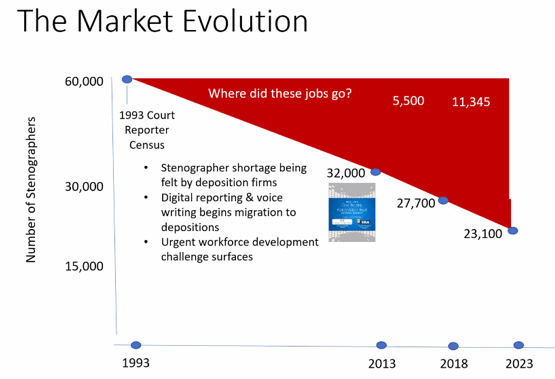
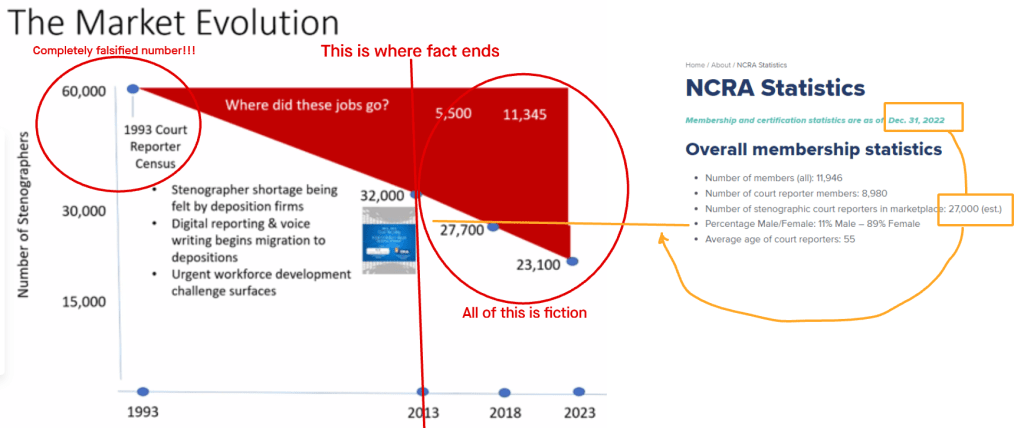
The starting point for their graph, the 60,000 reporters in a made-up 1993 Court Reporter Census is a completely fabricated number. There’s no evidence of a 1993 Court Reporter Census being done. There were never, ever 60,000 court reporters working in the United States at any time. According to the NCRA’s website on their history, in 1960, there were only 7,000 reporters employed in the U.S., using over 40 systems of shorthand writing, including pen writers. It is impossible to gauge the number of actual working court reporters in the United States because only 28 states have licensing requirements. We know how many official court reporter jobs there are in Federal and state courts without a licensing board. But that’s the best we can do. The estimates from the various sources are all over the place. No one has ever attempted a national court reporter census. To go from 7,000 court reporters in the US in 1960 to 60,000 reporters 30 years later in 1993 is preposterous! It contradicts even their own assertion that recruiting efforts to stem a 2018 shortage would be impossible.

Pricewaterhouse Coopers even gets it wrong:
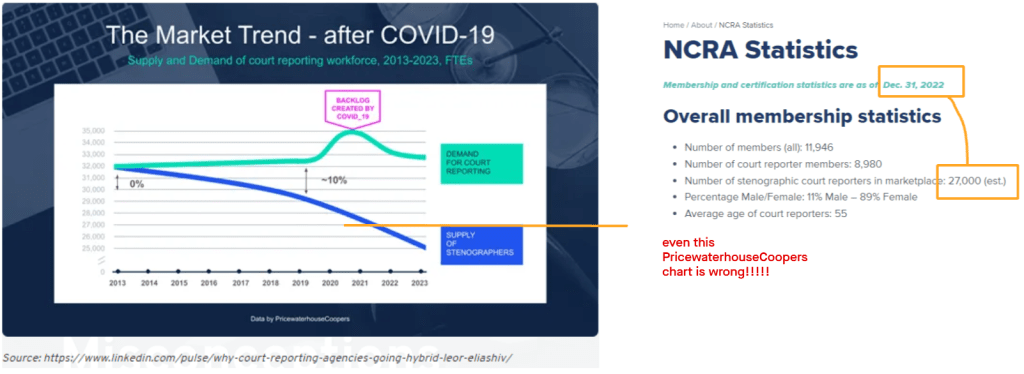
This next PlanetDepos chart is a complete work of fiction with no basis in reality. It was all a marketing hoax.
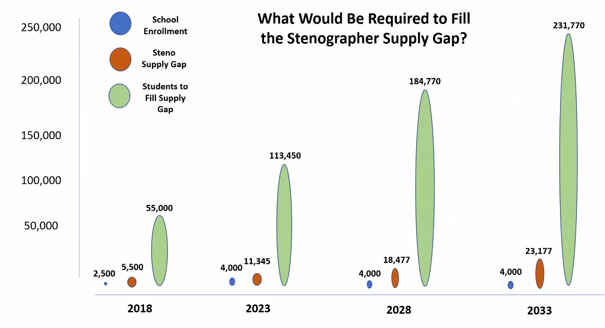
The STTI block also participated in propaganda using fake numbers of a projected shortage that was not based on any research or science.

According to the U.S. Labor Department, employment of court reporters and simultaneous captioners is projected to show little or no change from 2021-2031.6 But even the Bureau of Labor Statistics gets it wrong, and cites the number of court reporters in 2022 as 21,300. Then the USLD forecasts that there will be 21,900 court reporters by 2032, a 3% increase.
The red line is more accurate:
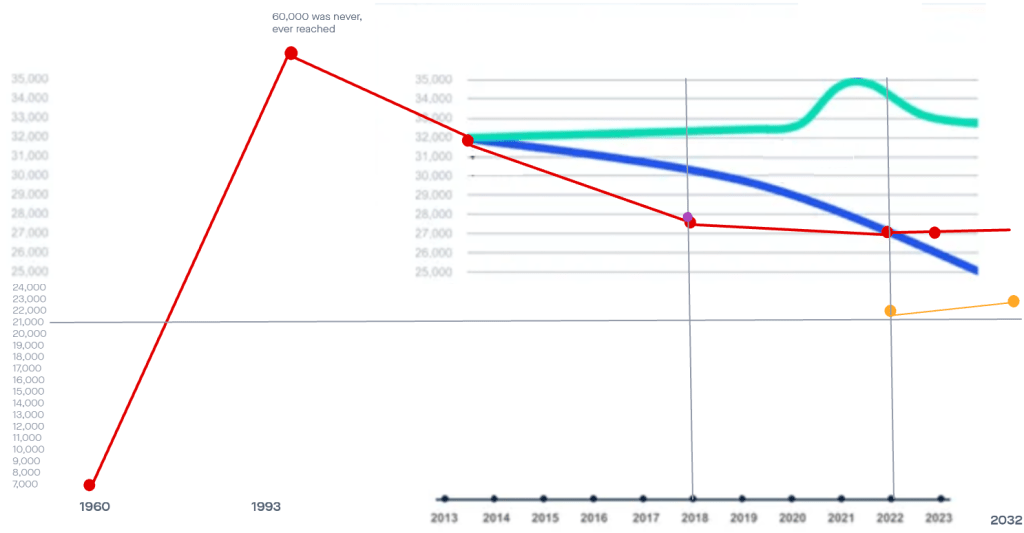
I have no information that the number of court reporter in the U.S. ever exceeded 32,000, but to illustrate the ridiculousness of the 60,000 number, I drew it as high as this chart went.
Here, let’s do the 60,000 number that Planet Depo used. Now you can see why they used it. It would help them to draw a more dramatic fictitious line downwards, because the more realistic representation would be a very undramatic horizontal line across the page with little downward change.

In California, the Court Reporters Board’s database of licensed CSR’s only dates back to 1952. The oldest active license was issued in 1958 and expires in June of 2024. California has been losing approximately 50 active licensees per year. There are approximately 1,000 active reporters in CA who have been working for more than 48 years. If we lost all of those active licensees, we would still not be close to the shortage that the Ducker study predicted for California alone.
On December 19, 2022, the NCRA Steno Strong committee members published an article in the Journal of Court Reporting with a catchy title, that finally called the report out of date and inaccurate and cited a lot of actions that were taken to overcome the predicted shortage since its publication.
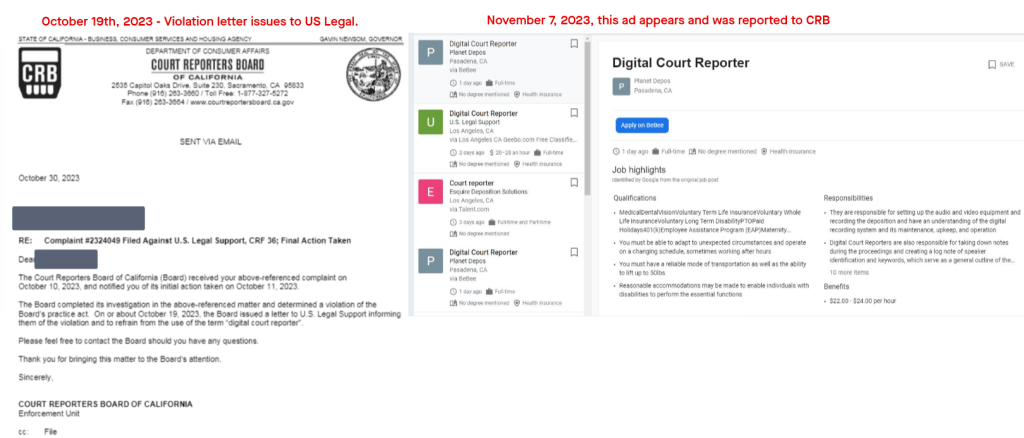
This action, however, is too little too late. The damage has been done. A decade of the proliferation of digital “recorders,” even in states where it is illegal, has not stopped them. The purveyors have been so emboldened that they’ve even made it mandated company policy to have digital recorders 50% of their business in every office, in every state, nationwide. Nobody – not the state CRBs, the DOJ, the State Attorney General’s office – NOBODY, will do a thing to stop them. After the CA CRB issues a violation letter to agencies, not even a week after receiving the letter, the agencies are caught publishing job ads for “Digital Court Reporters” again in states that have title protection, yet nothing is done to punish them. Here’s just one of many examples.
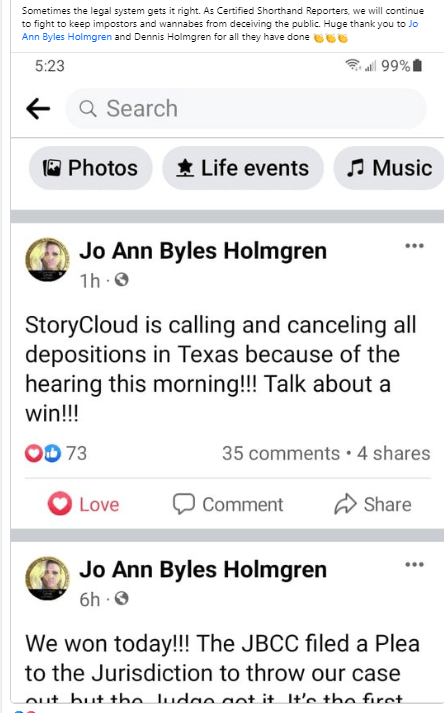
Court reporters are the superheroes in this story – vigilant and working voluntarily after a full day as a court reporter, to take actions such as writing articles, visiting their state politicians, advocating, educating, and filing lawsuits. A court reporter/attorney husband team has sued StoryCloud and put them out of business and then helped TX fight other litigation. Jo Ann Byles Holmgren and Dennis Matthew Holmgren have given speeches at national and state conventions all over the country talking about their winning efforts.


Even with these efforts – the recruiting, the overflowing schools, the articles, the lawsuits, the blogs, the social media darlings – it’s not enough. There are things all of us can do now that would have a huge impact on the ability for court reporters to survive. The NCRA needs to publish a “Responsible Charge Statement” that clearly defines the court reporter’s role in being responsible for the chain of custody and keeps the court reporter in charge of transcript production, and not the agencies, as the big agencies are trying to do. There needs to be a law in CA that takes away the ability for a notary to swear in a witness in legal proceedings, a law like Texas has had for a long time. An initiative to bring a lawsuit that would seek to define the term “Deposition Officer” and how the only one that term could possibly be a reference to is a certified court reporter needs to happen. Efforts need to be made to get all states to have CSR licensing requirements. Currently, there are only 28 states that have certification requirements. Reciprocity between states to license more CSRs to help meet the demand needs to happen. All state certifications need to be standardized and use the same acronym. The focus should be on getting all states to require licensing of CSR’s and standardizing on one.
Most importantly, the CA CCRA and LACCA associations need to revive their 1993 lawsuit against Los Angeles County and sue them again. LASC has installed recording devices in all civil courtrooms in advance of legislation that allows them to do so. They are already recording in one beta civil courtroom. The clerk staff has already been trained to use it. More on that in a little bit. We need a writ of mandate to stop them again like the one we got in 1993! Where are our CA leaders?
What’s at stake if more aggressive measures against the fraud and proliferation of digital recording aren’t taken in our industry? The players behind the movement are those behind STTI and now STAR, and they have money and are with the biggest players in our industry, and they are backed by private equity funds and Silicon Valley investors. These players have been attempting to get laws changed in states that have weak and inadequate representation, laws that would allow their plan to prevail, to allow digital recording. Stenographers have countered these moves successfully like a joint whack-a-mole effort. They keep popping up.


In California last year, SB 662 popped up on the legislation, a move that would allow CA courts to record all civil proceedings. The backers of this, however, was not the STTI/STAR conglomeration, but the judges, judicial council, and lawyers. But the fraudulent STTI numbers were used to help make their decision and they were given a presentation by For The Record. Getting back to the start of my story about the layoffs of official reporters and privatization of civil, what has happened in the last decade is that the pricing of private court reporter fees in court has been going up and up and up. At a certain point, it reached the point that the market will no longer bear. The court reporters are getting blamed for gouging attorneys, but the reporters are held to statutory rates in court. The per diems are not statutory, and those have gone way up. When reporters were first laid off, they were charging a half-day per diem of $250 and a full day per diem of $500. Now those rates are $750/$1,600 and higher. But that’s what reporters are charging. Agencies are adding their margins on top of that and attorneys are getting billed $1,250/$2,300 from the agencies.
Here is an example of a court reporter’s invoice to the agency and then that agency’s invoice for the very same copy order to the non-client attorney on a court trial. You can see that the reporter billed for 209 pages of a copy order at statutory rates, but the agency charged for 255 pages, 46 more pages that include a condensed mini. The agency billed the attorney $1,929.05. That’s $1,711.69 more than the reporter’s invoice for the same copy order. The one line item on the reporter’s invoice turned into six line items for the same thing on the agency’s invoice to the attorney. The statutory rate on a copy order is $1.04/pg, which is what the reporter invoiced, but this agency charged $1.56, taking a $0.52 cut of the invoice, which they’re not allowed to do according to Government Code 69950 and 69954.

It is this gouging of attorneys by agencies that has California lawyers so upset with court reporters that they are quietly planning to bring SB 662, proposed by Senator Rubio, back to the CA legislature for a vote in early 2024. The Judicial Council in CA also supports SB 662, citing the unavailability of court reporters, and they say they will ensure every effort will be made to find an available court reporter first, yet they have no tangible plan to do that. The fact is, the 79 laid-off reporters successfully covered all the civil proceedings in LA County for years, but now the list has grown to over 400 freelance court reporters who want to cover civil courtrooms in Los Angeles County. The number of licensed court reporters is only down by 500 in California since 2012, from 7,100 in 2012, to 6,580 in 2024 – not a shortage at all.
Yet, the judges are so confident that SB 662 will pass in 2024 that the County of Los Angeles has already installed recording equipment in all of their civil courtrooms in Los Angeles County and have already preliminarily trained all of their civil clerks how to use the equipment. They have a beta civil courtroom that is already using their recording equipment, whether or not a live stenographer is present to report the proceedings verbatim. In 2018, LA County Superior Court installed recording equipment in 78 misdemeanor courtrooms. The plan to roll it out in civil courtrooms has been in the works for many years, but now the judiciary has the backing and support of the attorneys. The Los Angeles Superior Court is flagrantly violating Government Code 69957.
In its planning to replace stenographers with electronic recording equipment in all civil courtrooms in Los Angeles County, a report was prepared for the California
Trial Court Consortium (CTCC) whose membership includes all courts in California with 38
judges or fewer. In that report, the fraudulent STTI chart was cited to exaggerate the shortage of court reporters forecasted, in order to persuade the Judicial Council to approve the purchase of electronic recording equipment. It is a fraud being perpetrated on the Judicial Council, judges, the Superior Court, attorneys, and the public.
This graph that was created by the Speech to Text Institute and is completely fraudulent and was not based on a real math, a study, or scientific research was included in the CTCC report that was used to make the decision to purchase and install electronic recording equipment in all of the Los Angeles Superior Court civil courtrooms in 2022-2023. The numbers were plotted on the graph by simply drawing the line on a made-up downward trajectory.
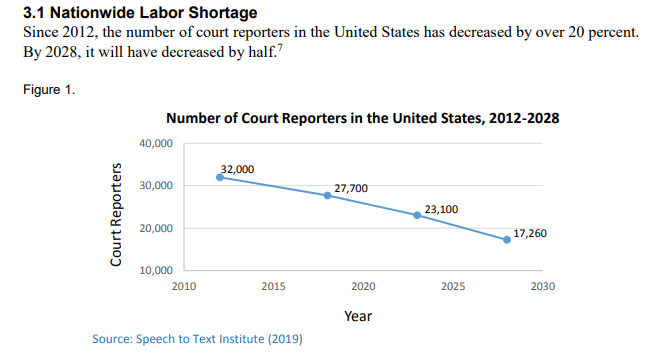
This graph of supply and demand has no basis in reality, yet it appears in the report on page 5 and is used as a basis for their decision to install electronic recording equipment in all the Los Angeles County civil courtrooms in 2023. The basis for these numbers was taken from a flawed 2013 Ducker Worldwide study where only 120 people were interviewed. No court reporter participated in this study – not one. The numbers in this STTI chart, beyond 2013, are made-up projections that have no basis in reality, it’s not real math, and it’s not based on a scientific study. The Ducker prediction of the 2018 shortage was never realized and was completely false. This is pure fraud by the Speech to Text Institute. FRAUD!!!

The Los Angeles Superior Court has made a decision to purchase For The Record electronic recording equipment and installed it in all their civil courtrooms based on a FRAUDULENT graph put out by the STTI. It is a fraud on our largest court system in the world. The California Trial Court Consortium has been played! And the Judicial Council is supporting the passage of SB 662 based on this fraudulent information published by the STTI. The STTI, Speech To Text Institute, no longer exists. Their website was taken down after being named in a lawsuit and after being accused of this FRAUD by Stenonymous and many others in the court reporting community. Anir Dutta, current president of Stenograph, and the former president of STTI has announced that he has nothing to do with them any longer, distancing himself from their fraud, which he helped perpetrate for about five years.
Another thing that has attorneys so upset with Southern California court reporters and has made it very easy for them to cling to the proposed SB 662 is the reporters’ refusal to comply with their “SoCal Stip.” The stipulation has been around for at least 40 years. No one seems to be able to remember how long. But I spoke with the late Judge Chavez of the Los Angeles Superior Court before the pandemic who took the bench in the 1980’s and he had no knowledge of the SoCal Stip, so it possibly post-dates his appointment to the bench.
In 2015, the movement for reporters to not follow the stipulation heated up, and within 16 months, the reporters practically eradicated the SoCal Stip. Reporters utilized the gray rock strategy and refused to comply with the stip and said simply that they were going by code, never explaining that if the reporter is a party to the stipulation, then they could be disciplined by the CRB for not complying with the law. And further clarified that if the reporter says nothing when the attorneys stipulate, then the reporter is a party to the stipulation and their silence is an agreement to their stipulation; a reporter must refuse to participate in their stipulation at the time of the stipulation, instructed the CRB. I believe that had reporters just told the attorneys their license could be on the line, the attorneys would have understood. But attorneys didn’t like a lowly court reporter telling them they could not stipulate to anything they wanted. Reporters created a very powerful enemy, basically 200,000 attorneys in California, who are now all for digital recording in the state.

Electronic Recording Court Proceedings is NOT a Viable Alternative to Live Stenographers
What most of the outside world doesn’t realize is that court reporters rely on scopists and proofreaders to help produce massive amounts of pages per week so that they can keep appearing in person. For every hour of reporting on a machine, it takes two hours of scoping and proofreading to produce a transcript, but some can do it in half the time. Court reporters do the work themselves for the first few years of reporting, but once they start getting cleaner translation rates and can do realtime, they are thrown into demanding work where daily transcripts are ordered. Heavy-hitter reporters produce around 1,000 to 1,500 pages per week, and work five days a week on the machine from 9 to 5, then work in the evenings and weekends on transcripts, even with a team of scopists and proofreaders. Some trial reporters doing dailies will work until 10:00 p.m. and then get up at 5:00 a.m. to complete their daily transcripts.
There is a shortage of really good, reliable scopists and proofreaders for court reporters to hire and keep on their team doing their work. There’s few training programs out there for proofreaders and scopists. Proofreaders can generally make $0.60 – $1.00 per page doing daily transcripts and scopists make $2.50 – $3.60 doing daily transcripts and realteam. Realteam allows a scopist to log into the court reporter’s CAT software (Computer Aided Transcription) and edit live, while the court reporter is writing on their machine, so that by the end of the day, the transcript has been completely scoped and can be delivered as a final almost instantaneously. Once the scopist is done with a chunk, they can send it to a proofreader who trails behind them. The court reporter pays for the scopists and proofreaders. The agency does not share in that burden. The court reporter oversees all of the work to ensure it is done properly and the court reporter puts it all together and has eyes on every single word on every page and approves it once the scopists and proofreaders are done. Scopists and proofreaders have been increasing their rates every year, while court reporters have not raised rates in almost 50 years, yet reporters continue to pay their subcontractors, leaving less and less for the court reporter.
There are now a plethora of speech-to-text software options on the market, Stenograph being the largest provider. It is the new plan to create a transcript using the speech-to-text software and then have scopists or proofreaders clean it up and create a final, and completely cut out the stenographers. They are recruiting scopists and proofreaders from the stenographers’ already small pool of subcontractors to do their transcript work. This hurts stenographers by competing for their pool of limited resources. Stenographers will not be able to work on their machines all week taking the demanding work, if they don’t have the support team to help them. It’s impossible for a stenographer to keep up with the workload single-handedly. There are stenographers who can do it single-handedly, but they need to take more time off between trials to recuperate. It leads to burnout and injuries, such as carpal tunnel and tendonitis, back pains, vein issues in the legs, and heart attacks and strokes from the stress, and other ailments. There’s even a Facebook group dedicated to the job-related health issues from which court reporters suffer. It also will lead to court reporter fees going up; if they have to reduce the amount of work they take a week, they can’t suffer earning less, so prices will naturally go up.
In Massachusetts, the entire court system transitioned to electronic recording. They are having their existing official court reporters work on transcribing proceedings from the audio recordings, where they listen to the audio and write it on their steno machines to create a transcript. It is not by choice that the reporters are doing this, but they have pensions on the line and health benefits, so they chose not to quit, but ride out their remaining time. They will do it until they can retire, which is fast approaching, given that the average age of court reporters is 55 and court reporters work for an average of 38 years. Massachusetts is a ticking time bomb.
“Once you’ve got missing or incomplete transcripts, you might as well kiss your appeal goodbye.”
There are freelance court reporters who will transcribe from audio. They get the audio file and write the proceedings on their steno machine, which is still the fastest way to transcribe. Most realtime reporters have a translation rate, including punctuation, of around 99.5%. The speech-to-text software has a translation rate of around 80%, but that’s not including punctuation, and it drops to less than 60% with heavy accents. If it takes an hour of scoping for every hour in court to create a steno-machine generated transcript at 99.5% translation rate, guess how long it takes to scope an AI-generated transcript at 80% translation rate? I’m told it could be upwards of six hours. The alternative is what they’ve been doing since before steno machines were invented, typewriters. Now they have foot pedals to assist with rewinding and playing the audio so they could keep their fingers on the typewriter to go faster. Most typists doing legal proceedings can type as fast as 120 words per minute. That’s about 3-4 minutes per page, with the average page containing 300 words. A full day of 200 pages is 800 minutes or 13 hours.
There are numerous problems with the plan to use scopists and proofreaders on speech-to-text AI-generated transcripts and eliminating stenographers. One, frankly, scopists and proofreaders aren’t good enough to replace stenographers. They have no formal schooling, they have no certifications or licenses, and they are just not good enough to replace stenographers. Two, scopists and proofreaders cannot act as the responsible charge. Usually, several of each are used and the transcript is broken up and sent out to multiple contractors. They were not present at the original proceeding, and they cannot attest to the accuracy, completeness, and genuineness of the recording. The chain of custody is completely broken when an audio recording is made and then sent out to multiple contractors. Three, there’s an even larger shortage of scopists and proofreaders than there are court reporters. It’s an even smaller pool of resources with a wider spectrum of capabilities, meaning even fewer of the good ones out there to work with. And four, it takes even longer to train a scopist and proofreader to get them to a level of competence than it does a stenographer. The average stenographer takes an average of 3 years to complete school. To gain sufficient competence as a scopist and proofreader, it takes a minimum of five years of experience. But there’s no oversight body to even determine what acceptable standards of competency is for scopists and proofreaders. It’s left for every individual court reporter to determine what’s acceptable of the scopists and proofreaders working for them by reviewing their work personally.
The other bad plan is to take the speech-to-text generated content, copy it and paste it into a Word document and then use transcriptionists who use a QWERTY keyboard. It takes longer to edit the document than it would if they were to just type it from scratch using their foot pedals and the original audio recording. They would have to play the recording and then compare it to the text, then correct words that are mistranslated, add the punctuation, and then add words it didn’t get, replay the audio in spots that were garbled or where people were talking over one another, and use their mouse to navigate through the Word document. It would take longer than the 13 hours it would take a typist to create it from scratch. You still have the issue of transcriptionists lacking any education, certification, and accountability. You have absolutely nobody who was present for the hearing who is involved in or overseeing the creating of the end-product transcript.
And because the amount of hourly pay would drop to below minimum wage pay in just about every single state in the U.S., you’re going to have to hire these resources from overseas. In California, the minimum wage just rose to $20.00/hour. A fast typist at 120 wmp, typing one page in four minutes, would produce 15 pages an hour. At $1.00/pg, that’s not enough to meet the minimum wage requirements for the fastest typist.
It is inarguably going to take longer to acquire transcripts that are electronically recorded than those that are stenographically produced. Official court stenographers are bound to strict turnaround deadlines for transcripts and appeals. If they don’t produce transcripts, they can be put in jail until the transcript is produced, and it has happened more than once. But for the most part, stenographers meet their deadlines. There is no jurisdiction over the transcriptionists, scopists, and proofreaders who are just assigned to pieces of the transcript, and may reside in countries other than the U.S. Stenonymous has blogged about a situation where it took two months to get a court transcript. I’ve heard of it taking a year to get a transcript on appeal that was electronically recorded. There will be a backlog of transcript orders from electronically-recorded court proceedings because the pool of transcriptionists is already at a breaking point now, without courts moving to ER.
I believe courts are expecting stenographers to transition to working on electronic recordings of court proceedings, but I believe they are very wrong about that. Court reporters would rather change careers or exit happily into retirement than take down audio recordings of court proceedings on their steno machines and produce transcripts that way. Court reporters are exiting the field at retirement without having recruited or trained their incoming replacements. There is no book that contains all of the information that court reporters learn on the job as they go along, having the benefit of consulting with their more senior peers throughout their careers. That book, if it existed, would take 30 years to compile and complete and would be larger than the Oxford English dictionary.
The shortage of stenographers will be massively eclipsed by a shortage of transcriptionists if courts all over the country allow electronic recording in all civil courtrooms. It would be a tsunami of destruction of justice and democracy and freedom in America. Without a record, there can be no meaningful appellate review, nor oversight of the judiciary, especially when the judiciary is the keeper of the record.
One of the justifications to use electronic recordings is cost savings, but that’s inaccurate. In addition, electronic recordings jeopardize the accuracy of the record because they are pone to flaws and errors, could violate privacy laws, and may violate the court’s compliance with the Americans with Disabilities Act.
Stenography is one of the great secret societies on par with the Oracle at Delphi or the Cult of Mithras, Freemasons, and The Knights Templar. (I jest, of course) It’s the best kept secret of which not much is known by the outside world. Not much is known about the inner workings of this exclusive cult. All applicants must pass a complex rite of passage – achieve 200 wpm at 96.5% accuracy – before they were considered fully vested members or syndexioi, “sealed by a handshake.” The crusader-like charge to protect the record is a uniting bond. Like the Freemasons, stenographers rose from apprentices to journeymen to master masons of their craft, in secret, individually. Stenography definitely meets the International Encyclopedia of Secret Societies and Fraternal Orders criteria to be defined as a secret society, in that it is exclusive, it claims to own special secrets, and shows a strong inclination to favor its members. Stenographers would never, ever divulge its secrets to outsiders – the digital recorders, QWERTY transcriptionists, and other interlopers threatening its existence. The extinction of stenographers would mean the extinction of a vast body of knowledge on the creation of the verbatim record.


Is a world without bees possible? Albert Einstein is arguably attributed as having said, “If the bee disappears from the surface of the earth, man would have no more than four years to live.”

If attorneys are unhappy with the rising costs of court reporters (through their agencies) now, just wait until they help to make us more scarce by allowing the use of electronic recording and digital recorders through legislative means. Just like if bees became extinct, we’d still have coffee, but it would be rare and become expensive.
So I will then ask, can the legal world live without Stenographers? Probably, yes, but justice would suffer tremendously. The turnaround times would suffer, the translation rates of realtime feeds would diminish, the accuracy of transcripts would diminish, and the cost of transcripts would surge. Judicial oversight would suffer. The unquestionable authenticity and credibility of transcripts would become extinct; there would be no way that survives without the protector of the record. But worst of all, there is no coming back. There will not be a return of stenographers once it reaches extinction. That is a certainty.
 STENOIMPERIUM
Hi Frederick. I hope you’re not investing your client’s money in any of these companies who are perpetrating this fraud on the American public. They’re going down. I see bars in their future, and not the kind where you can buy a drink.
LikeLike