Existing law establishes the Court Reporters Board of California to license and regulate shorthand reporters. Existing law establishes that a person who holds a valid certificate as a shorthand reporter shall be known as a “certified shorthand reporter,” and prohibits any other person, except as specified, from using that title or any words or symbols that indicate or tend to indicate that they are a certified shorthand reporter. A violation of the provisions regulating shorthand reporters is a misdemeanor. Existing law requires an individual to have satisfactorily passed an examination, as prescribed by the board, in order to be certified as a shorthand reporter.
8023 and 2023 the Business and Professions Code.
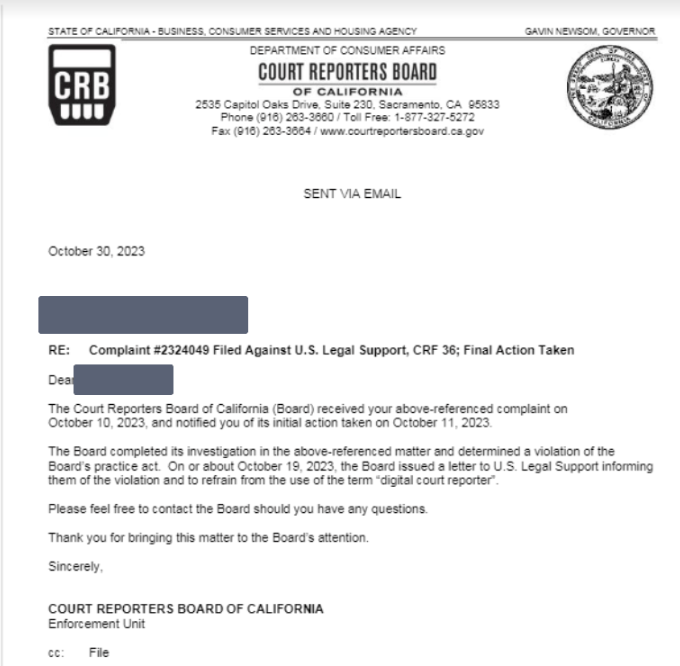
It was reported to the Court Reporters Board on Monday, October 9th, 2023 that “US Legal is flagrantly advertising for “digital court reporters” in CA. Are we to believe that once they hire them, they don’t actually have them go out and work as digital court reporters?”
The following screenshots of the US Legal ads in California were allegedly submitted along with the complaint.
The Court Reporters Board found US Legal to be in violation of the law and issued a letter informing them of their violation on October 19, 2023 and asked them to cease and desist from using the term “digital court reporter.”
While apparently a win for certified shorthand reporters in the state, it doesn’t stop them from just changing the title used in their ads to something like what other agencies are doing and getting away with.
Another agency, Planet Depos, was reported back in March of 2023 for job ads using the term “Digital Technologist” in California. On the Planet Depos website, they clearly have only stenographic court reporters or digital recorders. One can only conclude that although they are calling it something different, it is, in fact, a digital reporter position that they are recruiting and hiring, and we all know, working, in CA.
What good does title protection do for our industry if it doesn’t stop them from performing our duties under another unprotected job title?
Only those with CSR licenses should get to use the court reporter and certified shorthand reporter title. This ensures public safety and keeps liability issues at bay. Plus, it preserves the integrity of the record by:
Upholding high professional standards for creating and protecting the verbatim record
Preventing service devaluation through supply and demand
Court reporting is an important and learned profession. As members of this profession, court reporters are expected to exhibit the highest standards of honesty and integrity. Court reporting has a direct and vital impact on the quality of life for all people. Accordingly, the services provided by court reporters require honesty, impartiality, fairness, and equity, and must be dedicated to the protection of the public health, safety, and welfare. Court reporters must perform under a standard of professional behavior that requires adherence to the highest principles of ethical conduct.
Want to call yourself a court reporter? Then you need that CSR license, plain and simple. No license, no title.
If you see a violation of the use of the “court reporter” title protection, please report it to the California Court Reporters Board using this complaint form.
We exist to facilitate the fortifying of the Stenography profession and ensure its survival for the next hundred years!
As court reporters, we've handed the relationship role with our customers, or attorneys, over to the agencies and their sales reps. This has done a lot of damage to our industry. It has taken away our ability to have those relationships, the ability to be humanized and valued. We've become a replaceable commodity.
Merely saying we are the “Gold Standard” tells them that we’re the best, but there are alternatives. Who we are though, is much, much more powerful than that! We are the Responsible Charge. “Responsible Charge” means responsibility for the direction, control, supervision, and possession of stenographic & transcription work, as the case may be, to assure that the work product has been critically examined and evaluated for compliance with appropriate professional standards by a licensee in the profession, and by sealing and signing the documents, the professional stenographer accepts responsibility for the stenographic or transcription work, respectively, represented by the documents and that applicable stenographic and professional standards have been met.
This designation exists in other professions, such as engineering, land surveying, public water works, landscape architects, land surveyors, fire preventionists, geologists, architects, and more. In the case of professional engineers, the engineering association adopted a Responsible Charge position statement that says, “A professional engineer is only considered to be in responsible charge of an engineering work if the professional engineer makes independent professional decisions regarding the engineering work without requiring instruction or approval from another authority and maintains control over those decisions by the professional engineer’s physical presence at the location where the engineering work is performed or by electronic communication with the individual executing the engineering work.”
If we were to adopt a Responsible Charge position statement for our industry, we could start with a draft that looks something like this: "A professional court reporter, or stenographer, is only considered to be in responsible charge of court reporting work if the professional court reporter makes independent professional decisions regarding the court reporting work without requiring instruction or approval from another authority and maintains control over those decisions by the professional court reporter’s physical presence at the location where the court reporting work is performed or by electronic communication with the individual executing the court reporting work.”
Shared purpose
The cornerstone of a strategic narrative is a shared purpose. This shared purpose is the outcome that you and your customer are working toward together. It’s more than a value proposition of what you deliver to them. Or a mission of what you do for the world. It’s the journey that you are on with them. By having a shared purpose, the relationship shifts from consumer to co-creator.
In court reporting, our mission is “to bring justice to every litigant in the U.S.” That purpose is shared by all involved in the litigation process – judges, attorneys, everyone. Who we are is the Responsible Charge. How we do that is by Protecting the Record.
View more posts
2 thoughts on “Title Protection: The Court Reporters Board Comes Down on Violator: US Legal”





 STENOIMPERIUM
2 thoughts on “Title Protection: The Court Reporters Board Comes Down on Violator: US Legal”
Comments are closed.