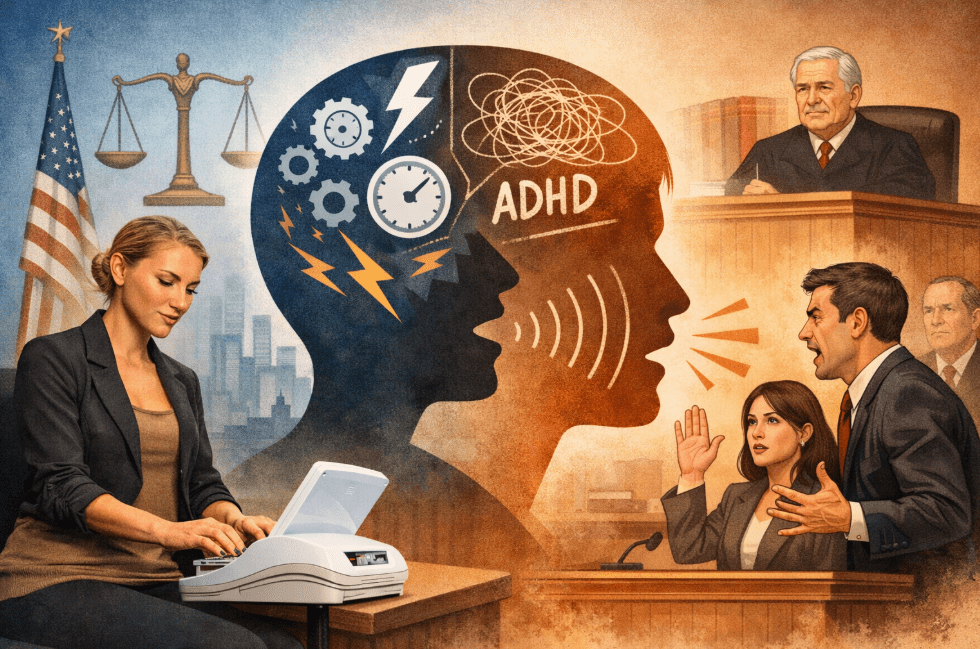
In courtrooms, deposition rooms, and hearing chambers across the country, interruption is one of the most familiar sources of friction. A witness cuts off a lawyer mid-question. An attorney finishes a judge’s sentence before it is fully formed. A party interjects emotionally, urgently, sometimes repeatedly. For court reporters, whose job depends on clear, sequential speech, interruption is not a social quirk; it is a technical obstacle, a threat to the integrity of the record. Over time, repeated exposure to this behavior can quietly harden into annoyance, judgment, or fatigue. The interrupter becomes a “problem personality,” rather than a human being with a nervous system under pressure. Yet a growing body of psychological research suggests that frequent interrupting is often not rooted in arrogance or disrespect, but in cognitive speed, anxiety, impulse regulation differences, and heightened emotional engagement.
Many habitual interrupters experience thoughts that arrive quickly and insistently, often outpacing their ability to hold them internally. High processing speed can create a constant sense of urgency, as if each idea must be spoken before it evaporates. Anxiety can produce a parallel pressure, the fear that silence equals loss of control or that unspoken ideas will be forgotten or misunderstood. Attention-regulation differences, including ADHD, can make turn-taking feel unnatural, even when the person deeply values what others are saying. In these cases, interruption is not a dismissal of another speaker, but an overflow of internal momentum. The mouth moves before social brakes fully engage. The result can look like rudeness, but the engine underneath it is often intensity, not indifference.
For court reporters, this distinction matters in ways that are both technical and human. The technical consequences of interruption are obvious: stacked voices, false starts, dropped words, and transcripts riddled with parentheticals. The human consequences are quieter. When a reporter begins to see interrupters as inherently inconsiderate, irritation leaks into tone, body language, and intervention style. The room becomes adversarial in subtle ways, even when the reporter is maintaining professional neutrality. But when interruption is reframed as a stress response rather than a character flaw, a different professional stance becomes possible. The reporter’s role shifts from merely controlling the room to helping regulate it. That shift does not excuse disruptive behavior, but it opens the door to methods that reduce it.
One of the most effective tools a court reporter has is not equipment or software, but pacing. Many interrupters speak over others because the conversational tempo feels intolerably slow to them. Strategic slowing can paradoxically create more order, not less. When a reporter calmly interjects, “One at a time, please,” or “Let’s go back and finish the question,” they are not only protecting the record; they are signaling rhythm. Over time, consistent rhythmic correction can entrain a room to speak in turns. The key is predictability. Interrupters often escalate when boundaries feel erratic. A reporter who intervenes gently but immediately, every time voices overlap, provides an external structure that some nervous systems struggle to generate internally.
Another powerful intervention is normalization. When a reporter says, “I’m having trouble taking you both down at once,” rather than, “Stop interrupting,” the focus shifts from blame to mechanics. The issue becomes the limitation of the record, not the failure of a person. This framing reduces defensiveness, which is one of the drivers of compulsive speech. People interrupt more when they feel unseen or unheard. By positioning the transcript as the shared constraint, the reporter becomes an ally in clarity rather than an enforcer of decorum. This subtle change in language can dramatically alter how often speakers correct themselves without being prompted again.
Court reporters can also use process transparency to help interrupters become more mindful. Briefly explaining the impact of overlap, especially early in a proceeding, often prevents later breakdowns. A simple statement such as, “If more than one person speaks at once, it creates an unclear record,” plants awareness before frustration builds. Many interrupters genuinely do not register how frequently they interject until the consequence is named. When awareness increases, self-regulation often follows, even if imperfectly. The goal is not silence, but sequencing. Most people want to be understood, and the transcript remains the most concrete reminder that understanding requires order.
There is also room for compassion in moments of visible cognitive overflow. When a witness repeatedly cuts in, a reporter might say, “I’m going to ask you to pause between thoughts so I can keep up,” rather than waiting for counsel to intervene. This reframes interruption as a pacing mismatch, not misconduct. It also gives the speaker a practical instruction: pause. Many habitual interrupters benefit from concrete behavioral anchors. Pausing, jotting a note, or raising a finger before speaking can provide a physical substitute for the mental brake they lack. While reporters cannot coach from the chair, they can invite behaviors that support the shared task of creating a clear record.
Some reporters quietly keep notepads visible and will gesture toward them when a witness seems desperate to interject. The visual cue legitimizes the urge to capture a thought without vocalizing it. It gives the interrupter a way to discharge internal urgency without disrupting the flow. This mirrors a technique many people with fast cognition learn privately: writing to hold ideas so they can listen more fully. When such strategies are modeled in the room, even indirectly, they often diffuse tension. The interrupter feels accommodated rather than policed, which reduces the very impulse that causes the interruptions.
Understanding the inner life of interrupters can also protect reporters themselves. Chronic annoyance is a form of cognitive load. It drains attention, shortens patience, and makes already demanding work heavier than it needs to be. When a reporter sees interruption as neurological weather rather than moral failure, emotional friction softens. The work remains challenging, but it becomes less personal. This emotional neutrality is not just a wellness benefit; it is a professional one. Reporters who remain internally calm are more likely to intervene early, speak clearly, and maintain consistent control of the room. Regulation begets regulation.
In a legal system increasingly aware of trauma, neurodiversity, and the cognitive impact of stress, the court reporter occupies a unique and underappreciated position. Reporters are not therapists, but they are often the first to detect when communication patterns are breaking down. They sit at the intersection of language and nervous systems. When they respond to interruption not only as a technical error but as a human signal, they elevate both the quality of the transcript and the tone of the proceeding. They help transform chaotic speech into an intelligible narrative. And sometimes, without realizing it, they give people their first experience of being guided rather than shamed for the way their minds move.
Interruption will never disappear from legal environments. The stakes are too high, the emotions too present, and the cognitive demands too intense. But it can be understood, anticipated, and shaped. When reporters approach interrupters with structured empathy—firm boundaries delivered through calm, neutral, and informative language—they create space for better behavior to emerge. They also remind everyone in the room, quietly but powerfully, that the record is not just a technical artifact. It is a human one, built word by word, by people doing their best under pressure to be heard.
Disclaimer
This article is a journalistic commentary and educational discussion. It does not constitute medical, psychological, or legal advice. References to cognitive traits, anxiety, or attention-regulation differences are general in nature and are not intended to diagnose any individual. The views expressed are those of the author and are offered to encourage professional reflection and dialogue about courtroom communication and the integrity of the legal record.
 STENOIMPERIUM
These thoughts are well described… putting a name and a face to a vital aspect of the process of certifying the official record, as well as in general life. Thank you! Slow speech is a thing. People know that too, and often rush others and bully their way through and think fast-paced questioning is going to get the truth or they really just don’t want to be there in that moment, doing that thing, so that is when this type of thing happens. “The faster you get, the slower I go” is a centering lens.
LikeLike