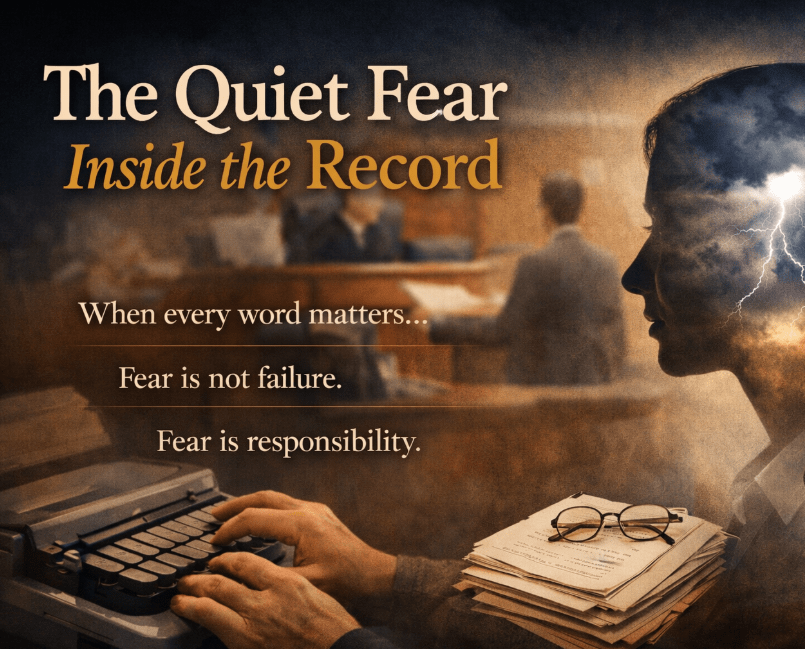
Court reporters rarely talk about fear. The profession rewards composure, invisibility, and control. The best reporters are often described as “solid,” “unflappable,” “machines.” They sit a few feet from the most emotionally charged moments of people’s lives and produce a clean, neutral record, as if nothing could touch them. In courtrooms, conference rooms, hospital rooms, and makeshift hearing spaces across the country, reporters are expected to absorb chaos without reflecting it. Their faces are calm. Their hands move. Their presence fades. But behind the machine, fear is far more common than the profession admits.
It often arrives quietly. A new reporter might feel it walking into their first real courtroom, before a single word is spoken. An experienced reporter might feel it years later, in a high-stakes trial, when a new judge takes the bench or a new technology is introduced or a new expectation is imposed. It shows up as a tightening in the chest when attorneys begin speaking over each other. It appears when a witness breaks down or when a courtroom erupts or when a proceeding veers into unfamiliar procedural territory. It surfaces in the small, private thoughts reporters almost never voice: What if I miss something? What if I fail this record? What if I am not as good as everyone thinks I am?
Two days into a long trial, when exhaustion sets in and the tempo changes, that fear often sharpens. The work no longer feels automatic. Fingers hesitate. Confidence wavers. The internal voice grows louder. I’m not keeping up. I should be better at this by now. Someone else could do this faster, cleaner, easier. Sitting at home editing or taking a routine deposition suddenly seems more appealing than being on the floor of a courtroom where every second feels exposed. The reporter may begin to fantasize about assignments that carry less risk, fewer variables, fewer eyes.
This moment is usually interpreted as a warning. Something is wrong. Something is off. Many reporters respond by pulling back. They turn down trials. They stick to safer work. They avoid the environments that provoke that internal unease. Over time, their world narrows. The profession loses not only skilled reporters, but resilient ones. And the reporters themselves quietly carry a sense that they failed some unnamed test.
But what if that moment is not failure? What if that moment is the work?
Fear, in court reporting, rarely comes from incompetence. It comes from responsibility. The record matters. The transcript will shape appeals, settlements, verdicts, and lives. Court reporters are not spectators; they are architects of the official memory of proceedings. When fear appears, it is often because the reporter understands the weight of what they are doing. They are not just capturing words. They are safeguarding the infrastructure of justice.
In that sense, fear is not an intruder. It is evidence.
It is evidence that the reporter is awake to the stakes. It is evidence that the work has not been reduced to rote motion. It is evidence that the person behind the machine still recognizes that this role is not neutral in consequence, even if it must be neutral in tone. Fear emerges when the mind grasps that something irreplaceable is happening in real time and cannot be replayed. That awareness is not weakness. It is professional consciousness.
The profession, however, has inherited a dangerous myth: that mastery should feel comfortable. That once you are certified, once you are experienced, once you are “real,” the work should stop unsettling you. When discomfort persists, reporters often conclude that they are misaligned, burnt out, or unsuited for certain settings. But change rarely feels like alignment while it is occurring. Growth rarely announces itself as confidence. More often, it feels like exposure.
The reporter who moves from depositions into court. The reporter who leaves a familiar courthouse for a new jurisdiction. The reporter who takes on realtime, complex litigation, technical testimony, or emotionally brutal subject matter. The reporter who continues working while the profession itself is being reshaped by technology and policy. Each of these transitions produces fear. Not because something has gone wrong, but because something new is being demanded.
The instinct is to make fear disappear. To wait until the nerves settle. To wait until the work feels natural. To wait until confidence arrives. But waiting for fear to go away before continuing guarantees stagnation. The reporter who insists on comfort as a prerequisite for participation will, over time, participate less and less.
Courage in court reporting does not look like bravado. It does not announce itself. It looks like returning to the chair when you would rather retreat. It looks like setting up in a courtroom where you know no one and everything is unfamiliar. It looks like continuing to take trials even after one has shaken you. It looks like allowing your hands to tremble and your voice to stay steady. It looks like doing the job while fear rides quietly alongside you.
There is a profound difference between fear that paralyzes and fear that instructs. Paralyzing fear narrows attention and pulls the reporter inward. Instructive fear sharpens attention and pulls the reporter outward. It asks: What matters here? What must not be missed? What do I need to listen for? When treated not as a verdict on one’s fitness, but as information about one’s investment, fear becomes a tool rather than an obstacle.
This reframing violates much of what professionals are taught about authenticity and self-alignment. We are told that when something is right, it feels right. That when something fits, it flows. But the self that seeks only ease is not the same self that grows. The part of us that avoids discomfort is not the part that builds capacity. The authentic self is not a static thing waiting to be discovered. It is something constructed through repeated contact with difficulty.
Court reporters, perhaps more than most, live in controlled environments. They are trained to anticipate, prepare, and manage variables. Fear disrupts that sense of command. It cannot be edited out. It cannot be corrected on a second pass. It arrives unannounced, mid-proceeding, and demands to be acknowledged. The temptation is to interpret that arrival as a sign to exit. But the deeper professional move is to stay.
Staying does not mean romanticizing anxiety or ignoring real limits. Burnout is real. Overwork is real. Trauma exposure is real. But fear alone is not evidence of harm. Often, it is evidence of proximity to meaning. It shows up when the work is alive. It shows up when the outcome matters. It shows up when the reporter understands that what is being built in that room will outlast the room itself.
Over time, something subtle happens when reporters stop treating fear as a disqualifier. They become steadier, not because fear leaves, but because it no longer governs. The sensation still arises, but it no longer carries the same authority. It becomes part of the background weather of serious work. Confidence grows not from its absence, but from repeated survival. From sitting through it. From producing the record anyway.
This is how professional identity actually forms. Not through certificates alone, or years alone, or reputation alone, but through encounters with moments that feel larger than you and choosing not to step away. The reporter who can sit inside uncertainty without collapsing it into avoidance becomes someone different than the reporter who cannot. Their presence changes. Their listening deepens. Their judgment sharpens. Their work becomes quieter, not because it is easier, but because it is grounded.
In an era when the profession itself is under pressure, fear has multiplied. Fear of being replaced. Fear of being marginalized. Fear of technological misdirection. Fear of institutional neglect. These fears are not irrational. But they too can either constrict or concentrate. They can drive retreat into smaller and smaller professional spaces, or they can clarify what is worth defending, improving, and insisting upon.
The court reporter who remains engaged despite fear is not merely preserving a career. They are preserving a standard. They are asserting that the integrity of the record deserves presence, not automation. That justice deserves witnesses, not just devices. That accuracy is not a product, but a practice carried out by accountable humans.
Fear does not mean you are failing. More often, it means you are standing at the edge of something that matters. The question is not how to eliminate it. The question is how to relate to it. Whether you will treat it as a stop sign or a signal. Whether you will interpret its voice as an indictment or as evidence of care.
Every court reporter who has lasted in this profession has known this feeling. They may not have named it. They may not have shared it. But it has been there, under the surface, in the trials that ran too long, the cases that cut too close, the moments when the machine felt suddenly inadequate to the human weight passing through it. They stayed anyway. And in staying, they became something more than technicians. They became stewards.
Fear will not leave this profession. It should not. It is part of what keeps the work honest. The invitation is not to conquer it, but to carry it differently. To hold it not as proof of inadequacy, but as proof of investment. To recognize that the unease you feel is not separate from your professionalism, but bound up in it.
Sit down. Set up. Take the record.
Even if your hands feel unfamiliar. Even if the room feels too large. Even if your inner voice is loud.
Especially then.
Disclaimer
This article is a professional commentary intended to explore the psychological and structural realities of court reporting. It reflects the author’s analysis and opinion and is not offered as legal, medical, or mental-health advice. Any references to fear, stress, or professional experience are general in nature and do not substitute for individualized guidance, employment policies, or clinical support.
 STENOIMPERIUM
Oh, wow, beautifully written and captures the fear and the weight perfectly! Thank you for sharing!
LikeLike
Thank you so much. That means a great deal. It’s a feeling many of us know well, even if we don’t often say it out loud.
LikeLike
Fear becomes a tool to inspire diligence and courage to show up and to continue to show up professionally and with passi
LikeLike