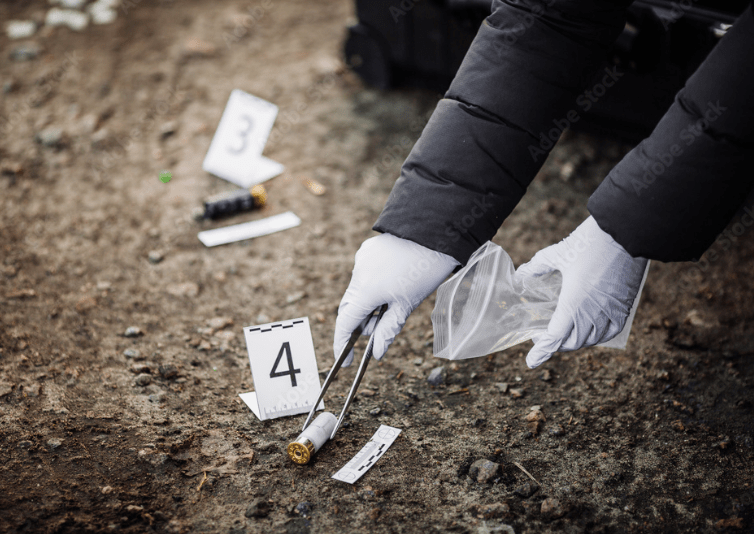
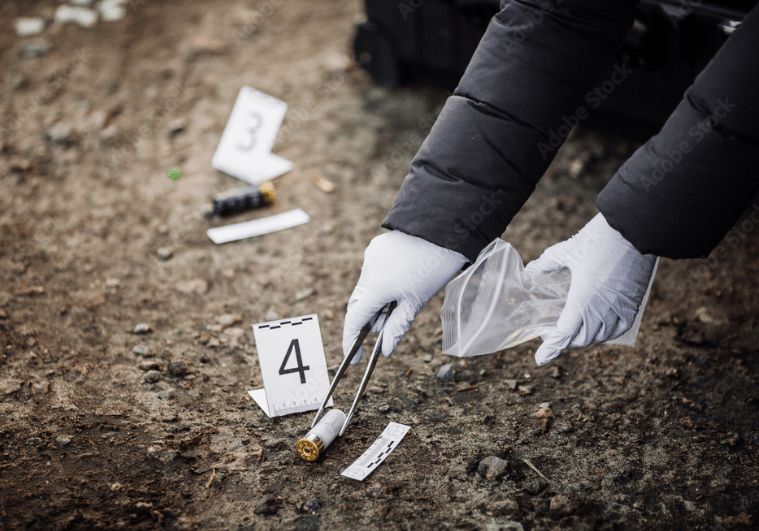
A homicide scene is taped off. A body lies on the ground. Shell casings are scattered nearby. A bloody knife is found a few feet away.
But instead of trained, certified evidence technicians, the court contracts with a “capture vendor.”
A person with no forensic license, no evidentiary oath, and no statutory authority walks onto the scene with a camera and a plastic bin. They take photos. They scoop up objects. They drop them into generic bags. No standardized chain-of-custody logs. No sworn evidence officer. No certification of methods. No testimony-ready professional whose career, license, and liberty are on the line for the integrity of what they collect.
The evidence is then driven to a warehouse.
Weeks later, another person — not a forensic analyst, not licensed, not court-appointed — opens the bags and begins “processing.” They decide which shell casing belongs to which marker. They label samples. They discard “irrelevant” material. They generate reports.
Finally, a document is produced:
“Evidence summary of the crime scene.”
The court is told:
“Don’t worry. It’s accurate. The system worked.”
What Happens the First Time That Evidence Is Challenged
Defense counsel stands up and asks very basic questions:
• Who collected this evidence?
• What training did they have?
• Were they licensed?
• Under what legal authority did they touch it?
• Where was it stored?
• Who accessed it?
• What logs exist?
• Who decided what was relevant?
• Who can testify to its integrity?
• Who is certifying this as a true and accurate representation of the scene?
No sworn evidence officer stands.
No certifying professional raises their hand.
No one can testify from personal knowledge of the scene and the evidence simultaneously.
The prosecution now has a box of objects and a stack of papers — but no evidentiary spine.
Every item becomes vulnerable:
Chain of custody breaks.
Authentication fails.
Contamination is alleged.
Tampering is plausible.
Selective capture is unprovable.
Context is lost.
The “evidence” is no longer evidence. It is material.
What the Court Would Have to Do
The court would be forced to reconstruct legitimacy after the fact.
They would need:
• multiple witnesses to establish foundation
• vendor employees to testify to system design
• warehouse workers to testify to storage
• processors to testify to labeling decisions
• IT staff to testify to data integrity
• experts to opine on reliability
Every criminal trial would begin with a mini-trial about whether the evidence is evidence.
Costs would explode.
Delays would multiply.
Appeals would skyrocket.
Wrongful convictions would become easier.
Legitimate convictions would become harder.
Public trust would erode.
And eventually, after enough collapsed cases, overturned verdicts, and civil suits, legislatures would intervene and say:
“Only licensed, accountable professionals may create criminal evidence.”
Because evidence is not data.
Evidence is a legal construct.
Now Translate That Back to the Legal Record
This is exactly what is happening when courts treat the legal record as something that can be “captured” by a device and later “processed” by unlicensed transcribers.
The transcript is not a clerical product.
It is the evidentiary artifact of the proceeding.
A certified stenographic reporter plays the same structural role in civil and criminal proceedings that a licensed evidence technician plays at a crime scene:
• present at the moment evidence is created
• trained to capture it correctly
• empowered to intervene when integrity is threatened
• bound by statute and ethics
• able to testify
• required to certify
• personally accountable
Remove that role, and you do not modernize the system.
You dismantle the evidentiary chain.
You replace sworn creation with casual capture.
You replace legal provenance with technical convenience.
You replace admissibility with hope.
The Deeper Consequence
In your imagined world, no one would tolerate unlicensed people processing bullets, blood, and fingerprints.
Because everyone understands that evidence must be born inside a legal framework — not laundered into one later.
The legal record is no different.
Testimony, objections, rulings, admissions, and procedural moments are not “content.”
They are events that create rights, burdens, waivers, and consequences.
Once they occur, they cannot be recreated.
They must be captured correctly the first time.
By someone authorized to do so.
🔹 Disclaimer
This article is a public-interest commentary on court record creation, evidentiary standards, and professional frameworks. It is not legal advice. The views expressed are the author’s own and are offered to encourage discussion among legal professionals, policymakers, and the public about how official court records are created, certified, preserved, and relied upon within the justice system.
 STENOIMPERIUM
This is why the words “We, as certified shorthand reporters (court reporters), do what we do the way we do it and have done it for the better part of human history for a reason” will ring in the ears of those that acted without knowledge in that they unknowingly or perhaps somewhat knowingly (dramatic… yes, but it’s serious) acted out of greed and/or misinformation in treating the record with disrespect.
D
LikeLike