
Yesterday, Dec 23, 2025, Veritext circulated a polished email inviting reporters, videographers, transcriptionists, and “industry partners” to participate in a year-long series of complimentary CEU webinars. On its face, the messaging is reassuring—language about professionalism, ethics, adaptability, and “the human in the room” is designed to sound unifying and forward-looking. But when a corporation whose core business strategy depends on replacing licensed court reporters positions itself as the educator, convener, and ethical authority for the profession, that messaging deserves close scrutiny. Education is never neutral when it is funded, framed, and curated by a party with a direct financial stake in the outcome.

The most troubling signal is not any single seminar title, but the unifying thesis running through the entire series: that “the strength of the court reporting profession lies not in the capture method, but in the professionalism of the individual.” This assertion directly contradicts the legal reality that stenographic capture by a sworn, licensed court reporter is what makes a transcript original evidence rather than reconstructed hearsay. By deliberately flattening the distinction between stenography, digital recording, and ASR-assisted transcription, Veritext’s programming advances a long-term narrative shift—one that reframes displacement as “evolution,” substitutes corporate assurances for evidentiary standards, and gradually conditions professionals to accept a future in which their own skills are rendered optional. That is why this email should not be received passively. It should be read critically, with a clear understanding of who is speaking, why they are speaking, and what they stand to gain if the profession accepts their framing unchallenged.

The Core Falsehood: “It’s Not the Capture Method”
Veritext’s framing rests on a foundational error: the claim that “the strength in our profession comes not from capture method, but from the skill, judgment, and professionalism of the individual.” This is not merely misleading—it is legally wrong.
The capture method is the profession. Stenographic capture by a licensed court reporter is not interchangeable with audio recording, digital monitoring, or post-hoc transcription. The method determines whether the resulting record is original evidence or derivative hearsay. A stenographic transcript is created contemporaneously by a sworn officer of the court, subject to statutory duties, ethical rules, chain-of-custody requirements, and judicial oversight. Audio recordings and ASR outputs are not. They are secondary artifacts that require interpretation, reconstruction, and substitution.
No amount of “professionalism” can convert hearsay into original evidence.
This is not ideology. It is black-letter law, embedded in rules of evidence, appellate standards, and decades of jurisprudence recognizing the court reporter as the guardian of the record precisely because of the method of capture.
To suggest otherwise is not neutral education. It is narrative conditioning.
January: The State of the Profession
CON: Reframing erosion as evolution
This session promises an “honest look” at change while carefully avoiding the central question: What changes are legally permissible, and which ones degrade the evidentiary record? By lumping stenography, digital recording, and transcription into a single “profession,” the webinar blurs distinctions that courts and statutes intentionally preserve.
This is not a state-of-the-profession discussion. It is a normalization exercise—preparing professionals to accept diminished standards as inevitable, rather than challenge them as improper.
February: Setting the Record Straight
CON: False equivalence masquerading as balance
The claim that “every capture method must evolve through consistent training and certification” implies parity where none exists. Stenographic reporting is not simply one “method” among many—it is the only method that produces a verbatim record without an intermediary layer of interpretation.
Digital recording does not “evolve” into stenography through training. It remains dependent on later transcription, editorial discretion, and machine inference. Treating these as equivalent paths to accuracy is a category error, not a policy position.
March: Advocating in the Real World
CON: Teaching reporters to sell their own obsolescence
This session trains professionals to defend “the profession” without allowing them to defend stenography as the gold standard. It asks reporters to become ambassadors for a diluted message: that all roles on the “record-creation team” are interchangeable.
Advocacy that forbids naming the problem is not advocacy. It is compliance training.
April: A Day in the Life
CON: Shifting allegiance from the record to the firm
By centering the experience of internal scheduling and engagement teams, this session subtly reorients reporters away from their primary duty—to the record—and toward operational loyalty to the firm. Court reporters are not cogs in a logistics machine. They are independent officers whose ethical obligations do not yield to workflow convenience.
Understanding support staff is fine. Redefining the reporter’s role as a service appendage is not.
May: All About ASR
CON: The most dangerous session of all
ASR does not “enhance accuracy across all methods of capture.” That statement is demonstrably false. ASR introduces probabilistic guesswork, undocumented error rates, and opaque correction layers that cannot be audited in real time.
Worse, this session reassures reporters that ASR “supports rather than replaces” them—while Veritext’s business model, acquisitions, and staffing decisions point in the opposite direction. This is classic displacement rhetoric: soothe the workforce while building the infrastructure that eliminates it.
June: Guardians of the Record in a Digital Age
CON: Ethics without enforcement
Ethics divorced from capture method are performative. Confidentiality, neutrality, and chain of custody cannot be meaningfully protected when the record itself is fragmented across platforms, vendors, and algorithms.
Technology does not “strengthen integrity” by default. It does so only when subordinated to a method designed for evidentiary reliability—which ASR and digital recording are not.
July: Certification: The Power of Credentials
CON: Credential laundering
By promoting credentials “across all methods of capture,” this session dilutes what certification means. A stenographic certification reflects mastery of a skill that directly produces the record. Certifications attached to monitoring, recording, or transcription do not.
Equating them erodes public trust rather than strengthening it.
August: Independent Contractor Essentials
CON: Independence in name only
True independent contractors control their work, pricing, and professional judgment. Encouraging “collaboration” while centralizing control within a corporate intermediary is not independence—it is dependency with paperwork.
September: Virtually Unstoppable
CON: Normalizing fragility
Remote proceedings are inherently more fragile, not more reliable. Training professionals to manage technical failures does not cure the underlying problem: a system that fails silently, without a sworn human capturing the record in real time.
October: AI, Ethics, and Data Security
CON: Trust us, we’ve got it handled
This session asks professionals to accept assurances about AI use without transparency, auditability, or meaningful consent. Ethics cannot be outsourced to corporate policy decks.
November: The Habit of Excellence
CON: Individual virtue as a substitute for structural integrity
No amount of punctuality or good attitude compensates for a structurally inferior record. Excellence begins with method, not manners.
December: Year in Review
CON: Celebrating adaptation instead of preservation
The year closes not by reaffirming stenography as the evidentiary standard, but by celebrating “growth” within a model that steadily marginalizes it.
A Direct Rebuke to Participating Reporters
Reporters who lend their credibility to this programming—who sit on panels, collect CEUs, and repeat the talking points—are not neutral participants. They are helping legitimize a framework designed to make them unnecessary.
This is not collaboration. It is assisted displacement.
If you believe stenography matters, you cannot simultaneously endorse the idea that capture method does not. You cannot defend the record while helping a corporation redefine it downward. And you cannot claim surprise when the replacement you were told was “supportive” becomes permanent.
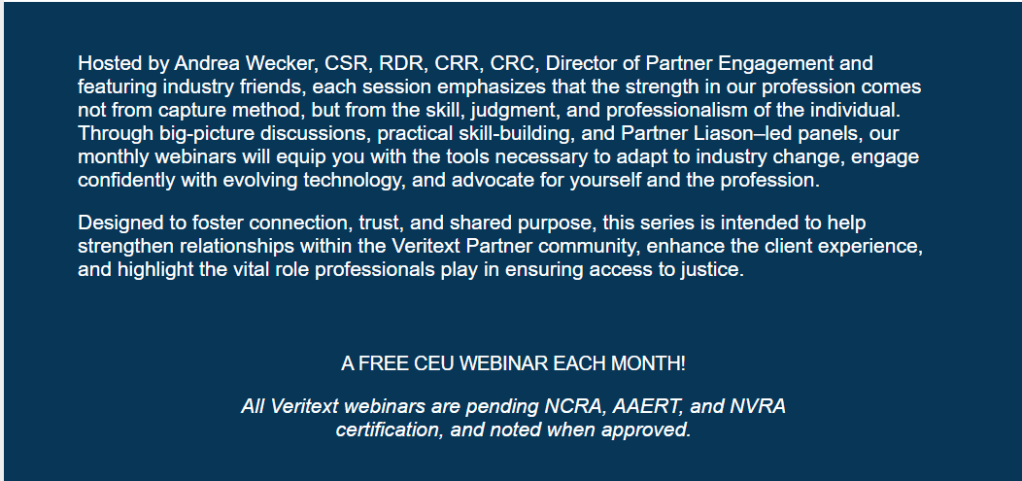
Why this series should concern NCRA members specifically
These webinars are not neutral skills training. They advance a core thesis that directly conflicts with NCRA’s stated mission to protect the stenographic record:
That capture method does not matter.
If NCRA approves CEUs built around that premise, it:
- Undercuts stenography as the evidentiary gold standard
- Lends institutional legitimacy to a corporate displacement narrative
- Signals to courts, attorneys, and regulators that method parity is acceptable
That is not a small policy choice. It is existential.
Bottom Line
Veritext’s CEU series is not about strengthening the profession. It is about managing resistance during a transition away from stenographic reporting. The language is careful, the tone is inclusive, and the result is corrosive.
Do not participate. Do not lend your license, your credentials, or your reputation to a narrative that undermines the very thing that gives this profession legal meaning.
The record is not a brand.
The method is not optional.
And the profession does not survive by pretending otherwise.
A Call to Defend NCRA’s Mission—and the Record It Exists to Protect
For these reasons, NCRA members should not remain silent. The Association’s own mission statement commits NCRA to advancing the profession of stenographic court reporting and captioning and protecting the integrity of the record. Approving CEUs that promote capture-method equivalence conflicts with that mandate. It also cuts against NCRA’s Core Values—particularly professional excellence, public trust, and advocacy—by lending institutional legitimacy to programming that minimizes the very method that makes a transcript original evidence. Further, the NCRA Code of Professional Ethics, including the duties of impartiality, accuracy, and safeguarding the record, presupposes a contemporaneous, reporter-controlled method of capture; those duties cannot be meaningfully satisfied when the record is reconstructed through recording or ASR. Members should write to NCRA leadership and the CEU Review Committee now—while these programs are still pending—to formally object to CEU approval, to request that NCRA require clear acknowledgment of stenography as the evidentiary gold standard, and to urge the Association to refuse continuing education credit for content that undermines its bylaws, mission, and ethical foundations. Silence will be read as consent. A written objection is how members protect the record—and the profession—before the window closes.
Disclaimer:
This article reflects the author’s professional opinion and analysis based on publicly available materials and longstanding industry standards. It is not intended to assert undisclosed facts, impugn the character or motives of any individual, organization, or association, or provide legal advice. References to companies, associations, or educational programming are made solely for the purpose of discussing policy, governance, and professional practice issues affecting the court reporting profession. Readers are encouraged to review original source materials and applicable NCRA governing documents and to form their own independent conclusions.
 STENOIMPERIUM
Thanks for all this informati
LikeLike
Hi
I will write to the NCAA. Why would they ever give continuous education units for something like this? If they do, they are just as bad as the people putting it on.
Sent from my iPad
Tara Sandford, CSR
LikeLike