
The email:
“Starting tomorrow, Wednesday, any jobs submitted before 11:59pm EST Sunday, 9/28/25, will be eligible for $2,000 in giveaways on the Magna Spin to Win Wheel… EVERY JOB ENTERED IS ANOTHER CHANCE… FOR ANY JOB… 100 PAGES OR MORE, YOU WILL RECEIVE A DOUBLE ENTRY… We only enter jobs that generate transcripts… PRIZES: $500, $250 (x2), $100 (x5), $50 (x5), $25 (x10).”
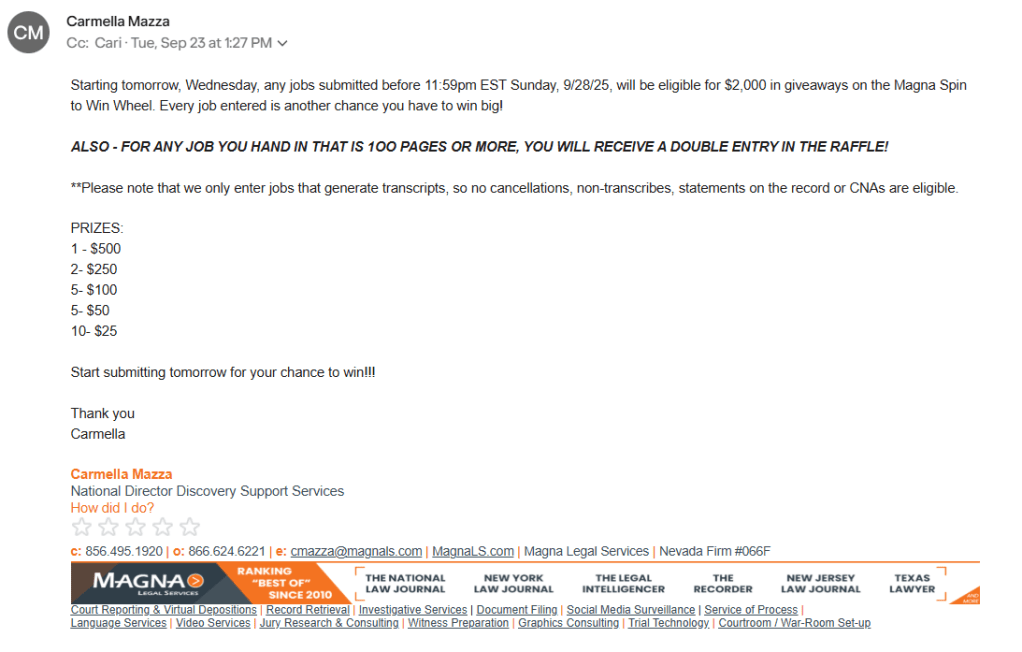
This promotion is being sent to reporters working in California. It ties entries in a prize drawing to turning in transcript-producing work, and even doubles entries for 100+ page jobs. On its face, it sounds like lighthearted gamification. Under California law and court-reporter regulations, though, it raises serious red flags.
Below, I’ll break down (1) California’s illegal lottery framework and sweepstakes rules, (2) the narrow charitable-raffle exception (and why it doesn’t apply here), and (3) the Court Reporters Board’s professional standards that restrict gifts and incentives. I’ll close with a practical compliance checklist and a short template you can adapt if you need to flag this to a regulator or to the promoter’s compliance team.
1) California’s core rule: if you have Prize + Chance + Consideration, you’re likely operating an illegal lottery
California defines a lottery as “any scheme for the disposal or distribution of property by chance, among persons who have paid or promised to pay any valuable consideration.” CA Penal Code § 319 (2024). Put more simply, when (a) there’s a prize, (b) it’s awarded by chance (e.g., spinning a wheel, random drawing), and (c) people must provide consideration (money, time, effort, or a condition with value) to enter, you’ve created an illegal lottery unless a statute says otherwise. Conducting or even proposing such a lottery is a misdemeanor.
- Prize? Yes—cash awards ($500, $250, $100, etc.).
- Chance? Yes—“Spin to Win”/raffle mechanics.
- Consideration? The email conditions entries on turning in jobs that generate transcripts, and even awards double entries for longer (100+ page) work. Conditioning entry on performing revenue-generating work for the sponsor is classic consideration because the entrant must confer value to get a chance to win.
Because all three elements appear present, the promotion looks like an unlawful lottery unless it squarely qualifies as a legal sweepstakes (which requires a truly free, equal alternative means of entry) or falls into a charitable-raffle carve-out (which it does not—see §2). California’s Attorney General also educates consumers about illegal sweepstakes/raffles and invites reports of noncompliant promotions—underscoring the state’s enforcement posture.
Why “free AMOE” matters: In legitimate sweepstakes (prize + chance), promoters remove the “consideration” element by offering a No Purchase Necessary route—an Alternative Method of Entry (AMOE)—with equal odds and no extra hoops. California’s Business & Professions Code BPC § 17539.1 polices sweepstakes and contest practices and requires clear disclosures; courts and enforcers look to whether there’s a genuine free path to entry and whether the paid/effort-based path has any advantage.
The email you shared includes no AMOE—only entries earned by turning in transcript-producing jobs, and bonus entries contingent on page counts. That is consideration and likely converts the promotion from a sweepstakes into an illegal lottery under Penal Code §§319–320.
2) “But what about raffles?” California’s charitable-raffle exception is narrow and doesn’t apply to for-profit agencies
California carves out a limited space for charitable raffles—only for eligible nonprofit organizations—subject to strict conditions: annual registration with the Department of Justice, limits on how funds can be used (e.g., the well-known 90% to charitable purposes rule for standard raffles), and operational restrictions (including no sale/redemption over the internet). CA Penal Code PEN § 320.5.
The DOJ’s raffle guidance makes clear: if participants must buy a ticket (or otherwise provide consideration) for a chance to win, you’re in the raffle/lottery zone—and only eligible nonprofits can run such raffles with registration and compliance. For-profit companies do not qualify.
Because the promotion here is run by a for-profit litigation support agency and appears to require work output to enter (no free entry path), it doesn’t fit the charitable-raffle exception at all.
3) California’s Business & Professions Code: sweepstakes/contest fairness and disclosure rules
Even when a promotion avoids “lottery” status via a free AMOE, California imposes additional fair-marketing and disclosure obligations under the Business & Professions Code. Sections 17539–17539.55 prohibit unfair sweepstakes practices, require clear “no purchase necessary” disclosures, and restrict deceptive claims and mechanisms (e.g., pay-per-call entries via 900 numbers without registration). CA Bus & Prof Code § 17539 (2024)
A compliant California sweepstakes typically includes:
- No-purchase-necessary language prominently displayed.
- A free, equal AMOE (e.g., mail-in entry) with substantially equal odds and no extra burdens.
- Clear start/end dates (with time zone), eligibility, prize descriptions/values, odds, winner selection, tax responsibility, sponsor identity, and void where prohibited language.
- Equal treatment of free and paid entries in winner selection—no multipliers for paid/effort entries that undermine equal odds.
The “Spin to Win” email lacks these consumer-protection staples. As written, it strongly suggests consideration (work) is required and even rewards more work with more chances—the opposite of equal-odds AMOE design. That combination risks violating both Penal Code (illegal lottery) and B&P Code (unfair sweepstakes practices). Justia Law+2Justia Law+2
Note: California’s legislature has recently doubled down on policing sweepstakes-style gaming, moving AB 831 to curb “online sweepstakes casinos.” While that bill targets a different sector, it signals a strict enforcement climate around chance-based promotions in general. CA Penal Code § 319 (2024).
4) The Court Reporters Board’s Professional Standards: restrictions on gifts & incentives that compromise impartiality
Separately from gambling/sweepstakes law, California court reporters and reporting businesses must follow the Court Reporters Board’s Professional Standards of Practice (Title 16, CCR §2475). Violations can result in discipline—including citation, suspension, or revocation. Cal. Code Regs. Tit. 16, § 2475.
Two provisions are especially relevant:
- §2475(b)(7): Do not “enter into, arrange, or participate in a relationship that compromises the impartiality of the certified shorthand reporter, including… a relationship in which compensation for reporting services is based upon the outcome of the proceeding.” Although a raffle isn’t outcome-based, incentive schemes tied to volume/page counts can be argued to pressure speed over accuracy, undermining the duty of neutrality and record integrity. Cal. Code Regs. Tit. 16, § 2475.
- §2475(b)(8): “Other than the receipt of compensation for reporting services, neither directly or indirectly give nor receive any gift, incentive, reward, or anything of value to or from any person or entity associated with a proceeding being reported,” subject to narrow exceptions (e.g., small-value items up to $100 aggregate per calendar year to/from specified categories such as attorneys and clients). The rule is broad: it applies to businesses that render shorthand reporting services and to licensees, and it covers both giving and receiving.
Here, the sponsor is a litigation-support/reporting services business; the participants are reporters performing those services. Both are “persons or entities associated with a proceeding being reported.” The program then offers prizes—cash rewards—as incentives for turning in transcript-producing jobs, with extra entries for high-page-count jobs.
That structure appears to be exactly the type of “gift, incentive, [or] reward” §2475(b)(8) prohibits—because it is in addition to compensation for reporting services and tied to the work. The regulation carves out compensation for services (your actual page rates/appearance fees), but not game-of-chance bonuses that reward volume. In short: even if the promotion were somehow made sweepstakes-compliant, §2475(b)(8) would still pose a separate professional-standards problem for both the agency and any licensee who participates.
California professional groups have repeatedly warned against “gift-driven” inducements in court reporting, emphasizing neutrality and limits (e.g., the long-standing $100 per year cap on gifts to/from parties connected to proceedings). This CCRA article by Early Langley is excellent.
A Pattern Repeating – From Steno in the City™ in Long Beach to Magna’s “Spin to Win”
The Magna promotion is not the first time court reporters in California have been pitched an unlawful lottery disguised as a “giveaway.” In April 2024, Shaunise Day, founder of Steno in the City™, hosted a Long Beach event where she offered a raffle drawing. Attendees could not enter freely; eligibility was tied to sign-ups and event participation, acts that carried clear value to the sponsor. Importantly, she never filed with the California Department of Justice as required for a raffle, and there was no free, alternative method of entry (AMOE).
At the time, I wrote that this structure was unlawful under Penal Code §§319–320 because all three lottery elements were present: Prize, Chance, and Consideration. A new label could not change the substance. The problem was not the word “raffle,” it was the absence of a free entry route and the requirement that participants give value to qualify.
Since that Long Beach event, Day has shifted her marketing language. Instead of advertising “raffles,” she now promotes “giveaway prizes.” Yet the mechanics remain unchanged. Participants are still required to provide value—by registering, signing up, or otherwise engaging with her enterprise—to be entered. There is still no AMOE. As consumer-protection regulators have long made clear, the law doesn’t care what you call it. If consideration is required, you are running a lottery. And unless you are a registered nonprofit under DOJ supervision, that lottery is illegal in California.
Magna’s “Spin to Win” wheel follows the same script. Court reporters are told they can only earn entries by turning in transcript-producing jobs, with extra entries awarded for 100+ page transcripts. Just like Steno in the City™, Magna has simply substituted a different gimmick—“spin the wheel” instead of “raffle ticket”—but the underlying elements are identical. In both cases:
- Prize: Cash payouts to winners.
- Chance: Random drawing or wheel spin.
- Consideration: The requirement of work, sign-ups, or participation of value to the sponsor.
This is why the continuity matters. These are not isolated missteps. They reveal a recurring tactic in our industry: disguising illegal lotteries as “giveaways,” hoping that a playful label will obscure the legal defects. But California law is explicit—what counts is the substance, not the marketing spin.
And this isn’t just a California problem. Most states apply the same three-element test—Prize, Chance, Consideration—to determine whether something is an illegal lottery. Some jurisdictions go even further:
- New York and Florida require sweepstakes with prizes above certain thresholds to be formally registered with state regulators.
- Texas enforces strict charitable-raffle laws, mirroring California’s DOJ registration requirements, and does not permit for-profit companies to run raffles.
- Across the board: if there is no free alternative method of entry (AMOE), regulators treat the promotion as an illegal lottery.
If regulators were to examine Magna’s wheel in 2025 alongside Steno in the City™’s raffle in 2024, they would see the same structural violation. And if they applied the rules of New York, Florida, Texas, or nearly any other state, the outcome would be no different: Prize + Chance + Consideration = illegal lottery.
5) Practical compliance playbook (if a company truly wants to run a lawful promotion in California)
The cleanest option: Don’t tie entries to work output, job submissions, page counts, or anything of value provided by reporters. If you offer a morale-building sweepstakes, separate it completely from revenue-generating conduct.
If they insist on running a drawing:
- Remove consideration
- Offer a conspicuous No Purchase Necessary route with equal odds (e.g., a simple online or mail-in entry that is not more burdensome than a work-based route). Better yet, remove the work-based route entirely to avoid “dual path” complexities. BPC § 17539.1.
- End the page-count multipliers
- “Double entries for 100+ pages” weaponizes consideration. Equalize odds or (preferably) make all entries free and one-per-person/day.
- Publish full Official Rules compliant with the B&P Code
- Eligibility, start/stop (with time zone), prize details/ARV, winner selection, odds, tax responsibility, privacy terms, limitations/void jurisdiction, and sponsor identity. Avoid any 900-number mechanisms unless properly registered (rare today).
- Run a professional-standards check
- Ensure the promotion does not conflict with 16 CCR §2475(b)(7)-(8) (no gifts/incentives tied to the work; no structure that could compromise neutrality). When in doubt, don’t incentivize transcript volume.
- Avoid “raffle” terminology
- In California, “raffle” is a legal term mostly reserved to registered nonprofits under Penal Code §320.5. For-profits should avoid “raffle” frameworks entirely.
6) Bottom line for California reporters
- Lottery law risk: As written, Prize + Chance + Work-based Entry (and multipliers) means the promotion looks like an illegal lottery under Penal Code §§319–320.
- Sweepstakes law risk: There’s no “No Purchase Necessary” path, no AMOE, and no required disclosures—contrary to Business & Professions Code provisions governing sweepstakes/contests.
- CRB professional-standards risk: 16 CCR §2475(b)(8) prohibits giving/receiving incentives beyond compensation to or from any person or entity associated with a proceeding—which includes your agency. The structure here appears to violate that rule, independent of gambling law issues. Cal. Code Regs. Tit. 16, § 2475.
- Enforcement climate: California is actively tightening laws around sweepstakes-style gaming (e.g., AB 831 for online sweepstakes casinos), reflecting a strict posture toward chance-based promotions.
Practical advice: Until (and unless) the promoter publishes compliant Official Rules with a true free AMOE and re-tools the mechanic to avoid work-based consideration—and clears §2475(b)(8)—California reporters should not participate. If you wish, you can forward the promotion to the California Attorney General’s consumer protection unit for review of sweepstakes/lottery issues, and to the Court Reporters Board for a professional-standards inquiry. California DOJ
Key Sources (California)
- Penal Code §319 (definition of lottery); §320 (prohibition). Justia Law+1
- Attorney General consumer page on sweepstakes and prize notifications. California DOJ
- Business & Professions Code §§17539–17539.55 (sweepstakes/contest practices & disclosures; 900-number restrictions). Justia Law+2FindLaw Codes+2
- Charitable raffles (Penal Code §320.5) – DOJ registration and restrictions. FindLaw Codes+1
- Professional Standards of Practice (16 CCR §2475), especially (b)(7) and (b)(8) (impartiality; no gifts/incentives). Legal Information Institute
- Recent policy context: AB 831 (online sweepstakes casinos). Nelson Mullins Riley & Scarborough LLP+1
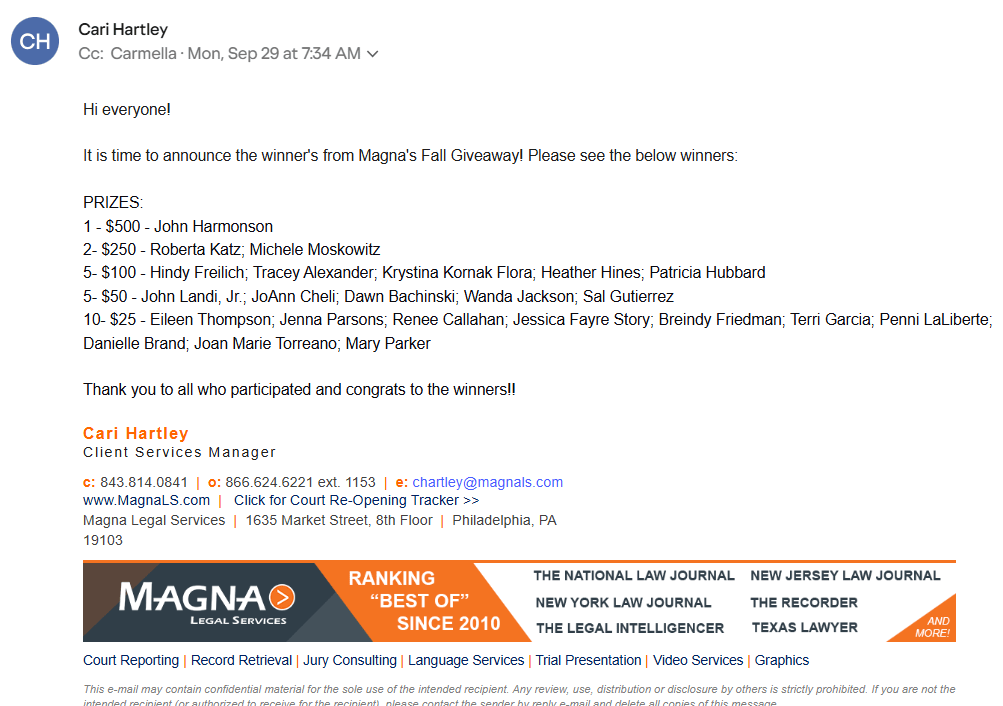
** 9/29/2025 – Even after publishing the article and emailing Magna with the article, they still went ahead with it:
StenoImperium
Court Reporting. Unfiltered. Unafraid.
Disclaimer
This article reflects my perspective and analysis as a court reporter and eyewitness. It is not legal advice, nor is it intended to substitute for the advice of an attorney.
This article includes analysis and commentary based on observed events, public records, and legal statutes.
The content of this post is intended for informational and discussion purposes only. All opinions expressed herein are those of the author and are based on publicly available information, industry standards, and good-faith concerns about nonprofit governance and professional ethics. No part of this article is intended to defame, accuse, or misrepresent any individual or organization. Readers are encouraged to verify facts independently and to engage constructively in dialogue about leadership, transparency, and accountability in the court reporting profession.
- The content on this blog represents the personal opinions, observations, and commentary of the author. It is intended for editorial and journalistic purposes and is protected under the First Amendment of the United States Constitution.
- Nothing here constitutes legal advice. Readers are encouraged to review the facts and form independent conclusions.
***To unsubscribe, just smash that UNSUBSCRIBE button below — yes, the one that’s universally glued to the bottom of every newsletter ever created. It’s basically the “Exit” sign of the email world. You can’t miss it. It looks like this (brace yourself for the excitement):

 STENOIMPERIUM
Debra Stark Florida Court Reporter since 1976
LikeLike