
Not long ago, someone asked on Facebook: Where did this all begin? Where did the idea come from that the fake, so-called ‘reporters’ could simply get a notary license, swear in witnesses, and record proceedings without a certified shorthand reporter present? This article is my answer. I’ve been waiting a long time to tell my story. This is my perspective. I was there when the notary loophole first broke wide open, and I witnessed how it all unfolded. Now is the time.
Depositions are central to civil litigation. They capture testimony under oath, lock in facts for trial, and shape settlements. But depositions only carry weight because they are presided over by a neutral officer of the court who swears in the witness, contemporaneously takes down the verbatim record, and certifies the transcript.

On July 21, 2018, at a Deposition Reporters Association of California (CalDRA) town hall in Huntington Beach, that bedrock principle was challenged. At the urging of members frustrated with videographer-only proceedings, CalDRA’s legislative counsel Ed Howard presented a statutory interpretation that allowed videographers with notary commissions to serve as deposition officers. As I recall it, Ed Howard told the audience that in his reading of the statute, it was the act of administering the oath that defined the ‘deposition officer.’ By that logic, he asserted that anyone with a notary commission who could swear in a witness could technically serve as the Deposition Officer. He was very clear in laying this out and even illustrated it for the group, referencing the statutory language on a demonstrative.
This interpretation had no precedent in case law — not because it had been rejected, but because no court had ever squarely addressed the issue. The issue had never been litigated. It also lacked support in legislative history, and ignored both purposivism (statutes should be interpreted consistent with their purpose) and the absurdity doctrine (rejecting readings that produce irrational results). Yet it became the foundation of the “notary loophole”—a practice that today puts the admissibility of testimony at risk and undermines the integrity of the record.
The July 21, 2018 CalDRA Town Hall
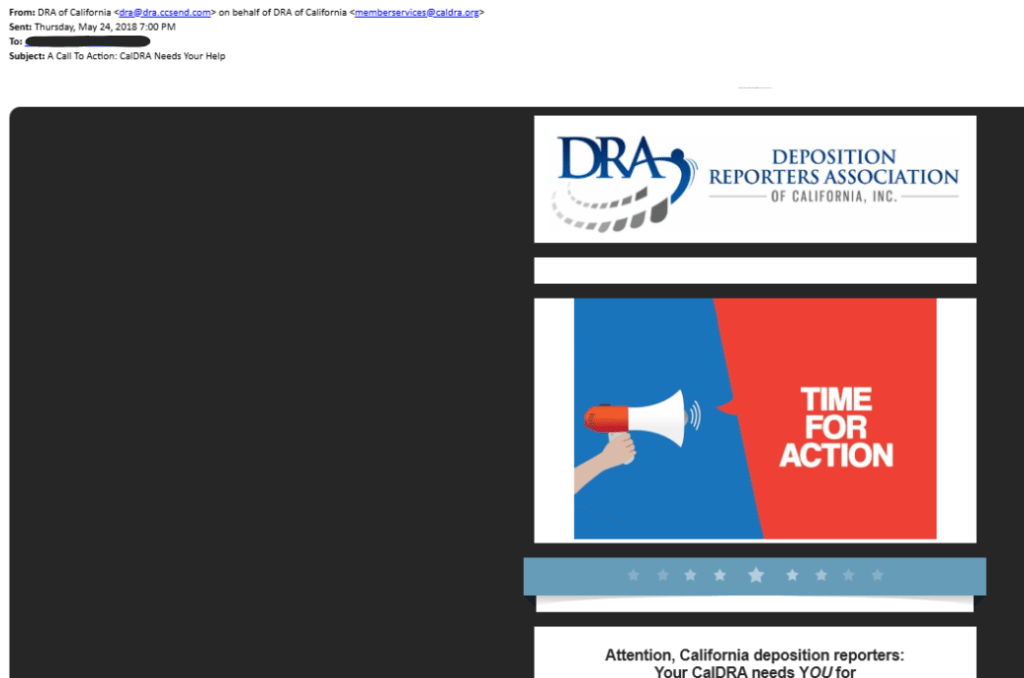
CalDRA called the meeting after receiving alarming reports of “videographer-only” depositions being conducted across California and beyond. The board voted earlier that spring to form a task force, and the town hall was billed as an opportunity to gather input.

The invitation email set the tone:
“After receiving numerous reports from across the state and country of videographer-only depositions being held with alarming frequency, your CalDRA board, at its April meeting, voted to form a task force committee dedicated to research, strategy, and leadership on this issue … We believe that this is a strategic effort … to undermine our profession and deepen their corporate pockets rather than coming to the table to find an ethical resolution to capturing the record. This dangerous new method of preserving testimony sets a precedent that ultimately could result in the total replacement of certified shorthand reporters as guardians of the record.”
The meeting was hosted at DRS Athletics in Huntington Beach, the gym of then-CalDRA president Cheryl Haab. It was a sweltering July afternoon in Huntington Beach, so hot I nearly suffered heat stroke. A cooler filled with ice and bottles of water sat off to the side, and I helped myself just to keep from overheating. Industrial fans roared so loudly they eventually had to be turned off, leaving us in stifling heat with no air conditioning. Poor event planning, and it set the tone for the chaos that followed inside.
Attendees included:
- Cheryl Haab, then-President of the Deposition Reporters Association (DRA).
- Kelly Bryce Shainline, who would later co-found the Protect Your Record Project and who was highly visible at the meeting, repeatedly taking the microphone and guiding discussion.
- Small and regional agency owners such as Stephanie Leslie (Regal), Susan Sullivan (The Sullivan Group, acquired by Esquire), Reagan Evans (Olympic, acquired by Pohlman then Veritext), and Mary Pierce (Pantera), as well as about 60-70 court reporters. Their presence reflected the wide interest in the issue. I recall each of them taking the microphone at some point to share their views, though I don’t remember the specifics of what was said — only the general unhappiness in the room with Howard’s interpretation and the questions and comments it sparked.
- Numerous videographers and videographer-firm owners.
- Terrie Campbell, the CEO of Esquire Deposition Solutions, who flew in from Texas—evidence that national firms immediately recognized the stakes.
- CalDRA’s legislative counsel, Ed Howard.
- Erika Echternkamp Sjoquist – a rock-star CA CSR member who stenographically reported the entire meeting for the DRA.
While Kimberly D’Urso had raised concerns about videographer-only depositions in the months leading up to the meeting, she was not in attendance at this DRA event. (corrected)
The Question on the Table
The July 21, 2018 town hall was convened because Kimberly D’Urso relentlessly pressed one question: could videographers conduct depositions without a reporter present? To settle the matter, DRA hired lobbyist Ed Howard, who spent hours researching and then flew in to deliver his answer. Far from solving the problem, his interpretation, in my opinion, opened Pandora’s box.
On its face, California’s Code of Civil Procedure seemed to resolve the issue. The statutes clearly assign responsibility to the “officer of the court” who presides, administers the oath, takes down the verbatim record, and certifies the transcript. But Howard introduced a narrower reading that collapsed these duties into a single act: administering the oath.
The Statutory Framework
California law is explicit about what constitutes a valid deposition. Four interlocking requirements appear in the Code:
- Supervision by an Officer of the Court
- Cal. Code Civ. Proc. § 2025.320: “A deposition shall be conducted under the supervision of an officer of the court who is authorized to administer oaths and who is not otherwise interested in the action.”
- A deposition is only a deposition if a qualified officer presides.
- Oath Administration
- Cal. Code Civ. Proc. § 2025.330(b): “The officer before whom the deposition is taken shall put the deponent under oath.”
- The key word here is “taken.” In deposition practice, “taken” means the record is contemporaneously captured—taken down verbatim—by the officer. It does not mean “hosted” or “observed.”
- Certification of the Transcript
- Cal. Code Civ. Proc. § 2025.540(a): “The deposition officer shall certify on the transcript … that the deponent was duly sworn and that the transcript is a true record of the testimony given.”
- Certification ties the entire process together. Only the officer who was personally present at the proceedings, administered the oath, contemporaneously took down the verbatim record, and then certified its accuracy can lawfully complete the deposition
- Presence at the Proceeding
The deposition officer must be personally present — whether physically in the room or connected remotely in compliance with statute — to witness the proceeding.
Taken as a whole, the statutes create an indivisible chain: presence → oath → taking → certification. Break the chain, and the proceeding is not a deposition.
Every lawful deposition rests on an unbroken chain of duties: presence, oath, record, and certification. Only a licensed court reporter can fulfill all four — being physically present, administering the oath, contemporaneously taking the record, and certifying its accuracy. Break one link, and it is no longer a deposition under California law.

Swearing In – A Fault Line
The debate over who has the authority to swear in witnesses is not just theoretical. In another piece I wrote, Who Really Has the Authority to Swear in Witnesses? The Notary vs. Court Reporter Divide, I explored the stark difference between notaries and court reporters. A notary’s role centers on identity verification—checking IDs, logging acts in a journal, and affixing seals. A court reporter’s role, by contrast, rests on statutory authority as an officer of the court, empowered to administer oaths without notarial rituals because the transcript itself documents presence and identity within the adversarial system.
This distinction exposes one of the deepest cracks in the digital reporting model. Digital operators who rely on notary commissions often skip the safeguards that notarial law requires: they don’t check IDs, they don’t log oaths, and they don’t maintain journals in the middle of depositions. They act as if they were reporters, without the statutory authority or oversight. That’s more than sloppy—it’s precarious. Testimony sworn under such conditions may later be challenged as invalid, leaving attorneys vulnerable to exclusion of evidence, sanctions, or even malpractice exposure.
Howard’s Misinterpretation
Despite this framework, Howard suggested that since notaries are authorized to administer oaths, a videographer with a notary license could serve as the deposition officer.
This interpretation failed on two levels:
- Purposivism: The legislature’s purpose was to ensure depositions result in a certified, admissible record. By focusing solely on oath administration, Howard ignored the broader statutory purpose—ensuring the reliability of testimony through contemporaneous record-taking and certification.
- Absurdity Doctrine: Courts reject interpretations that produce irrational results (People v. Belleci (1979) 24 Cal.3d 879, 884). The idea that a videographer could swear in a witness but not produce or certify the record is legally unsustainable and the very definition of an interpretation that courts would likely reject as absurd.
Out of Step with Legislative Intent
When the California deposition statutes were drafted, the legislature explicitly envisioned licensed court reporters as the officers of the court. Only reporters could perform all four essential duties: administering the oath, being physically present, contemporaneously taking down the verbatim record, and certifying the transcript.
Howard’s reading reduced the role to a single act—administering the oath—while ignoring the full statutory chain. That was not simply unsound; it was contrary to legislative intent from the beginning. The deposition statutes were designed to ensure integrity from start to finish, and only court reporters fulfill all four duties.
The Consequences
Reporter-Free Depositions
Following the meeting, videographers began obtaining notary commissions. Agencies marketed “reporter-free” depositions, claiming cost savings and flexibility.
Expansion to Digital Recording
The practice expanded quickly. If a notary-videographer could preside, why not a notary with an audio recorder? Soon, uncertified transcripts created from digital recordings entered the marketplace.
Admissibility at Risk
The flaw is fatal: under § 2025.540(a), only the officer who “took” the deposition may certify the transcript. A videographer who merely observed or operated a camera cannot make this certification. Transcripts created later are hearsay. Attorneys relying on them risk exclusion, sanctions, or having to retake testimony.

For clarity: the ‘writing accompanying an audio or video record’ clause in § 2025.540(a) has existed since 2004 (Stats. 2004, ch. 182). It was part of a Law Revision Commission reorganization to address audio/video recordings and certification. It did not authorize reporter-free proceedings; the statute still requires a deposition officer to witness the proceeding, administer the oath, take the record, and certify it.
No Case Law Precedent
At the time of the meeting, no California case law addressed whether a notary-videographer could act as a deposition officer. Rather than urging caution, Howard filled the vacuum with an interpretation that was expansive in who it included, but limiting in what it required. By reducing the role to oath administration alone, he overlooked the statutory duties of taking the record and certifying the transcript. That lack of precedent remains a vulnerability: the first court to rule squarely could invalidate years of reporter-free depositions.
Risks for Attorneys
For attorneys, the risks are acute:
- Evidentiary Exclusion: Opposing counsel can move to strike testimony as improperly taken.
- Duplicative Costs: Depositions may have to be retaken at client expense.
- Malpractice Exposure: Lawyers who stipulate to reporter-free depositions risk liability if critical testimony is excluded.
- Ethical Duties: ABA Model Rule 1.1 and California RPC 1.1 require lawyers to understand the risks of their procedural choices. These risks are not abstract—they directly impact trial strategy, client costs, and attorney ethics. While broader reform is needed, there are steps lawyers can take right now to protect their cases.
Practical Guidance for Attorneys
Until the courts or legislature definitively close the notary loophole, attorneys must take proactive steps to protect their cases:
- Object on the Record
If a deposition proceeds without a certified shorthand reporter, object on the record to preserve the issue for later motions or appeals. - Control Stipulations
Do not stipulate away the requirement of a reporter. Push back if opposing counsel suggests proceeding with only a notary or videographer. - Educate Clients
Explain to clients that uncertified transcripts may be excluded, forcing expensive retakes and jeopardizing strategy. Protecting the integrity of the record is part of effective representation. - Vet Transcripts
Before relying on a deposition transcript for impeachment, motions, or trial, verify that it was taken and certified by a licensed court reporter. - Remember Your Ethical Duties
Under ABA Model Rule 1.1 and California RPC 1.1, competence includes ensuring testimony is properly preserved. Attorneys remain ultimately responsible for the integrity of the record.
The Economic Subtext
Even as individual attorneys work to safeguard their records, the larger forces driving this problem cannot be ignored. The presence of Esquire’s CEO at the 2018 meeting underscored the business stakes. National firms saw cost savings in eliminating reporters and leaned into the loophole. Smaller agencies, under competitive pressure, followed. What began as a statutory misstep became an industry practice.
Closing the Loophole
Restoring integrity requires:
- Legislative Amendment: Clarify that “officer of the court” means a licensed verbatim court reporter.
- Judicial Clarification: Courts should apply purposivism and the absurdity doctrine to reject notary-videographer depositions.
- Bar Guidance: The State Bar should warn attorneys about the risks of uncertified transcripts.
- Attorney Advocacy: Lawyers should refuse to stipulate away court reporters and insist on certified transcripts.
The Fallout
On July 21, 2018, in a Huntington Beach gym, CalDRA President Cheryl Haab convened and led a town hall that was intended as a forum for brainstorming solutions. Instead, it became a turning point for the entire profession. Haab presided over a room full of court reporters, firm owners, and videographers, where Kimberly D’Urso pressed the issue of reporter-free depositions and Ed Howard advanced a flawed interpretation of the law that fractured the chain of presence, oath, taking, and certification.
I was there. As an eyewitness, I saw the people who filled the room, I spoke directly with videographers and agency owners, and talked with fellow reporters alarmed about the direction of the discussion. I personally introduced myself to the CEO of Esquire Deposition Solutions, who flew in from Texas to attend (and handed me her business card) — a gesture that underscored just how high the stakes were.
What I witnessed that day was more than a professional debate. It was the ground zero of the notary loophole — the moment a statutory misinterpretation blew the doors wide open on a practice that was already taking place, giving it explosive momentum and a veneer of legitimacy. In the years since, that loophole has been exploited by videographers, digital recorders, and national firms, producing uncertified transcripts that undermine admissibility and place attorneys at risk.
The heart of the problem lies in misunderstanding the difference between notaries and court reporters. As I’ve written elsewhere, notaries are designed for identity verification—checking IDs, logging acts, affixing seals. Court reporters, by statute, are officers of the court: they are physically present, administer the oath, contemporaneously take down the record, and certify its accuracy. Their authority is rooted in the justice system itself, not paperwork or procedure.
Digital reporting collapses this distinction, pretending the two roles are interchangeable when they are not. And the cost of that confusion is steep: testimony that can be challenged, records that can be undermined, and cases that can unravel. This isn’t about protecting “turf” for reporters. It’s about protecting the very foundation of the oath—the bond between words and truth under penalty of perjury.
The law, properly read, leaves no room for doubt: only licensed court reporters fulfill the four inseparable duties: presence, oath, record, and certification. Anything less is not a deposition under California law. And unless this loophole is closed, the integrity of testimony—and the justice system itself—remains at risk.
Selected Citations
- Cal. Code Civ. Proc. § 2025.320
- Cal. Code Civ. Proc. § 2025.330(b)
- Cal. Code Civ. Proc. § 2025.540(a)
- People v. Belleci (1979) 24 Cal.3d 879, 884
- ABA Model Rule 1.1; Cal. Rules of Professional Conduct, Rule 1.1
Contrary to Legislative Intent
When the 1986 Civil Discovery Act was enacted, the Legislature expressly tied the role of “deposition officer” to certified shorthand reporters. The Law Revision Commission’s official comment made clear that the officer was to be the neutral professional who administers the oath, contemporaneously takes down the record, and certifies the transcript.
Committee reports described the deposition officer as “the reporter who swears the witness and records the testimony,” emphasizing that certification of the transcript must come from the same officer who both presided and took down the record.¹
Howard’s interpretation, which reduced the role to oath-giving alone, was therefore not just a misreading of statutory text but directly contrary to the legislative purpose behind the 1986 Act.
📚 Footnote Citations (1986 Civil Discovery Act)
- California Law Revision Commission, Recommendation Proposing the Civil Discovery Act of 1986, 18 Cal. L. Revision Comm’n Reports 1, 104 (1986) (comment to proposed § 2025).
- Notes: “[T]he deposition officer is the certified shorthand reporter who administers the oath and records the testimony.”
- Assembly Committee on Judiciary, Analysis of AB 169 (1985–1986 Reg. Sess.) at 14–15 (April 1986).
- Notes that “deposition officer” refers to the court reporter presiding, who both swears the witness and certifies the transcript.
- Senate Committee on Judiciary, Analysis of AB 169 (1985–1986 Reg. Sess.) at 11 (June 1986).
- Reinforces that certification by the deposition officer ensures integrity of the record.
📚 Footnote Citations for CCP § 2025.540(a)
- Stats. 2004, ch. 182, § 23 (Assem. Bill 3081), operative July 1, 2005 (part of the nonsubstantive reorganization of the Civil Discovery Act).
- This enactment reorganized and renumbered provisions of the Civil Discovery Act of 1986 and introduced the current phrasing in § 2025.540(a), including certification “or in a writing accompanying an audio or video record of deposition testimony.”
- California Law Revision Commission, Recommendation: Civil Discovery Nonsubstantive Reform (Dec. 2003), 33 Cal. L. Revision Comm’n Reports 789, 835–36.
- The Commission’s report notes that the deposition officer’s certification requirement applies both to transcripts and to audio/video recordings, codified in the reorganization bill.
- Assem. Com. on Judiciary, Analysis of AB 3081 (2003–2004 Reg. Sess.), April 2004.
- Committee analysis describes the reorganization’s goal of modernizing discovery statutes to reflect the use of non-transcript formats while retaining the same officer-of-the-court certification requirements.
📚 Footnote Citations for CCP § 2025.320 (Officer of the Court)
- Stats. 2004, ch. 182, § 23 (Assem. Bill 3081), operative July 1, 2005.
- Renumbered § 2025.320 as part of the Civil Discovery Act reorganization, requiring that depositions be “conducted under the supervision of an officer of the court who is authorized to administer oaths and who is not otherwise interested in the action.”
- California Law Revision Commission, Recommendation: Civil Discovery Nonsubstantive Reform (Dec. 2003), 33 Cal. L. Revision Comm’n Reports 789, 830–31.
- The Commission commentary clarifies that “officer of the court” refers to the certified shorthand reporter, acting as the neutral official with authority to administer oaths and ensure integrity of the record.
📚 Footnote Citations for CCP § 2025.330(b) (Oath Administration)
- Stats. 2004, ch. 182, § 23 (Assem. Bill 3081).
- Codified that “the officer before whom the deposition is taken shall put the deponent under oath.”
- Cal. Law Revision Comm’n, supra note, at 832–33.
- Notes that the phrase “before whom the deposition is taken” requires the officer’s presence at the proceeding, emphasizing that the reporter’s role is not merely ceremonial but inseparable from contemporaneous record-taking.


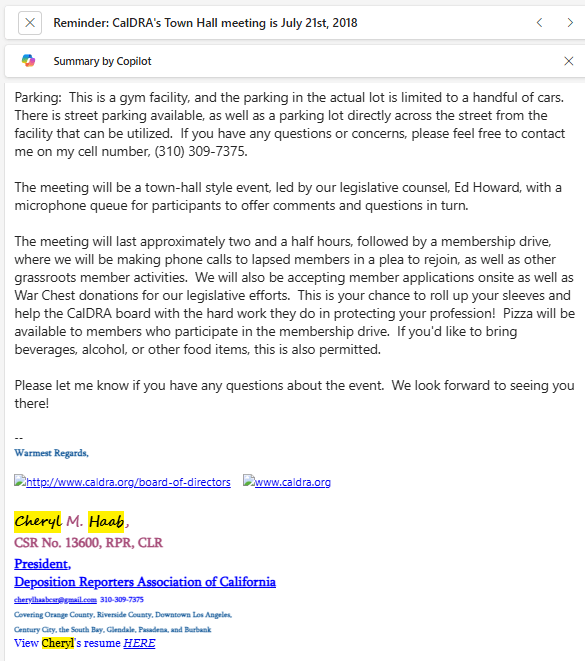
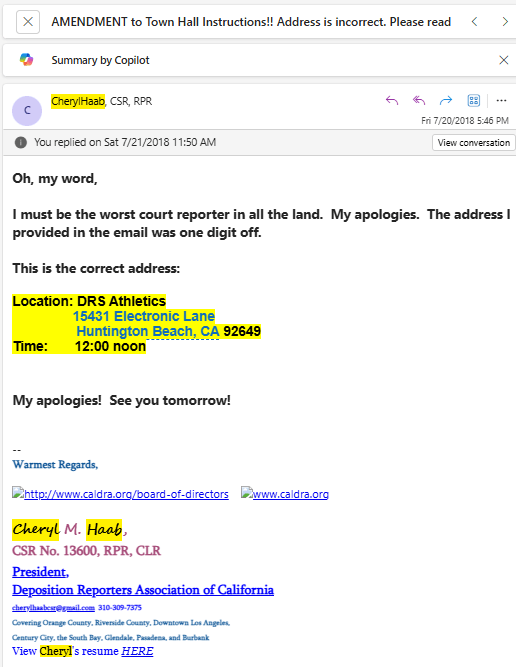
In one email, Cheryl joked, ‘I must be the worst court reporter in all the land.’ When people tell you who they are, you should believe them. In my view, her tenure marked a turning point — seven years of decisions that weakened, rather than strengthened, our profession. To me, it remains an example of how damaging bad leadership can be. The irony? Years later, she’s still being given a microphone at DRA events. To me, it’s a reminder that in our profession, leadership doesn’t always mean accountability.”

StenoImperium
Court Reporting. Unfiltered. Unafraid.
Disclaimer
This article reflects my perspective and analysis as a court reporter and eyewitness. It is not legal advice, nor is it intended to substitute for the advice of an attorney.
This article includes analysis and commentary based on observed events, public records, and legal statutes.
The content of this post is intended for informational and discussion purposes only. All opinions expressed herein are those of the author and are based on publicly available information, industry standards, and good-faith concerns about nonprofit governance and professional ethics. No part of this article is intended to defame, accuse, or misrepresent any individual or organization. Readers are encouraged to verify facts independently and to engage constructively in dialogue about leadership, transparency, and accountability in the court reporting profession.
- The content on this blog represents the personal opinions, observations, and commentary of the author. It is intended for editorial and journalistic purposes and is protected under the First Amendment of the United States Constitution.
- Nothing here constitutes legal advice. Readers are encouraged to review the facts and form independent conclusions.
***To unsubscribe, just smash that UNSUBSCRIBE button below — yes, the one that’s universally glued to the bottom of every newsletter ever created. It’s basically the “Exit” sign of the email world. You can’t miss it. It looks like this (brace yourself for the excitement):

 STENOIMPERIUM
I am enjoying your articles immensely. This was one of your best.
LikeLike
Thank you so much! That really means a lot to me. I’ve been waiting a long time to tell this story, and knowing it resonates makes the work worthwhile.”
LikeLike