The National Court Reporters Association (NCRA) has always stood as a professional beacon in the court reporting industry, grounded in ethics, transparency, and member representation. With the 2025 elections underway, the role of Vice President carries particular weight—especially during a time when our profession faces existential threats from automation, declining enrollment, and internal division.
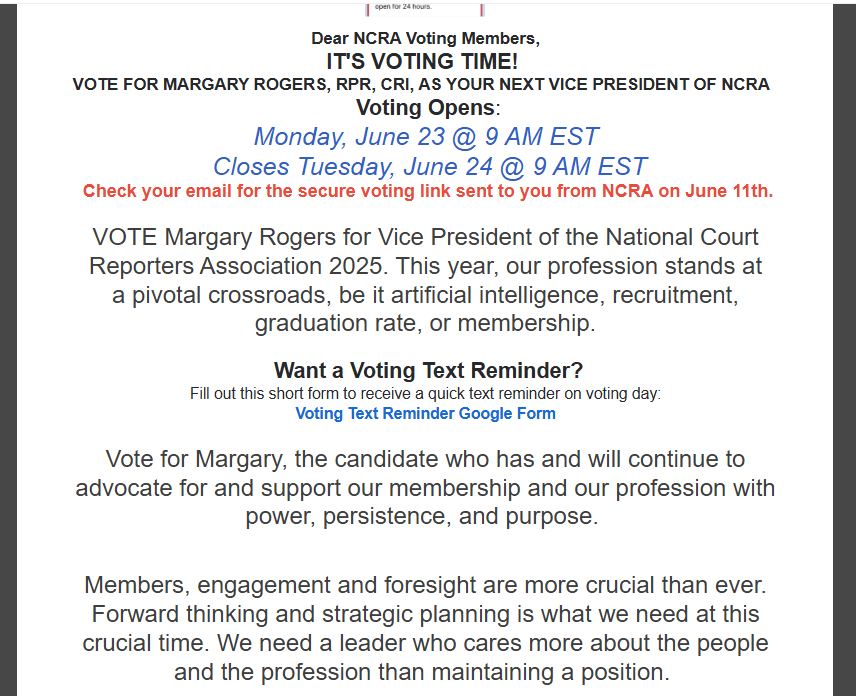
So when campaign communications land in inboxes at 9:07 p.m. the night before the election, it matters how candidates present themselves—not just in policy, but in tone, integrity, and respect for the process. Unfortunately, Margary Rogers’ recent campaign email—sent to a wide distribution of voting members—raises several red flags, in my humble opinion, that deserve a closer look.
Full disclosure: I don’t personally know either candidate. I didn’t attend the town hall or participate in any pre-election discussions. I come to this moment not as a loyalist to one name or another, but as a concerned voting member responding to what landed in my inbox.
❖ An Email Received, But Never Subscribed To
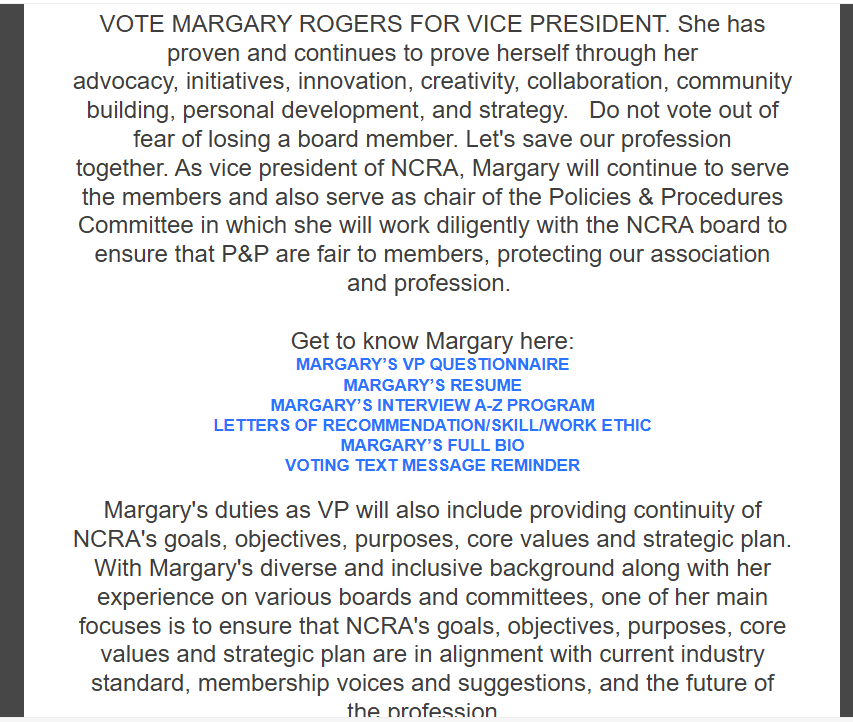
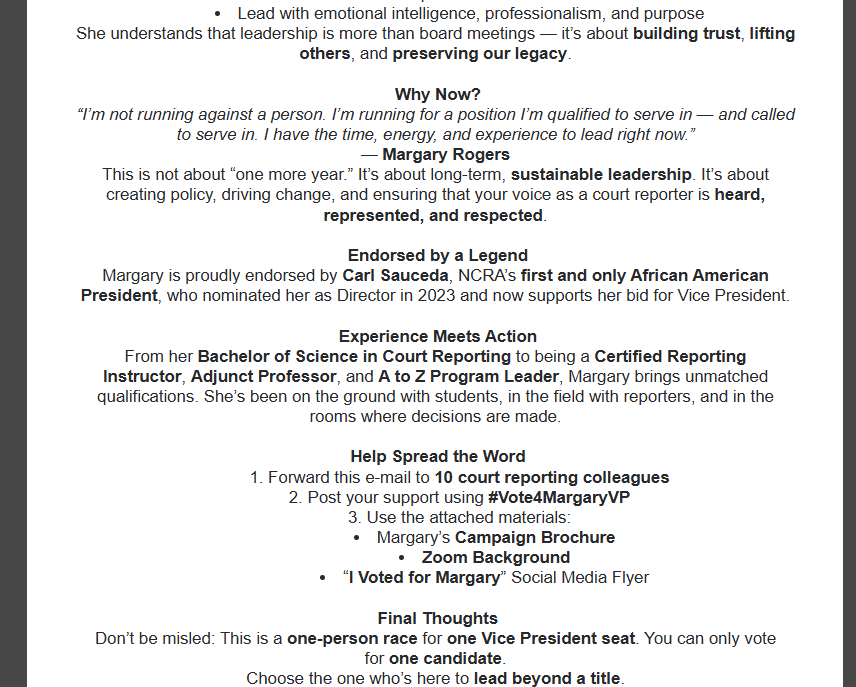
Let’s start with the basics. Many NCRA members, including myself, received a campaign email from Margary Rogers, candidate for Vice President. The message was lengthy, formatted like a press release, and filled with links to promotional materials, text reminders, and endorsements. It was framed as a direct appeal for votes and came across more like a full-scale political campaign than a collegial invitation to support a peer.
The first problem? I never opted in. I never subscribed to receive promotional emails from this candidate, nor did I provide my personal email for campaign communications. So how did she get access? While this may feel intrusive, it’s important to clarify that it is not illegal. Under the federal CAN-SPAM Act, campaign or informational emails—especially those related to nonprofit associations—are not considered commercial spam and do not require prior opt-in. As long as the email includes accurate sender information, a physical address, and an option to unsubscribe, it generally complies with the law.
That said, this isn’t just about legality—it’s about fairness. If one candidate was allowed to use NCRA’s member contact data to launch a strategic email and texting campaign, while the other wasn’t given the same access or tools, that calls into question the equity of the process.
It appears that the candidate is using NCRA’s membership data—something that, to my knowledge, should only be made available under strict and equal-access guidelines. That begs the question: Was the same access and opportunity afforded to all candidates?

❖ Is This an Abuse of Member Contact Information?
Let’s clarify an important point: There is no inherent wrongdoing in using NCRA membership contact data during campaign season—if it’s done equitably.
Under NCRA policy, all vetted candidates are expected to receive equal access to the same communication tools—such as visibility in the Journal of Court Reporting, bios on the Election Center, and permission to communicate with voting members. The association does not prohibit candidates from sending direct emails or organizing text message reminders, as long as all candidates are given the same opportunity.
But here’s where it gets concerning: I received a campaign email from Margary Rogers. I did not receive one from her opponent.
That discrepancy is not just anecdotal—it points to a potential imbalance in how campaign access was offered, explained, or utilized.
This raises several critical questions:
- Was Margary offered a list or contact channel that the other candidate was not?
- Did both candidates know they could send campaign emails or text reminders?
- Did the Election Committee provide the same guidance and tools to both sides?
Because here’s what matters:
- ✔️ There’s no problem with using NCRA member contact data—if all candidates had access and were made equally aware of how to use it.
- ❗ There is a problem if only one candidate used that access to launch a comprehensive outreach campaign, while the other remained silent—possibly because they weren’t informed, empowered, or resourced to do the same.
That’s not just a campaign strategy issue—it’s a matter of election integrity. The NCRA Election Committee is charged with maintaining a level playing field. If only one candidate made it into members’ inboxes, while the other didn’t, the membership deserves an explanation.
❖ A Campaign Laced with Subtle Smears
Substance matters, but so does tone. And in this case, the tone of Margary’s email was troubling.
Amid the long list of credentials and enthusiastic endorsements, the email makes a jarring pivot into subtle mockery of the opposing candidate—though without naming them directly:
“As cliché as it may sound on a flyer by the opponent’s supporters that ‘If you vote for the other candidate, you vote for both,’ DO NOT believe that… I know many of us Court reporters are not good at math, but you cannot vote for both candidates…”
This was clearly intended as a joke—but at whose expense? Not only does it trivialize the intelligence of court reporters (a deeply educated and highly skilled profession), but it casts unnecessary aspersions on the opposing candidate’s supporters, reducing their message to “cliché flyers” and implying they’re misleading voters.
It’s one thing to make a strong case for your own qualifications. It’s another to undermine others in the process. The email crosses that line repeatedly. Phrases like “not just about board meetings,” “legacy over ladder climbing,” and “choose the one who serves with sincerity” all subtly cast doubt on the character or motives of the opposition—without directly naming them or allowing a fair rebuttal.
This isn’t just poor form. It’s a concerning glimpse into the kind of leadership approach the candidate may bring to the boardroom: one more focused on marketing and optics than unity and ethical restraint.
❖ Style Over Substance?
The email reads like a polished PR document, complete with a Zoom background, campaign flyer, Google Forms sign-up, hashtags, and graphics. While well-designed campaign materials are not inherently problematic, they raise concerns about style eclipsing substance—especially in a volunteer-led professional organization.
We are not electing a brand. We are electing a Vice President who will help steer the future of our profession, act as a steward of member interests, and protect the integrity of our national body. Flashy deliverables, social media outreach, and cross-promotional buzz should not distract us from what really matters: the candidate’s track record, decision-making skills, and ethical grounding.
❖ The Shaunise Day Factor
While the email doesn’t mention her, it’s worth noting that Margary Rogers has shown ongoing support for and association with Shaunise Day—a controversial figure in the stenographic community. Day has repeatedly hosted events that raised questions about financial transparency, nonprofit compliance, and professional credentialing. Her leadership style and brand-driven visibility have sparked divisiveness within the industry.
The association between the two is not speculative. In 2019, Margary Rogers and Shaunise Day were both featured at the “Steno in the City” (a trademarked name) event in Washington, D.C., where Rogers was credited with assisting with event logistics, decor, and sponsorship. Additionally, Shaunise Day authored an article in the Journal of Court Reporting while Rogers served as chair of the NCRA Membership Committee. These instances reflect more than passing collaboration—they suggest a consistent professional alignment.
To be clear, association alone is not disqualifying. But it does warrant scrutiny—especially when one of the few other candidates for leadership in NCRA seems to align herself, directly or indirectly, with someone who has actively challenged institutional norms while skirting ethical lines.
If elected, will Margary bring that same media-first, influencer-style, rules-optional approach to the NCRA boardroom? Or will she enforce the very standards that some of her allies appear to flout?
We need leadership that defends the professional, regulatory, and legal integrity of our association—not alliances that weaken it.
❖ Who Is This Really About?
The most concerning part of the email is the feeling that this campaign is about elevating a persona rather than serving the profession.
Lines like:
“This is not about one more year. It’s about long-term, sustainable leadership. It’s about creating policy, driving change, and ensuring that your voice as a court reporter is heard, represented, and respected.”
…sound great on paper. But what do they actually mean in practice? What policies? What changes? What concrete actions have already been taken? It’s easy to invoke change and inclusivity as buzzwords. It’s harder to demonstrate tangible impact.
Let’s not confuse visibility for vision.
❖ The Vote Is Yours—Make It Count
Ultimately, members of the NCRA have a personal and professional obligation to vote for the candidate who reflects the values we believe should guide this association into its next chapter.
For me, that does not include Margary Rogers—not because she lacks credentials, but because her campaign choices reflect troubling patterns: email overreach, veiled attacks, influencer-style branding, and alignment with problematic industry figures.
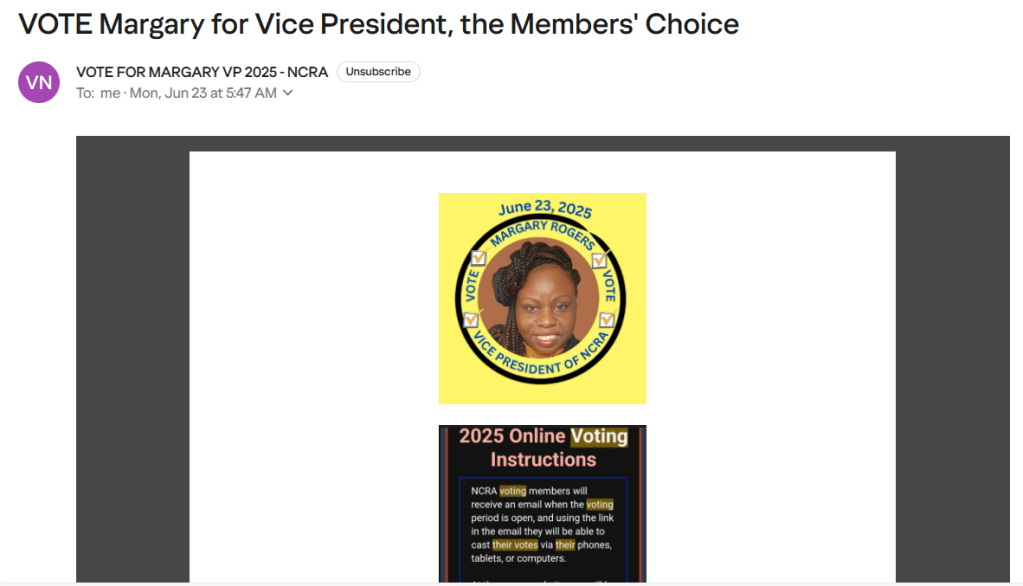
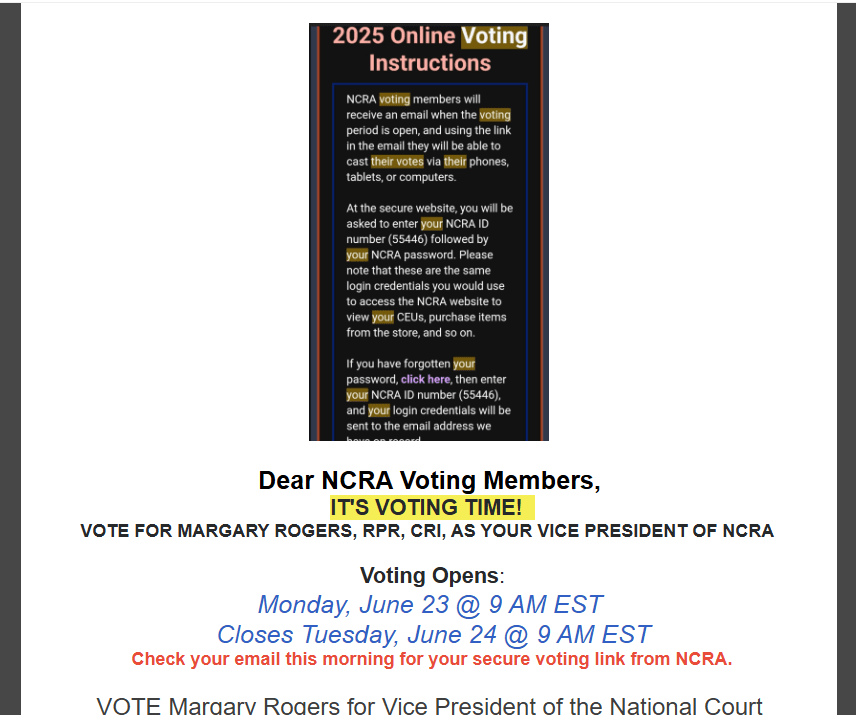
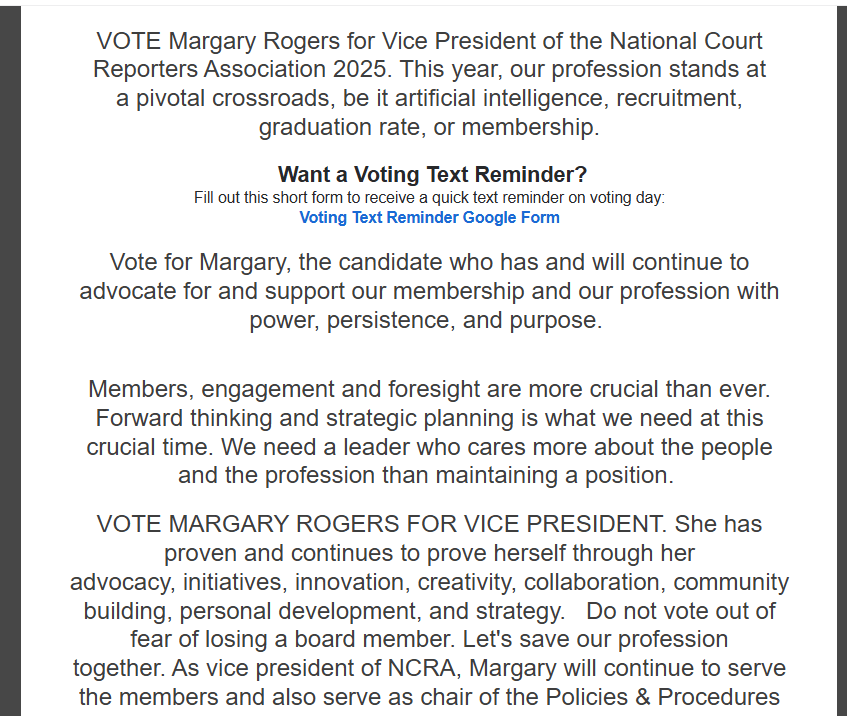
Here’s Margary’s email so you can read and decide for yourself:



❖ Addendum: A Second Campaign Email
A credible source familiar with both campaigns confirmed that NCRA did not provide either candidate with a list of member email addresses specific to this election. One candidate gathered emails manually using ProLink—NCRA’s public-facing membership portal—copying member-by-member only those emails that individuals had chosen to make visible. The other, however, appears to have leveraged broader access to NCRA’s membership data.
Notably, a member who has not been active in ProLink—and hasn’t had a profile listed in years—received multiple campaign emails. This strongly suggests that internal database access beyond public tools was used. Given that Margary Rogers previously chaired NCRA’s Membership Committee, it is plausible that she retained access to the internal member database. While NCRA may not have formally granted her permission to use that data for campaign purposes, the outcome appears to reflect unequal access to voter contact information.
Further, I personally did not receive any campaign messages from the candidate who used ProLink, likely because I had removed my profile after receiving excessive spam. The discrepancy in outreach—both in quantity and reach—now appears less a matter of strategy and more a matter of access.
On the morning of June 23, at 5:47 a.m. Pacific (8:47 a.m. Eastern), just before the official 9:00 a.m. Eastern voting window opened, a second email from Margary Rogers was distributed to members. Nearly identical in tone, structure, and content to the first, the email again included the controversial line about reporters “not being good at math,” as well as repeated personal promotion tactics.
This second email establishes a pattern—not just a one-time outreach. While this likely does not violate federal law (such as the CAN-SPAM Act), it does raise procedural and ethical concerns, particularly if the Election Committee:
- Did not clearly state whether repeat campaign emails were allowed
- Did not offer equal tools, templates, or distribution opportunities to all candidates
Timing: The message was sent on the first morning of voting (June 23), reinforcing campaign messaging during the 24-hour voting window. While not illegal under NCRA’s rules, it raises ethical concerns if only one candidate is using repeated direct outreach.
Reinforces Unequal Visibility: You now have confirmed receipt of two campaign emails from Margary Rogers. You’ve received zero emails from her opponent. This further underscores the earlier point: whether or not member contact tools were made equally available, their use clearly was not equal in execution.
Its arrival at the very start of voting highlights not just message repetition, but a deliberate use of timed campaign outreach—raising further questions about balance, tone, and strategy in this election cycle. In addition to email outreach, Margary Rogers has also solicited members’ phone numbers via a Google Form for the purpose of sending text message reminders to vote. While creative campaigning is not inherently wrong, this adds another layer of concern: Were all candidates made aware that they could collect phone numbers and launch a coordinated text campaign? If not, the issue of unequal access—and unequal execution—continues to deepen.
DISCLOSURES
- Steno In The City® is a registered trademark of its respective owner. This blog is unaffiliated, unsponsored, and not endorsed by Steno In The City®or Shaunise Day.
- References to “Steno In The City” are purely descriptive and used for editorial critique under fair use. My use of the phrase ‘Steno In The City’ is purely descriptive and used solely to refer to the trademark holder in the context of journalistic critique and commentary. No content on the site implies affiliation, endorsement, or partnership with the trademark holder.
- The content on this blog represents the personal opinions, observations, and commentary of the author. It is intended for editorial and journalistic purposes and is protected under the First Amendment of the United States Constitution.
- Readers are encouraged to review the facts and form independent conclusions. All views expressed are based on publicly available information, direct experience, or opinion. Nothing on this site is presented as legal or professional advice.
- The organization known as Steno In The City (a registered trademark) has, to date, made no public statement regarding these concerns.
 STENOIMPERIUM
I received several of these emails. What was misleading, to me, this morning is when I looked at “Check your email for the secure voting link sent to you from NCRA on June 11th,” and I assumed I didn’t receive it and emailed NCRA; then a colleague informed me we don’t receive the link until today at 9:00 a.m. when voting starts.
LikeLike
I received one and haven’t been a member for two decades.
Yahoo Mail: Search, Organize, Conquer
LikeLike
I received emails from Margary’s opponent. Having no idea where she would have gotten my personal email address, I assumed it was from the public NCRA database, the same database where proofreaders, scopists, and agencies get my email address. Please don’t make this about something that it’s not.
LikeLike
Just wanted to comment that as an NCRA member, I did receive emails from both candidates regarding the campaign for VP. I enjoy reading your articles.
LikeLike
I really appreciate your website. IT’s hard to get any viewpoint outside the organizations
themselves. Keep up the good work.
LikeLike
Seriously? I get an email from you regarding Steno in the City the very day of her conference? This is wrong. Please remove me immediately from your email list.
LikeLike
Who are you, please, Stenoimperium? Please identify yourself. Thank you very much.
With best regards,
Diane
Diane M. Molas, RDR, CRI, CLR, CT LSR, NJ CCR, and Notary Public Registered Diplomate Reporter Certified Reporting Instructor NCRA Realtime Systems Administrator (Credentialed) Senior Court Reporter NCRA “Ethics First” Participant
LikeLike
Thank you so much for reading and for reaching out. I truly appreciate your interest and the thoughtful engagement with what I’m sharing.
I understand wanting to know who’s behind the message. For now, I’ve chosen to write as “StenoImperium” because I want the focus to stay on the issues, ideas, and questions that matter to all of us—not on who I am personally.
I promise, it’s not about hiding—it’s just about letting the work speak for itself. When the time feels right, I may step forward more directly. Until then, I hope we can stay connected through the message and the shared commitment to the profession.
Warmly,
StenoImperium
LikeLike
It’s actually a two-person race for one position…not a one-person race for one position.
Thank you for your commentary.
~Reagan
“Never stop doing your best just because someone doesn’t give you credit.”
LikeLike
Margary definitely used ProLink!! How do I know? Because I was the one who extracted member’s emails from what used to be known as “the sourcebook” as I was helping Margary campaign. So let’s stop with the lies and defamation.
I also received SEVERAL emails from Carol before the race, during, and last night around 9pm. It’s called an election, my dear. Just because YOU didn’t receive emails from Carol doesn’t mean other members did not.
Margary did nothing wrong while campaigning. She’s allowed to respond to all the social media hatred in her campaign emails. But I guess you don’t know anything about that considering your disclaimer. You did NOT attend the Town Hall and you aren’t privy to the pre-election discussions. So why create an article about something you know nothing about? 🤔
You have been bullying and defaming Shaunise Day for a long time, and now you’re doing it to Margary. It makes me wonder your motive. Why are you hiding behind Steno Imperium? Personally, I want to see your face. I would love to sit down with you and talk about your hatred towards women of color in this profession. I will fly to wherever you are to have a respectful and meaningful conversation. Or maybe we can meet via Zoom. You can contact me at the email I’m listing below. I want answers from the human behind all this.
LikeLike
Thank you for your message. Let’s set a few things straight:
I did not receive Carol’s emails because I’m not listed on ProLink. That’s not “defamation”—that’s a fact. Meanwhile, Margary’s campaign emails did land in my inbox. How? And how did they reach former members who were never on ProLink, inactive for decades? That’s not transparency—it’s a violation.
Also, are you seriously saying that a 20-year-old Sourcebook was used to mine emails? Because one of the individuals contacted by Margary’s campaign has not been an NCRA member in over two decades—and was never listed on ProLink. That alone proves the data used was outdated, improperly sourced, and absolutely not obtained through current, ethical means. Campaigning with scraped, defunct member data is not only dishonest—it’s a violation of trust.
You admitted to extracting member emails for Margary. Did she pay you? Because her campaign was not covered under NCRA’s nonprofit umbrella. That was for her personal gain. If she used another Black woman’s labor for free to boost her own run for office, that’s not community—that’s exploitation. It mirrors Shaunise Day’s pattern: using the language of empowerment while profiting off others’ unpaid time and credibility.
Let’s also address your baseless accusations of “lies and defamation.” There’s nothing defamatory about stating facts: Margary publicly said she bypassed the Nominating Committee “strategically.” She campaigned via questionable outreach. These are not rumors—they are on record.
My critiques are not race-based. I’ve written just as forcefully about white male leaders, white-owned agencies, and white-run institutions. If you think race exempts someone from scrutiny, you’re part of the problem. I don’t discriminate—I investigate.
Now, following Margary’s loss in the VP race, I’m suddenly being harassed, attacked, and maligned online. The timing is no coincidence. It’s retaliation. If this is how your side handles defeat—by trying to silence dissent—you’ve shown exactly why people like me speak out anonymously.
I’m not going anywhere. And I won’t stop writing. If you want honest dialogue, I welcome it. But if you’re here to deflect, accuse, and bully—go away. The election is over. Margary lost. And now it’s time for the steno community to reflect, regroup, and rebuild—without the distractions and drama.
LikeLike