

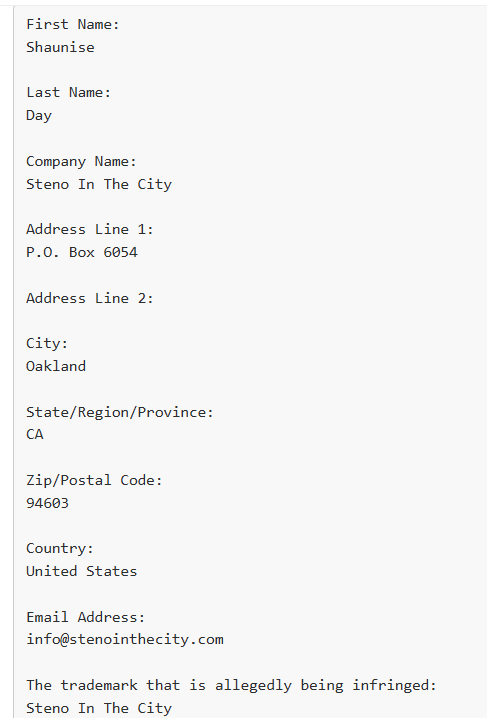
On June 19, 2025, I received an official complaint from WordPress regarding my blog, StenoImperium.com. The complaint was filed by an individual named Shaunise Day, who owns the brand “Steno In The City,” and it alleged that my use of the name in my blog content constituted trademark infringement.
This situation raises a larger issue about intellectual property, fair use, and how trademark law can sometimes be used not to protect a brand from confusion — but to stifle criticism, silence voices, and intimidate people who speak out.
Let me explain what happened, what the law actually says, and why this should matter to anyone who publishes commentary, criticism, or creative work online.
The Complaint – What Was Alleged
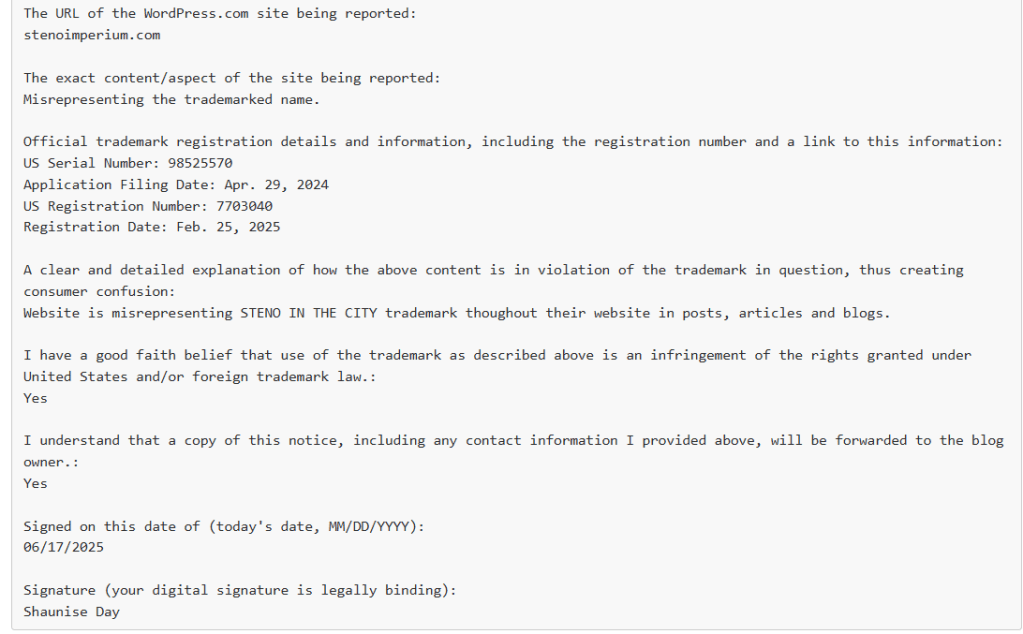
According to the report submitted to WordPress, Shaunise Day claimed that I was “misrepresenting the trademarked name” Steno In The City on my blog. She cited a U.S. trademark registration (Reg. No. 7703040, registered Feb. 25, 2025) and a filing date in April 2024.
It’s worth noting that the trademark for Steno In The City was only filed in April 2024 — immediately after I published my first exposé article raising serious questions about the brand’s operations. Looking back, it’s clear this wasn’t spontaneous — she’s been laying the trap for over a year. Since then, there’s been a slow, calculated pattern: curating a polished brand image, reframing criticism as “harassment,” and eventually weaponizing a newly minted trademark to try to shut me down.
This isn’t brand protection — this is legal strategy used to silence dissent. It’s a premeditated move that says more about controlling public perception than it does about protecting intellectual property.
She asserted that my use of the phrase in posts, articles, and blogs created “consumer confusion.” No specific examples were given — just the broad accusation that I was somehow impersonating her brand or benefitting from it.
Let’s be clear: I have never claimed to be Steno In The City. My blog is called StenoImperium — a name that is entirely distinct. I do not use her logo. I do not use her branding. I do not claim partnership or affiliation in any way.
What I have done is discuss the activities, public events, and decisions of her brand — sometimes critically, always honestly. That is not infringement. That is protected speech.

What Trademark Law Actually Says
United States trademark law is designed to prevent consumer confusion and stop one business from profiting off the brand identity of another.
It does not prevent people from talking about a trademarked name.
If someone writes a blog post about how Amazon treats its workers, or a think piece about Nike’s global labor practices, they’re allowed to name those companies. That’s called nominative fair use — and it’s protected under the First Amendment.
To be clear, fair use of a trademark generally involves:
- Referring to the trademarked entity by name for identification purposes.
- Not using the mark as your own branding or logo.
- Not misleading the public into thinking you’re endorsed or affiliated.
That’s exactly the standard I’ve followed. My references to “Steno In The City” have been made to identify the subject of my discussion — not to impersonate it.
Lack of Trademark Notice
One detail I want to highlight is that at the time of my writing, nowhere on the Steno In The City website did the trademark appear with a ® symbol or other notice that the name was federally registered. No disclaimer. No ownership mark. Nothing to indicate that I was using a federally protected name.

While such notice is not legally required for a trademark to be valid, it is required to pursue certain types of damages in court — especially those related to willful infringement.
This absence of notification reinforced what I believed at the time: that the name was being used as a brand, yes, but not one that had formal protection. I used it only to discuss what it publicly represents — not to exploit it.
Is This Really About Trademark… or About Silencing Critics?
What troubles me most is not the trademark claim itself, but the broader context of how it came about.
This is not the first time I have been the target of aggressive behavior from individuals connected to the Steno In The City brand. Over time, I have documented a growing pattern of online hostility, monitoring, and boundary-crossing behavior that, at best, feels like intimidation — and at worst, borders on harassment.
I won’t make sweeping claims of “cyberstalking” or “gangstalking” here — those are serious accusations that require serious legal evidence. But I will say this: when someone files a legal complaint not because they’re trying to protect a trademark, but because they want to remove unflattering commentary, that’s censorship disguised as IP enforcement.
And it’s not okay.
The trademark system should not be a weapon to suppress criticism. It should not be used to scare independent writers into silence. Yet increasingly, that’s what’s happening — not just to me, but to countless creators, journalists, and bloggers who dare to question public brands.
This trademark complaint appears less about actual brand confusion, and more about suppressing uncomfortable but truthful speech.
What I’ve Done to Address It
Because I care about integrity and clarity, I’ve taken several proactive steps:
- I’ve ensured that my website, StenoImperium, does not use the phrase “Steno In The City” in its branding, navigation, or promotional content.
- I’ve added a clear disclaimer: “Steno In The City is a registered trademark of its respective owner. StenoImperium.com is not affiliated with or endorsed by that brand.”
- I’ve reviewed my content to ensure that every reference to the trademark is for commentary or journalistic purposes only — not for promotion, not for confusion.
In other words: I’m doing everything the law expects of a responsible writer. I’m honoring the trademark while exercising my right to speak truthfully about public matters.
Why This Matters
This story isn’t just about me. It’s about the fragility of free expression in the digital age — and how easily our speech can be chilled by legal overreach.
When powerful voices use legal systems to intimidate smaller ones, it erodes public discourse. It sends a message that critique must be soft, that facts must be filtered, and that brands are above accountability.
We must push back against that.
I will continue to speak openly, honestly, and ethically about the world I work in — including the court reporting community and the brands that shape it. I encourage other independent voices to do the same.
Because speech is not infringement.
Truth is not defamation.
And critique is not a crime.
What Is a SLAPP?
SLAPP stands for Strategic Lawsuit Against Public Participation. It refers to legal threats or lawsuits designed not to win on legal grounds, but to intimidate critics into silence. Common in cases involving journalists, whistleblowers, or activists, SLAPPs misuse trademark, defamation, or copyright law to scare people away from speaking out. Many states have anti-SLAPP laws to protect public discourse from these tactics.
Looking back, it’s clear this wasn’t spontaneous — she’s been laying the trap for over a year. The trademark for Steno In The City wasn’t filed until April 2024 — conveniently, just after I published my first exposé. Since then, there’s been a slow, calculated pattern: curating a brand image, reframing critique as “harassment,” and finally weaponizing a newly minted trademark to try and shut me up.
This isn’t brand defense. This is legal entrapment designed to chill speech, and it couldn’t make her intentions any clearer.
On Branding, Profit, and Silencing Critics
It’s become increasingly clear that this individual’s priority is not accountability — it’s brand protection. Rather than address legitimate concerns about labor practices, nonprofit claims, and the exploitation of court reporters and students, she has chosen to focus her energy on controlling her public image.
Let’s be honest: this is a for-profit business operating under the guise of “community building.” That fact could not be more apparent. Many of us have supported her brand, shared her content, attended her events — often unpaid — believing it was for the good of the profession. But what are we actually supporting?
This person is not a stenographer. She has not worked in the field. From what I understand, she was a student who did not complete the program — part of the nearly 90% of students who don’t graduate from court reporting school. And yet, she’s positioned herself at the center of a profession she’s never been licensed in, building visibility, credibility, and financial gain on the backs of working stenos.
She expects the steno community to promote her brand, elevate her image, and support her endeavors — all while she profits. And now, faced with critique, instead of responding with transparency or reflection, she files a trademark infringement complaint in an apparent attempt to silence me.
This is not about confusion or brand misuse — it’s about control. It’s about preserving profit. It’s about stopping someone who’s asking uncomfortable questions.
If that doesn’t raise red flags, I don’t know what will.
I urge my fellow stenographers and students to take a closer look at where your support is going — and whether it’s truly building the profession, or just building a business for someone who is not part of it.
Instead of being open to accountability or taking responsibility for the serious concerns raised about her business practices — such as allegedly using unpaid labor improperly, misrepresenting a for-profit enterprise as a nonprofit, soliciting sponsorships under false pretenses, and running questionable “auctions” that some believe resemble gambling — her response has been to turn her energy toward silencing me.
Rather than addressing these public interest issues, she has chosen to target my livelihood, initiate a trademark complaint, and engage in what I believe is a pattern of harassment — including online monitoring, intimidation, and attempts to damage my reputation. I view this as a deeply unethical and potentially unlawful response to fair criticism.
So I ask: Is this the kind of leadership and behavior you want to align yourself with? If you’re aware of these allegations — and you continue to assist, promote, or support this activity — at what point does that become complicity? If these actions are part of a coordinated effort to silence critics and operate outside the law, some may reasonably ask whether that crosses the line into something even more serious — like organized misconduct or racketeering.
I leave that question open. But I won’t stop speaking about what I see. If you’ve ever faced similar attempts to silence your voice through misuse of trademark, copyright, or intimidation tactics, I see you — and I stand with you. Don’t back down. Know your rights. And keep speaking.
– StenoImperium

DISCLOSURES
- The content of this post is intended for informational and discussion purposes only. All opinions expressed herein are those of the author and are based on publicly available information, industry standards, and good-faith concerns about nonprofit governance and professional ethics. No part of this article is intended to defame, accuse, or misrepresent any individual or organization. Readers are encouraged to verify facts independently and to engage constructively in dialogue about leadership, transparency, and accountability in the court reporting profession.
- The content on this blog represents the personal opinions, observations, and commentary of the author. It is intended for editorial and journalistic purposes and is protected under the First Amendment of the United States Constitution.
- Steno In The City® is a registered trademark of its respective owner. This blog is unaffiliated, unsponsored, and not endorsed by Steno In The City®or Shaunise Day.
- References to “Steno In The City” are purely descriptive and used for editorial critique under fair use.
- Readers are encouraged to review the facts and form independent conclusions. All views expressed are based on publicly available information, direct experience, or opinion. Nothing on this site is presented as legal or professional advice.
- The organization known as Steno In The City (a registered trademark) has, to date, made no public statement regarding these concerns.
- My use of the phrase ‘Steno In The City’ is purely descriptive and used solely to refer to the trademark holder in the context of journalistic critique and commentary. No content on the site implies affiliation, endorsement, or partnership with the trademark holder.
***To unsubscribe, just smash that UNSUBSCRIBE button below — yes, the one that’s universally glued to the bottom of every newsletter ever created. It’s basically the “Exit” sign of the email world. You can’t miss it. It looks like this (brace yourself for the excitement):

 STENOIMPERIUM
I love your articles! Keep up the good work! You’re awesome!
Sent from my iPhone
Marlene Apodaca
California CSR 6579
LikeLike
Thank you so much for your kind words — they truly mean a lot! I’m so glad you’re enjoying the articles. Hearing encouragement from professionals like you, especially someone with your experience, keeps me inspired to keep writing and advocating for our field.
Appreciate you taking the time to reach out — you’re awesome, too!
LikeLike
Thank you for sharing your content and bringing awareness on topics that affect our profession and those whom operate within it.
Ariana Jordan
Principal
Broadcast Captioner/CART Provider
[RealTimeTV1-logo-FINAL EMAIL SMALL]St. Louis, MO
Realtime Ready Captions, LLC
realtimereadycaptions.comhttp://realtimereadycaptions.com/
CONFIDENTIALITY NOTICE
This email message is intended only for the individual or company to which it is addressed and may contain information that is confidential, privileged and exempt from disclosure under applicable law.
LikeLike
Thank you so much. I truly appreciate your kind words and support. It’s important to me to highlight the issues that impact our field and the dedicated individuals within it. I’m grateful to be part of a community that values awareness, growth, and meaningful dialogue.
LikeLike