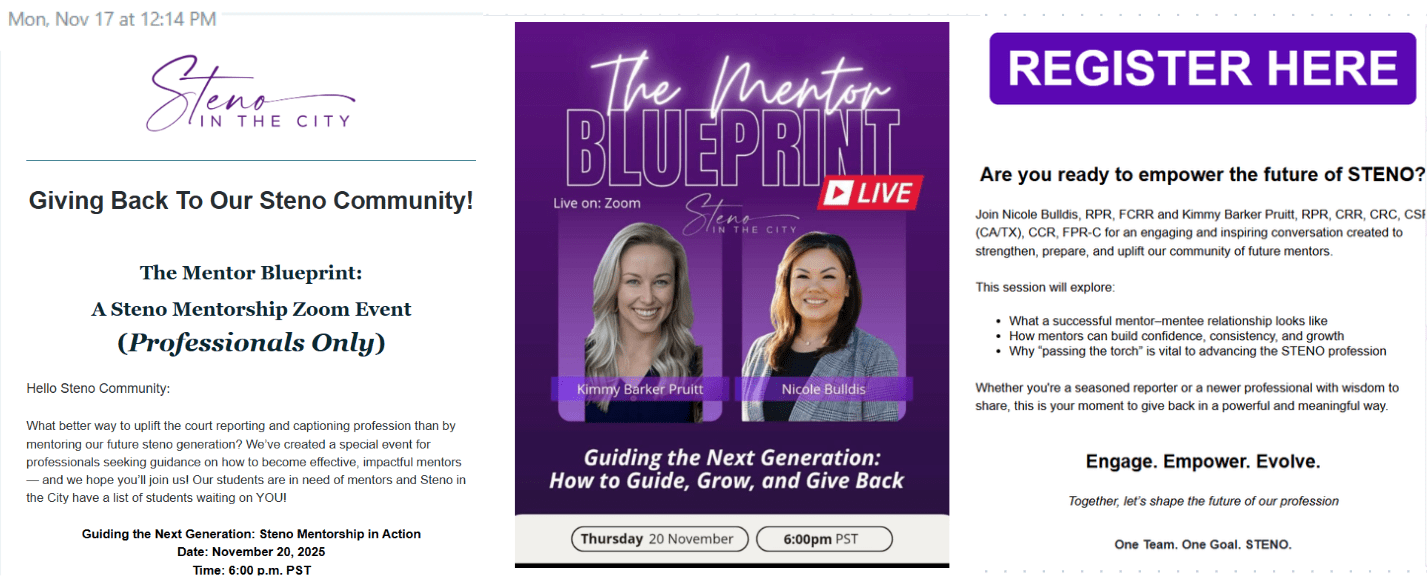
A “free mentorship event” sounds harmless—until you realize it may be a data-collection funnel for a trademarked for-profit brand. If speakers aren’t compensated, if attendees unknowingly become marketing leads, and if the program mimics a nonprofit without governance or transparency, the community must ask hard questions. Court reporters deserve mentorship rooted in ethics—not a commercial pipeline in disguise.
Tag Archives: StenoEducation
When the DRA Ignores Its Own Backyard – Why California’s Court Reporting Schools Deserve Defense, Not Displacement

California’s only NCRA-approved court reporting school has faced relentless audits while producing more CSRs than any other in the state. Yet the DRA features out-of-state speakers poaching students into unproven “write shorter” programs instead of honoring educators using proven speed-building methods like RWG theory. If the DRA truly supports the profession, advocacy must start at home — with California’s own schools.
The Great Theory Divide – Why “Short Writing” Alone Won’t Save Court Reporting

Court reporting’s future hinges on how we train new reporters. While “short writing” promises speed, decades of data show it fails to scale. Traditional phonetic theories taught in NCRA-accredited programs remain the backbone of reporter education—emphasizing accuracy, clarity, and proven outcomes. Recruitment reform, not shortcuts, will strengthen the pipeline and ensure a generation ready to protect the record.
Why AAERT-Certified Digital Reporters Are Not the Answer to the Court Reporter Crisis

Digital reporters certified by AAERT are not equivalent to licensed court reporters. They don’t write realtime, certify records on the spot, or meet the legal standards required in high-stakes proceedings. While digital recording may seem like a quick fix for shortages, it risks long-term damage to the integrity of the record. The solution isn’t substitution—it’s investment in the gold-standard profession that’s already working.
 STENOIMPERIUM