
When attorneys receive shocking court reporting invoices, frustration is understandable. But those inflated charges are not enriching court reporters. They are the product of private-equity consolidation, corporate billing structures, and middlemen who control pricing while paying reporters a shrinking share. If the profession is being hollowed out, it is not by stenographers. It is by the business models built on top of them.
Tag Archives: litigationsupport
If You Want Lower Transcript Costs, Help Create More Court Reporters

Transcript prices are not rising because court reporters are greedy; they are rising because there are fewer of them. Like any market, court reporting follows basic economic rules: when supply shrinks and demand grows, prices increase. If attorneys want lower transcript costs, the solution is not cheaper capture methods—it is helping rebuild, retain, and respect the human court reporting workforce.
A Harbinger of Collapse – What One Facebook Post Reveals About the Future of Court Reporting in the United States

A single Facebook post from a Canadian reporter—reduced to just 3–6 jobs a month—should terrify every U.S. attorney and stenographer. It is a glimpse of what happens when ASR replaces certified professionals: the market collapses, accuracy disappears, and justice erodes. Canada didn’t fail because reporters weren’t skilled. It failed because decision-makers chased “cost savings.” The U.S. is next—unless we stop it now.
Going Direct – The Court Reporter’s Complete Guide to Producing Transcripts Without an Agency

As more reporters work directly with attorneys, they must now replicate the full agency production workflow themselves. This guide explains how to create searchable PDFs, ASCII files, condensed transcripts, concordances, and PTX files; scan and label exhibits; manage read-and-sign obligations; invoice professionally; and archive transcripts securely. With clear processes, independent reporters can deliver courtroom-ready transcript packages while maintaining complete control of their work.
The Bubble Beneath the Record – A Financial Crisis in Court Reporting Is Coming

A financial bubble is forming beneath the court reporting industry. Private equity markups have pushed attorneys toward cheaper “alternative” record methods, but those substitutes fail evidentiary standards and are beginning to collapse under legal scrutiny. As reporters reject unsustainable rates and attorneys realize uncertified transcripts don’t hold up in court, the industry is nearing a correction. The record cannot be commodified—and the bubble will burst.
Why Transcript Correction Disputes Are Rising — And Where the Problem Originated

Certified court reporters are seeing a rise in large-scale transcript correction requests, but the issue is not declining reporter skill. It stems from the increased use of digital audio and ASR-generated transcripts being treated as equivalent to stenographic reporting. Once attorneys began comparing transcripts with software tools, the inconsistencies became clear. Accuracy starts at the point of capture, and the method matters.
The Court Reporting Industry Faces Structural Stress

The court reporting sector is showing signs of structural stress after years of private-equity consolidation and rising interest rates. Higher transcript costs and declining reporter compensation have prompted some firms to explore lower-cost recording methods, though many of these alternatives face evidentiary and certification limits. As labor supply tightens and compliance standards remain unchanged, the market appears to be shifting back toward models emphasizing reliability and credentialed recordkeeping.
The Real Markup – Why Attorneys Think Reporters Are Overcharging (and Who’s Actually Pocketing the Profit)

Attorneys often assume court reporters are the ones driving up transcript costs. In reality, it’s the agencies in the middle—marking up reporter rates and layering on fees for condensed transcripts, concordances, exhibits, and repositories that reporters don’t see a penny of. As transparency grows, attorneys are discovering the truth: working directly with certified reporters saves money and strengthens the record.
How Zoom Depositions, Consent Laws, and Competing Recordings Are a Growing Dilemma for Court Reporters

In the age of Zoom depositions, competing recordings raise more than technical concerns — they strike at the integrity of the record. When attorneys attempt to capture their own audio, they risk violating consent laws, breaching confidentiality, and undermining the court reporter’s role. Protecting the official record sometimes means halting proceedings, even when it costs time and money.
The Era of Aggregation – Lexitas, Veritext, Magna and Others Consolidating the Court Reporting Industry

The court reporting industry is undergoing rapid consolidation as giants like Lexitas, Veritext, Esquire, and Magna absorb smaller firms nationwide. While some see opportunity in acquisition, others are doubling down on independence. This article explores who’s buying, what they’re looking for, and how small agencies can survive—or sell—on their own terms.
Are Paralegals Being Automated Out of the Legal Workforce? A Critical Look at Lexitas’ New AI Tool

Lexitas’ new AI tool, Deposition Insights+, claims to streamline litigation prep—but at what cost? By automating key tasks traditionally handled by paralegals and junior attorneys, this technology risks replacing human insight with algorithmic shortcuts. Legal professionals must ask: Are we empowering teams, or eroding jobs and skills? Efficiency shouldn’t come at the expense of accuracy—or accountability. The legal industry must tread carefully.
The Ethical Dilemma of “No Payment Until Settlement” in Court Reporting
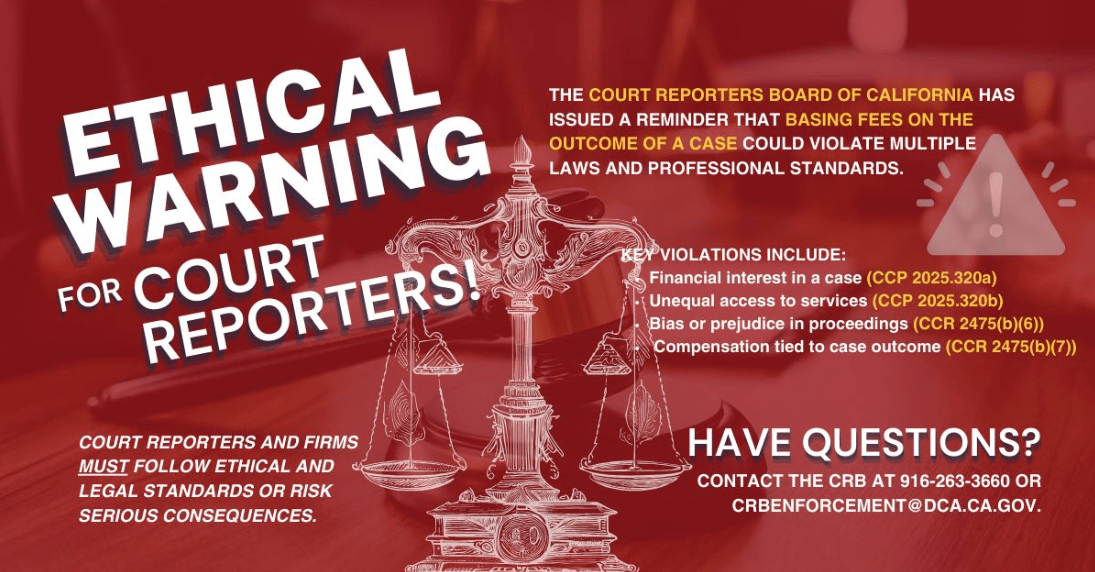
Court reporting firms must uphold neutrality, yet some offer “no payment until settlement” to clients while demanding immediate payment from opponents. This raises ethical concerns and may violate California law. The Court Reporters Board of California warns that such practices compromise impartiality and could result in regulatory action. Maintaining fair payment policies is essential to preserving trust and integrity in legal proceedings.
 STENOIMPERIUM