
Digital “reporters” are not licensed court reporters—and in California, their use is illegal in most court proceedings. Attorneys cannot stipulate around the law or sidestep due process. When the record is flawed, justice is compromised. A certified shorthand reporter (CSR) is not optional—it’s essential. Don’t be misled: replacing a stenographer with a recorder isn’t innovation. It’s a legal and ethical liability.
Tag Archives: legalethics
Are Paralegals Being Automated Out of the Legal Workforce? A Critical Look at Lexitas’ New AI Tool

Lexitas’ new AI tool, Deposition Insights+, claims to streamline litigation prep—but at what cost? By automating key tasks traditionally handled by paralegals and junior attorneys, this technology risks replacing human insight with algorithmic shortcuts. Legal professionals must ask: Are we empowering teams, or eroding jobs and skills? Efficiency shouldn’t come at the expense of accuracy—or accountability. The legal industry must tread carefully.
The High Cost of Convenience – How Digital Court Reporting Risks Destroying the Profession It Claims to Modernize

As court reporting agencies rush to adopt AI and digital tools, they risk undermining the very profession they rely on. Accuracy, ethics, and human expertise are being sacrificed for speed and cost. Agencies must choose: innovate with reporters, or replace them entirely—and suffer the consequences. The legal system deserves better than a transcript powered by hope and algorithms.
The Ethical Crossroads of Technology in Law – Why Attorneys Must Defend Human Court Reporters

Attorneys have an ethical obligation to verify the integrity of the record. Yet ASR transcripts, often created without disclosure or certification, are slipping into legal proceedings unchecked. With error rates nearing 30%, no human accountability, and real risks to confidentiality, lawyers must take a stand. Certified human stenographers remain the gold standard. Accept no substitutes—your client’s rights may depend on it.
AI Might Be Cheaper—But It’s Gutting the Court Reporting Pipeline

Courtrooms aren’t podcasts—and AI isn’t ready to replace human court reporters. What’s at stake isn’t just jobs, but an entire pipeline: schools, certification boards, machine makers, and trained professionals. Once that system collapses, it’s gone. If we cut too deep, there will be no one left when AI fails. Choose accuracy. Choose humans. Choose us—while you still can.
Ethical Red Flags – Are Attorneys Violating Rules of Professional Conduct by Retaliating Against Court Reporters?

Some plaintiff attorneys are retaliating against court reporters by replacing them with uncertified digital alternatives—not out of necessity, but spite. In doing so, they may be violating ethical rules around competence, candor, and fairness. Using uncertified transcripts can mislead the court, harm clients, and erode due process. It’s not just bad judgment—it may be professional misconduct.
The Backfire of the Stop the SoCal Stip Movement – How a Campaign to Protect Court Reporting Accelerated Its Threat

The Stop the SoCal Stip movement was meant to protect court reporters—but instead, it triggered resentment among attorneys that’s now fueling our replacement. What began as a legal ethics stand has been twisted into a narrative of greed. The result? Retaliation via digital recording and ASR. If we don’t reclaim the narrative, the gold standard of stenography could disappear.
The Case for Court Reporter Cost Transparency and Industry Reform
Attorneys are furious over rising court reporting costs—but the truth is, reporters aren’t the ones profiting. Agencies are marking up per diems by 100–200%, keeping fees for add-ons like exhibits and digital access, while reporters see less than half. It’s time for legislative reform, transparency, and a fair compensation model that protects the profession—and restores integrity to the legal record.
ASR in Court Reporting – Tool, Threat, or Transformation?

As court reporting faces increasing pressure from digital disruption, the debate over ASR (Automatic Speech Recognition) intensifies. Can it be used responsibly — or does its adoption spell the end of human-led recordkeeping? This article explores the nuanced question: If ASR is wielded by a trained, licensed stenographer, does it become a tool — or remain a threat? The future of our profession may hinge on the answer.
The Ethical Dilemma of “No Payment Until Settlement” in Court Reporting
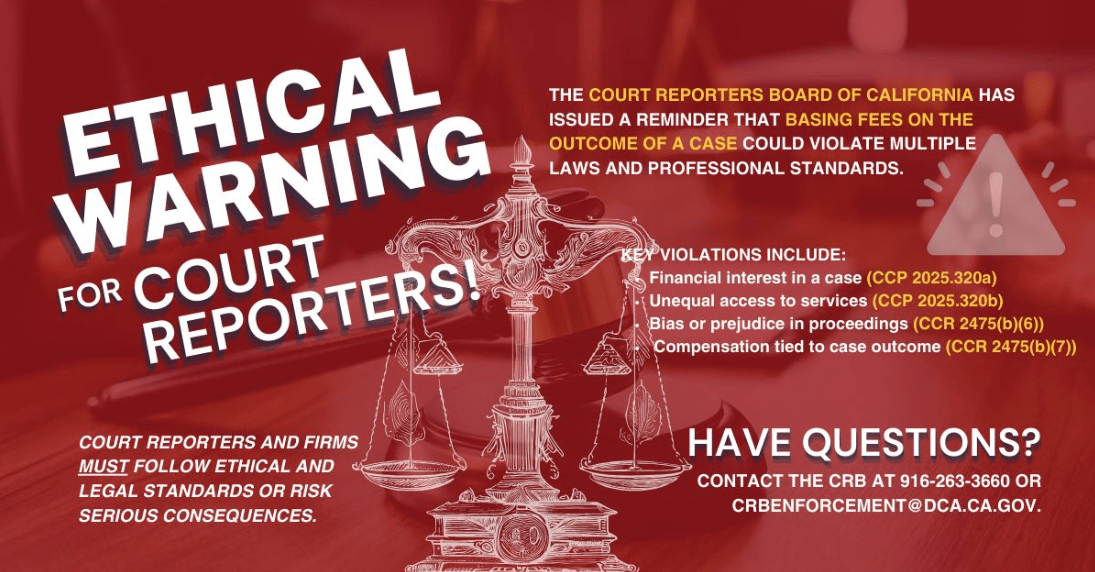
Court reporting firms must uphold neutrality, yet some offer “no payment until settlement” to clients while demanding immediate payment from opponents. This raises ethical concerns and may violate California law. The Court Reporters Board of California warns that such practices compromise impartiality and could result in regulatory action. Maintaining fair payment policies is essential to preserving trust and integrity in legal proceedings.
 STENOIMPERIUM