
Branded “unemployable” after a viral moment, Kristin Cabot’s story raises a larger question: what happens to capable professionals when public shame outpaces truth? Court reporting offers a rare second act—one grounded in skill, neutrality, and measurable merit. In a profession that values accuracy over optics, redemption isn’t performative. It’s earned, keystroke by keystroke.
Tag Archives: FutureOfWork
Bridging the Career Services Gap in the Court Reporting Profession

Court reporting associations are facing a reckoning. Reporters are not disengaging because they dislike the profession; they are disengaging because their associations no longer align with their most urgent priorities: jobs, advancement, training, and real career security. In an era of technological disruption and shrinking pipelines, associations that fail to become career catalysts risk losing not just members, but the future of the profession itself.
Beyond the Hype – Redefining Court Reporting in the Age of AI

Artificial intelligence is changing the conversation in court reporting—but it’s not a substitute for human judgment, ethics, and accountability. The real risk lies in misleading narratives and policy shifts that treat automation as “good enough.” By uniting as professionals and adopting AI on our terms, we can protect the record, strengthen our work, and ensure justice remains built on accuracy.
Perception vs. Reality – The Truth About Court Reporting Education Costs

Court reporting schools are often criticized as “for-profit cash grabs,” but the reality is very different. These programs operate on razor-thin margins, not windfall profits. Tuition reflects the true cost of specialized training—not greed. The real story is value: a $35,000 investment can yield a lifelong career with six-figure potential. Perception misleads; the payoff is undeniable.
Court Reporting is the $35,000 Investment That Can Yield Millions
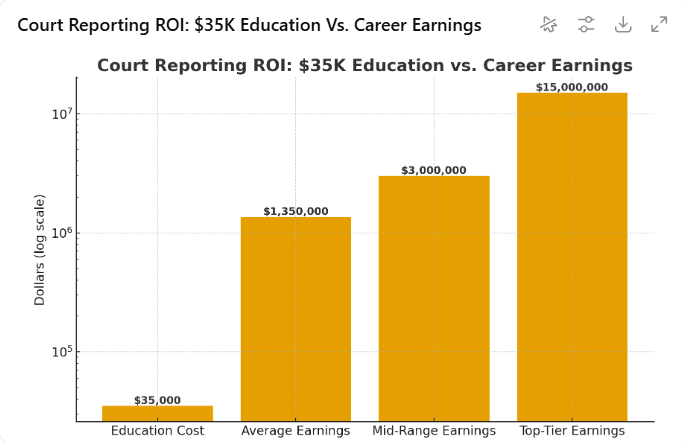
Court reporting may be the smartest career investment few people talk about. For about $35,000 in education, reporters can earn anywhere from $45,000 a year on average to $500,000+ at the top of the field. That’s a lifetime income range of $1.35 million to $15 million. Even at the low end, the ROI far outpaces most college degrees.
 STENOIMPERIUM