
Court reporting faces a critical pricing question: should new reporters charge less for the same official record? The answer determines whether the profession maintains a stable foundation or trains the market to seek the lowest bidder. Experience should raise earnings through advanced services like realtime and expedited delivery — not reduce the baseline value of the record itself.
Tag Archives: education
An Open Letter to Kristin Cabot: A Profession That Understands Second Acts

Branded “unemployable” after a viral moment, Kristin Cabot’s story raises a larger question: what happens to capable professionals when public shame outpaces truth? Court reporting offers a rare second act—one grounded in skill, neutrality, and measurable merit. In a profession that values accuracy over optics, redemption isn’t performative. It’s earned, keystroke by keystroke.
Why Most Court Reporters Don’t Quit — And Why That Matters

An AI summary claims court reporters quit because the job is unbearable. The reality is the opposite. Most reporters stay for decades—often an entire working lifetime—because the profession rewards mastery, autonomy, and adaptability. Court reporting is demanding, yes, but for those built for it, it becomes a superpower, not a burnout sentence.
The Great Theory Divide – Why “Short Writing” Alone Won’t Save Court Reporting

Court reporting’s future hinges on how we train new reporters. While “short writing” promises speed, decades of data show it fails to scale. Traditional phonetic theories taught in NCRA-accredited programs remain the backbone of reporter education—emphasizing accuracy, clarity, and proven outcomes. Recruitment reform, not shortcuts, will strengthen the pipeline and ensure a generation ready to protect the record.
Court Reporting is the $35,000 Investment That Can Yield Millions
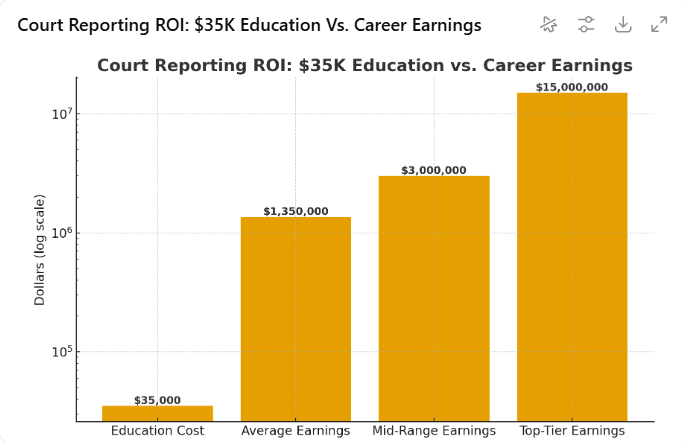
Court reporting may be the smartest career investment few people talk about. For about $35,000 in education, reporters can earn anywhere from $45,000 a year on average to $500,000+ at the top of the field. That’s a lifetime income range of $1.35 million to $15 million. Even at the low end, the ROI far outpaces most college degrees.
Saving Court Reporting – It’s About More Than Fighting AI

The legal world has spent years debating artificial intelligence and digital recording in courtrooms. And with good reason. Accuracy, privacy, and accountability are not luxuries; they are the bedrock of justice. Human court reporters remain the gold standard for preserving the record. But while we fight Silicon Valley’s latest experiment, another crisis is starving ourContinue reading “Saving Court Reporting – It’s About More Than Fighting AI”
No, You Never Served Me – The Truth Behind False Cease-and-Desist Claims

Shaunise Day falsely claimed a cease and desist “didn’t work” against me — but the truth is, it was never valid to begin with. The letter came from someone with a JD but no law license. The California State Bar ruled it was unauthorized practice of law, issued a cease and desist to her, and referred the case to the DOJ. Facts matter. Lies don’t intimidate me.
A Dangerous Shift in California – Why Changes to CSR Exam Requirements Could Gut the Stenographic Pipeline

A qualified student, ready to take California’s rigorous CSR exam after five years of training, was blocked by her school for not passing an internal 225 test—not a state requirement. Other schools refused to sponsor her out of fear of retaliation. Meanwhile, voice writers face fewer barriers. This isn’t about standards—it’s gatekeeping. Politics and policy shifts are sabotaging the steno pipeline from within.
Court Reporting – The Delta Force of Professions

Court reporting school has a dropout rate as high as Delta Force selection—only 5 to 10% make it through. We’re not just typists; we’re elite professionals with real-time mental endurance and precision under pressure. Like Tier One operators, we train for years to master a high-stakes craft. We are the Responsible Charge of the official record—and no machine can replace that.
An Urgent Call for Federal Action – Protecting the Legal Record in the Age of ASR

To the NCRA Board of Directors and Executive Leadership: As our profession stands at a technological crossroads, we are faced with a choice: lead the conversation on responsible innovation—or watch from the sidelines as automation reshapes our industry without us. This letter is a call to action, urging the National Court Reporters Association to takeContinue reading “An Urgent Call for Federal Action – Protecting the Legal Record in the Age of ASR”
When a State Association Leaves the State – Why ILCRA’s Move to Florida Is a Red Flag for Court Reporters Everywhere
Illinois—home to one of the top four court reporting populations in the U.S.—just saw its association headquarters moved to Florida, a state that has eliminated licensing and gone digital. This alarming relocation by ILCRA raises serious concerns about transparency, oversight, and the future of stenography. Why outsource leadership to a state that no longer values licensed court reporters? Members must demand accountability now.
Should Reporters Be Rallying Behind Shaunise Day?

Shaunise Day has positioned herself as a voice within the court reporting profession—despite never completing certification or working as a licensed reporter. While she promotes events and media under the banner of advocacy, many professionals question her credibility and qualifications. In a field defined by precision and licensure, critics argue that leadership should come from those who’ve earned their place within the industry through experience and certification.
Saving Court Reporting – Why Canada’s Loss Is America’s Opportunity to Help

Canada’s only accredited court reporting program is on the verge of collapse—and with it, the integrity of legal records, live captioning, and accessibility services. Called a “national crisis” by the Canadian Hard of Hearing Association, NAIT’s decision jeopardizes justice and inclusion. Court reporters aren’t typists—they are the final authority on the record. This profession is vital, and it must be protected.
California Court Reporters Board Strips School Names from CSR Results — A Troubling Move for the Industry

The California Court Reporters Board has removed school names from CSR exam results, sparking concern among the state’s few remaining court-reporting programs. This change, made without notice, strips schools of public recognition crucial for accreditation, recruitment, and credibility. At a time when the profession faces a severe shortage, the move threatens to further weaken the already fragile pipeline of trained court reporters in California.
One Man, Many Hats – Is It Time to Talk About Dave Wenhold’s Role Across Court Reporting Associations?

Dave Wenhold, Executive Director of both NCRA and ILCRA, wields uncommon influence across court reporting associations—raising serious questions about transparency and fairness. With overlapping leadership roles in multiple organizations, critics warn of blurred priorities, potential conflicts of interest, and limited oversight. As membership declines and industry threats grow, many are asking: is this governance structure truly serving the profession—or concentrating too much power in one place?
California Court Reporters Are Being Squeezed Out – So How Do We Fix This?

California CSRs are being pushed into unsustainable in-person work while remote jobs go to out-of-state reporters—many unfamiliar with California’s strict formatting laws. As noncompliant transcripts flood the system and local professionals are quietly sidelined, the state’s regulatory board remains largely inactive. Without stronger enforcement, equitable job distribution, and industry-wide reform, the profession risks losing both its standards and its future in California.
Court Reporting vs. Other Professions – A Wake-Up Call on ROI for Students

Court reporting is one of the best-kept secrets in high-income careers. With just 1–3 years of training and a $20K–$65K investment, skilled reporters in California can earn $180K–$360K+, with top earners hitting $500K–$1M+. Compared to the time and cost of becoming a doctor or lawyer, court reporting offers an unmatched ROI—fast, lucrative, and future-proof for students seeking real financial freedom.
The Court Reporter Shortage Is a Myth: A Manufactured Crisis to Push Automation

The so-called court reporter shortage is a manufactured crisis driven by budget cuts and tech interests—not a true lack of skilled professionals. Courts and private vendors push this narrative to justify replacing trained stenographers with unreliable digital systems. In reality, systemic underinvestment and poor recruitment are to blame. This myth threatens due process and shifts the burden of justice onto those who can least afford it.
The Biden Audio Leak Is a Warning to All of Us in Court Reporting

The leak of President Biden’s deposition audio reveals a deeper issue: what happens when legal recordings are handled by bureaucracies instead of court reporters? With a track record of confidentiality and ethical responsibility, court reporters must remain the Responsible Charge of legal records. This incident is a warning—and a call to preserve the integrity of our justice system.
The Record Must Remain Ours – A Court Reporting Call to Action

Court reporters are not outdated—we’re digital pioneers. As ASR and CAT tools flood the market, we must assert professional control. Certification, responsibility, and independence are non-negotiable. The individual capturing the record must also certify it. Letting courts or unlicensed tech operators own the record threatens justice itself. We must lead the change—on our terms. The record must remain ours.
Fail to Adapt to Disruption and Pay the Price – Court Reporters Heed the Warning
Court reporting isn’t antiquated—it’s one of the most technologically advanced professions in the legal world. As we pass the tipping point of digital disruption, our challenge isn’t resisting change but leading it. Certified reporters, using sophisticated tools like ASR-integrated CAT software, must set the standard. The future depends on preserving integrity, enforcing certification, and maintaining responsible charge in every courtroom transcript.
“Why I Love Court Reporting” FB Group Celebrates a Decade of Dedication in the Court Reporters’ Community & Camaraderie

For ten years, the Why I Love Court Reporting Facebook group has fostered camaraderie, inspiration, and unwavering support for court reporters worldwide. With over 5,000 members, this thriving community celebrates the profession’s passion, perseverance, and purpose. As we mark this milestone, we honor the dedication of those who uphold justice with every keystroke. Here’s to a decade of dedication—and many more to come!
The Digital Court Reporting Scam – How Aspiring Court Reporters Are Being Duped
Digital court reporting programs are misleading aspiring court reporters, especially in states like California, where digital recording of legal proceedings is illegal. Many students invest time and money in these courses, only to find out they do not lead to licensure. Universities continue to offer these programs for profit, despite their lack of credibility. Prospective students must research and choose accredited stenographic training instead.
Save What You Love

Stenography is at a crossroads, facing technological disruption, educational decline, and misconceptions about its relevance. However, innovation offers hope—new technology is emerging that integrates human expertise with automatic speech recognition, ensuring unmatched accuracy. To save stenography, we must revitalize training programs, challenge outdated perceptions, and embrace advancements that empower, rather than replace, skilled professionals. The future of this vital profession depends on it.
How the NCRA Can Increase Its Membership and Thrive Again

The NCRA can revitalize its membership by advocating for state-mandated certification, ensuring legal recognition and job security for court reporters. By lobbying for standardized state licensing, transitioning from proprietary certifications, and fostering industry partnerships, the NCRA can strengthen career stability and elevate professional standards. This bold shift would cement court reporters’ essential role in the legal system and make the organization more relevant than ever.
7 Ways A Steno Imposter is Manipulating You To Make You Trust Them

In the world of stenography, trust is everything—but it’s also something that fake scammers prey on. Court reporters are increasingly targeted by imposters who use manipulative tactics to gain trust and exploit it for their own gain. From playing the role of a caring listener to fast-tracking relationships, these imposters employ deceptive strategies to manipulate the legal community and profit off of us. Learn how to spot the signs and protect yourself.
 STENOIMPERIUM