
Court reporting is not a sprint profession. It is a deep-water profession. Built on repetition, neural conditioning, emotional regulation, and thousands of invisible strokes. Certification is not won by panic or comparison. It is won by consistency. By showing up. By consolidating. By letting progress compound quietly. The turtle always arrives.
Tag Archives: CourtReporterLife
Between the Words – What Court Reporters Can Learn From the People Who Interrupt

In courtrooms, interruption is often treated as a matter of manners. But emerging research suggests it is more often a matter of nervous systems. High processing speed, anxiety, and attention-regulation differences can drive people to speak before they mean to. For court reporters, understanding this distinction is not indulgence. It is a practical tool for protecting the record and restoring order with precision rather than irritation.
Staying in the Chair – What Court Reporting Teaches Us About Pain, Presence, and Power

Court reporters spend their careers staying in rooms most people instinctively want to leave. They sit inside conflict, grief, tension, and pressure so the legal record can exist. But the profession rarely teaches reporters what to do with what accumulates inside them. This article explores why presence, not avoidance, is often the beginning of resilience—and real professional power.
Whitney Kumar Returns to the Spotlight as Judy Justice Begins Another Season – 2026

Whitney Kumar is back for another season of Judy Justice, returning to the courtroom where precision meets prime time. As the show’s official court reporter, Whitney brings authenticity, professionalism, and deep legal expertise to one of streaming’s most-watched courtroom series. Her continued presence highlights not only her own success, but the vital role court reporters play in preserving the integrity of the record.
Remote Reporting Didn’t Devalue the Profession. It Forced It to Clarify Its Value.

Remote proceedings did not cheapen court reporting. They stripped away logistics and forced the profession to confront what it actually sells: custody of the legal record. As rate debates intensify, the future of stenography may depend less on where reporters sit and more on whether the profession anchors its value in accountability, professional responsibility, and the integrity of the record itself.
The Voice Writing Question – Is the Fastest Entry Path Quietly Reshaping—and Risking—the Court Reporting Profession?

Voice writing is rapidly being marketed as the fastest path into court reporting, even as it remains unrecognized as stenography by the profession’s own national association. This article examines the growing disconnect between how voice writing is sold and how the legal record actually functions, why many machine reporters are learning voice for longevity—not superiority—and what happens when speed of entry outpaces experience in a profession built on precision.
Court Reporters, Technology, and Reality – Resetting Expectations in a Small Industry

Court reporting technology vendors are not Big Tech. They are small, specialized companies serving a shrinking professional market. Expecting instant, round-the-clock concierge support misunderstands the realities of the industry. Professional competence requires patience, self-sufficiency, and deep knowledge of one’s tools. When a reporter’s livelihood depends entirely on immediate vendor intervention, the risk is not poor service—it is misplaced dependency.
Relaxed, Rhythmic, Relentless – Why Letting Go Is the Fastest Way Forward in Stenography

In 2025, court reporting students are discovering a counterintuitive truth: speed does not come from pressure, panic, or perfectionism. It comes from rhythm, calm, and trust in the training already done. When stenographers stop treating every take like a verdict on their future, their writing smooths, accuracy improves, and progress accelerates.
Trial Etiquette – The Unwritten Code Every Court Reporter Is Expected to Follow

Trial etiquette carries unwritten rules, and one of the strongest is this: if you accept a trial, you finish it. Leaving mid-trial hurts colleagues, judges, and even jurors—especially when readback requests arise and transcripts were never prepared. Substitute reporters are often handed unusable roughs or incomplete PDFs, creating risk of reversible error. Judges notice. Agencies remember. Professionalism demands continuity from start to finish.
The Great Wage Mirage – When Digital Court Reporting Claims Outpace Reality
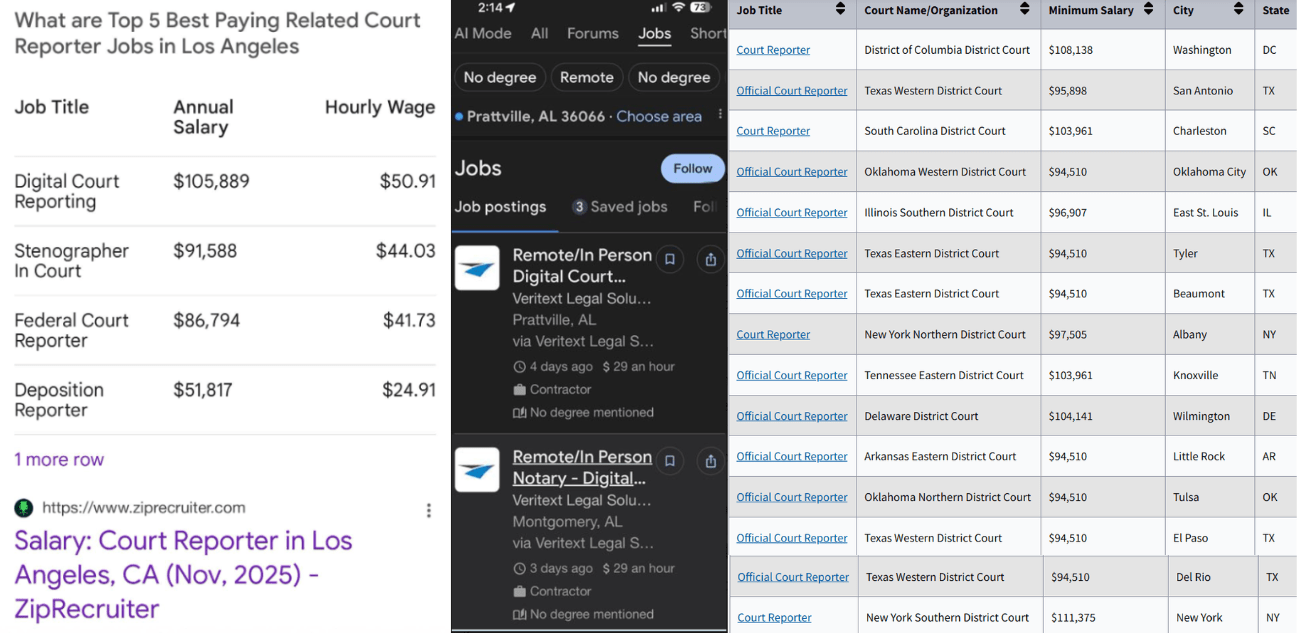
A viral wage graphic now claims digital court reporters in Los Angeles earn more than licensed stenographers and federal officials. The figures collapse under scrutiny, revealing a dangerous distortion of how court reporting is valued and understood. When passive recording is framed as more lucrative than producing the certified legal record, the profession’s integrity is compromised and the public misled about justice, skill, and accountability.
The First Impression Bias & How Female Court Reporters Are Judged on Appearance Before Skill
Women in court reporting are often judged on appearance long before anyone recognizes our skill. I’ve walked into rooms dressed like an attorney and still been mistaken for anything but the professional safeguarding the record. These subtle moments add up—and they reveal a deeper bias in the legal system. Our work deserves recognition based on expertise, not aesthetics.
“What Even Is 6-7?” When a Meme Walks Into a Courtroom (And Everyone Over 30 Panics)

In court this week, an entire room of adults—attorneys, clerk, judge, and yes, even me—realized we had absolutely no idea what “6-7” meant. Turns out it means… nothing. Everything. Whatever kids want it to mean. This chaotic, context-free meme is the perfect reminder that language is shifting faster than ever—and why human court reporters remain essential guardians of clarity in an increasingly nonsensical world.
Surviving the Holidays as a Court Reporter – A Realistic Guide to Family Drama, Deadlines, and the December Blues

The holidays can be brutal for court reporters — transcript overload, family drama, grief, financial stress, and the pressure to be “festive” when you’re barely holding it together. This guide offers real strategies for surviving December without drowning: boundaries, triage systems, emotional self-care, and expectations that won’t break you. You don’t need a perfect holiday. You need a kind one — and you deserve that peace.
Where Your CEU Dollars Go – Choosing State Associations and Nonprofits That Reinvest in the Profession

Every continuing education dollar is a decision about the future of court reporting. When those funds are directed to legitimate state associations and nonprofit organizations, they strengthen advocacy, education, and ethical standards that preserve the integrity of the record. When they flow instead to personality-driven ventures, the profession risks becoming a revenue stream for individual ambition rather than a sustained legacy built on collective stewardship.
Your Journey. Your Way. Flawlessly.

Court reporting is no longer confined to a single path or setting. Today’s reporter chooses where, how, and when they work—courtroom, deposition, captioning, remote, or across borders. The skill remains constant: the ability to capture testimony with precision and integrity. The journey, however, now belongs to the reporter. Your profession. Your autonomy. Your record. Your Journey. Your Way. Flawlessly.
The New “Mentorship” Funnel – Why Court Reporters Should Be Cautious About Handing Over Their Professional Data

A “free mentorship event” sounds harmless—until you realize it may be a data-collection funnel for a trademarked for-profit brand. If speakers aren’t compensated, if attendees unknowingly become marketing leads, and if the program mimics a nonprofit without governance or transparency, the community must ask hard questions. Court reporters deserve mentorship rooted in ethics—not a commercial pipeline in disguise.
Spooky Season or Shady Season?

Magna’s Halloween “Spooky Season” giveaway offers $25 gift cards for every 100-page transcript — a festive twist that may violate California’s court-reporting ethics code. By tying rewards directly to transcript production, the program breaches CCR § 2475(b)(8), which bans gifts or incentives for reporting services. What looks like a treat could become a costly trick for Magna and participating reporters.
What Court Reporters Can (and Cannot) Talk About – Ethics, Boundaries, and Public Perception

Court reporters hold the public’s trust—and that includes what we say after we leave the room. Sharing case details, even without names, can still identify participants and damage our impartiality. Confidentiality isn’t just about secrecy; it’s about respect, neutrality, and professionalism. Protecting the record means protecting our reputation—on and offline.
The Yin and Yang of Court Reporters – What Do You Do Outside the Record?

Kevin O’Leary says top talent balances discipline with creativity — the Yin and Yang of performance. Court reporters embody that perfectly. From musicians and marathoners to painters and pilots, our passions beyond the record fuel precision on the job. What’s your other side? Share what keeps you inspired beyond the transcript.
“Spin to Win” for Transcripts? Why This Giveaway Likely Violates California Lottery & Professional Standards Laws

Magna’s “Spin to Win” wheel isn’t harmless fun—it’s an illegal lottery in disguise. By tying raffle entries to transcript submissions and page counts, the company recreates the same scheme Shaunise Day’s Steno in the City™ ran in Long Beach without DOJ registration. In California and most states, Prize + Chance + Consideration = lottery. No free entry means no compliance.
 STENOIMPERIUM