
Subscribe to continue reading
Subscribe to get access to the rest of this post and other subscriber-only content.
Protecting the Record. Preserving Justice. Empowering Stenographers.

Subscribe to get access to the rest of this post and other subscriber-only content.

Subscribe to get access to the rest of this post and other subscriber-only content.

Subscribe to get access to the rest of this post and other subscriber-only content.

When Branding Outshines Accountability in Court Reporting
We’ve all asked it: “Why is she still here?” How does someone with no stenography credential, a trail of unanswered questions about labor practices, and a habit of quashing criticism remain a fixture in our profession?
Below is a candid look at the forces that keep her brand afloat—and what we can do to change the story.
In today’s attention economy, image often outranks substance. A slick website, vibrant social feeds, and high-energy events create the illusion of authority. For outsiders—or newcomers eager for motivation—that polish can look like leadership. Meanwhile, those of us doing the real work behind courtroom doors lack the time (or desire) to curate a brand narrative.
Result? The loudest voice, not the most experienced one, dominates.
Many stenos see the red flags—unpaid “volunteers,” corporate donations funneled into a for-profit venture, inflated success stories—but choose silence. Some fear backlash or ostracism; others just want to avoid drama. Every time we stay quiet, her platform grows taller. Silence isn’t neutrality; it’s passive endorsement.
Push back and you’re labeled “negative,” “jealous,” or “toxic.” Legal threats—like the recent trademark complaint leveled at my blog—turn the tables, framing the whistle-blower as the bully. It’s classic intimidation: shift focus from the allegations to the person raising them, and the real issues vanish from the feed.
Sponsorships, speaking fees, affiliate sales—profit flows to the person controlling the spotlight. Why abandon a cash-generating brand? Until the community stops clicking, sharing, and attending, the incentives favor staying put, credentials or ethics be damned.
Regulators, associations, and schools rarely police the “influencer” fringe. Unless a clear violation surfaces—tax fraud, false licensure—there’s little external pressure to step aside. That leaves accountability in our hands.
Because the equation works:
Polished branding – scrutiny + community silence = sustained influence and profit
She’s still here because the system rewards brand optics over professional substance—but only as long as we allow it. The moment enough stenos decide that ethical practice matters more than flashy marketing, the spotlight shifts. Let’s make that shift together.
Stenos, stay loud, stay factual, and above all, stay united.
***To unsubscribe, just smash that UNSUBSCRIBE button below — yes, the one that’s universally glued to the bottom of every newsletter ever created. It’s basically the “Exit” sign of the email world. You can’t miss it. It looks like this (brace yourself for the excitement):



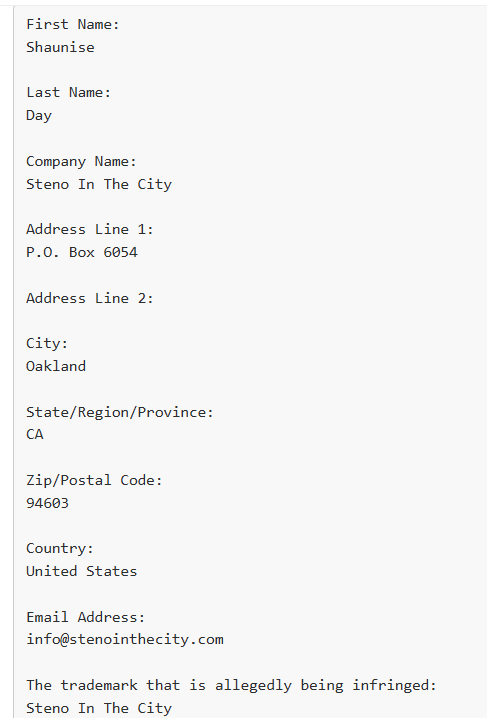
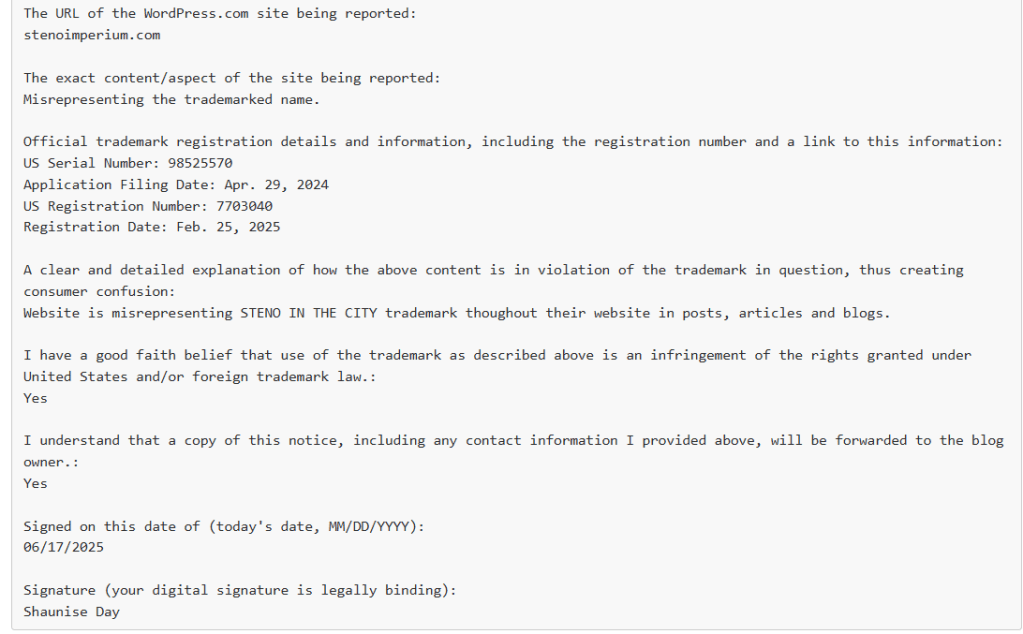
On June 19, 2025, I received an official complaint from WordPress regarding my blog, StenoImperium.com. The complaint was filed by an individual named Shaunise Day, who owns the brand “Steno In The City,” and it alleged that my use of the name in my blog content constituted trademark infringement.
This situation raises a larger issue about intellectual property, fair use, and how trademark law can sometimes be used not to protect a brand from confusion — but to stifle criticism, silence voices, and intimidate people who speak out.
Let me explain what happened, what the law actually says, and why this should matter to anyone who publishes commentary, criticism, or creative work online.
According to the report submitted to WordPress, Shaunise Day claimed that I was “misrepresenting the trademarked name” Steno In The City on my blog. She cited a U.S. trademark registration (Reg. No. 7703040, registered Feb. 25, 2025) and a filing date in April 2024.
It’s worth noting that the trademark for Steno In The City was only filed in April 2024 — immediately after I published my first exposé article raising serious questions about the brand’s operations. Looking back, it’s clear this wasn’t spontaneous — she’s been laying the trap for over a year. Since then, there’s been a slow, calculated pattern: curating a polished brand image, reframing criticism as “harassment,” and eventually weaponizing a newly minted trademark to try to shut me down.
This isn’t brand protection — this is legal strategy used to silence dissent. It’s a premeditated move that says more about controlling public perception than it does about protecting intellectual property.
She asserted that my use of the phrase in posts, articles, and blogs created “consumer confusion.” No specific examples were given — just the broad accusation that I was somehow impersonating her brand or benefitting from it.
Let’s be clear: I have never claimed to be Steno In The City. My blog is called StenoImperium — a name that is entirely distinct. I do not use her logo. I do not use her branding. I do not claim partnership or affiliation in any way.
What I have done is discuss the activities, public events, and decisions of her brand — sometimes critically, always honestly. That is not infringement. That is protected speech.

United States trademark law is designed to prevent consumer confusion and stop one business from profiting off the brand identity of another.
It does not prevent people from talking about a trademarked name.
If someone writes a blog post about how Amazon treats its workers, or a think piece about Nike’s global labor practices, they’re allowed to name those companies. That’s called nominative fair use — and it’s protected under the First Amendment.
To be clear, fair use of a trademark generally involves:
That’s exactly the standard I’ve followed. My references to “Steno In The City” have been made to identify the subject of my discussion — not to impersonate it.
One detail I want to highlight is that at the time of my writing, nowhere on the Steno In The City website did the trademark appear with a ® symbol or other notice that the name was federally registered. No disclaimer. No ownership mark. Nothing to indicate that I was using a federally protected name.

While such notice is not legally required for a trademark to be valid, it is required to pursue certain types of damages in court — especially those related to willful infringement.
This absence of notification reinforced what I believed at the time: that the name was being used as a brand, yes, but not one that had formal protection. I used it only to discuss what it publicly represents — not to exploit it.
What troubles me most is not the trademark claim itself, but the broader context of how it came about.
This is not the first time I have been the target of aggressive behavior from individuals connected to the Steno In The City brand. Over time, I have documented a growing pattern of online hostility, monitoring, and boundary-crossing behavior that, at best, feels like intimidation — and at worst, borders on harassment.
I won’t make sweeping claims of “cyberstalking” or “gangstalking” here — those are serious accusations that require serious legal evidence. But I will say this: when someone files a legal complaint not because they’re trying to protect a trademark, but because they want to remove unflattering commentary, that’s censorship disguised as IP enforcement.
And it’s not okay.
The trademark system should not be a weapon to suppress criticism. It should not be used to scare independent writers into silence. Yet increasingly, that’s what’s happening — not just to me, but to countless creators, journalists, and bloggers who dare to question public brands.
This trademark complaint appears less about actual brand confusion, and more about suppressing uncomfortable but truthful speech.
Because I care about integrity and clarity, I’ve taken several proactive steps:
In other words: I’m doing everything the law expects of a responsible writer. I’m honoring the trademark while exercising my right to speak truthfully about public matters.
This story isn’t just about me. It’s about the fragility of free expression in the digital age — and how easily our speech can be chilled by legal overreach.
When powerful voices use legal systems to intimidate smaller ones, it erodes public discourse. It sends a message that critique must be soft, that facts must be filtered, and that brands are above accountability.
We must push back against that.
I will continue to speak openly, honestly, and ethically about the world I work in — including the court reporting community and the brands that shape it. I encourage other independent voices to do the same.
Because speech is not infringement.
Truth is not defamation.
And critique is not a crime.
What Is a SLAPP?
SLAPP stands for Strategic Lawsuit Against Public Participation. It refers to legal threats or lawsuits designed not to win on legal grounds, but to intimidate critics into silence. Common in cases involving journalists, whistleblowers, or activists, SLAPPs misuse trademark, defamation, or copyright law to scare people away from speaking out. Many states have anti-SLAPP laws to protect public discourse from these tactics.
Looking back, it’s clear this wasn’t spontaneous — she’s been laying the trap for over a year. The trademark for Steno In The City wasn’t filed until April 2024 — conveniently, just after I published my first exposé. Since then, there’s been a slow, calculated pattern: curating a brand image, reframing critique as “harassment,” and finally weaponizing a newly minted trademark to try and shut me up.
This isn’t brand defense. This is legal entrapment designed to chill speech, and it couldn’t make her intentions any clearer.
It’s become increasingly clear that this individual’s priority is not accountability — it’s brand protection. Rather than address legitimate concerns about labor practices, nonprofit claims, and the exploitation of court reporters and students, she has chosen to focus her energy on controlling her public image.
Let’s be honest: this is a for-profit business operating under the guise of “community building.” That fact could not be more apparent. Many of us have supported her brand, shared her content, attended her events — often unpaid — believing it was for the good of the profession. But what are we actually supporting?
This person is not a stenographer. She has not worked in the field. From what I understand, she was a student who did not complete the program — part of the nearly 90% of students who don’t graduate from court reporting school. And yet, she’s positioned herself at the center of a profession she’s never been licensed in, building visibility, credibility, and financial gain on the backs of working stenos.
She expects the steno community to promote her brand, elevate her image, and support her endeavors — all while she profits. And now, faced with critique, instead of responding with transparency or reflection, she files a trademark infringement complaint in an apparent attempt to silence me.
This is not about confusion or brand misuse — it’s about control. It’s about preserving profit. It’s about stopping someone who’s asking uncomfortable questions.
If that doesn’t raise red flags, I don’t know what will.
I urge my fellow stenographers and students to take a closer look at where your support is going — and whether it’s truly building the profession, or just building a business for someone who is not part of it.
Instead of being open to accountability or taking responsibility for the serious concerns raised about her business practices — such as allegedly using unpaid labor improperly, misrepresenting a for-profit enterprise as a nonprofit, soliciting sponsorships under false pretenses, and running questionable “auctions” that some believe resemble gambling — her response has been to turn her energy toward silencing me.
Rather than addressing these public interest issues, she has chosen to target my livelihood, initiate a trademark complaint, and engage in what I believe is a pattern of harassment — including online monitoring, intimidation, and attempts to damage my reputation. I view this as a deeply unethical and potentially unlawful response to fair criticism.
So I ask: Is this the kind of leadership and behavior you want to align yourself with? If you’re aware of these allegations — and you continue to assist, promote, or support this activity — at what point does that become complicity? If these actions are part of a coordinated effort to silence critics and operate outside the law, some may reasonably ask whether that crosses the line into something even more serious — like organized misconduct or racketeering.
I leave that question open. But I won’t stop speaking about what I see. If you’ve ever faced similar attempts to silence your voice through misuse of trademark, copyright, or intimidation tactics, I see you — and I stand with you. Don’t back down. Know your rights. And keep speaking.
– StenoImperium

***To unsubscribe, just smash that UNSUBSCRIBE button below — yes, the one that’s universally glued to the bottom of every newsletter ever created. It’s basically the “Exit” sign of the email world. You can’t miss it. It looks like this (brace yourself for the excitement):

Imagine waking up tomorrow and no steno court reporters exist—not a single shorthand operator, no schools, no mentor networks, no equipment, no institutional backbone. What follows isn’t a tech-forward utopia, but a digital heist that collapses under its own weight.
Once all that’s gone, you can’t rebuild overnight. Unlike digital platforms that can be spun up quickly, court reporting relies on decades of skill and structure.
In our hypothetical “day zero,” digital “reporters” step in—but not to save the day. What users find is:
What remains is a deeply brittle network: superficially digital, but functionally rudderless.
Court reporting isn’t just typing. Consider:
When shorthand skill vanishes, our legal system loses these invisible yet vital safeguards.
Proponents of digital training often tout speed and low cost—but have you considered:
This churn isn’t innovation—it’s clearing out equity for expense.
With the ecosystem dismantled, two things become so much harder:
What starts as cost-cutting ends in legal fragility and societal harm.
Picture this scenario unfolding over days, weeks, months:
Resilience doesn’t come after collapse—it’s built beforehand.
The future of justice depends not on digital gimmicks, but on real skills, institutional knowledge, and a fully functional, human-centered ecosystem.
A world without stenographic court reporters is not futuristic—it’s a failed experiment, stripped of craftsmanship, structure, and fairness. What’s left is a brittle, expensive, unaccountable labor model built on cheap assumptions. Unless we act now—with awareness, support, and strategic investment—our “day without court reporters” becomes permanent.
The message couldn’t be more urgent: Our fragile ecosystem won’t survive a digital heist. Without steno, there’s no foundation—and restoring it later is an order-of-magnitude harder than preserving it today.
Because when stenos disappear… we all go with them.
***To unsubscribe, just smash that UNSUBSCRIBE button below — yes, the one that’s universally glued to the bottom of every newsletter ever created. It’s basically the “Exit” sign of the email world. You can’t miss it. It looks like this (brace yourself for the excitement):


Imagine a day in America where courtrooms are silent, not due to lack of proceedings, but because the protectors of the record have vanished. Not a single court reporter—no stenographers, no realtimers, no veterans with decades of institutional knowledge—is present to capture what’s being said, argued, decided. If this sounds like the dystopian premise of a film, think again. It’s already happening.
Just as the 2004 satirical film A Day Without a Mexican showed how essential, yet invisible, a marginalized group is to a society’s daily functioning, the disappearance of court reporters exposes a fragile legal ecosystem poised for collapse. “If you haven’t been paying attention to what’s been happening in the stenographic court reporting industry in the past decade,” one advocate warns, “then you are about to be hit by the proverbial bus… more like an atomic bomb extinction-level event.”
For decades, stenographic court reporters have held together the integrity of court records with a precision no digital recorder can replicate. Yet behind closed doors, powerful interests—backed by Silicon Valley money and private equity—have been waging a silent war against them, replacing trained professionals with digital recorders and AI-transcription models, all in the name of cost-saving and modernization. It’s a tech solution in search of a problem, and the consequences are starting to show.
Let’s be clear: digital court reporting is not equivalent to live stenography. As StenoImperium documented, Planet Depos and other mega-agencies recruited “digital reporters” off the street, only to discover a 320% turnover rate. Their new hires couldn’t meet the rigorous demands of accurate legal transcription. They tried to recruit trained stenographers to edit the mess—at cut rates. This revolving door of underpaid, undertrained labor results in massive inefficiencies, poor-quality transcripts, and delayed justice.
Worse, the so-called “shortage crisis” that helped fuel the digital takeover was largely a fabrication. The infamous 2013 Ducker Worldwide study predicted a shortfall of 5,500 court reporters by 2018, especially in California. But by 2024, California still boasts over 6,500 licensed stenographers—only a modest dip from 2012. The doom-and-gloom graph used by agencies to justify their pivot to digital was based on fictional data, no real census, and not a single interview with working court reporters. As Steno Imperium exposed, “It was invented, fabricated, concocted, made-up, complete fiction to fit their sales narrative.”
When you replace the tried-and-true human experts with algorithmic approximations, you lose more than people—you lose standards, ethics, oversight. Court reporters are trained professionals who manage realtime feeds, preserve decorum, and ensure an accurate, secure record. In contrast, digital systems require post-production editing by anonymous proofreaders and scopists—many overseas—who weren’t present during the proceeding and are not accountable for the final transcript. This breaks the chain of custody and jeopardizes appeals. As one court reporter noted, “Once you’ve got missing or incomplete transcripts, you might as well kiss your appeal goodbye.”
But this story gets darker. There’s a shortage—not of court reporters, but of the support systems that make their work sustainable. The manufacturing of steno machines is in decline. CAT software vendors are closing shop or switching focus to AI. Associations are dissolving. Schools are shutting down. Mentors are aging out, with no one to replace them. Once that expertise disappears, it’s gone forever.
If the traditional model is cast aside without a safety net, what’s left?
Greedy middlemen. Legal service agencies now gouge attorneys while paying court reporters less. Steno Imperium uncovered an agency that charged an attorney over $1,900 for a transcript the reporter invoiced at just over $200. That’s not inflation—that’s exploitation.
And then there’s accountability—or rather, the lack thereof. With digital recording, there’s no one to clarify who’s speaking, ask for repetitions, or flag audio issues in real time. There’s no guardian of the record, no ethical firewall, no licensed professional on the hook if something goes wrong. In high-stakes litigation, that should terrify us all.
So what happens next in a world without stenographers?
Turnaround times explode. Transcripts take weeks, sometimes months. Appellate courts are left in limbo. Trial outcomes can’t be reviewed. Legal errors go unchecked.
Access to justice erodes. Communities that rely on accurate, affordable court records—especially marginalized ones—are the first to suffer. Digital systems fail to meet ADA compliance. Language access becomes a nightmare. Costs soar.
And finally, institutional knowledge dies. Stenography is not a plug-and-play job; it is a craft, passed from master to apprentice. Without schools, mentors, or standardized licensing, there’s no way to rebuild the profession once it’s gone. As one advocate put it, “The extinction of stenographers would mean the extinction of a vast body of knowledge on the creation of the verbatim record.”
This is not inevitable. But we must act—now.
Because a day without court reporters is more than just quiet courtrooms—it’s the beginning of a legal system where truth is fungible, justice is delayed, and democracy is weakened.
We still have time to stop it. But we won’t get a second chance.
Subscribe to get access to the rest of this post and other subscriber-only content.

Subscribe to get access to the rest of this post and other subscriber-only content.

Subscribe to get access to the rest of this post and other subscriber-only content.

In a decision that’s been widely criticized as shortsighted and damaging, the Northern Alberta Institute of Technology (NAIT) has paused admissions to Canada’s only accredited Captioning and Court Reporting diploma program. This move, while perhaps appearing as a logistical or budgetary adjustment on the surface, poses an existential threat to the integrity of Canadian courts, accessibility services, and public media. It also offers the U.S. a rare opportunity to play a supportive role in preserving a profession vital to democracy and inclusion.
The NAIT program isn’t just another academic credential—it’s a rigorous, elite pipeline that trains the country’s most reliable human record-keepers. Students who are accepted often wait years for entry, only to spend two full years in intensive training, learning the art of real-time stenography: a skill that allows them to transcribe every word in fast-paced, overlapping conversations with near-perfect accuracy. Graduates earn the Certified Shorthand Reporter designation, a credential required for courtrooms, real-time TV captioning, and communication access for people with disabilities. Without this program, Canada has no domestic infrastructure to support the development of these professionals.
Imagine a murder trial where a key piece of testimony is muddled by cross-talk. Or a deaf patient attending a high-stakes consultation without real-time captioning. Or a government hearing where the transcript contains critical omissions. These are not hypothetical scenarios. They are real risks when trained stenographers are replaced with automated transcription tools, which routinely miss subtle speech nuances, misinterpret voices in noisy environments, and fail to request clarification when something is unclear.
Court reporters don’t just type—they verify, clarify, and deliver transcripts that hold legal weight. They are the responsible charge, the final authority over the accuracy of the record. They’re neutral, real-time arbiters of record, and their work underpins due process, journalistic integrity, and accessibility. The NAIT program’s suspension places this entire ecosystem at risk.
The Canadian Hard of Hearing Association has called this situation a “national crisis” in terms of accessibility. This isn’t just a matter of curriculum—it affects real people every day: those who rely on accurate captions in medical settings, in classrooms, and in courtrooms. It’s being glossed over as a niche issue when it’s a foundational one.
NAIT’s stated reasons for pausing the program—such as insufficient international student enrollment—are particularly troubling. This career requires a strong grasp of the English language and the ability to transcribe with grammatical precision at extremely high speeds. It was never designed as a mass-market program, and to hold it to those metrics is to fundamentally misunderstand what it trains people to do.
Claims of low graduation rates also deserve context. Court reporting students graduate not on a fixed timeline, but when they reach 225 words per minute with 95 percent accuracy—a standard upheld for public safety and legal reliability. That takes time, and rightfully so. Despite the difficulty, the program has consistently maintained a waitlist.
And as for job security? Many graduates have jobs lined up before they even finish the program. Since 2007, I’ve worked in closed captioning, CART, legal proceedings, and more—because this career opens doors, not closes them.
Artificial intelligence is not capable of doing what we do. NAIT’s decision, led in part by Tamara Peyton, appears rash, poorly researched, and out of sync with the school’s responsibility to serve the public good.
The North American court reporting profession is already grappling with a looming crisis: a massive wave of retirements with no new generation ready to take over. In Canada, nearly half of the approximately 7,900 court reporters are over the age of 50. The situation is similarly dire in the U.S., where estimates suggest a shortage of more than 5,000 reporters in the coming years. Yet instead of doubling down on training and recruitment, NAIT’s pause effectively shutters the only pipeline for new professionals in Canada.
This is not just a Canadian problem—it’s a cross-border issue that invites American institutions, courts, and organizations to reflect on the importance of this craft and consider how to lend support.
The National Court Reporters Association (NCRA) is the professional body that accredits court reporting programs in North America. NAIT is the only Canadian institution that holds this prestigious accreditation. Losing this program would mean losing NCRA’s presence in Canada and a critical North American training partner.
Contrary to earlier impressions, the NCRA has taken formal action. On June 3, 2025, NCRA President Keith R. Lemons, FAPR, RPR, CRR (Ret.) sent a letter to NAIT President Laura Jo Gunter and Alberta Minister Myles McDougall, urging them to reconsider the decision to pause the Captioning and Court Reporting (CCR) program. In the letter, the NCRA emphasized that cancelling the program would worsen Canada’s shortage of court reporters and captioners—roles essential for justice and communication access, especially for the deaf and hard of hearing communities. They offered to collaborate with NAIT on hybrid or alternative delivery models to keep the program viable.
That same day, the NCRA received a supportive response from the office of Alberta Legislative Assembly member David Eggen, who confirmed that he had also contacted the Minister of Advanced Education to advocate for the program’s continuation.
While this advocacy effort was not widely publicized at first, it now stands as a meaningful step that reflects the NCRA’s recognition of the crisis and willingness to act.
Still, further engagement and visibility are needed. NAIT has not yet reversed its decision, and more robust, public-facing support remains critical to keeping this program alive.
Here are five practical and impactful steps the NCRA can and should take to support NAIT and the profession:
The NCRA should release a formal statement urging NAIT to reinstate its court reporting program. They must frame this issue as a matter of justice, accessibility, and professional integrity. Engaging the public and policymakers in this conversation is essential to building pressure on institutional decision-makers.
If NAIT is pausing the program due to budgetary or administrative constraints, the NCRA can offer direct support: sharing resources, providing teaching materials, and possibly co-developing online components to reduce overhead. A North American educational partnership could ease institutional burdens while keeping the program alive.
Students currently enrolled or accepted into NAIT’s program are left stranded. The NCRA should facilitate transfer agreements with U.S. programs, offer scholarships or funding for displaced students, and clarify credentialing options so Canadian students can still enter the profession.
The NCRA can commission research on the cost of losing human stenographers in Canada—from legal liability and transcription errors to increased reliance on foreign or AI-based services. Data-backed arguments can strengthen advocacy efforts and demonstrate the program’s value beyond academia.
The NAIT crisis is an opportunity to deepen U.S.-Canada professional ties. The NCRA could lead in forming a Canadian Court Reporting Advocacy Task Force, offer joint conferences and training, and expand its international focus to ensure Canada remains a stakeholder in the profession.
American institutions and professionals can also step up. This isn’t about taking Canadian jobs—it’s about reinforcing a vital profession across borders:
This is not just about career training; it’s about democratic infrastructure. Without qualified human court reporters, the legal system becomes vulnerable to error, manipulation, and bias. Without live captioning, millions of people with hearing loss lose access to communication. Without CART providers, equitable access to education and healthcare vanishes.
NAIT’s decision strips away a vital support beam from Canada’s legal and media systems. But worse still, it sends a message that precision, accessibility, and truth aren’t worth investing in. That’s unacceptable.
NAIT’s decision to suspend the only accredited stenography program in Canada overlooks a crucial truth: court reporters do more than work in courts. Many provide real-time captioning and transcription for people who are deaf or hard of hearing, serving in hospitals, classrooms, and beyond.
This is not a convenience issue. It’s a matter of basic human rights.
For nearly two decades, I’ve delivered weekly transcripts in scenarios with layered speech, thick regional accents, and fast-paced conversation—linguistic challenges that routinely stump AI. These skills can’t be replicated by machines. The program’s removal not only fails students, but fails the public.
NAIT is considering turning this rigorous, credentialed program into a non-credit course or cutting it entirely. Either option erodes a vital public service and leaves over 3 million Canadians who rely on captioning and CART services without future support.
🚨 Why this matters:
We cannot allow accessibility to be sidelined by short-term metrics or administrative miscalculations.
Take action now. Contact the following to voice your concerns:
Please also copy the Canadian Hard of Hearing Association (CHHA National) in your correspondence.
Help protect our collective right to equitable communication.d inclusion.
NAIT must reinstate the Captioning and Court Reporting diploma. The NCRA must rise to meet this moment. And American professionals must lend their voices to protect a profession that safeguards justice and inclusion on both sides of the border.
If we let this program vanish without a fight, we trade accuracy for error, inclusion for exclusion, and a proud Canadian profession for outsourced guesswork. But if we act together—decisively and vocally—we can save more than a school. We can save the standard.
Let’s make sure the guardians of the record are not silenced. Because when they are, the truth is the first casualty.
***To unsubscribe, just smash that UNSUBSCRIBE button below — yes, the one that’s universally glued to the bottom of every newsletter ever created. It’s basically the “Exit” sign of the email world. You can’t miss it. It looks like this (brace yourself for the excitement):

In recent months, a noticeable shift has taken place across Facebook Groups dedicated to court reporters. Posts are no longer proudly authored with names and credentials. Instead, a growing number are tagged with the familiar gray label: “Posted anonymously.”
At first glance, it might seem harmless—perhaps someone asking a sensitive question or navigating a difficult situation. But scroll long enough, and a troubling pattern emerges: reporters are afraid to speak openly. They worry about backlash, gossip, being reported to their agencies, or worse—being doxxed and targeted.
The rise of anonymous posts in these groups isn’t just a behavioral shift; it’s a red flag. It signals a deeper, systemic dysfunction within the online culture of court reporting—and a growing obsolescence of the platforms we once trusted to connect and support us.
The “post anonymously” feature on Facebook was designed as a way to encourage open dialogue about personal or vulnerable issues. But in court reporting communities, it’s become a shield against professional retaliation.
Reporters use it to:
The fact that these posts are anonymous doesn’t make them less important. In fact, it makes them more urgent. What does it say about a profession when members can’t ask for help or express doubt without fearing consequences?
Many who work in court reporting will quietly admit what some say out loud: the culture can be brutal. Gossip is rampant. Bullying goes unchecked. People take screenshots of group posts and share them in backchannels. In extreme cases, reporters have been tattled on to their agencies or clients, resulting in job loss or damaged reputations.
This behavior doesn’t just create a toxic atmosphere—it actively undermines the profession’s future. Talented new reporters, overwhelmed by the hostility, either go silent or leave. Experienced reporters stop mentoring, choosing self-protection over engagement.
An anonymous poster recently wrote, “I love the work, but I’m terrified of the people. I’ve never seen a profession where everyone is so eager to destroy each other.” And judging by the number of supportive comments (and the fact it was posted anonymously), they’re far from alone.
Once a vibrant hub for sharing knowledge and community support, Facebook Groups for court reporters are now increasingly dysfunctional. That’s not just due to the toxic culture—they’re also suffering from platform decay.
These issues make the platform functionally obsolete for professionals who need timely, reliable, and safe spaces to learn and grow. And when you combine that with the social toxicity, it’s no wonder people are opting for anonymity—or leaving entirely.
When a professional community sees a surge in anonymous interaction, it’s not a sign of strength. It’s a symptom of deep psychological unsafety.
Anonymity is supposed to encourage vulnerability—but here, it’s being used to avoid punishment. Reporters don’t trust the space. They don’t trust their peers. And many no longer trust that their honest questions or opinions won’t be weaponized against them.
This isn’t sustainable. A profession where people must hide to participate is a profession at risk.
There’s a choice to be made—individually and collectively. Do we continue to tolerate a culture where fear rules the conversation? Or do we take steps to rebuild a professional environment where respect, mentorship, and real support are the norm?
Here’s where we can start:
Court reporting is already under pressure—from automation, shrinking budgets, and public misunderstanding of the profession’s value. The last thing it needs is self-inflicted damage through a hostile online culture that isolates and intimidates its own members.
The explosion of anonymous posts isn’t just a curiosity—it’s a message. People are desperate for help, for connection, for safety. The fact that they don’t feel they can get that under their own name should alarm everyone who cares about the future of this profession.
Facebook may still be the most active platform for court reporters right now. But if this trend continues—if fear continues to outweigh trust—it won’t matter how many members are in the group. The real conversation will be happening elsewhere, behind closed doors, in whispered chats, or not at all.
And if that happens, we won’t just lose a Facebook Group—we’ll lose one of the few remaining spaces where this fractured profession could still come together.
The content of this post is intended for informational and discussion purposes only. All opinions expressed herein are those of the author and are based on publicly available information, industry standards, and good-faith concerns about nonprofit governance and professional ethics. No part of this article is intended to defame, accuse, or misrepresent any individual or organization. Readers are encouraged to verify facts independently and to engage constructively in dialogue about leadership, transparency, and accountability in the court reporting profession.
***To unsubscribe, just smash that UNSUBSCRIBE button below — yes, the one that’s universally glued to the bottom of every newsletter ever created. It’s basically the “Exit” sign of the email world. You can’t miss it. It looks like this (brace yourself for the excitement):


The California Court Reporters Board (CRB) has quietly enacted a policy change with major implications for the court reporting industry and education community: it has removed the names of schools from official pass lists of the California Certified Shorthand Reporter (CSR) exam.
This administrative decision may seem minor on the surface, but it has sparked significant concern among the few remaining court reporting schools in the state—many of whom are already struggling under regulatory burdens. The omission of school names from CSR reports severs a critical connection between student outcomes and the institutions that trained them, undermining transparency, accountability, and the future of court reporting education in California.
Perhaps the most frustrating aspect of the CRB’s decision is that it came without any advance notice or communication to the schools affected. Programs that have worked for years to prepare students for the CSR exam were not informed of the change, nor given an opportunity to provide feedback. The decision was simply implemented, leaving educators to discover the shift on their own.
Historically, these pass lists served multiple purposes. Not only did they confirm who passed the rigorous licensing exam, they also publicly recognized the institutions that trained those candidates. This transparency has long been a benchmark of credibility and performance for schools. Now, that institutional recognition has been erased.
For schools, public identification in CSR pass lists is more than just a matter of pride—it’s a vital part of their operations. School-specific pass rates are essential for:
One court-reporting school in California even used its track record of student performance on the CSR exam to achieve full accreditation. That would be virtually impossible under the new CRB policy, which anonymizes data and leaves schools without public proof of success.
The change in reporting comes at a particularly precarious time for the court reporting industry. While the overall number of vocational and trade schools in California has remained relatively stable or even grown in some sectors, the number of court reporting programs has sharply declined over the last two decades.
At one time, California was home to more than a dozen court reporting schools. Today, there are only 7 or 8 still operating in the state. That contraction is not due to a lack of student interest or industry demand—the need for court reporters remains high, and many positions go unfilled. Instead, schools have closed or relocated because of increasingly hostile business conditions created by the state’s regulatory environment.
Court reporting programs—most of which are private vocational institutions—have faced repeated audits, high compliance costs, and the unpredictable demands of the California Department of Education. Accreditors have pulled out of the state entirely in some cases, unable to navigate the regulatory red tape. Without accreditation, many schools lose eligibility for financial aid programs, insurance recognition, and other support systems, forcing them to shut down.
Unlike traditional public or nonprofit educational institutions, private court-reporting programs operate on tight budgets and depend heavily on transparency to remain competitive. Public performance data, like CSR exam outcomes, helps them validate their existence in a niche but vital field. Removing that information from public view could deliver the final blow to some of the state’s last-standing programs.
The timing of this change couldn’t be worse. California—and the country more broadly—is in the midst of a court reporter shortage. Retirements are outpacing new entries to the field, and the pipeline of qualified graduates is drying up. According to industry associations, the demand for court reporters is not expected to slow down any time soon, especially in civil and criminal courts where live stenographers remain essential.
In this context, the CRB’s policy of withholding school data is not just bureaucratically shortsighted—it’s potentially damaging to the long-term viability of the profession. With fewer schools and fewer students, the industry needs every possible incentive to attract new talent. Highlighting where students succeed could help encourage future enrollment. Instead, the state is opting to obscure that information, making it harder to promote and defend these critical educational programs.
Transparency in education helps all stakeholders: students can make better-informed decisions, schools can market their success, employers can trust the competency of graduates, and state agencies can monitor the effectiveness of licensing pipelines.
Without this visibility, it becomes harder to assess whether educational programs are effective. It also reduces accountability for both the schools and the board itself. If pass rates dip, no one can trace whether it’s due to declining instruction quality or increased difficulty in the exam. If rates improve, schools can’t showcase their success to new students or accreditors.
It’s also worth noting that the CRB, as a state agency, has an obligation to support and sustain the court reporting pipeline—not stifle it through administrative opacity.
If California is serious about addressing the court reporter shortage and maintaining a robust pipeline of well-trained professionals, it must reverse this policy. The CRB should:
Moreover, broader state leadership—especially within the Department of Consumer Affairs and the Legislature—should investigate how regulatory decisions are influencing school closures in high-need fields like court reporting.
The removal of school names from CSR exam results may have seemed like an administrative formality to the CRB, but it has real consequences for the few remaining court-reporting programs in California. At a time when the industry is fighting to survive and rebuild, this decision undercuts the very institutions working to train the next generation of professionals.
If not reversed, this policy risks accelerating the decline of court-reporting education in California—at the exact moment the profession needs it most. Transparency and partnership, not secrecy and silence, are what the industry deserves.
The content of this post is intended for informational and discussion purposes only. All opinions expressed herein are those of the author and are based on publicly available information, industry standards, and good-faith concerns about nonprofit governance and professional ethics. No part of this article is intended to defame, accuse, or misrepresent any individual or organization. Readers are encouraged to verify facts independently and to engage constructively in dialogue about leadership, transparency, and accountability in the court reporting profession.
***To unsubscribe, just smash that UNSUBSCRIBE button below — yes, the one that’s universally glued to the bottom of every newsletter ever created. It’s basically the “Exit” sign of the email world. You can’t miss it. It looks like this (brace yourself for the excitement):

When aspiring court reporters hear horror stories about the Certified Shorthand Reporter (CSR) exam—like students who sit for it seven times before passing—it can stir up fear and doubt. One student recently asked a seasoned 20-year veteran of the field if those tales were true: “Seven times???? Would like to pass the first time.”
The court reporter’s reply was candid, grounded, and full of both personal insight and tough love. She admitted to passing the CSR on her second try, but her first attempt was sabotaged not by a lack of skill, but by her insistence on using a typewriter. “Stupid move on my part,” she said bluntly. That alone is a powerful lesson: success often hinges on both preparation and making smart, up-to-date choices with technology and strategy.
But the bigger takeaway from her story is how you approach school, practice, and professional development. According to her, “Plenty of people pass their first time.” The deciding factor? Discipline. Focus. A willingness to work smarter—not just harder—and a refusal to settle for mediocrity.
The CSR isn’t some impossible mountain that only the lucky few can summit. Yes, test anxiety is real. Yes, nerves can get the best of even the most prepared student. But blaming the test, the school, or fate isn’t the path to success. Preparation is.
The veteran recalls pulling the steno notes of a fellow student who had been in court reporting school for ten years and wasn’t making progress. What she saw shocked her: “Her notes were a mess, didn’t resemble any correct steno outlines, and lots of shadows. She was writing slop.”
That student eventually quit—not because she lacked intelligence, but because she lacked discipline and a willingness to self-correct. And, unfortunately, she wasn’t alone. “There are a lot of students like her,” the reporter explained. “With no work ethic, without the need to perfect their writing, and will show up every day and write pure slop.”
In court reporting, simply showing up isn’t enough. Mastery requires more than time—it demands excellence.
The most striking part of this veteran’s insight wasn’t the warning about bad habits—it was the secret to her own success: “I approached school like a D1 athlete.”
For those unfamiliar, Division I athletes are the elite of college sports. Their days are tightly scheduled around training, practice, competition, and recovery. Every rep, every drill, every meal is intentional. The margin for error is thin, and expectations are high. That’s exactly the mindset the court reporter brought to her training.
Here’s what that looks like when applied to court reporting school:
“I gave it 120% every day. My time in class was laser focused.” This is key. It’s not just about how much time you spend practicing—it’s about how well you use that time. Passive listening, sloppy shorthand, distracted practice sessions—those won’t get you anywhere.
In class, treat every speed-building drill like a game-day performance. Minimize distractions. Analyze your weaknesses. Seek feedback. Push yourself to write with accuracy and purpose.
“I kept my standards high and I was very hard on myself in terms of expectations for progress.”
Elite performers don’t wait for external deadlines. They set personal benchmarks and push to exceed them. Make your own timeline for passing each speed test. Track your errors. Record your dictations and play them back critically. Push yourself harder than any instructor ever will.
After school, the veteran would pack up and head to a movie or lunch with friends. “I never took [my bag] out to practice.” To some, this might sound like slacking—but it’s actually strategic.
Just like athletes need recovery days, your brain needs downtime. When you work intensely during class, stepping away afterwards helps consolidate memory, avoid burnout, and keep your passion alive. That only works, of course, if your class time is truly effective.
There were times when this seasoned reporter did take her bag home and practice—“when I was falling behind my self-imposed schedule.” That’s an important nuance. Practicing outside of class wasn’t a daily grind; it was a tactical move when progress slowed.
Many students panic and start practicing blindly, drilling the same mistakes into muscle memory. Instead, practice with intention. Address specific weaknesses. Use dictations that challenge your accuracy. Practice isn’t about clocking hours—it’s about gaining skill.
The CSR is hard—but not impossible. The stories of people failing it seven times are real, but they’re not inevitable. They’re often the result of poor habits, low standards, and an unwillingness to course-correct.
This veteran reporter didn’t sugarcoat the reality: “I can tell you exactly why someone would take that long to get through school and why people fail. That’s easy to answer.”
The answer isn’t some mystery. It’s discipline.
Here are some steps to adopt the elite mindset of a Division I athlete in your court reporting journey:
Anyone can go through the motions of court reporting school. But if you want to pass the CSR on the first try—or simply graduate faster—you’ll need more than attendance and effort. You’ll need drive. Standards. Precision. Grit.
Think like a D1 athlete. Every class is a competition. Every test is a proving ground. And every minute spent writing should serve a purpose. That’s the difference between someone who passes the CSR once—and someone who never gets there.
Show up. Lock in. And aim higher.
The content of this post is intended for informational and discussion purposes only. All opinions expressed herein are those of the author and are based on publicly available information, industry standards, and good-faith concerns about nonprofit governance and professional ethics. No part of this article is intended to defame, accuse, or misrepresent any individual or organization. Readers are encouraged to verify facts independently and to engage constructively in dialogue about leadership, transparency, and accountability in the court reporting profession.
***To unsubscribe, just smash that UNSUBSCRIBE button below — yes, the one that’s universally glued to the bottom of every newsletter ever created. It’s basically the “Exit” sign of the email world. You can’t miss it. It looks like this (brace yourself for the excitement):

In the rush to embrace new technologies, the court reporting industry is undergoing a disruption that, for many professionals, feels more like destruction. AI transcription tools, digital reporters, and automated editing systems are being marketed as sleek, efficient solutions to modern demands. But behind the scenes, the very people who hold the system together—scopists, proofreaders, and certified court reporters—are being pushed out, underpaid, and overworked. The result is a deteriorating standard of transcript quality and a looming crisis of workforce attrition that threatens the entire profession.
Tech vendors and some reporting agencies are touting AI and digital audio systems as faster and more cost-effective than traditional stenographic reporting. But anyone actually working with these transcripts knows better. Yes, the initial capture might be immediate. But getting from rough digital file to final, usable transcript is anything but fast. The process of reviewing, correcting, and editing AI-generated content—or audio-based recordings transcribed by unskilled operators—requires immense human labor, often more than it would take to simply do the job right the first time through stenographic methods.
Proofreaders and scopists are now being handed what can only be described as messes: raw files riddled with inaccuracies, lacking punctuation, filled with untrans and dropped sentences. These aren’t polished drafts in need of a final check. They’re barely coherent transcripts that require hours of editing—and often without the benefit of audio or the original steno file. These workers are effectively being asked to do multiple jobs for the rate of one—and many are saying no.
The fallout is predictable: skilled scopists and proofreaders are quitting in droves. The work has become thankless and unsustainable. What used to be a vital second set of eyes on a nearly-final document has devolved into being the sole quality control checkpoint for entire transcripts—often at sub-minimum wage rates. One former court reporter, now working as a proofreader, recently described earning just $8 an hour due to the volume of errors per page and lack of formatting in the files she received.
This isn’t proofreading—it’s unpaid scoping. And it’s being done under unrealistic expectations, inadequate pay, and without the professional respect the role deserves. If this trend continues, there will be a serious shortage of proofers and scopists willing to work under these conditions, compounding delays, increasing costs, and further degrading the quality of legal transcripts.
Let’s be clear: scopists and proofreaders are essential, but they cannot replace court reporters. Court reporters are the official custodians of the record. Their real-time transcription, accuracy, and ability to manage proceedings are what ensure the integrity of legal documentation. Replacing them with unregulated digital recording systems or AI tools, then attempting to “clean it up later,” not only shifts legal responsibility away from the point of capture but also introduces a minefield of errors and inconsistencies.
Scopists and proofers work downstream, and they do not hold legal responsibility for transcript accuracy. Expecting them to retroactively reconstruct what happened in a deposition or courtroom—often with partial information—is both unfair and impractical. Moreover, the professionals being handed this burden aren’t being paid enough to justify their role becoming the new frontline of accuracy.
Ironically, this technological “advancement” is a giant leap backward. Fifty years ago, in the 1970s, dictation machines and typists were the norm. Court reporters would dictate their notes, and typists—paid fairly for their time—would transcribe them. In 1970, transcript rates averaged around $3.00 per page. Adjusted for inflation, that’s about $18 per page today. In that economic context, the cost of having multiple humans touch a transcript—reporter, typist, editor—was manageable.
But today’s transcript rates haven’t kept up with inflation, while expectations have ballooned. The industry is now attempting to achieve the same level of quality at one-third of the cost, with three times the workload, and none of the skilled infrastructure in place. It’s a financial model that is fundamentally unsustainable. What worked 50 years ago at fair wages doesn’t work today at cut-rate prices.
While AI and digital solutions are sold as cost-cutting measures, the real-world math tells a different story. Instead of paying one highly trained court reporter to scope and deliver a polished transcript, firms are now paying:
All told, that adds up to more time, more labor, and more cost—often two to three times what a single steno reporter would charge to produce a transcript that requires minimal revision. The perceived savings evaporate quickly, and the additional burden placed on support professionals threatens to collapse the system entirely.
The driving force behind the AI and digital reporting movement isn’t the professionals who actually create the record—it’s the national agencies, vendors, and software companies like Stenograph and Procat, many of whom have never set foot in a deposition or courtroom. These decision-makers build tools based on abstract workflows, not firsthand experience, and they lack a true understanding of the skill, responsibility, and precision that court reporters bring to the job. Their motivation is clear: reduce costs by eliminating highly skilled reporters and replace them with cheaper labor and digital tools, assuming the transcript can still be cobbled together downstream. But they grossly underestimate the complexity of the work and the economic chain it supports. By cutting court reporters, they believe they’re saving money—when in reality, they’re destabilizing a fragile, interdependent system of subcontracted professionals who are now re-evaluating their worth.
Scopists and proofreaders, traditionally supporting court reporters by editing already-clean steno files, are now being asked to clean up disorganized, error-ridden transcripts produced by AI and digital recorders. This isn’t just scoping anymore—it’s reconstructive transcription, and many scopists are demanding higher rates accordingly. While a court reporter’s scoped file might command $1.25 per page, the cleanup required for digital/AI transcripts often justifies $4.00 per page or more. And here’s the ripple effect: scopists now know they can earn more working on AI/digital jobs, so they’re less inclined to accept lower-paying work from court reporters, unless those rates rise too. Reporters, in turn, are being squeezed from both ends—expected to deliver quality while paying more to subcontractors who are understandably unwilling to shoulder the burden without fair compensation. The economics are shifting rapidly, not by design, but as a consequence of a profit-driven system that failed to account for the real labor behind the transcript. But once that shift occurs, court reporters themselves will have no choice but to raise their rates to cover the increased subcontracting costs—and that introduces a new layer of economic tension.
Attorneys and law firms are already pushing back on what they perceive as skyrocketing court reporting fees, but what many don’t realize is that reporters themselves are often still earning what they earned 30, even 50 years ago. The real cost increases are coming from the big national agencies—many of which are now doubling or tripling rates to clients while failing to pass any meaningful portion of that markup downstream to the professionals doing the work. So while the legal industry is being told that technology is the path to savings, what’s actually happening is a redistribution of cost and profit that leaves the professionals underpaid, overburdened, and increasingly unwilling to stay in the game. It’s not just inefficient—it’s unsustainable.
So while the legal industry is being told that technology is the path to savings, what’s actually happening is a redistribution of cost and profit that leaves the professionals underpaid, overburdened, and increasingly unwilling to stay in the game. It’s not just inefficient—it’s unsustainable. And for many court reporters, it’s starting to feel intentional. The big national agencies and vendors profiting from this shift aren’t merely ignoring the fallout—they’re accelerating it, creating conditions so unworkable that experienced reporters are being squeezed out by design. Whether by negligence or strategy, the outcome is the same: the quiet elimination of skilled stenographers under the guise of innovation.
Seasoned proofreaders are now voicing frustration and burnout. Many express disbelief at the lack of quality in the work they’re handed—some of it coming not just from digital reporters, but even from credentialed steno reporters who’ve abandoned scoping altogether to save money. This erosion of pride and professionalism is disheartening. Longtime reporters once took ownership of every transcript that carried their name. Now, there’s a growing trend of outsourcing the bulk of the work to others, and paying them poorly to do it.
This commodification of skill is driving experienced professionals away—and once they’re gone, they won’t return. We’re not just losing manpower; we’re losing institutional knowledge, quality control, and the mentorship that once raised the bar for newcomers in the field.
The court reporting industry must take a hard look at what’s happening. Technology can be a tool, but it should never be a substitute for skill, ethics, and responsibility. We must:
We must also reject the dangerous idea that AI or digital tools can fully replace human oversight. They can supplement the process, but without skilled hands guiding them, they will never be capable of meeting the high standards legal proceedings demand.
The foundation of justice is a clear, accurate, and timely record. That record is only possible because of the professionals who create, refine, and verify it at every stage. As the industry leans into automation and outsourcing, it risks losing the very precision and trustworthiness that give transcripts their value.
If we continue down this path, we won’t just be replacing humans with machines—we’ll be replacing integrity with convenience, and professionalism with chaos. And that’s a price none of us can afford.
The content of this post is intended for informational and discussion purposes only. All opinions expressed herein are those of the author and are based on publicly available information, industry standards, and good-faith concerns about nonprofit governance and professional ethics. No part of this article is intended to defame, accuse, or misrepresent any individual or organization. Readers are encouraged to verify facts independently and to engage constructively in dialogue about leadership, transparency, and accountability in the court reporting profession.
***To unsubscribe, just smash that UNSUBSCRIBE button below — yes, the one that’s universally glued to the bottom of every newsletter ever created. It’s basically the “Exit” sign of the email world. You can’t miss it. It looks like this (brace yourself for the excitement):
The content on this blog represents the personal opinions, observations, and commentary of the author. It is intended for editorial and journalistic purposes and is protected under the First Amendment of the United States Constitution.

In most industries, transparency and neutrality are non-negotiable values—especially when it comes to leadership in professional associations. But in the court reporting world, one man holds a surprising amount of influence: Dave Wenhold, Executive Director of both the National Court Reporters Association (NCRA) and the Illinois Court Reporters Association (ILCRA).

What’s more? Wenhold, through his firm Miller Wenhold Association Management, has held executive roles in multiple state and industry associations—including the New York State Court Reporters Association (NYSCRA) —spanning industries, states, and causes far beyond stenography.
This reality has led many professionals to ask an uncomfortable but necessary question:
Is this structure fair to the rest of the profession? Or are we looking at a conflict of interest hiding in plain sight?
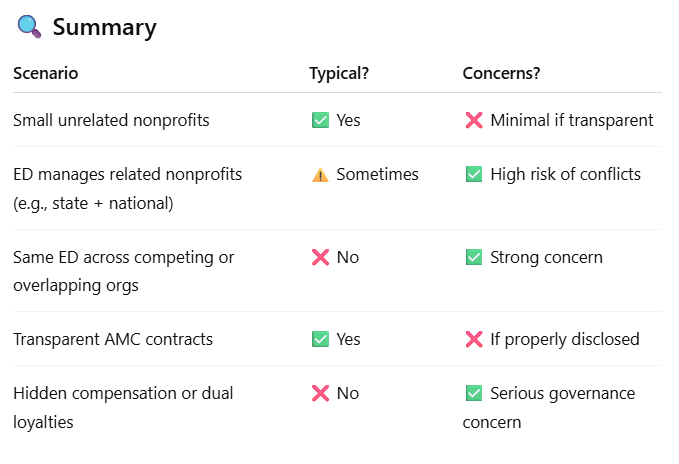
Being Executive Director of both the national and one of the most prominent state associations is unusual. It’s not illegal. It’s not necessarily unethical on its face. But it’s definitely unprecedented—and more importantly, it’s loaded with risk.
The NCRA is tasked with serving all states equally. It creates national policy, directs federal advocacy, is entrusted with distributing attention and resources across all its state-level partners, and helps guide the strategic future of the stenographic profession. ILCRA, meanwhile, advocates for a single state’s interests of one specific region.
With one individual at the helm of both, how can members be sure the national agenda isn’t being influenced by local priorities? Are other states receiving the same level of access, attention, and support that Illinois might be?
Dave Wenhold serves as the Executive Director for multiple associations beyond the NCRA and ILCRA. Through his firms, Miller Wenhold Association Management, and Miller Wenhold Capitol Strategies, he holds executive roles in various organizations across different industries.
For instance, he has also been involved with the New York State Court Reporters Association (NYSCRA). According to a detailed account on Stenonymous.com, concerns were raised during his tenure about record-keeping and management practices, leading to operational challenges for the association after his departure.
In addition to these roles, Wenhold’s firm manages or has managed associations such as:
This list is not exhaustive, as the full number of associations for which Dave Wenhold directly or indirectly serves as Executive Director is not publicly known.
This extensive portfolio raises fair questions about the potential for divided attention and the ability to dedicate sufficient focus to each organization’s unique mission.
While holding executive positions in multiple organizations is not inherently unethical, it does necessitate a high level of transparency, accountability, and clear delineation of responsibilities to ensure that each organization’s interests are fully represented and protected. The concerns raised highlight the importance of evaluating governance structures and leadership roles to maintain trust and effectiveness within professional associations.
That’s a broad list, with very different missions. It’s entirely fair to ask:
If you’re a board member or active volunteer in another state association—say, Texas, Florida, or New Jersey—you might rightly wonder:
Even if decisions are made in good faith, the perception of favoritism is real—and perception alone can be damaging.
How much bandwidth does one person—or one management company—really have?
Can one executive simultaneously advocate for the national interests of court reporters, oversee local chapter affairs, and maintain focus on entirely unrelated fields—all while staying up to speed on stenographic policy battles, member needs, and emerging threats like digital transcription encroachment?
Every professional association exists to serve its members. That includes:
But when so much administrative power is concentrated in one person—or one firm—accountability becomes difficult. Mistakes can be repeated across organizations. Conflicts can go unchecked. Priorities can become blurred.
And worse: members often don’t even know it’s happening.
In nonprofit governance, executive compensation is always a critical metric. It should reflect:
But when an executive holds multiple paid roles, the conversation shifts from what’s fair to what’s appropriate. That’s especially true in the case of Dave Wenhold, who is not only the Executive Director of the NCRA, but also of the ILCRA—and several other unrelated associations.
According to the NCRA’s IRS Form 990 filings, Wenhold’s compensation as of the latest reports was:
These filings are public and reflect the industry-appropriate salary for the Executive Director of a national professional association with over $3 million in annual revenue.
That, on its own, might not raise eyebrows.
Unlike NCRA, the Illinois Court Reporters Association (ILCRA) does not publicly disclose what it pays Wenhold or his firm. ILCRA is a smaller, state-level nonprofit, and although it is subject to similar nonprofit regulations, it has not published any Form 990s with salary details easily accessible to members or the public.
This lack of transparency leaves key questions unanswered:
Without clear disclosure, the overlap of compensation and roles becomes not only unusual—but also potentially unprecedented in this industry.
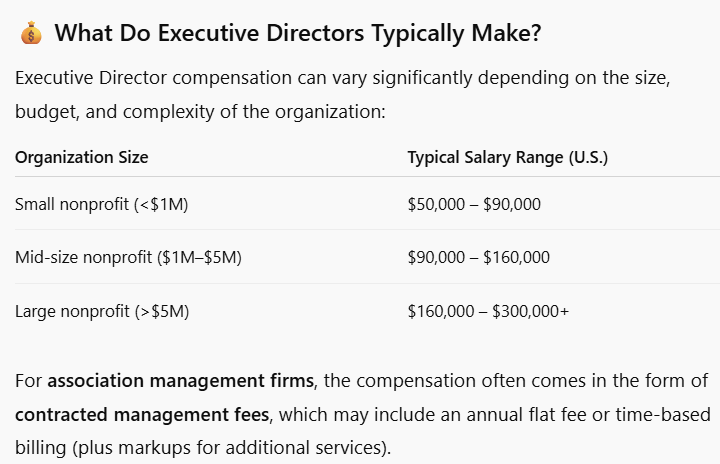
We know from public records that Dave Wenhold earns over $300,000 per year from NCRA alone. When estimating his total compensation, we must also account for his roles in ILCRA and numerous other associations managed under his firms, including Kautter Wenhold and Miller Wenhold Association Management.
If he receives even modest compensation—say, $30,000–$60,000 per year—from each of 8 to 12 additional associations, his total annual earnings could range from $500,000 to over $1 million. This would place him among the highest-paid association executives in the nonprofit space.
Beyond earnings, such an arrangement raises serious governance questions:
At this level of income and influence, the profession must demand transparency, rigorous oversight, and clear separation of responsibilities.
In most nonprofit sectors, especially among larger, fully funded organizations, it is not standard for an Executive Director to hold multiple concurrent paid executive roles, particularly within related fields. It’s one thing to be a part-time executive for a small, local group; it’s another to be the full-time, six-figure-paid leader of a national association while simultaneously leading a state affiliate and others.
Best practices, as outlined by governance watchdogs like BoardSource, emphasize:
This concentration of influence, decision-making authority, and potentially duplicated compensation is not typical—and certainly not transparent.
Adding to the concern, the NCRA has seen a steady decline in membership under Wenhold’s leadership. The profession itself is under siege, yet the national organization tasked with defending it appears to be shrinking in size, budget, and impact.
Meanwhile, NCRA has been criticized for failing to take a strong enough stance against digital reporting—a growing threat to the profession. Perhaps most troubling is NCRA’s lack of visibility and involvement in major legislative efforts in California, which has the largest court reporting population in the country.
If the national association isn’t showing up in the most critical legislative battles, and its membership and visibility are declining, then what exactly are members paying for?
This issue should spark serious reflection within the court reporting community:
In many other professions, this kind of overlap would be viewed as a governance risk—something to fix, not normalize.
Here’s a roadmap for reform:
This conversation isn’t personal—it’s principled. Dave Wenhold may be a capable executive. But the issue isn’t whether he can handle the work. It’s whether the structure itself serves the best interests of the profession.
A thriving, credible court reporting field depends on balanced leadership, clear boundaries, and true member representation. If we let convenience override fairness, or familiarity override scrutiny, we undermine the very trust that keeps our associations strong.
It’s time to take a hard look at how power is distributed in our profession—and to make sure every court reporter in every state gets a fair seat at the table.
Leadership must reflect the values of the profession it serves—accuracy, impartiality, integrity. That applies as much to how our associations are run as it does to how our transcripts are produced.
One person can’t be everywhere. One firm shouldn’t be at the center of everything. The appearance of control, influence, or favoritism—even if unintended—is enough to warrant review.
Members deserve assurance that their associations are being run with focus, fairness, and fidelity to their mission. And when one person or firm holds a dozen titles across overlapping organizations, that assurance becomes harder to provide.
The content of this post is intended for informational and discussion purposes only. All opinions expressed herein are those of the author and are based on publicly available information, industry standards, and good-faith concerns about nonprofit governance and professional ethics. No part of this article is intended to defame, accuse, or misrepresent any individual or organization. Readers are encouraged to verify facts independently and to engage constructively in dialogue about leadership, transparency, and accountability in the court reporting profession.
***To unsubscribe, just smash that UNSUBSCRIBE button below — yes, the one that’s universally glued to the bottom of every newsletter ever created. It’s basically the “Exit” sign of the email world. You can’t miss it. It looks like this (brace yourself for the excitement):
The content on this blog represents the personal opinions, observations, and commentary of the author. It is intended for editorial and journalistic purposes and is protected under the First Amendment of the United States Constitution.

Subscribe to get access to the rest of this post and other subscriber-only content.

A respectful reply to a comment submitted in support of the entity known as Steno In The City‘s (registered trademark) event partnership with ILCRA
*”Since this blog is labeled as a safe space, let me ask, could there possibly be a different perspective to consider in regard to the scrutiny of this matter? For example, many non-profits contract with private businesses in order to throw events and such for social networking opportunities. When I looked at the posts it is clear that the $75 ticket is going directly towards the food, drinks and access to the venue. Just because ILCRA is a non-profit does not entitle them to use any event space for free. Food and drinks also come with a price tag. The event is in no way marketed as a fundraising event, nor does it suggest that funds will be distributed to any specific cause other than providing a space and food/drinks to those who voluntarily purchase a ticket.
I do not believe that ILCRA allowing SITC to help organize a social gathering is illicit. The work SITC has done to promote the court reporting industry is invaluable, and their events are notoriously upscale and high quality. Maybe ILCRA wants to partner with an org that has the same goals, which is to advance the industry of court reporting. Sometimes it’s okay to let things be fun. We don’t have to put a magnifying glass on everything, especially not a cocktail party.”*
Thank you for the comment — you raise points that many people might also be wondering, and it’s important that this conversation happens in a transparent and respectful way. So let’s take a closer look at the assumptions here and break down why this is not just “a fun social event” but a partnership that raises serious legal, financial, ethical, and data privacy concerns.
Let’s walk through this point by point, clearly and without judgment:
🔴 WHAT’S WRONG:
You’re absolutely right — nonprofits do contract with caterers, venues, and vendors. But that’s not what’s happening here.
This isn’t just about ILCRA paying a vendor. In this case:
This is not a standard vendor relationship — this is a joint branding and financial arrangement with a private entity. That’s legally and ethically different from hiring a caterer.
🔴 WHAT’S WRONG:
Even if that’s true — that doesn’t justify sending money and data through a private business without transparency, oversight, or board authorization.
Unless:
Then ILCRA cannot claim this is a simple cost-recovery event. It may actually violate:
Even for a cocktail party, nonprofits must account for every dollar collected in their name.
🔴 WHAT’S WRONG:
The issue isn’t whether this is labeled a fundraiser — the issue is where the money goes and how it’s handled.
Then ILCRA is opening itself up to questions about misuse of its name, lack of board supervision, and possible inurement violations.
Fundraising or not — if money is being collected under the ILCRA brand, members deserve transparency.
🔴 WHAT’S WRONG:
Even if past events were enjoyable, reputation and aesthetics do not exempt anyone from scrutiny.
The concern is that:
This is not about whether an event looks upscale — it’s about whether ILCRA should legitimize a partnership with someone facing serious and unresolved legal allegations.
🔴 WHAT’S WRONG:
This is the most dangerous assumption of all.
Even a cocktail party becomes serious when:
Professional associations must scrutinize every public-facing activity — especially ones involving finances, branding, and member trust.
Calling it “just a social event” doesn’t make the risk go away.
While the event may be described as a simple social gathering, it’s important to consider the broader legal context involving the individual co-hosting and facilitating the event.
In addition to the pending COPE complaint filed with the NCRA, there are active and documented investigations into the actions of SITC’s founder by multiple agencies:
These investigations are not speculative or anecdotal. They are based on formal complaints, documented communication with agencies, and direct confirmations. The existence of these ongoing inquiries underscores why ILCRA — as a professional nonprofit bound by fiduciary duty — should be exercising extreme caution before associating its name, membership, and data infrastructure with this individual or her organization.
All of the allegations outlined herein are based on Shaunise Day’s own public admissions and documented activity across her social media platforms, where she has personally posted evidence of the events, practices, and representations in question.
In March 2025, a formal and confidential complaint was submitted to NCRA through the COPE process. That complaint included detailed allegations and supporting documentation of the above-listed allegations and investigations. NCRA Executive Director Dave Wenhold was directly informed of these matters at that time in his NCRA leadership capacities, and at the time, he was also the ILCRA Executive Director.
At no point was confirmation given that these concerns would be escalated to ILCRA leadership — and to be clear, COPE matters are confidential. However, given that Mr. Wenhold was fully informed of the nature and scope of the allegations in March 2025, he was in a position to ethically and prudently advise against any formal partnership with the subject of the complaint while serious legal and ethical concerns remained unresolved.
While he may have been limited in what he could disclose due to COPE rules, he was not prevented from exercising sound judgment or advocating that ILCRA avoid affiliations with individuals under known investigation — especially when those affiliations involve handling member funds and personal data.
✅ 1. Federal Law (Applies in Chicago): Fair Labor Standards Act (FLSA)
The FLSA, enforced by the U.S. Department of Labor, strictly limits the use of unpaid volunteers to:
🔴 For-profit businesses may not legally use volunteers to perform work that benefits the company.
Even if someone says they’re “volunteering,” if they’re doing productive work (e.g., planning events, staffing tables, promoting a brand), they are considered employees and must be paid at least minimum wage.
Under both federal (FLSA) and Illinois law, a for-profit entity cannot legally use unpaid volunteers for work that benefits the business.
Even nonprofits must be careful, but a for-profit like the entity known as Steno In The City (registered trademark) using unpaid labor for event work could be in serious violation of Illinois labor law, especially if the work replaces what would otherwise be paid labor (e.g., registration, marketing, set-up, etc.). If the $75 admission is run through SITC, then her for-profit can’t use volunteers for the event.
These labor law concerns are not isolated to a single event or jurisdiction. Based on available documentation and first-hand reports by Day herself, SITC has held events in multiple states — including California, Louisiana, Texas, New York — as well as internationally in Cancun, Mexico, where unpaid individuals were used to perform event-related labor (such as marketing, setup, logistics, and staffing).
Under both federal law and each of these states’ respective labor codes, for-profit businesses may not legally use volunteer labor. These actions may constitute systemic wage and hour violations, particularly under the Fair Labor Standards Act (FLSA) and equivalent state labor laws. Investigations are ongoing in some jurisdictions, and complaints have been submitted to various agencies.
* Important Note: These matters remain under investigation. The subject of these allegations has not been formally charged and is entitled to the presumption of innocence. This information is shared in the context of risk disclosure, member protection, and nonprofit governance standards, not as a legal conclusion.
This wasn’t addressed in the comment, but it’s critical:
Under:
ILCRA must ensure that members’ data is:

This space is a safe one — for truth, for accountability, and for the court reporting community to ask difficult questions and expect honest answers.
Enjoyable events and fun moments are important — but fun doesn’t override fiduciary duty. Ethical leadership means ensuring every member’s data, trust, and money are protected, no matter how casual the setting may seem.
This isn’t just a cocktail party — it’s a liability event in the making.
***To unsubscribe, just smash that UNSUBSCRIBE button below — yes, the one that’s universally glued to the bottom of every newsletter ever created. It’s basically the “Exit” sign of the email world. You can’t miss it. It looks like this (brace yourself for the excitement):
**(“Steno In The City is a registered trademark of its respective owner. StenoImperium.com is not affiliated with or endorsed by that brand.”)
“My use of the phrase ‘Steno In The City’ is purely descriptive and used solely to refer to the trademark holder in the context of journalistic critique and commentary. No content on the site implies affiliation, endorsement, or partnership with the trademark holder.”

Subscribe to get access to the rest of this post and other subscriber-only content.

“Who are you?”
“Because I want to know if it’s [someone I don’t like] — before I block you.”
These words, or variations of them, have become increasingly common in our profession — not in jest, but as a genuine litmus test for who gets to speak.
Let’s be clear: This is not professionalism. This is not leadership. This is gatekeeping fueled by fear, power, and personal vendettas. And it’s silencing people who are raising valid concerns about the wellbeing of our industry — and our colleagues.
There is a deeply corrosive pattern forming: when someone raises questions about workplace abuse, toxic culture, or mismanagement within our state and national associations, they’re often not met with dialogue. They’re met with suspicion.
Not: “What are your concerns?”
But: “Who are you?”
Not: “Can we address this?”
But: “Is this [insert name]? If so, I’m blocking you.”
This isn’t about safety. It’s about power and punishment.
If someone’s words are true, they’re true regardless of who said them. If someone is raising concerns respectfully and constructively, they deserve to be heard — regardless of whether you personally like them, or whether their name has been whispered in backchannel chats and Facebook DMs.
What we are seeing is a culture where personal bias overrides professional integrity — where truth-tellers are preemptively excluded, simply because they’ve previously challenged power.
This behavior — questioning people’s identities to determine whether they’re worthy of being heard — is not neutral. It’s a form of social control. It’s the profession’s way of saying: “We don’t want to talk about the message. We want to silence the messenger.”
It tells others:
This keeps people silent. It keeps them compliant. And it protects those in power from accountability.
It’s alarming that much of this behavior is coming from individuals in leadership — people who sit on boards, run state associations, or serve in public official court management roles. These are the same individuals tasked with ensuring ethical standards, transparency, and inclusion in our profession.
But instead of modeling those values, they’re asking:
“Is this someone I’ve blacklisted?”
When our professional spaces operate like high school lunch tables — where only those who conform are allowed a seat — we all lose. The culture becomes hostile, defensive, and unsafe.
Especially for:
This isn’t just interpersonal drama. It’s a systemic issue. And it’s hurting people — personally, professionally, and sometimes irreparably.
We don’t need to agree on everything. But we do need to stop weaponizing identity as a way to silence people. Here’s what a healthy profession does instead:
If you disagree with someone’s views, say so — respectfully, factually, constructively. But when you start the conversation with “Who are you?” and end it with “If you’re someone I don’t like, you’re gone,” you’ve already abandoned any pretense of integrity.
If you’ve been on the receiving end of this — if you’ve been blocked, dismissed, or interrogated simply for asking hard questions — you’re not alone.
You’re not the problem. You’re part of a much-needed reckoning.
Keep speaking. Keep documenting. Keep showing up.
The profession won’t change because those in power suddenly grow a conscience. It will change because those who’ve been shut out stop asking for permission and start building something better — out loud, together.
***To unsubscribe, just smash that UNSUBSCRIBE button below — yes, the one that’s universally glued to the bottom of every newsletter ever created. It’s basically the “Exit” sign of the email world. You can’t miss it. It looks like this (brace yourself for the excitement):


Across Texas, a troubling trend is gaining traction within the legal system — and it’s eroding trust in a profession that is foundational to justice: court reporting. For attorneys and legal professionals, especially those involved in depositions, the issue is no longer just about finding a court reporter. It’s about ensuring that the person showing up is actually a qualified, licensed professional — not an unlicensed technician operating a recording device under the misleading label of “digital court reporter.”
This isn’t a minor miscommunication or an innocent mistake. It’s a calculated business decision by certain court reporting firms to maximize profits at the expense of legal integrity, courtroom accuracy, and state law. And it’s wreaking havoc on the legal community in Texas.
In recent years, some court reporting agencies have begun substituting certified stenographic court reporters with so-called “digital reporters.” These individuals are not licensed court reporters, do not take down the record in realtime, and often lack the legal training and ethical grounding that certified stenographers undergo. Many are simply trained to press “record” and capture audio.
The problem? In Texas, that’s not just a questionable business practice — it’s a legal violation.
The Texas Government Code and Texas Rules of Civil Procedure are clear: depositions require licensed shorthand reporters. These are professionals who have passed stringent testing, are held to high ethical standards, and are equipped to produce verbatim transcripts under pressure, in real time, with accuracy and impartiality. Sending someone without that licensure — and without disclosure — is not only unethical but illegal.
Court reporting firms that use digital operators in place of certified stenographers are knowingly bending, if not outright breaking, the rules. Their motivations are simple: profit and market share. By paying a digital operator a fraction of what they’d pay a licensed reporter, they slash their overhead while charging the same fees to law firms. It’s a bait-and-switch — and many attorneys don’t even realize it’s happening until it’s too late.
These firms often don’t notify counsel ahead of time that a deposition will be taken by a digital reporter. In some cases, they cancel at the last minute or falsely claim that a licensed reporter backed out, when the reality is they never had one scheduled. Meanwhile, the responsibility — and the stress — falls on attorneys and their staff, who are left scrambling to find a legitimate replacement or determine whether the deposition can proceed legally at all.
This strategy is not just underhanded; it’s dangerously deceptive. It damages reputations, delays proceedings, and casts doubt on the reliability of the entire legal transcript process. Some depositions — even complex, high-stakes expert depositions — have had to be repeated due to unusable transcripts produced by digital reporters. Trials have seen evidence thrown out. Legal budgets are strained, and clients are left footing the bill for rework.
One of the most disturbing aspects of this trend is the deliberate obfuscation of the truth. Attorneys are often told the firm has a “reporter” lined up, only to discover at the deposition that the person is merely operating a recording device. These operators often begin with a disclaimer script that forces counsel to object immediately or lose the ability to contest the use of the transcript later — catching attorneys off guard, especially those unfamiliar with these deceptive practices.
Even worse, firms are violating the Texas Rules of Civil Procedure by treating nonstenographic depositions as if they were stenographic. Under the rules, a deposition that is not taken by a licensed court reporter cannot be read and signed by the witness in the same way a stenographic transcript can. But that doesn’t stop some firms from sending these transcripts for review, pretending they are equivalent, further muddying the legal waters and jeopardizing case integrity.
This bait-and-switch practice doesn’t just hurt attorneys — it unfairly tarnishes the reputation of real court reporters. When attorneys receive poorly transcribed or unusable transcripts, they often blame the “reporter” — not realizing they were never working with a real one to begin with. The result is a growing mistrust of the profession, all while certified reporters, who have spent years honing their craft, find themselves sidelined in favor of cheaper, unqualified alternatives.
Meanwhile, legal professionals are inundated with last-minute calls and emails from frantic colleagues trying to fix the mess left behind by these deceptive firms. Schedulers, paralegals, and attorneys are all caught in the fallout — juggling caseloads, managing court deadlines, and now being forced to double-check whether their deposition will even be legally valid.
Attorneys in Texas need to be vigilant. It’s not enough to ensure your own depositions are covered by licensed professionals — you must also inform your clients that the opposing party may be hiring these unlicensed digital operators. Many lawyers are shocked when they realize that even if they hire a legitimate firm, the transcript from their opponent’s deposition could still be flawed or unusable if taken by a digital reporter.
The defense starts with awareness. Attorneys should ask explicitly whether a licensed Texas Certified Shorthand Reporter (CSR) will be covering a deposition — and they should get it in writing. They must object on the record when an unlicensed person is presented as a reporter, and they must educate clients about the downstream risks of allowing such transcripts into evidence.
It’s not about attacking individuals who work as digital recorders — it’s about defending the integrity of the judicial process, the rule of law, and the right to accurate, reliable transcripts.
The Texas legal community cannot remain passive while these deceptive practices persist. State regulatory bodies must enforce existing laws and hold firms accountable for substituting digital reporters under false pretenses. Bar associations, court reporting associations, and litigation support professionals should speak up, share experiences, and support transparency.
Legal proceedings rely on an accurate, impartial record. Allowing unqualified individuals to masquerade as licensed professionals is not just a regulatory breach — it’s a betrayal of the justice system. It compromises outcomes, undermines trust, and disrespects the hard-working professionals who do the job the right way.
This must stop — and it must stop now.
***To unsubscribe, simply click on the UNSUBSCRIBE button below – it’s literally found on every single newsletter in the universe. It looks like this, below:


“Workplace intimidation isn’t just a toxic culture — it’s a weapon. And when it ends in death, the boardroom becomes a crime scene. Or does it become the place of cover-up?”
This isn’t about corporate America. This is about our boardrooms — the association board members, the state and national court reporting organizations, the regional leaders, and the official management in superior, district, and federal courts.
These are the spaces that shape the profession. They set the tone. They decide what is prioritized — and what is quietly ignored. And too often, they look the other way when the culture becomes dangerous.
Let’s say it plainly: a culture of fear and silence within our own institutions has ended lives. First it destroys someone’s spirit — then, tragically, their body may follow. When that happens, it’s not just a tragedy. It’s a failure of leadership.
Workplace abuse — whether through bullying, intimidation, exclusion, or retaliation — is not a personality conflict. It is systemic harm. And when those in power stay silent, when whistleblowers are ostracized, and when grievances are ignored or dismissed as “drama,” the system is no longer flawed — it’s complicit.
In the court reporting profession, this shows up in chilling ways:
These patterns don’t happen by accident. They persist because the people with power let them.
As I’ve raised these concerns publicly, I’ve received a recurring type of response. Not thoughtful disagreement. Not evidence-based debate. But vague, passive-aggressive comments like:
“Who is this?”
“Who created this page?”
These aren’t sincere questions. They’re tone-policing. They’re gatekeeping. They’re attempts to discredit the person so they don’t have to address the message.
It’s a tactic we see often when someone dares to speak out — especially someone without a formal title or protected position. The implication is that only people with status are allowed to raise uncomfortable truths. But let me be clear:
You do not need a title to tell the truth.
You do not need a badge to bear witness.
And you certainly don’t need permission to speak about harm.
These kinds of comments don’t just derail important conversations — they reinforce the very power dynamics that have allowed workplace abuse to thrive unchecked. And they prove the point: when you challenge silence, intimidation will often try to take its place.
Every board member, every court reporting association leader, every official in a management role — you hold lives in your hands. Your job is not just to maintain procedure or protect tradition. Your duty is to protect people.
That includes:
Culture starts at the top. And if fear is growing in the profession, look upward. Look at who benefits when people are afraid to speak.
Let us remember the human toll: the colleague who stopped showing up. The professional who took their own life. The person who was mocked after speaking out about mistreatment. These are not abstractions. They are real people — and their pain was real.
To make fun of the person who died from workplace abuse is not just cruel — it’s a second violence. To dehumanize them is to absolve the system that harmed them.
Empathy — not policy — is the first step to change. Because we don’t leave jobs. We leave people. And in this field, far too many are leaving in silence, in shame, and sometimes, for good.
It’s time for association boards and court leadership to stop hiding behind bureaucracy. This profession deserves better. It needs better.
Accountability is not just a buzzword. It’s a shift in power. It means:
This profession was built on precision, ethics, and truth. We can’t afford to abandon those values inside our own institutions.
When abuse happens in our ranks, the boardroom doesn’t get to claim innocence. It must face the mirror. Because the next time harm is ignored, the legacy won’t be one of leadership — it will be one of complicity.
***To unsubscribe, simply click on the UNSUBSCRIBE button below – it’s literally found on every single newsletter in the universe. It looks like this, below:
Subscribe to get access to the rest of this post and other subscriber-only content.
Subscribe to get access to the rest of this post and other subscriber-only content.

As the Illinois Court Reporters Association (ILCRA) prepares for its much-anticipated Summer Kickoff Cocktail Party on June 20, 2025, many in the court reporting community are raising serious questions—not about the event itself, but about its co-host: Shaunise Day and her brand, Steno in the City.
At first glance, the collaboration may seem like a vibrant show of professional unity. But beneath the glittering promise of cocktails and camaraderie atop the Willis Tower lies a growing unease, fueled by a barrage of allegations and controversies tied to Day and her ventures.
A series of articles published by StenoImperium—a watchdog platform focused on ethics in court reporting—have outlined a deeply troubling pattern of alleged misconduct. These include:
These allegations—spanning from early 2024 to mid-2025—paint a deeply concerning portrait of an organization that appears to operate in contradiction to the ethical standards expected in the stenographic community.
It’s one thing to innovate within the profession. It’s another to do so at the apparent expense of legality, transparency, and respect for both the workforce and the law. The continued silence or complicity of major organizations in the face of these red flags is causing fractures within the community.
By continuing to partner with individuals and organizations under serious ethical scrutiny, professional bodies may be damaging their own reputations, alienating long-standing members, and setting a dangerous precedent for future collaborations.
ILCRA has not publicly responded to these allegations, and the decision to partner with Day for a flagship event suggests either a lack of awareness or a conscious choice to overlook these issues. If it’s the former, transparency and due diligence must be urgently revisited. If it’s the latter, the question becomes more pressing:
Court reporters uphold the integrity of the legal record. They are guardians of truth, accuracy, and ethics. If those values are not reflected in our leadership and collaborations, then what message are we sending to the next generation of reporters—or to the public at large?
It’s not about cancel culture or personal grudges. It’s about integrity, accountability, and the credibility of a profession that depends on trust.
(** “This site does not claim to be affiliated with Steno In The City. My usage is strictly nominative and journalistic. I was unaware of any active federal registration as no ® symbol or trademark notice appears on the SITC brand’s website.”)
Subscribe to get access to the rest of this post and other subscriber-only content.

A recent promotional article by transcription service TranscribeMe boldly declares: “The U.S. Court Reporter Shortage Creates A Need For Transcription Services.” Their argument leans heavily on a misrepresented “crisis” in the court reporting industry to justify replacing licensed, certified court reporters with unlicensed transcriptionists.
This approach is not just misguided—it’s dangerous. It threatens the accuracy of the official record, undermines the authority of the courts, and ignores the certified professionals who are already solving the problem the right way.
Let’s set the record straight.
The idea of a catastrophic shortage of court reporters has been pushed aggressively by tech companies and digital transcription startups eager to grab market share. But when we examine the actual data—as StenoImperium’s latest blog post does thoroughly—the numbers paint a very different picture.
StenoImperium debunked this “crisis” using data from state licensing agencies and court systems, showing that the number of working court reporters in the U.S. has remained relatively steady. While there are natural retirements happening (as with any profession), these are being replaced at a sustainable pace, especially as new certified voice writers are entering the field.
Yes, there is a dip. But it is a small, manageable one—not the drastic cliff some articles would have you believe. Court reporters are also working longer and delaying retirement specifically to uphold the profession and the justice system. These are not signs of an industry in collapse—they are signs of professionals stepping up to meet demand.
One concept TranscribeMe entirely overlooks is the idea of Responsible Charge—a legal and ethical principle in court reporting that says only a qualified, licensed reporter can take ownership of a transcript.
As detailed in numerous StenoImperium articles, the court reporter isn’t just a notetaker. They are a sworn officer of the court, responsible for:
They are the “Responsible Charge” for that legal proceeding. Without them, the record has no legal standing. An unlicensed transcriptionist—no matter how fast they type—has neither the training nor the authority to assume this role.
Importantly, court reporting agencies themselves cannot assume the role of Responsible Charge. Only a licensed, certified court reporter present at the proceeding can legally take ownership of the record. Agencies may coordinate logistics or billing, but they have no legal standing to certify transcripts, administer oaths, or protect the integrity of the record—that authority belongs solely to the reporter.
TranscribeMe’s proposal that “transcriptionists create the rough draft and court reporters just proof” ignores this vital legal function. Court reporters do not simply review the work of others—they create and take responsibility for the record.
What TranscribeMe fails to mention is that the industry already has a tested and scalable solution to expand the workforce: voice writers.
Voice writers are trained professionals who use speech recognition technology and masks to repeat every word spoken in a courtroom or deposition. Their output is real-time, highly accurate, and—most importantly—certified.
As the National Verbatim Reporters Association (NVRA) has demonstrated, voice writing programs are already producing new certified court reporters at a pace that matches or exceeds current retirement trends. States like Florida, Georgia, and Texas have embraced voice writers as a critical part of their reporting workforce.
This is a technological solution that preserves the integrity of the record while expanding capacity.
Let’s be clear: what TranscribeMe proposes is not a supplement to court reporting—it’s a replacement of it, using unqualified individuals.
Consider the risks:
By outsourcing to transcriptionists, we’re not easing a burden—we’re compromising justice.
TranscribeMe and similar services push a seductive narrative: let automation and gig workers take over, and the courts will run smoother. But this vision is built more on profit motive than public good.
Their argument is economically self-serving: they reduce costs by hiring uncredentialed labor, then market that product back to overwhelmed legal systems as a “modern solution.”
In reality, this “solution” creates layers of confusion, inconsistency, and risk. Errors from unlicensed transcriptionists could have profound consequences—reversals on appeal, wrongful convictions, or disputes that never get resolved because the record is incomplete or invalid.
Technology should support certified professionals—not replace them with underqualified labor.
Far from being resistant to change, the court reporting community is already embracing modern tools—on its own terms:
What differentiates this from TranscribeMe’s model is that every innovation is still under the command of a certified professional. The Responsible Charge never leaves the hands of a trained reporter.
Perhaps the most overlooked fact in this debate is the incredible effort made by current reporters to stay on the job longer to stabilize the field. Many professionals who could retire are staying in the trenches—not because they have to, but because they care deeply about the legal system.
They are mentoring students, assisting with training programs, and doing what tech companies won’t: putting in the time to preserve the gold standard of legal transcription.
These individuals are the real heroes of the profession—not the untested, unaccountable transcription gig economy workers being passed off as a “solution.”
If transcriptionists truly want to be involved in the legal record, then they must do what certified reporters have done for decades:
✅ Pass licensing exams
✅ Be subject to ethics boards
✅ Undergo continuing education
✅ Accept legal responsibility for their work
✅ Be present, in real-time, as the record is made
Without those credentials, they do not belong in a courtroom. Period.
We are at a crossroads. The path forward is clear:
As StenoImperium rightly put it: “The profession is not dying. It is transforming—and court reporters are leading the way.”
The legal record deserves nothing less than the highest standard of integrity. Let’s make sure the guardians of that standard—the certified reporters—stay in charge.

For decades, California Certified Shorthand Reporters (CSRs) have been regarded as the gold standard in legal recordkeeping — professionals trained to produce accurate, legally compliant transcripts under some of the strictest standards in the nation. But today, those very professionals are being quietly edged out of their own market, forced into unsustainable in-person work while remote opportunities are siphoned off to out-of-state reporters — many of whom are unfamiliar with, or outright ignore, California’s formatting and transcript laws.
This isn’t just a labor imbalance. It’s a systemic failure that, if left unaddressed, threatens the integrity of legal records and the viability of court reporting as a career in California.
It’s becoming increasingly common for California jobs — even realtime and state jurisdiction work — to be covered by out-of-state reporters. In many cases, these reporters hold California licenses, but live and work remotely from other parts of the country. The issue isn’t their physical location, per se, but their compliance — or lack thereof — with California’s mandatory transcript formatting requirements.
California has very specific guidelines: from margins and font size to line counts and index formatting. These rules are codified in law and enforced by the California Court Reporters Board (CRB). Or at least, they’re supposed to be.
Yet more and more transcripts are showing up on dockets that blatantly violate these standards — some formatted illegally in multiple ways. Whether due to ignorance on the part of the reporter or reformatting by the agency, the end result is the same: the client receives a noncompliant record, and California CSRs are left fuming over the erosion of professional standards.
In a profession where licensing is meant to safeguard the integrity of the judicial process, the failure of the CRB to enforce its own standards is especially alarming. When attorneys practice law in California without a license, they’re investigated, referred to the California Bar, and potentially prosecuted by the Department of Justice. There are teeth behind the law.
Not so with the CRB.
The Board has openly stated that it lacks jurisdiction over unlicensed reporters and that it has limited enforcement capacity even when complaints are filed against licensed ones. This regulatory paralysis has created a gaping hole in accountability. Unlicensed individuals — including digital or voice reporters without a CSR — may report jobs illegally, and licensed reporters can repeatedly submit noncompliant transcripts without meaningful consequence.
The result? A chilling message to California CSRs: Your hard-earned license means less every day.
This enforcement vacuum isn’t happening in a vacuum. While remote jobs are handed out to reporters who may not even live in California — and who may not follow California law — those of us who do live here are pushed into increasingly burdensome in-person coverage. Commutes of three to five hours a day are becoming routine. Jobs we wouldn’t normally accept are now the only ones offered. Meanwhile, we see remote coverage lists go out, often just minutes after being told no remote work is available.
This two-tiered system is not just inconvenient. It’s unsustainable.
We live in one of the most expensive states in the country. Our housing, fuel, insurance, and operating costs far outpace those of the out-of-state reporters now undercutting us on price. And while we’re held to rigorous standards — including passing one of the toughest skills exams in the nation — others can backdoor into the system via limited reciprocity or remote credentialing, without ever demonstrating their ability to meet California’s operational requirements.
1. Strengthen CRB Enforcement Authority
The CRB must be given enforcement capabilities equivalent to other professional boards. If unlicensed individuals are taking depositions in California or licensed reporters are submitting noncompliant work, there must be clear investigatory and disciplinary processes — and they must be enforced consistently. Legislative pressure and industry advocacy can help ensure this becomes a reality.
2. Require Full Skills Testing for All California Licenses
The practice of granting partial reciprocity — especially when it allows voice reporters to bypass the skills portion of the California CSR exam — undermines the integrity of the license. No matter how a reporter qualifies, they should be required to pass the same test and demonstrate the same proficiency in California-specific formatting, procedures, and realtime capability.
3. Audit Transcripts and Agencies
Agencies operating in California should be subject to random transcript audits to ensure compliance with CRB rules. If agencies are reformatting transcripts after delivery — thus introducing illegal formatting — that should be grounds for disciplinary action. Furthermore, agencies should be required to disclose which reporters worked on a given job and whether formatting was altered in-house.
4. Implement Transparency in Job Assignment
Agencies need to establish clear and equitable policies for job assignments. Remote work should not be exclusively routed to out-of-state reporters while in-state CSRs are pushed into time-consuming in-person work. Balanced scheduling — and even modest in-person commitments from fully remote reporters — could help distribute workloads more fairly.
5. Create a Reporter Advocacy Coalition
California reporters must band together to form or bolster existing coalitions that advocate for policy reform, regulatory enforcement, and fair labor practices. This coalition could coordinate lobbying efforts, organize outreach to the CRB and legislators, and promote awareness of these issues within the legal community.
This isn’t about pitting steno against voice, in-state against out-of-state, or seasoned reporters against newcomers. It’s about ensuring that the rules — and the value of the California CSR — actually mean something. If we continue down the current path, we won’t just lose jobs — we’ll lose credibility, consistency, and the ability to define our own profession.
And for those who say, “If you can’t beat them, join them”? That’s not a solution. It’s surrender. We shouldn’t be forced to leave California or abandon hard-earned standards just to survive.
The question isn’t whether the system is broken. It’s whether we’re ready to fix it.
The future of court reporting in California depends on it.

In California, court reporters have long been the gold standard of litigation support. Armed with years of training, specialized certification, and a deep understanding of our state’s stringent formatting and transcript requirements, California Certified Shorthand Reporters (CSRs) provide a critical service to the justice system. But lately, many of us who live and work in this state are finding it harder than ever to maintain a sustainable career — not because we lack skill or work ethic, but because we’re being systematically edged out of remote opportunities in favor of out-of-state reporters.
The issue isn’t just a logistical one. It cuts deep into questions of legality, professional ethics, and the long-term survival of California’s court reporting workforce.
Despite clear rules and regulations set by the California Court Reporters Board (CRB), transcripts from California jobs are increasingly being prepared by reporters living elsewhere — including realtime work and jobs under state jurisdiction. The reasons for this are varied: lower overhead for agencies, greater remote availability from out-of-state reporters, and a nationwide push to fill perceived shortages.
But in many cases, the result is transcripts that are non-compliant with California’s formatting requirements — including line spacing, margins, font, and index rules — which, under state law, is not just a technical error, but an ethical and potentially legal violation.
If you’re a California CSR, you know the formatting standards are non-negotiable. We’re tested on them. We’re accountable for them. And if we fail to meet them, we risk disciplinary action from the CRB. Yet the market is now flooded with transcripts that are clearly noncompliant — even from reporters who hold a California license.
How does that happen? In some cases, the reporters may be unaware their formatting is off, especially if they passed the written exams but never worked extensively in California. In others, large agencies may be reformatting transcripts after delivery, intentionally or unintentionally breaking the rules. Either way, the accountability is blurred — and that’s a big problem.
As remote jobs are increasingly assigned to out-of-state reporters, California CSRs are being funneled into in-person work. On paper, that sounds fair — someone needs to be physically present, after all. But in practice, it’s not that simple.
Many of us are being asked to cover depos that require three-, four-, or even five-hour roundtrip commutes. Jobs we wouldn’t normally accept — due to distance, duration, or scheduling challenges — are suddenly the only ones on offer. Meanwhile, remote lists go out with dozens of jobs that we aren’t offered, even after explicitly asking to be considered.
The pressure to take in-person work isn’t just frustrating. For those of us juggling family responsibilities, health concerns, or simply trying to preserve a decent quality of life, it’s completely unsustainable. The result? Burnout. Disillusionment. And a creeping sense that we’re being punished for living in the very state we were licensed to serve.
One major elephant in the room is cost. Reporters living in California simply can’t compete with those based in states with significantly lower living expenses. Our housing, gas, insurance, and general overhead are drastically higher — yet agencies often offer flat rates for jobs, regardless of where the reporter lives.
This creates a downward pressure on rates, particularly for remote work. Out-of-state reporters are sometimes willing to accept California jobs at rates no local CSR could afford to work for. The long-term consequences of this practice are obvious: fewer working opportunities for in-state professionals, greater attrition, and a weakening of the very standards we worked so hard to establish.
So, what can be done?
One possible route is to begin reporting noncompliant transcripts to the CRB. It’s a serious step, and it should never be taken lightly — but if the law is being broken, and the quality of our professional environment is suffering as a result, silence isn’t a solution. In many cases, the offending reporter may simply be unaware of the formatting rules, particularly if they’ve never worked regularly in California. A courteous heads-up to the agency or reporter could fix the issue without escalating it.
But when the violations persist, or when agencies knowingly use incorrectly formatted transcripts to cut costs, it becomes a systemic issue that the CRB must address.
Still, we need to balance accountability with empathy. Many out-of-state reporters are just trying to make a living, and it’s the agencies — not always the individual reporters — who are bending the rules. This isn’t about pitting steno against voice, or in-state against out-of-state. It’s about enforcing consistent standards across the board, so that no one is disadvantaged simply for doing things the right way.
We need an honest, structured conversation among all stakeholders: reporters, agency owners, attorneys, and regulatory boards. The current approach — quietly shifting remote work to cheaper, out-of-state labor while forcing in-state CSRs into unreasonable in-person assignments — is short-sighted and self-destructive.
Agencies must ask themselves: Is this sustainable? Is it ethical? Is this how we treat the professionals who’ve upheld the industry for decades?
One potential solution is to establish clearer criteria for job assignment — balancing remote vs. in-person expectations among all reporters, and creating transparent policies for scheduling. For instance, local reporters might be offered remote work equally with out-of-state CSRs, and those who take predominantly remote work could commit to periodic in-person jobs, ensuring fairness.
Another approach is to push for stricter enforcement of CRB standards, including random transcript audits and clearer accountability for agencies that alter formatting post-production.
And most importantly, the licensing pipeline needs review. If reciprocity is being granted to reporters without requiring the full California skills test, we risk diluting the value of the CSR credential. California’s standards exist for a reason — to protect the integrity of the transcript and ensure the highest quality of legal recordkeeping. If they’re not upheld equally, what’s the point?
It’s heartbreaking to hear from skilled, dedicated California CSRs who are thinking of relocating just to stay afloat. We should be building a future where California court reporters can thrive here — not be forced to choose between their home and their profession.
Remote work should be an opportunity for inclusion, flexibility, and efficiency — not a tool to undercut local professionals. If we want to preserve this career in California, we must build a system that values our credentials, compensates us fairly, and respects the realities of modern work.
Because if we don’t fix this soon, we won’t just lose jobs. We’ll lose a generation of reporters who love their work but can no longer afford to do it in the state they call home.
In April 2025, the Los Angeles Superior Court introduced a revised form titled “Order Appointing Court Approved Reporter As Official Reporter Pro Tempore.” This form, as the name suggests, formalizes the appointment of a court-approved reporter as a temporary official reporter for proceedings. But the revised form has sparked confusion and concern among court reporters, particularly because it now includes a section asking for agency information—even when the reporter is already on the court’s approved list.
This change has raised an important question within the court reporting community: If the court reporter is the official responsible for the record, why is the agency’s information even being requested?
To understand why this issue matters, we first need to unpack the role of a court reporter, the purpose of agencies, and why the concept of responsible charge is so central to the integrity of the court record.
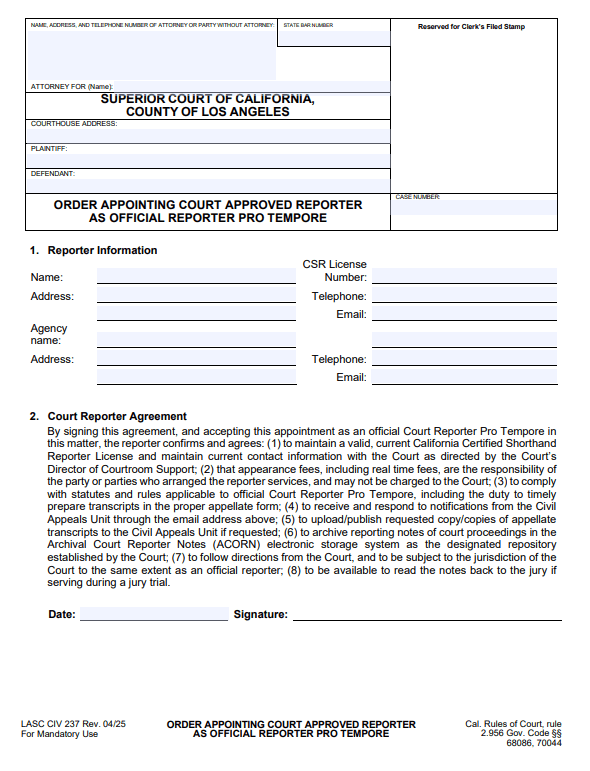
Court reporters serve a critical function in the judicial system. They are not mere transcribers or passive observers—they are officers of the court charged with creating and maintaining the official verbatim record of proceedings. This includes not only capturing every spoken word but also noting nonverbal cues, interruptions, and other essential details that could impact the record.
Importantly, the reporter’s duties are not limited to what happens inside the courtroom. They are also responsible for the timely preparation of transcripts, responding to appellate deadlines, certifying the accuracy of the record, and ensuring that the record can withstand legal scrutiny. The reporter holds the ultimate responsibility and liability for the integrity of that record.
This is why the concept of responsible charge matters so much. When we say the reporter is the “responsible charge,” we mean that the reporter—not any third party—is accountable for the accuracy, timeliness, and reliability of the record.
Court reporting agencies, on the other hand, provide critical—but fundamentally different—services. Agencies typically handle the business side of reporting: scheduling, marketing, billing, and producing copies of the reporter’s work. They are administrative intermediaries, not legal authorities.
An agency might help facilitate communications between a reporter and a law firm, or between the reporter and a client who needs a transcript. But the agency does not create or control the official record. It does not sign the certification page of the transcript. It does not bear responsibility if a record is incomplete or defective. That burden falls squarely on the court reporter.
Given this clear distinction, the new “Order Appointing Court Approved Reporter As Official Reporter Pro Tempore” form raises concerns. Specifically, why does the form now require agency information for reporters who are already vetted and included on the court’s approved list?
If a reporter is on the court’s approved list, it means they have already met the qualifications, licensing, and experience requirements set by the court. They have been deemed competent to handle official proceedings. In theory, once appointed as a reporter pro tempore, they are stepping into the shoes of an official court reporter, taking on full responsibility for the record.
Asking for agency details on the same form creates a troubling implication: that the agency has some role in the official record. This is not only inaccurate but potentially misleading. It muddies the chain of accountability and raises the risk of confusion if issues arise later in the appellate process or if questions come up about transcript production.
Legal records are only as trustworthy as the systems that produce them. One of the key strengths of the U.S. court system is that it maintains clear lines of accountability: judges, clerks, attorneys, and court reporters all have distinct duties. Blurring these lines, even unintentionally, can have serious consequences.
If agencies are perceived—incorrectly—as having a role in maintaining or certifying the official record, it could:
If the court’s goal in requesting agency information is simply to improve communication—particularly in urgent cases like appeals—there’s a simpler and more appropriate solution: make the court reporters themselves more reachable.
Some practical options include:
If a reporter repeatedly ignores deadlines or becomes unreachable, the solution is not to involve agencies—it is to remove that reporter from the approved list until they can meet their obligations.
Agencies play an important and legitimate role in the court reporting ecosystem. They help reporters manage their businesses, provide valuable logistical support, and make sure transcripts get into the hands of those who need them. But their function is commercial, not legal.
Expanding their footprint on official court forms risks:
Agencies are not the “responsible charge,” and the system works best when that line remains clear.
The revised “Order Appointing Court Approved Reporter As Official Reporter Pro Tempore” form should reflect the reality of court operations: the reporter is the custodian of the record, and the agency is a logistical partner, not a legal actor.
If the court is struggling to get timely responses from reporters, the solution lies in improving the court’s directory, enhancing communication protocols, or tightening oversight of the approved list—not in putting agencies on official forms where they don’t belong.
At a time when public trust in the legal system is under pressure, clarity and accountability have never been more important. We should not let administrative convenience blur the bright line between those who create the official record and those who simply help deliver it.

The bedrock of any functioning democracy is a transparent, accountable, and impartial judicial system. At the heart of that system lies a critical, often overlooked figure: the stenographic court reporter. These highly trained professionals are not simply typists; they are the living guardians of the verbatim record, ensuring every word uttered in court is captured, preserved, and available for scrutiny. Yet, in recent years, a troubling trend has emerged across the United States: courts are replacing these human safeguards with electronic recording devices, consolidating control of the legal record within the very institutions the record is meant to check.
At first glance, the shift toward electronic recording is often justified as a cost-saving measure. Faced with budget constraints, many jurisdictions have deemed stenographic court reporters expendable, replacing them with microphones and digital recorders. California led the charge, privatizing court reporters in civil cases more than a decade ago. Since then, other states—including Colorado, Texas, Washington, and Florida—have followed suit. Even more concerning, states like Massachusetts and Wisconsin have eliminated stenographic court reporters entirely in favor of electronic recording across all courts, including in high-stakes criminal proceedings.
This transition is not merely a logistical or financial decision. It represents a profound transformation of the very mechanism that safeguards judicial integrity. When courts themselves control the creation, storage, and production of the legal record, a dangerous conflict of interest is created. The record ceases to be an independent, inviolable account of proceedings and instead becomes a tool wielded by the institution it is supposed to hold accountable.
The judicial system was never intended to be its own watchdog. By its nature, the court is a party to the legal process—it rules on motions, makes findings of fact, and interprets the law. Allowing it to also control the recording and preservation of the proceedings removes a critical layer of independence. The record of what was said in court is often the only evidence of whether justice was served, whether a judge acted impartially, or whether a defendant’s rights were protected. If the court owns the record, it controls the narrative—and that is the essence of tyranny.
Consider the chilling example of the Darrell Brooks case in Wisconsin. After Brooks was charged with injuring a woman with his vehicle just a week before the Waukesha Christmas parade tragedy, there was no record of his bail hearing. The recordings from the day before, the day after, and the day of his hearing were all conveniently “missing.” Had a stenographic court reporter been present, an independent transcript would have existed, impervious to deletion or manipulation by those who might wish to avoid accountability. Instead, the court—being both the decision-maker and the keeper of the record—was left free to explain away the absence without consequence.
This is not merely a clerical failure. It is a systemic vulnerability. The possibility that a record might be lost, edited, or selectively produced undermines public confidence in the courts and creates the appearance—if not the reality—of corruption. An impartial record cannot exist if it is owned by the same body that has a vested interest in the outcome of the proceedings it documents.
Stenographic court reporters are more than passive observers; they are sworn officers of the court who bear legal and ethical responsibility for the integrity of the record. Every transcript they produce comes with a certification that the reporter personally witnessed, captured, and preserved the proceedings without alteration. Their work involves a meticulous chain of custody that ensures the record has not been tampered with—from the moment the words are spoken to the final production of the transcript.
By contrast, electronic recordings are impersonal and detached. Audio files pass through multiple hands—court clerks, unlicensed transcribers, data storage personnel—each link adding the possibility of error, omission, or manipulation. Often, to save money, these recordings are outsourced to overseas transcription services, where accountability is practically nonexistent. Should a critical error or breach occur, there is no professional licensure, no malpractice insurance, and no regulatory body to hold accountable.
In essence, the shift away from stenographic court reporters dissolves the protective framework that has historically shielded the legal record from bias, negligence, or corruption. It transforms the record from an independently verified document into an institutional artifact, subject to the whims and pressures of the very system it is meant to monitor.
Another overlooked danger of centralized, court-controlled electronic records is the security risk inherent in concentrating vast amounts of sensitive data in a single repository. Stenographic court reporters maintain decentralized archives of their notes and transcripts, often preserving them personally for decades. This redundancy acts as a safeguard against catastrophic loss—whether from natural disasters, cyberattacks, or bureaucratic negligence.
When the court system consolidates all records into a central database, it creates an irresistible target for hackers, corrupt insiders, or simple administrative error. Once the data is compromised, it is compromised for everyone. The decentralized nature of stenographic recordkeeping is not an inefficiency; it is a critical security feature that ensures no single point of failure can erase the record of justice.
Real-world cases underscore this point. Individuals exonerated years after conviction have sometimes relied on the personal archives of court reporters who retained their notes long after official records were lost or destroyed. In such instances, the decentralized, independently maintained record was the difference between continued injustice and freedom.
The maxim “absolute power corrupts absolutely” rings especially true in the context of the judiciary controlling its own record. If courts are allowed to own and manage the official record without independent oversight, the potential for abuse is not hypothetical—it is inevitable. The record of proceedings is the raw material from which appeals, complaints, and accountability mechanisms are built. Controlling that material allows the court to influence, obstruct, or erase those mechanisms entirely.
In an era where trust in public institutions is already fragile, further eroding transparency in the judiciary is a perilous path. While technological advancements can and should be used to aid human recordkeepers, they must not replace them. The irreplaceable element of human accountability, professional ethics, and personal responsibility cannot be replicated by machines.
The gradual dismantling of stenographic court reporting is not simply a modernization effort—it is an erosion of one of the last independent safeguards in the judicial process. We must recognize the grave implications of placing the power to create, control, and alter the legal record solely in the hands of the court. To do so is to hand unchecked power to an already powerful institution, removing one of the few remaining checks that ensure fairness and justice.
The record of court proceedings is not merely an administrative formality; it is the lifeblood of justice. To entrust its creation and custody to the very institution it holds accountable is to invite the abuse of power, diminish public trust, and imperil the rights of litigants and defendants alike.
We must resist the siren call of short-term cost savings and technological convenience. Instead, we must reaffirm our commitment to an independent, accurate, and impartial record—one safeguarded by trained, licensed, and ethically bound stenographic court reporters. Anything less is not merely a bureaucratic shift; it is the dismantling of a vital pillar of democracy.
Because when the court owns the record, the court owns the truth—and in a system without independent truth, justice itself becomes an illusion.

In a world where the average American worker eyes retirement at 65, a unique and determined group of professionals defy the trend. They are the veteran court reporters—many in their late 60s, 70s, and even pushing 80—who continue to transcribe the wheels of justice with relentless dedication, sharp skill, and a passion that refuses to wane. Often overlooked, these seasoned stenographers are the very backbone of an industry that was once predicted to face a severe shortage by now. And yet, the crisis hasn’t fully materialized—not because the predictions were entirely off, but because these professionals never left.
The 2013/2014 Ducker Worldwide study once warned of a looming shortage in court reporters due to aging professionals and a lack of new entrants into the field. While the study was insightful in many respects, it missed one critical point: court reporters don’t retire at 65. In fact, many of them keep going well into their 70s—and some until their final days—simply because they love the work, they’re still good at it, and, frankly, the industry still needs them.
Let’s take a closer look at the real lives behind the aging hands that keep our legal records intact.
“I’m not interested in, nor in a financial position to retire,” says one veteran reporter. “And there aren’t human replacement reporters available. We’re the last of a dying breed, and I’d like to just stick around and go down with the ship.”
This sentiment is echoed across the board. There’s no mourning here—just gritty endurance and pride. These individuals don’t view themselves as clinging to relevance. They see themselves as essential, seasoned, and skilled.
Another reporter puts it simply: “I am going to be working until I’m in my 80s. I’m hoping to get another good 20 years out of this. Though I’m not feeling like a fossil yet, it’s insane that I’m now consistently the oldest one in these proceedings. And that happened literally overnight.”
A third shares with laughter, “I’ll be scoping all day today from a comfy recliner. How many people can say they can do that and make money? I’ll probably be going down with the ship too!”
Thanks to remote work, the landscape of court reporting has changed significantly, making it more sustainable for older reporters to remain active.
“I’ll be 74 in another month and I still work two days from home remotely,” one veteran shares. “I hope to do it for at least another couple of years, as long as my health and stamina hold up.”
Others note how tools like Zoom have extended their careers. “Remote changed everything,” a 62-year-old reporter explains. “Maybe not full time, but I’ll keep on plugging. I’m going ‘til these hands can’t move.”
Remote reporting has reduced the physical demands of commuting and made it possible for older reporters to scale back without stepping out. As one 70-year-old proudly puts it, “I can still handle three jobs a week—and I still love it. Honestly, I don’t really want to retire.”
The value of experience in court reporting cannot be overstated. Many of these professionals have worked for over five decades and, by their own admission, feel like they’re at the peak of their careers.
“I have been reporting 45 years,” one says, “and I feel like I am at the peak of my career. I no longer give a [hoot] because I know how good I am. I’m going to milk this job for as long as my body holds up!”
Another veteran, at 70, echoes a similar tone: “I told myself 70 was my cutoff. Well, I’ll be 71 in a few months and I’m still going. You know what? You’ll know when enough is enough. Until then, I’m grateful this business still needs me.”
One 77-year-old tops the list: “I WIN! I’ll be 78 in November and still take three jobs a week—sometimes back-to-back all-dayers. Yes, it tires me out, but I enjoy getting out, hearing people’s stories, and working with attorneys I really like. I guess I’ll keep doing it until I lose my concentration.”
For many, retirement is not the dream—continuing to do meaningful, fulfilling work is. And that’s what court reporting provides.
A 67-year-old reporter reflects with humor and dignity: “I like the people. The cases are interesting. I think when they see me, they act better—like I’m their mom or grandma. They probably figure with my gray hair and still working, I must be good at my job. I always like seeing older workers do repairs on my house. In fact, I’ve been known to say, ‘Send a plumber with some whiskers!’ I’ve got whiskers now too.”
This career, for many of them, isn’t just a job—it’s part of their identity, a source of pride and purpose.
These over-65 reporters are doing more than just extending their personal careers—they are holding up the profession itself. The anticipated shortage of court reporters hasn’t hit quite as hard, largely because these professionals never left.
They are the reason courtrooms, depositions, and hearings continue to run smoothly. They are the bridge between generations, the mentors, the institutional memory, and the iron will behind the stenograph.
One reporter sums it up with a smile: “This ship is getting more and more crowded by the day.” And that’s a good thing.
The next time you hear the rhythmic tapping of a stenograph machine, consider this: the person behind that machine might have been doing this work for 50 years or more. They’ve transcribed murder trials, family disputes, corporate scandals, and legislative sessions. They’ve seen it all, heard it all, and written it all down—word for word.
They are not fossils. They are cornerstones.
In a profession facing technological shifts and workforce changes, it’s these steadfast veterans—working in their recliners, logging into Zoom, commuting only five miles from home—who are keeping the courts running and the record intact.
The court reporting profession owes a standing ovation to its elder statespeople. They are the unsung heroes whose enduring devotion and incredible stamina have kept the wheels of justice spinning.
And they’re not done yet.

May 17, 2025
The “FairSplit” proposal was designed with a simple yet powerful idea in mind: to restore balance, transparency, and sustainability to a court reporting industry under increasing pressure from venture capital consolidation, automation, and opaque billing structures. The reactions to the original article ranged from enthusiastic support to skeptical pushback. That’s not only understandable — it’s necessary. Dialogue is the first step to meaningful reform.
In this follow-up, we’ll resummarize the intent behind FairSplit, thoughtfully address the most common concerns raised, and reaffirm why now is the time for working reporters to take a more active role in reshaping the economics of our profession.
The FairSplit proposal advocates for a transparent, percentage-based revenue-sharing model between reporting agencies and the independent contractors who perform the actual work — the court reporters. Rather than a fixed “page rate” or “rack rate” system that hides client billing, FairSplit would calculate a fair, predetermined split (say, 60/40 or 70/30) of all billables for a given job. That includes transcripts, roughs, realtime feeds, and yes — per diem charges.
The idea is not to eliminate agency value. It’s to ensure equitable sharing based on actual revenue earned, while maintaining trust and transparency for both sides of the contractor-client relationship.
We received a number of thoughtful objections, and they deserve full consideration. Let’s break them down:
That’s true — to a point. As independent contractors, we do have the right (and responsibility) to set our own rates. But let’s be honest: in today’s agency-dominated environment, we rarely get that luxury. We’re often told what we’ll be paid — not asked.
And more importantly, independence works both ways. If an agency expects contractors to shoulder the cost of equipment, training, certification, and personal liability, then that agency owes it to those professionals to offer transparency in how shared revenue is distributed.
Would you hand over a finished transcript to a client without knowing what you were being paid for it? No? Then why do we accept it from agencies?
Transparency is not about nosiness. It’s about fairness and informed decision-making. Knowing what a client was billed allows us to assess whether the compensation aligns with the value we bring to the table.
This is a reasonable comparison — but it misses a key distinction.
You’re paying your proofreader from the revenue you earned. You’re the client in that scenario, not a middleman. Agencies, by contrast, are coordinating a transaction between two parties — the client and the reporter. In a brokered model, the compensation should be transparent to both sides of the deal.
Would you accept a real estate agent who refuses to tell you the home’s selling price while charging you a “standard fee” based on mystery math? Of course not.
FairSplit doesn’t demand agencies show every line item of their internal finances. It simply requires that the actual billed revenue for a job be disclosed to the person who performed the core work, so a pre-agreed revenue share can be fairly applied.
Agencies add value, and that should be compensated. No argument there.
But let’s examine what a per diem represents: it’s a flat daily rate to compensate a reporter for showing up, often covering costs like transportation, meals, and time spent waiting around. It’s not a fee for transcription or scheduling — it’s for being there.
If the reporter is the one traveling, giving up their day, and often dealing with long hours or unexpected delays, it only makes sense that the per diem — like mileage, parking, and lodging — goes to the person absorbing those costs.
That said, FairSplit doesn’t propose 100% of all revenue streams go to the reporter. It proposes a fair percentage split of all billables — per diem included. If the agency is billing it, it should be split in line with the agreed ratio. That’s consistent, clean, and fair.
You’re absolutely right — they won’t. And that’s exactly the point.
FairSplit is not a plan to persuade every megafirm to play nice. It’s a framework for independent agencies, boutique firms, and forward-thinking reporters who want to build something better.
The major corporate players have already shown their priorities: automation, cost-cutting, and shareholder returns. They are replacing skilled professionals with audio recorders and AI transcription engines because it’s cheaper — not better. The only way to fight back is to build a more sustainable alternative.
FairSplit is that alternative.
If you’re a veteran reporter, you’ve likely watched your margins shrink, your responsibilities grow, and your control over your own work diminish. Agencies that used to be partners now feel like overlords. New reporters enter an industry where rates are secretive, expectations are vague, and burnout is inevitable.
But here’s the truth: you don’t have to play their game.
FairSplit empowers reporters and ethical agencies to do business differently:
This model works best when both sides respect what the other brings to the table. Agencies deserve compensation for scheduling, marketing, client acquisition, billing, and coordination. Reporters deserve fair pay for the labor-intensive work of capturing and producing the record.
If we accept the current model as unchangeable, we’re signing off on our own obsolescence. But if we challenge the assumptions, build partnerships based on fairness, and demand transparency where it matters most — we have a shot at a more sustainable and ethical profession.
FairSplit isn’t about tearing down agencies. It’s about realigning incentives so everyone can thrive — especially the professionals who keep the record.
The status quo isn’t sacred. It’s just familiar. Let’s build something better.

Introduction
On May 27, 2025, California Assembly Bill 882 (AB 882), authored by Assemblymember Diane Papan (D-San Mateo), passed out of the Assembly Appropriations Committee, clearing its final legislative hurdle in the Assembly before heading to a full floor vote. This marks a critical juncture in the ongoing debate surrounding the chronic shortage of court reporters in California and the controversial proposal to expand the use of electronic recordings in court proceedings. While AB 882 is framed as a stopgap solution to maintain access to justice, its language leaves much to be desired—and may ultimately pave the way for permanent erosion of the court reporting profession.
What AB 882 Proposes
AB 882 authorizes California courts to utilize electronic recording in specific cases, including family law, probate, and civil contempt proceedings, under strictly limited circumstances. The authority to electronically record expires on January 1, 2028. Key provisions of the bill include:
At first glance, these provisions seem protective of the profession while offering a pragmatic solution to a long-standing shortage. But closer inspection reveals critical deficiencies, particularly in the accountability and long-term policy implications of the bill.
The 5/27/25 Milestone: A Turning Point?
The bill’s passage through the Assembly Appropriations Committee on May 27, 2025 signifies not just legislative momentum, but also the implicit endorsement of a controversial shift. Sponsored by SEIU and supported by the California Court Reporters Association (CCRA), the bill now faces a floor vote by June 6, after which it moves to the Senate Judiciary Committee. Yet, the Judicial Council of California opposes the bill, raising concerns about administrative burdens and encroachment on judicial autonomy. More tellingly, they appear resistant to meaningful reforms that could revive and sustain the court reporting profession.
Where the Language Falls Short
One of the most glaring weaknesses in AB 882 is the vague requirement that courts must “actively recruit certified shorthand reporters” and maintain “documentation showing they made a good-faith effort.” While this sounds reassuring in theory, the bill provides no specific criteria or standards for what constitutes “active recruitment” or “good faith.” This ambiguity invites minimal compliance and undermines the accountability that this clause is supposed to enforce.
In the absence of clear metrics or audit standards, courts can easily claim compliance while doing the bare minimum. This loophole essentially allows courts to justify the use of electronic recordings with little to no real effort in staffing up with human reporters.
A Band-Aid on a Broken System
While the bill is presented as a temporary measure, it’s ultimately a Band-Aid on a broken system that has suffered from over a decade of hiring neglect. California has failed to maintain robust pipelines for training, certifying, and hiring court reporters. AB 882 does nothing to address systemic issues such as:
In this light, AB 882 is not a solution but a deferral. Worse, by institutionalizing electronic recording under the guise of an emergency fix, it normalizes a practice that has long been viewed as a last resort.
The Trojan Horse Argument
Perhaps the most dangerous aspect of AB 882 is its potential to act as a Trojan horse for widespread electronic recording. Although the bill includes a sunset clause (January 1, 2028), history shows that temporary measures often become permanent fixtures—especially when they align with cost-cutting and administrative control objectives.
The Judicial Council has long advocated for expanding electronic recording as a way to reduce dependency on human personnel. AB 882 gives them a legal framework to start building infrastructure and habits around recording, all while courts fail to genuinely engage in recruitment. When 2028 arrives, it will be far easier to argue for extending or removing the sunset clause than to reinvest in human talent.
A Path Forward: Embedding Accountability and Innovation
If AB 882 is to truly serve the public interest and protect the integrity of the court reporting profession, it must be amended to include:
Conclusion
AB 882, as currently written, is a flawed attempt to patch a critical weakness in California’s justice system. While it aims to preserve access to justice in the face of staffing shortages, it fails to impose meaningful accountability on the courts and leaves the door wide open for the permanent replacement of human court reporters. Without clearer standards, stronger oversight, and a commitment to long-term workforce investment, AB 882 risks becoming the legislative foundation for a judicial system that prioritizes convenience and control over accuracy and fairness.
Stakeholders must act now to tighten the bill’s language, incorporate compliance technologies, and resist the quiet creep of electronic recording into the core of our legal process. The future of real-time, human-captured justice depends on it.


Court reporting is a cornerstone of the legal system. These professionals deliver accurate, real-time transcripts that become part of official records and influence major decisions in litigation, depositions, and trials. Despite this critical role and the high level of skill required, court reporters today are facing an increasingly inequitable economic landscape.
In many markets, the compensation model for court reporters has shifted from a once-standard 70/30 split (reporter/agency) to an even 50/50 divide, with some agencies taking even more. Worse, reporters are expected to cover all costs—equipment, software, certification, and training—while being treated as independent contractors with no benefits or legal protections.
This article outlines the problem, analyzes how similar industries operate, and presents a new model: FairSplit™, a framework for a more equitable, sustainable approach to court reporting compensation.
1. Inadequate Pay Splits
Many agencies now claim 50% or more of the total transcript fee. This means a reporter producing a 100-page transcript billed at $4.00/page to the client may only see $2.00/page—or less, if extra fees are added on by the agency.
2. No Benefits, No Safety Net
Reporters are almost universally treated as 1099 contractors. They receive no health insurance, retirement contributions, sick leave, or workers’ comp.
3. Exploitation of Reporter Products
Agencies often upcharge for services like condensed transcripts, keyword indexes, or concordance pages without sharing the revenue. These derivative products are created from the reporter’s work but generate additional profit for the agency alone.
4. Per Diem Splits
Some agencies now take 50% of per diem fees, which are intended to compensate the reporter for simply showing up—something the agency does not do.
FairSplit™ is a modern agency model designed to realign incentives, respect the reporter’s contributions, and restore balance to the profession.
1. Revenue Sharing That Reflects Work
2. Reporter Ownership of Transcripts
3. Derivative Product Compensation
Agencies that offer extras derived from the transcript (e.g., keyword indexes, condensed formats, rough draft copies) must either:
4. Per Diem Integrity
5. Full Transparency
6. Optional Subscription Model
For high-volume reporters or those seeking more independence:
Let’s compare current practices in court reporting to other industries that use similar dispatch agency models:
| Industry | Common Split | Notes |
|---|---|---|
| Nursing (travel/per diem) | 70/30 or 60/40 | Some receive benefits |
| Legal Interpreting | 50/50 to 60/40 | Often little back-end support |
| IT/Tech Contracting | 65/35 to 80/20 | High-skill roles command better rates |
| Creative (e.g. designers) | 70/30 to 85/15 | Platforms like Upwork take 10–20% |
| Transportation (gig) | 70/30 to 80/20 | Uber/Lyft-style models |
Court reporters are on par with the most skilled and certified professionals on this list. Yet their share of total compensation is among the lowest when factoring in ownership loss, derivative sales, and per diem cuts.
Section X: Compensation and Revenue Sharing
The Reporter shall receive no less than seventy percent (70%) of gross transcript revenue for all standard transcript production. For premium services including rough drafts, realtime feeds, and expedited delivery, the Reporter shall receive eighty percent (80%) of revenue generated from such services. The Agency shall disclose client billing rates to the Reporter upon request.
Section Y: Transcript Ownership and Derivative Products
The Reporter retains intellectual property rights to any transcript produced, granting the Agency a limited, non-exclusive license for the purpose of distribution to the client. Any derivative products derived from the transcript—including but not limited to condensed transcripts, keyword indexes, or concordance pages—shall either:
- (a) Be subject to a fifty percent (50%) revenue share with the Reporter, or
- (b) Compensate the Reporter at a flat rate of $0.50 per page derived from the original transcript.
The Agency shall not reproduce, resell, or modify transcripts outside the licensed use without written consent from the Reporter.
Section Z: Per Diem and Appearance Fees
All per diem or appearance fees billed for a Reporter’s time or presence shall be paid in full (100%) to the Reporter. These fees compensate physical time and presence, and are not subject to agency split unless mutually agreed in writing and for clearly defined additional services.
Section AA: Transparency of Billing
The Agency shall make available, upon reasonable request, client invoice amounts related to any job the Reporter performed. This is to ensure fair enforcement of agreed-upon percentage splits and compensation.
For court reporters seeking maximum control over their work and revenue, FairSplit™ offers a flat-fee subscription model. Under this arrangement:
FairSplit™ is not just a compensation model—it’s a movement to:
Court reporters are indispensable to the legal system, yet the current agency model undervalues their skill and labor. The FairSplit™ model offers a better way—one rooted in respect, transparency, and sustainability.
If you’re a reporter, agency owner, or legal professional who values fairness, it’s time to start the conversation. Adopt or advocate for FairSplit™ and help build a future where court reporters are compensated not only fairly, but honorably.
Join the FairSplit™ Movement Today
Fair pay. Fair rights. Fair future.
Business Pitch: “FairSplit™ Court Reporting Network”
Elevator Pitch:
FairSplit™ is a modern agency alternative that respects the craft of court reporting. We believe the professionals who produce the work deserve the majority of the pay — not the middlemen. Our model offers transparent billing, 70/30 splits (minimum), 100% per diem pay, and revenue sharing on all transcript derivatives. We’re restoring dignity and sustainability to the court reporting profession.

In the ongoing federal trial of Sean “Diddy” Combs, a significant yet underappreciated figure is the court reporter capturing every word spoken in the courtroom. While media outlets often reference AI-generated transcripts, the official record is meticulously documented by a live stenographer from Southern District Reporters, P.C., the official court reporting firm for the Southern District of New York. This professional provides real-time transcription, ensuring an accurate and immediate record of the proceedings.
The question all stenographers are asking around the country right now: Who is the incredibly skilled stenographic realtime reporter producing the daily transcripts and instant realtime feed to the judge and attorneys during this trial?

The official court reporter for Sean “Diddy” Combs’ federal trial is still unknown. But the Raquel Robles, who serves as the Chief Court Reporter at the U.S. District Court for the Southern District of New York, leads a team of certified real-time stenographic reporters responsible for producing official transcripts of federal court proceedings, including high-profile cases such as the ongoing trial of Sean “Diddy” Combs. With extensive experience in real-time stenographic reporting, Robles is responsible for producing the official transcripts of court trial proceedings like this one.

Despite the presence of this skilled stenographer, many media reports rely on AI-generated summaries. For instance, Court TV has openly stated that their transcripts are AI-generated, leading to confusion among viewers who assume they are reading official court records. This reliance on AI has sparked discussions among legal professionals and court reporters, emphasizing the irreplaceable value of human expertise in accurately capturing courtroom dialogue.
Legal affairs journalist Meghann Cuniff has highlighted the exemplary work of the court reporter in this trial, acknowledging the challenges of real-time transcription in such a high-profile case. She has also pointed out the discrepancies between official transcripts and AI-generated summaries, underscoring the potential for inaccuracies when relying solely on artificial intelligence.
The trial, which began on May 12, 2025, involves serious charges against Combs, including racketeering and sex trafficking. The proceedings have garnered significant media attention, with journalistic reporters like Cuniff providing detailed coverage. However, the limitations on electronic devices in the courtroom mean that real-time updates are often based on AI-generated content, further highlighting the importance of the official court reporter’s work.
In conclusion, while AI technology offers convenience, it cannot replace the precision and reliability of a professional court reporter. The ongoing Diddy trial serves as a reminder of the critical role these individuals play in the justice system, ensuring that every word is accurately recorded for the official record.

A previous version of this article incorrectly stated that Raquel Robles, Chief Court Reporter for the U.S. District Court, Southern District of New York, is personally covering the Sean “Diddy” Combs federal trial. In fact, multiple court reporters from the Southern District are rotating or jointly handling the real-time reporting duties for this high-profile case. Robles, as Chief, oversees court reporting operations but is not personally transcribing the proceedings.
Editorial Note: The image used in this article is a stock photo and does not depict any of the court reporters working on the Diddy trial.
We regret the errors and sincerely thank the court reporting community for pointing out the inaccuracies.

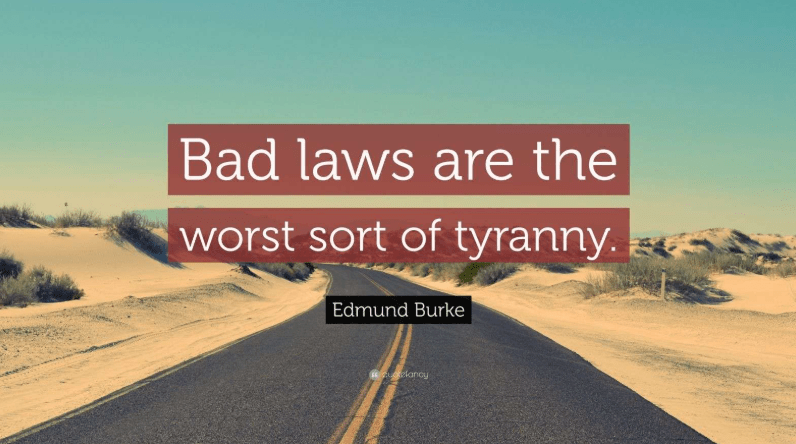
As a freelance court reporter in California, I’ve grown accustomed to the unpredictability of legal scheduling. Hearings get bumped, trials settle, motions are continued at the last minute. This uncertainty is why many reporters like me accept only one solid booking at a time—there’s simply no way to reliably stack jobs. California Assembly Bill 711, introduced this session, either ignores this reality or fails to understand it.
AB 711 would require parties in civil matters to disclose whether they will provide a certified shorthand reporter (CSR) for motion hearings and in meet-and-confer declarations. On its face, the bill might look like an effort to bring transparency and planning to the use of court reporters in litigation. But in practice, it poses several problems that directly undermine the freelance reporter’s ability to earn a living and serve the courts effectively.
AB 711 assumes that lawyers—and by extension, court reporters—can plan accurately around future court appearances. In the real world, the opposite is true. Cases shift. Hearings are vacated with no notice. A single change on the docket can ripple through a reporter’s entire week. Requiring attorneys to “declare” a court reporter in advance creates a false sense of certainty and pushes the burden of that uncertainty onto us.
If I reserve time for a “confirmed” hearing that gets rescheduled or dropped the night before, that’s work I’ve lost—not because I was unavailable, but because the system misrepresented the certainty of the job. Multiply that across a week or month, and the financial and professional impact is significant.
By turning the use of a CSR into a simple box to check, AB 711 may unintentionally normalize the idea that a court reporter is optional. If the attorney doesn’t check the box, there’s no reporter. If they do but plans change, there’s still no guarantee a reporter will actually be hired.
This not only undermines our role but signals to judges, litigants, and younger attorneys that live, certified transcription isn’t essential to due process. It is.
Let’s be clear: this bill doesn’t guarantee us more work. It doesn’t mandate a CSR’s presence or provide courts with more resources to hire us. It creates the illusion of increased demand through advance declarations—without actually producing more jobs or providing enforcement if those declarations are ignored. In other words, it’s all optics, no substance.
As declarations become the norm, lawyers may begin exploring cheaper, more convenient options, like AI transcription or uncertified digital recordings. The state, already struggling with court staffing, may begin to see human reporters as expendable. AB 711 opens the door to these substitutions, even as it pretends to elevate our relevance.
That’s not modernization. It’s marginalization.
Finally, AB 711 does what too many well-meaning bills do: it adds administrative overhead under the guise of reform. What we need is meaningful investment in training, recruitment, and retention of CSRs. We need courtrooms staffed with licensed professionals—not more paperwork that gives parties and judges a false sense of procedural propriety.
This bill doesn’t fix a problem; it manufactures one. It reduces court reporting to a pre-hearing checkbox, pretending that scheduling is predictable and that our presence is optional. It places the burden of legal uncertainty squarely on the shoulders of working reporters while offering no substantive support in return.

The cost of attending court reporting school can be a major hurdle for many prospective students. With tuition and associated expenses sometimes reaching well over $60,000, it’s natural to question whether the investment is justified. Is it worth spending that much to enter a specialized field like court reporting? While the upfront price tag may seem steep, understanding what the job entails, the certification requirements, long-term career prospects, and potential earnings can help put that cost into perspective.
Realtime reporting is a specialized skill within court reporting where the words written on the stenography machine appear immediately—in real time—on a computer screen. This is essential in legal settings, especially during trials, where judges rely on realtime feeds to instantly review questions, answers, and objections.
For instance, if an attorney makes an objection during a trial, the judge doesn’t need to rely solely on memory or ask the attorney to repeat themselves. The judge can glance at their monitor and see exactly what was said, thanks to the realtime transcription provided by the court reporter. It’s like closed captioning for the courtroom—only faster and more precise.
Attorneys also rely on realtime feeds during high-stakes depositions—where millions of dollars may be at stake and they have only one opportunity to question a witness—to instantly review testimony, catch inconsistencies, and adjust their strategy on the fly.
Speed and accuracy are critical in this profession. In California, to earn the Certified Shorthand Reporter (CSR) license—the credential required to work as a court reporter in the state—you must demonstrate the ability to transcribe at 200 words per minute (wpm) for four voices, with a minimum accuracy rate of 97.5%. This is tested in a live dictation environment, simulating real courtroom conditions. Realtime certification standards are even more rigorous at the national level.
The National Court Reporters Association (NCRA) offers the Registered Professional Reporter (RPR) credential, which is commonly required for federal positions or to boost one’s freelance credentials. The RPR test includes:
Each leg must be passed individually, and the pass rate is roughly 95% accuracy for each section. These higher standards reflect the demands of realtime captioning and complex legal work.
In California, the CSR license is non-negotiable. Whether you’re working as a freelancer (handling depositions and hearings) or applying for a full-time position in Superior Court, you must hold the California CSR. However, for certain official roles—especially in federal court—additional credentials like the RPR are preferred or required.
California Superior Courts often have their own hiring criteria, but most will not even interview you without a CSR. Some higher-paying roles, especially in federal court, seek candidates with both the CSR and RPR, given the high standards and complex caseloads.
Currently, 24 states have their own licensing or credentialing requirements for court reporters, similar to the California CSR, while 8 states either allow or require the nationally recognized RPR (Registered Professional Reporter) certification as the sole credential needed to work in the field.
Pension vesting is another key factor when considering a long-term career in official court reporting. Here’s how it works:
Once vested, you’re eligible for a defined benefit pension plan based on your years of service and highest earning years—an increasingly rare benefit in today’s job market.
While this can vary by county or agency, California court reporters working for the government typically enjoy excellent health benefits, including:
One major caveat: you lose these benefits upon leaving government employment, unless you’ve worked for 25 years, in which case you’re eligible for lifetime medical benefits.
In federal court, the benefits are even more generous. After just five years of service, you become eligible for lifetime health insurance coverage, provided you retire from federal service.
Many new court reporters are tempted by freelance work, which often comes with a higher per-job pay rate and greater flexibility. However, freelancers must manage their own:
While the gross income may be higher, the net take-home pay can be significantly reduced once these costs are accounted for. For instance, government-employed reporters often receive:
As one seasoned reporter advises: Work for Superior Court for at least five years to vest your pension, gain experience, and enjoy stable benefits. Then, consider moving to Federal Court, where compensation and benefits increase further.
This is one of the most puzzling contradictions in the field. With the well-documented national shortage of court reporters, many wonder how layoffs could even happen.
Here’s the backstory:
In 2012, California faced a *huge judicial budget shortfall. Courts were ordered to slash costs, and they looked at the highest-salaried employees—which included court reporters. During union negotiations, SEIU (Service Employees International Union), which represented both court reporters and social workers, had to prioritize. According to reports from that time, SEIU decided to back social workers, leaving court reporters vulnerable to layoffs.
The following year, in 2013, the Ducker Report was published, highlighting a looming national shortage of qualified court reporters. Unfortunately, this study came after the layoffs. Had the union made court reporters a priority, the layoffs might never have occurred.
It was a case of bad timing, political decisions, and fiscal austerity—all colliding before the true value of court reporters was widely recognized again.
So, back to the original question: Is $65,000 for court reporting school a crazy investment?
Not necessarily—if you finish and pass the CSR. Court reporting is one of the few careers where you can earn a six-figure income without a traditional four-year degree. Once certified, your skills are in high demand, especially in California. But the path is rigorous. It demands discipline, accuracy, and speed. The investment pays off—but only if you’re all in.
For those willing to put in the time, court reporting offers a rare combination of job security, strong benefits, and professional satisfaction in a field that truly matters to the justice system.
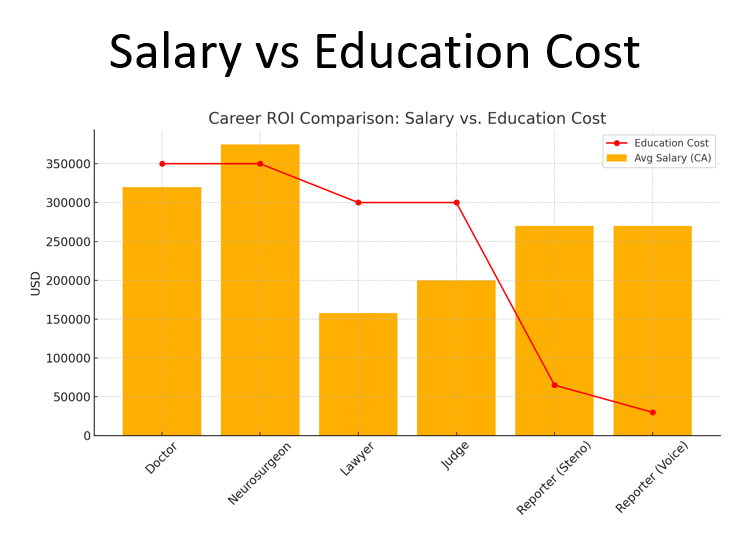
**In 2012, California’s judicial branch faced cumulative ongoing budget reductions totaling $653 million, including a $350 million reduction enacted in the 2011–12 fiscal year. These cuts led to significant operational changes across the state’s court system, including furlough days, courtroom closures, and layoffs of court personnel.
Los Angeles Superior Court, the largest trial court in the nation, announced budget cuts affecting 431 employees in June 2012, citing a need to reduce spending by $30 million due to reductions in state financial support. The court had already implemented various cost-saving measures since 2010, including layoffs, hiring freezes, and cuts in supplies, to address the ongoing budget crisis.
Overall, the state’s budget shortfall for the 2012–13 fiscal year was estimated to be $15.7 billion, prompting Governor Jerry Brown to propose a combination of spending cuts and tax increases to close the gap. The judicial branch bore a significant portion of these reductions, impacting access to justice and court operations throughout California.
In the 2012–2013 fiscal year, California’s trial courts reported total expenditures of approximately $25.5 million for court reporter services. This amount was remitted to the Trial Court Trust Fund as mandated by Government Code sections 68086 and 70313.
Additionally, the 2012 Budget Act introduced a new $30 fee for civil proceedings lasting less than one hour, aimed at offsetting the costs of providing official court reporters. This fee was intended to be collected from litigants and deposited into the Trial Court Trust Fund, with the funds subsequently returned to the courts where they were collected.
Despite these measures, the judicial branch faced significant financial challenges. The Budget Act of 2012 required the Judicial Council to allocate a $385 million reduction to trial courts’ Trial Court Trust Fund allocations. This substantial budget cut impacted various court operations, including the provision of court reporter services.
These financial constraints contributed to operational changes across the state’s court system, such as furlough days, courtroom closures, and layoffs of court personnel, including court reporters. The reductions underscored the challenges faced by the judicial system in maintaining essential services amid budgetary pressures.

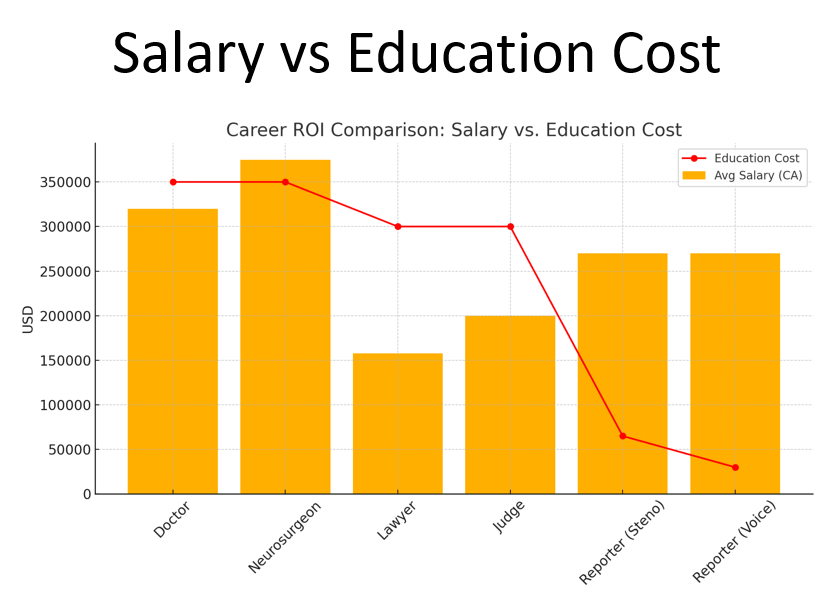
When students begin exploring their career paths, questions about income, education, and cost are front and center. It’s common to wonder, “How much does it cost to become a doctor, lawyer, or judge?” or “How long does it take to earn six figures in those fields?” Yet one career often overlooked in these conversations is court reporting—a profession that, once fully understood, challenges many assumptions about career value, income potential, and education investment.
Let’s break it down honestly and directly: for students evaluating their futures, especially in California, court reporting offers one of the highest returns on investment (ROI) of any skilled career.
Let’s look at some of the most respected and sought-after careers:
These careers are prestigious and well-compensated, but they also come with significant barriers to entry. Medicine and law may have higher academic entry rates, but court reporting has far higher performance and persistence barriers, particularly due to skill mastery and speed-building.
Now consider this:
That’s not a typo. Top court reporters, especially those working in high-demand markets like Los Angeles and San Francisco, earn more than many doctors and lawyers. Even average full-time reporters in California earn well over six figures when transcript income is included.
The catch? The general public doesn’t know this.
Why? Because national salary averages (“$60K–$100K”) include part-timers, retirees, and lower-cost regions. But full-time, certified professionals in California regularly earn $200K, $300K, or more.
The pass rate also contributes to court reporting’s exclusivity. Mastery takes time and mental discipline, not unlike mastering a musical instrument. It’s why those who make it into the profession are highly valued—and well-compensated.
That said, Court Reporting is not a casual career choice. Prospective students should consider whether they:
Court reporting is a service profession. It’s about accuracy, speed, organization, and reliability. If you love language, enjoy solving word puzzles, and feel energized by delivering precise results in high-stakes settings, maybe every played the piano or other musican instrument, you might be a natural fit.
But if you’re just here for the income, think carefully—because only the students who love the work and live the discipline make it through.

✅ Court Reporting, especially in California, offers:
| Metric | Court Reporter (Steno machine or Voice) | Doctor (MD) | Lawyer |
|---|---|---|---|
| Education Time | 1 year | 8 years | 7 years |
| Education Cost | $20K–$40K | $260K–$440K | $190K–$410K |
| Time to Enter Workforce | 1–1.5 years | 10–12 years | 7 years |
| Avg Salary (CA) | ~$360K | ~$320K | ~$150K |
| Top Earners | $400k – 1M+ | $500K–$1M+ | $300K+ |
| Payback Time on Education | <1 year | 3–6 years (after res.) | 5–10 years |
Some students balk at the idea of paying $65,000 to attend a private court reporting school like South Coast College. But that reaction is often based on sticker shock, not strategic thinking.
Let’s flip the question: why do pre-med students eagerly take out $400,000 in student loans to attend medical school? Why do future lawyers aim for Ivy League law schools, where tuition exceeds $70,000 per year?
Because they see it as an investment. They understand the long-term value of a high-income profession. And they know the prestige of their school can influence future earnings.
Here’s the difference: court reporters often earn more than lawyers, and many earn as much or more than doctors — but with far less debt, faster entry into the workforce, and less competition for jobs.
So when a court reporting student sees a $65,000 price tag and thinks it’s “kooky,” that’s a failure of industry messaging, not a failure of the math.
Meanwhile, a neurosurgeon testified under oath that he earned $300,000/year — and that’s after 15+ years of education and training.
Students need to think about education the way an investor thinks about startups:
When viewed this way, court reporting stands out as one of the most financially efficient and highly compensated skilled professions available today.
Sure, $65,000 isn’t cheap. But neither is wasting 7 years and $200,000 on a degree that doesn’t pay off.
Court reporting is a hidden gem. It deserves serious consideration from any student aiming to build a high-income, low-debt, future-ready career. The math speaks for itself.
If you’re a student who hesitates at the idea of spending $65,000 on a private court reporting school, take a second look at what you’re really investing in. South Coast College is the only NCRA-approved school in California, with the highest California CSR pass rates and a track record of producing the top earners in the industry. Even Judge Judy’s court reporter is a proud graduate. This isn’t just a school—it’s a launchpad. Don’t cut corners on the quality of your education when that education can place you among the best writers in the nation. I personally endorse South Coast College as that is my alma mater and I have first-hand experience of the value of the theory and personal network they provide.
That’s why students from across the country move to California just to attend South Coast College. They understand the ROI. They value the exceptional quality of instruction. And once they graduate, many return home equipped with the best credentials in the industry. If you’re serious about success, choose the institution that consistently turns students into stars.
(**This blog represents my personal views, experience, and expertise as a professional in the field of court reporting. I personally endorse South Coast College as it is my alma mater, and I have first-hand experience of the value of its theory-based curriculum and the professional network it provides. The information provided here is based on real-world knowledge and industry insight gathered over years of working alongside top reporters, educators, and legal professionals and research and personal knowledge of these other fields. )


California Assembly Bill 711, introduced in 2025, is the latest legislative attempt to address access to the official record in civil courtrooms. Backed by respected organizations like the Deposition Reporters Association (DRA) and the California Court Reporters Association (CCRA), the bill is built on the right intentions: to prevent hearings from going off record, to improve communication between parties, and to give court reporters more visibility into potential assignments.
But for those of us actually doing the work—freelance reporters, agency owners, and officials alike—the bill, in its current form, misses the mark. Despite its good-faith goals, AB 711 introduces new challenges, misinterprets how our schedules work, and may even accelerate the shift away from certified human reporting.
Let’s break down what the bill is trying to do—and why it may cause more harm than help.
The core idea of AB 711 is to require parties filing motions in civil cases to state whether they will be providing a certified shorthand reporter (CSR) at the hearing. It also requires a similar declaration in “meet-and-confer” letters. The aim is to prevent situations where one party assumes a reporter will be there, only to find out at the hearing that no official record is being made.
In theory, it’s about transparency and protecting litigants’ rights to a transcript. And those are important goals—ones that all of us in the industry support.
But theory and practice are two very different things.
Freelancers and agencies already know: the legal calendar is a moving target. Hearings are vacated the morning of. Motions are rescheduled without warning. If I, as a freelance reporter, commit to a job two weeks out, I’m taking a real financial gamble that it won’t fall through. And often, it does.
AB 711 creates a false sense of certainty. It assumes that if an attorney declares they “will provide a reporter,” a reporter will show up. But most of us don’t work that way. We book in real-time based on confirmation—not intention.
Agencies face this on a larger scale, juggling multiple requests with limited resources. A “maybe” two weeks in advance isn’t enough to staff a job or turn away other guaranteed work.
Let’s be blunt: attorneys are busy. Many don’t fully understand how reporter scheduling works. Requiring them to check a box—yes or no, will a CSR be present?—invites minimal effort and maximum misunderstanding. Some may default to “no” just to avoid follow-up logistics.
Worse, it could normalize skipping the record altogether. If it’s easy to say no to a reporter, many will. That’s a dangerous precedent for access to justice.
If a lawyer declares they intend to bring a reporter, but never follows through or communicates with an agency, the job may never get booked. That “demand” exists on paper only. Agencies and reporters may start chasing ghosts—jobs that were declared but never confirmed.
This creates scheduling inefficiency, wasted energy, and a distorted view of actual service need.
By putting the onus on attorneys—and giving them a clear off-ramp to say “no reporter”—the bill paves the way for AI transcription tools or uncertified digital audio recordings. As costs rise and availability shrinks, this checkbox could become a path toward low-quality, unverified alternatives.
In the long run, that erodes our professional standing—not just in the courtroom, but in the public’s understanding of our value.
We all agree: too many hearings go uncovered. But AB 711 doesn’t fix that. It shifts responsibility onto litigants instead of addressing the real cause: a shortage of reporters, lack of real-time coverage tools, and a disconnect between attorneys and service providers.
The bill creates paperwork—not a pipeline to coverage.
Rather than asking lawyers to guess about coverage weeks in advance, here’s what might actually move the needle:
Technology exists that can match open jobs with available reporters in real time. Courts and agencies should invest in systems that make on-demand coverage seamless—not dependent on declarations.
Let’s push for official coverage at all civil hearings—and treat freelance as the overflow, not the default. That would increase baseline coverage and reduce the pressure on attorneys to arrange their own.
Legislation should invest in training programs, tuition assistance, and licensing incentives. If we want more CSRs, we need to build the pipeline—not just regulate around its absence.
Instead of asking parties to declare whether they’re bringing a reporter, courts could require that any hearing not being reported include a written disclaimer signed by both parties. This adds friction to going off-record—not to hiring a professional.
DRA and CCRA deserve credit for trying to fix a real issue. AB 711 is a step in the right direction in terms of raising awareness, but it falls short of creating a practical, functional solution. It misunderstands how our industry operates, adds burden without benefit, and may even push us further out of the room.
We don’t need checkbox compliance. We need investment, infrastructure, and innovation. Let’s build solutions that reflect the actual work of today’s reporters—and protect the record with the urgency it deserves.

Subscribe to get access to the rest of this post and other subscriber-only content.

Subscribe to get access to the rest of this post and other subscriber-only content.


In recent years, California has faced a well-documented shortage of certified shorthand reporters (CSRs), the professionals responsible for preserving verbatim transcripts of courtroom proceedings. This shortage has prompted a flurry of legislative activity, public concern, and institutional strategy-shifting within the judiciary. However, beneath the surface of these systemic discussions lies an alarming and potentially scandalous detail: the numbers used to justify these strategic shifts may have been based on deeply flawed—and possibly manipulated—data.
This article explores the suspicious discrepancies in court reporter licensing records maintained by the California Court Reporters Board (CRB), the troubling timing of those discrepancies, and how they may have bolstered efforts to replace live reporters with electronic recording (ER) systems. The implications of this are vast, touching on government accountability, transparency, and the future of the court reporting profession.
While reviewing the publicly available licensing spreadsheet on the CRB website, I noticed something deeply unsettling: many reporters I knew personally, all of whom were actively working in courtrooms across the state, were listed as “inactive.” This wasn’t just a clerical oddity—it was a systemic inconsistency that undermined the reported count of active reporters in California.
Curious and increasingly concerned, I reached out to several of these individuals. Their responses were immediate and incredulous. None of them were aware that their licenses were listed as inactive. All had valid, current licenses and were actively working. Some even showed me their current physical license cards issued by the state.
This wasn’t just a handful of mistaken entries. After more extensive review, it became clear that there were hundreds—if not nearly a thousand—active CSRs misclassified as inactive. This data anomaly wasn’t merely a glitch; it directly contradicted the reality on the ground and cast doubt on the CRB’s official numbers.
These inaccuracies may appear technical or bureaucratic at first glance, but their impact reverberates through the entire California judicial system. The official CRB numbers feed into legislative analyses, judicial resource allocation, and the media narrative around court reporter shortages.
Take, for example, the 2022 report prepared for the California Trial Court Consortium: “The Causes, Consequences, and Outlook of the Court Reporter Shortage in California and Beyond.” The report, which drew heavily on CRB-provided data, stated that the number of active CSRs had dropped by nearly 20% over the previous seven years.
One pivotal paragraph stood out:
“Of CRB’s 5,728 active licensees, only 5,043 of them have addresses registered in California… Given the statutory ban on remote reporting, it is safe to assume that these licensees—more than ten percent of the total—are not available to work in California full time.”
This estimate itself is flawed if the active count of 5,728 was artificially deflated. My analysis, corroborated by personal outreach and physical license verification, indicated that there were over 6,500 truly active CSRs at the time—meaning the report was potentially undercounting by nearly 1,000.
This discrepancy is not just numerical; it is political. It paints a bleaker picture of workforce availability, which can be leveraged to support arguments for replacing stenographers with digital recording systems or other alternatives.
The timing of the misclassification is crucial. The data anomaly seemed to emerge around the same period the California Trial Court Consortium was pushing heavily for alternatives to human court reporters. Their 2022 report laid out a dire situation, one exacerbated by what now appears to be artificially low CSR numbers.
Around this same time, legislation concerning voice writing and remote reporting was also in flux. In 2019, Assembly Bill 1520 explicitly prohibited the CRB from licensing voice writers, even though just one week prior, the CRB had announced readiness to administer voice writer certification exams. The abrupt legislative reversal suggests intense political and institutional jockeying.
The 2022 Consortium report also used the shortage to highlight how inflexible and costly it was to rely solely on stenographic reporters:
“This shortage persists despite paying competitive wages, directly inviting and incentivizing court reporters to apply for open positions, and spending increasing time and funds on recruitment.”
If the shortage was partly manufactured by mislabeling active CSRs as inactive, then the foundation of these arguments—and any resulting policy changes—rests on manipulated data.
There are two possible explanations for this misclassification: an honest technical error or intentional misrepresentation.
A system glitch might explain how reporters were incorrectly marked as inactive. Licensing databases are complex and often outdated. Errors in syncing renewal dates, processing fees, or manually updating statuses could lead to misreporting.
But intent must be considered given the scale, the consistent pattern of affected individuals, and the suspicious timing. If the CRB knew about the discrepancies—and especially if they failed to correct them after being alerted—it raises the possibility of deliberate obfuscation.
When I informed Mary Pierce, then-president of the Deposition Reporters Association (DRA), about these discrepancies, I received no response. There was no public acknowledgment of the issue from DRA or CRB. Why the silence? If it were a mere glitch, a simple public statement could have cleared the air. But none came.
Misreporting the number of active CSRs has far-reaching consequences:
As the alleged shortage narrative gained traction, so too did the movement toward electronic recording systems. The 2022 report framed this shift as inevitable due to the workforce decline:
“Considering California’s aging-out workforce, declining court reporter education system… the number of court reporters in this state consistently trends downward.”
Yet if that narrative was constructed on manipulated or misunderstood data, then the justification for widespread ER deployment begins to crumble.
Moreover, the state has already experimented with ER in limited civil and criminal matters—despite evidence from other states showing its limitations in complex litigation. ER cannot clarify muffled speech, record gestures, or verify speakers the way a live reporter can.
Given the stakes, the CRB must immediately:
Additionally, the legislature and Judicial Council must investigate whether inaccurate data influenced policy decisions or budget appropriations.
If the CRB deliberately misrepresented the state of the workforce, it constitutes a breach of public trust and a disservice to the very professionals it purports to represent.
California’s court reporting crisis is real, but it may not be as severe—or as unsolvable—as presented. The disturbing possibility that the CRB’s data misrepresentations were used to further an agenda of technological replacement cannot be ignored. Whether through negligence or intent, the effect is the same: a distorted view of reality that influences courts, legislation, and public opinion.
Court reporters are not obsolete. They are essential protectors of the official record and the public’s right to a fair trial. If state institutions are distorting data to phase them out, it is not just a betrayal of professionals—it is a betrayal of justice.
If you’re a court reporter affected by this issue, or a member of the public concerned about courtroom transparency, speak up. Contact your local representatives, the CRB, and professional associations. Demand answers. Demand accuracy. Demand integrity.

In courtrooms, conference rooms, and deposition suites across the country, attorneys are failing—not in their legal reasoning or writing, but in one of the most essential aspects of advocacy – the ability to speak clearly, purposefully, and respectfully.
It’s time for a serious conversation about the state of oral communication in the legal profession, and how badly it is affecting not only the quality of legal practice, but also the well-being of the professionals who ensure our words matter—especially court reporters.
I propose a practical, long-overdue solution – every law school should require elocution and verbal communication training before graduation. Not as a luxury elective, but as a core skill—just like legal writing and professional responsibility.
Let’s be clear. This is not about snobbery or expecting every attorney to sound like a polished litigator from a 1950’s courtroom drama. This is about creating a clear record. It is about professionalism, respect, and acknowledging that our words—their clarity, their tone, their pacing—matter.
Spend a week in the trenches of depositions or hearings, and you’ll witness the problem firsthand. Some attorneys mumble. Some interrupt everyone. Others talk so fast with such erratic pacing or vocal fry that court reporters are forced to interrupt just to do their jobs. And when they do? Far too often, they are met with scorn or hostility, as though the failure to be understood is someone else’s fault.
One well-known legal professional who has spent years coordinating Reporter Empowerment conferences in Washington, D.C., invited every bar association in the region to send their litigators —free of charge—for training on how to make a clear record. And the response? Radio silence. No takers. Year after year.
The message is clear – those in the legal community now don’t value form, if it thinks it can get away with focusing on substance. But what these attorneys forget is that form is substance when it comes to transcripts. Without clear speech, without respect for the process, there is no reliable record. And without the record, there is no case.
Even in mock trial and deposition training exercises—meant to help young lawyers sharpen their skills—participants who mumble, interrupt, or derail the clarity of the proceedings are still applauded for “commanding the room” or “holding their ground.” Rather than rewarding clarity, the culture rewards verbal combativeness and theatrical dominance.
There’s a name for this – performative aggression. Talking over opposing counsel, cutting off witnesses, raising one’s voice to intimidate—it may impress clients, but it actively harms the quality of the legal process. It muddies the record, wastes time, and fosters a toxic environment for everyone involved.
And it especially takes a toll on court reporters, who are not just transcriptionists, but officers of the court responsible for preserving the integrity of the record. When they speak up to ensure accuracy, they are too often dismissed, disrespected, or outright yelled at.
While this issue crosses gender lines, many court reporters will tell you—and I agree—that there is a noticeable pattern in how some young female attorneys, in particular, are coached or allowed to behave. The “speed talk,” the nervous laughter, the vocal fry, and the refusal to adjust when the court reporter says they can’t be heard. When a reporter says, “I can hear everyone else, but not you,” the correct response is not to argue. It’s to stop, take a breath, and adjust.
It’s not about singling out women. It’s about addressing a systemic failure in how all lawyers are trained to communicate. The goal should be to speak with strength and clarity—not volume or attitude.
The irony is that many of these attorneys are brilliant. They write like poets and argue like scholars. But they’ve never been taught to read the room—or the reporter. They think louder is better. They confuse speed with intelligence. And when challenged, some resort to yelling or bullying to reassert control. That’s not advocacy. That’s insecurity masquerading as dominance.
Even worse are those attorneys who lash out at court reporters in vulgar, aggressive terms. I’ve seen it happen. And I’ve seen court reporters quietly pack up and walk out—without protest, without spectacle—because no one should have to endure that abuse just to do their job. That’s not a communication issue. That’s a moral one.
So, what’s the solution? It starts with law schools. Every law school should include a mandatory course in courtroom communication. Not just moot court—real training on pacing, diction, clarity, and professional interaction with court staff. We require Professional Responsibility courses—why not Professional Communication?
But law schools can’t do it alone. Bar associations, state courts, and national legal organizations should partner with court reporter associations to develop joint trainings. Court reporters are uniquely positioned to offer practical feedback that lawyers need to hear.
And, yes, national court reporter associations could have, and should have, led the charge on this issue years ago. There’s still time to make up for lost ground. There are working reporters in every major legal market—each of them carrying decades of insight that law schools could tap into tomorrow. All it takes is an invitation.
Respect for the record is respect for the profession. Clear speech is not a luxury—it’s a necessity. When attorneys don’t speak clearly, they don’t just hurt their own case—they waste time, frustrate judges, confuse juries, and disrespect the people whose job it is to ensure their every word is preserved.
And when attorneys scream at reporters or treat them as obstacles, they cross a line that should be professionally—and ethically—unacceptable.
So let this be a call to action for law schools, bar associations, and law firms alike – teach your students and your associates how to speak—not just to win, but to be understood. Not just to perform, but to preserve the record. Because if your voice can’t be heard, your argument might as well be silent.

If you’ve been following the news, you probably saw the headlines about President Joe Biden’s leaked audio recording. While most people are talking about what he said, those of us in the court reporting profession are looking at something else entirely – the fact that the leak happened in the first place.
This isn’t about politics. It’s about the security and trust built into the legal system, and importantly, what happens when the people handling legal audio aren’t trained or held to the same standards as licensed court reporters.
We’ve all been in the room. Depo after depo, hearing after hearing. We’re not just capturing words—we’re safeguarding them. As the “Responsible Charge” of the record, we understand the chain of custody, the confidentiality, and the trust that every attorney and witness places in us to get it right and keep it secure.
Now imagine a world where those recordings are made, stored, and passed around by people who don’t even know what a scopist is, let alone what our licensing requirements are. That’s not the future—it’s happening now.
Sure, some folks online pointed out that Biden’s leak wasn’t from a deposition. It was an interview. But let’s be honest: when court reporters are pushed out, and digital recorders are left to run the show, interviews, hearings, depos—they all become vulnerable.
Without a professional in the room monitoring access and protecting the integrity of the audio, files are more likely to be mishandled, misused, or straight-up leaked. That’s exactly what happened here. Someone with access to the government’s digital recording leaked it. And if it can happen to the President of the United States, it can happen to anyone.
Many states are moving toward letting courts—not neutral professionals—own and manage the record. That might sound efficient, but let’s think about the conflict. Courts are supposed to be impartial. If they also control the record, they’re acting as both judge and gatekeeper. That’s a problem waiting to happen.
Our role as outside professionals has always added a layer of protection and neutrality to the process. We’re not there to influence outcomes—we’re there to document them with precision and keep them secure.
Court reporters are bound by professional ethics that aren’t optional. We don’t just protect the record—we protect the people in the room, the attorneys who rely on us, and the system itself. When we say “off the record,” we mean it. When we say “this is confidential,” it stays that way.
Can a software program promise the same?
If we lose our position as the Responsible Charge of the record, everyone loses. Attorneys lose trust in the system. Witnesses hesitate to speak openly. Agencies face new liability. And we as reporters? We risk being replaced by systems that might be cheaper, but aren’t safer.
We’re already seeing the effects of cost-cutting over confidentiality. If these trends continue, we’ll be looking at a legal system where nobody wants to testify because they’re afraid their words will end up in a headline instead of a transcript.
Now more than ever, court reporters need to remind the legal world why we’re essential. We need to educate our clients, support state licensing requirements, and push for stronger protections around the chain of custody. Our job isn’t just to take down words—it’s to protect the record from start to finish.
Let’s make sure we don’t let moments like the Biden leak pass by without making it clear: if a court reporter had been the Responsible Charge of that audio, it never would’ve been leaked.

In the world of legal proceedings, where every word matters and timing is critical, court reporters serve as the unsung heroes. Their task seems simple on the surface – transcribe spoken words into accurate, official records. But the truth is, court reporting demands a level of precision, discipline, and professionalism that most people never witness. Interestingly, the characteristics that define successful court reporters mirror many of the qualities found in high-potential employees across industries.
Here are seven lessons from court reporting that illustrate what makes a high-potential professional stand out—and why these traits are worth cultivating in any career.
1. They Take Initiative Before Being Asked
Court reporters don’t wait to be told to pay attention or begin documenting proceedings. They are trained to anticipate the start of a session, prepare their equipment, and be fully engaged from the moment they walk into the room. Their work begins even before anyone speaks. Similarly, high-potential employees don’t need constant direction. They prepare, anticipate needs, and act without waiting for explicit instructions. This self-starting nature shows drive and ownership—hallmarks of leadership.
2. They Speak Up When Something Doesn’t Feel Right
Although court reporters are often silent, they are trained to raise their voices at critical moments—like when a speaker is too quiet, when multiple people talk over each other, or when legal jargon becomes unclear. They know the accuracy of the record is paramount and are empowered to halt proceedings to ensure clarity. High-potential employees exhibit the same courage: they speak up respectfully when something feels off, whether it’s a flawed process, ethical concern, or a strategic misstep. They prioritize long-term integrity over short-term comfort.
3. They Value Real Work Over Meetings
In a court reporter’s world, action trumps chatter. They thrive on concrete output – transcripts, legal records, certified statements. Every second counts, and their work is focused and tangible. High performers in any field similarly focus on results, not just participation. While meetings have their place, high-potential professionals look for ways to maximize impact. They gravitate toward producing outcomes rather than getting lost in endless discussion.
4. They Avoid Office Drama and Focus on the Mission
Court reporters are embedded in emotionally charged environments—criminal trials, divorce proceedings, civil disputes—yet they maintain professionalism and neutrality at all times. They don’t take sides or get involved in the drama. They stay laser-focused on their mission: to record facts impartially and accurately. In corporate life, the best employees do the same. They steer clear of gossip, align with purpose, and focus on advancing the goals of the organization.
5. They Work Well With Everyone, No Matter Their Title
From judges and attorneys to defendants and witnesses, court reporters interact with a diverse cast. Respect and communication are essential, regardless of someone’s position or behavior. High-potential employees demonstrate similar emotional intelligence. They build rapport across the hierarchy, treating everyone with respect and working collaboratively across departments. Their ability to navigate diverse personalities makes them invaluable team players.
6. They’re Obsessed With Learning and Growth
Court reporting is a skill-intensive profession. Reporters must maintain high typing speeds, master legal terminology, and keep up with new recording technologies and continuing education. They never stop learning because the stakes are too high. This same hunger for growth is a key indicator of high potential in any role. Employees who seek feedback, develop new skills, and stay curious are the ones who evolve into future leaders.
7. They Fiercely Protect Their Time and Know When to Recharge
Court reporters often work under tight deadlines, transcribing hours of dialogue into flawless documents. To maintain accuracy and speed, they must manage their energy well. They understand the importance of taking breaks, stepping away from the screen, and recharging to stay sharp. High-performing professionals know this too: burnout benefits no one. The ability to set boundaries, protect focus time, and practice self-care is not a luxury—it’s a necessity.
Bringing It All Together: The Leadership Blueprint Hidden in the Courtroom
It may seem unlikely that a courtroom’s quiet observer holds the keys to understanding what makes a standout employee. But court reporters exemplify a rare mix of vigilance, professionalism, and strategic presence. They don’t chase visibility, yet their work underpins the entire legal system. They don’t lead meetings, yet their transcripts shape court decisions. Their value is rooted in doing the right work, in the right way, at the right time—a lesson many corporate leaders strive to instill in their teams.
If you’re a manager looking to spot high-potential talent, look beyond the loudest voices. Look for those who take initiative, remain calm under pressure, and focus on quality. If you’re an employee aiming to grow, consider how the court reporter’s mindset might apply to your own career: Show up prepared. Speak with integrity. Focus on output. Grow your skills. Respect others. Protect your time.
The courtroom may be a world apart from the boardroom, but the attributes that lead to excellence are remarkably similar. Sometimes, the most powerful professionals are the quietest ones in the room—listening carefully, working relentlessly, and leading by example.

For years, the public has heard repeated alarms about a court reporter shortage—claims of vanishing stenographers, unfilled jobs, and impending crises in courtrooms. But scratch the surface, and a different picture emerges: one of orchestrated hype, driven by corporate interests, court administrators, and tech vendors eager to replace skilled professionals with automated systems.
Below, we take a hard look at the data often cited to justify this so-called “shortage”—and challenge the narrative that it’s real.
Claim: Los Angeles County Superior Court reported 117 vacancies, or a 26% shortfall in court reporter positions.
Claim Source: This statistic often comes from the Ducker Report and vendors like Rev.com, a tech transcription company with clear business motives.
Claim: The decline in court reporting schools proves that interest and accessibility have collapsed.
Let’s be clear: court reporters represent one of the last human-controlled safeguards in a legal system increasingly dominated by bureaucracy and cost-cutting.
So who benefits from the “shortage” narrative?
This isn’t about solving a crisis—it’s about replacing skilled workers under the cover of a fabricated one.
The irony? Courts now tell the public that they can’t afford to hire enough court reporters, and that recordless hearings are acceptable. But litigants—especially self-represented or under-resourced individuals—are left without a verbatim record, denying them their right to appeal.
Meanwhile, private parties are forced to pay $3,000–$5,000 per day for freelance reporters to ensure a record is made. That’s not access to justice—that’s privatization of the public record.
The so-called shortage of court reporters is not a natural crisis—it’s a manufactured justification for a slow-motion dismantling of a critical legal profession. The numbers, when viewed in context, reveal administrative failure, funding cuts, and agenda-driven messaging, not an unsolvable demographic decline.
Before accepting the shortage narrative at face value, we must ask:
If you’re a working court reporter or run a reporting agency, the recent leak of President Joe Biden’s deposition audio should send a chill down your spine—not because of the political buzz, but because of what it means for the future of our profession and the integrity of the legal record.
This moment is a clear sign of what happens when the record falls into the wrong hands—and why we, the professionals trained to protect it, must stay at the center of this process.
As court reporters, we’ve long served as the “Responsible Charge” of the record. It’s not just a title—it’s a duty. We are the ones who protect the record’s confidentiality, accuracy, and chain of custody. In 24 states, we’re licensed professionals held to legal and ethical standards that define our work and our responsibility to the justice system.
Let’s be real: when a reporter is in the room, attorneys know they can trust that what’s said will be recorded faithfully and handled professionally. We’ve earned that trust by doing our jobs with integrity, case after case, year after year.
The Biden leak is a perfect example of what can go wrong when legal audio ends up in the hands of a bureaucracy instead of a professional court reporter.
Yes, some folks online are quick to point out, “It wasn’t a deposition—it was an interview.” But that’s exactly the point. Without court reporters in the picture, interviews like this will start to follow the same protocol as depositions: recorded, archived, and leaked. The lines blur fast when ethical oversight disappears. What’s next? Depositions without us, stored on some server, with no one accountable for protecting the record?
When digital recordings are stored on government servers or shared with departments who don’t understand our ethical boundaries, they become vulnerable. More hands, more access, less accountability. That’s how leaks happen.
Can you imagine if this became the norm? If every deposition had the potential to end up on the internet? Clients, witnesses, attorneys—no one would feel safe speaking openly. That’s the start of a chilling effect on justice itself.
Here’s the thing the legal world needs to be reminded of: court reporters don’t leak.
Even when subpoenaed, many of us are trained to hold firm and let the court compel release through proper legal channels. We don’t hand over audio on a whim, and we never release confidential information without authorization. That’s not just ethics—it’s our professional culture.
Meanwhile, the systems being pushed as “efficient” replacements for reporters—automated recording tools, remote file storage, off-site transcription—open the door to exactly the kind of breach we just witnessed on the national stage.
Whether you’re a freelancer handling daily depos or an agency owner juggling assignments and contracts, this affects you.
If the legal community loses faith in the privacy of depositions, we all lose business. Clients may avoid scheduling depos altogether. Witnesses may clam up. Agencies may face new liability. This isn’t a one-off political headline—this is a direct threat to the trust we’ve built and the future of our work.
Now is the time for every court reporter and agency to remind clients, law firms, and even the courts why we matter. We are not outdated. We are not optional. We are the Responsible Charge.
Let’s talk about our ethics. Let’s share our role in protecting the record. Let’s push back against the idea that automation can replace human judgment, discretion, and accountability.
Because once the integrity of the record is compromised, there’s no going back.
If this Biden audio leak tells us anything, it’s that we need to hold the line. The legal system works best when court reporters are in the room, focused, listening, documenting, and protecting. That’s who we are.
Let’s keep showing the world—and the legal community—what Responsible Charge really means.

If you’ve ever spent three hours a day crawling through Los Angeles traffic, then hi, welcome to my life. I’m a court reporter who works mostly downtown—Stanley Mosk Courthouse, Spring Street, sometimes even further out. Every day, I leave before sunrise hoping to shave a few minutes off my commute, only to be met with the same sea of brake lights stretching from the 405 to the 110. It’s exhausting. Mentally. Physically. Spiritually.
And now? We’ve got the Olympics coming.
Don’t get me wrong—hosting the Summer Games is exciting. I remember watching L.A. pull it off in ’84 like it was a big backyard party. But 2028 is going to be a whole different beast. The city is expecting around 15 million people, and a huge chunk of that activity is going to center around downtown, which just so happens to be where our busiest courthouses live.
So, naturally, my first thought was: How in the world am I going to get to work?
Here’s where things get wild: LA28, the Olympic planning committee, has partnered with a company called Archer Aviation to bring electric flying taxis to the city. I’m talking about real-deal air taxis—quiet, all-electric aircraft that can take off and land vertically (like helicopters, but sleeker and more sustainable). They’re planning to shuttle VIPs, spectators, and probably some athletes between major Olympic hubs like SoFi Stadium, Dodger Stadium, LAX, Santa Monica, and Orange County. The flights? Ten to twenty minutes. Total.
Ten. Minutes.
Imagine that for a second. You’re at home in the Valley or Long Beach, and instead of spending an hour and a half stuck behind a Metro bus on the 10, you hop into a vertiport, take a short flight, and bam—you’re at the courthouse with time to grab a coffee.
Now, I know these air taxis are being marketed toward “VIPs,” not people like me schlepping court bags and stenography equipment, but let a girl dream, okay? After all, if they want this to be the most “car-free” Olympics in L.A. history, why not throw a few seats to the unsung heroes of the legal world?
A court reporter can hope.
In reality, though, most of us court staff, reporters, attorneys, and jurors will still be on the ground. And that’s where things get dicey. Between event road closures, re-routed buses, added security perimeters, and just the sheer volume of tourists flooding the city, getting to the Stanley Mosk or Spring Street courthouses might become a daily Olympic event of its own.
Can you picture it? Trying to beat rush hour only to find 1st Street closed off for an Olympic parade or some pop-up fan experience next to Grand Park. Or circling the block for 45 minutes because the Civic Center parking structure is full of TV crews. There’s already not enough parking on a regular Wednesday morning—what’s it going to be like with a million extra people downtown?
I wouldn’t be surprised if the court starts encouraging more remote appearances, especially for civil and family law matters. We’ve already gotten used to virtual depositions and remote hearings post-COVID. Maybe the Olympics will push us even further into the future. Not ideal for everything, but I’ll take a Zoom call over sitting in Olympic gridlock any day.
That’s the other big unknown. Are we even going to be open during the peak of the Olympics?
There hasn’t been an official word yet from the Superior Court, but I wouldn’t be shocked if some courthouses cut back operations or shut down temporarily, especially if they’re close to a major venue or affected by security zones. That could mean reshuffling calendars, delaying trials, or squeezing everything into fewer available days. Either way, it’s going to be a logistical headache.
And for freelancers like me, those kinds of disruptions have a real financial impact. If my job gets canceled because we can’t get jurors in the building, or if a case gets pushed because the witness is stuck in a traffic jam outside Dodger Stadium, that’s lost income.
All that said, I do see a few glimmers of hope. If the city invests in better transit and tech to deal with Olympic chaos, maybe those improvements will stick around after the Games. More reliable Metro access, better traffic coordination, upgraded digital court systems—those would make a difference long-term.
And maybe—just maybe—someone in a planning meeting will say, “Hey, what if we gave a few air taxi seats to court staff who need to be downtown at 8:30 sharp?”
I’d volunteer as tribute.
Because as much as I love my job, and as much pride as I take in being the eyes and ears of the record, I’d give just about anything not to spend half my life in traffic. Flying to work? That would be a dream. And hey, if the Olympics can make flying taxis a reality, who’s to say court reporters can’t hitch a ride?
Final Thoughts From the Road (or the Sky)
The 2028 Olympics will no doubt be an incredible moment for Los Angeles, but for those of us working in the real day-to-day machinery of the city—especially in the courts—it’s going to be a major adjustment.
From air taxis to virtual hearings to dodging downtown chaos, we’re all going to have to get creative about how we work, move, and adapt. Whether I’m driving three hours or flying ten minutes, I’ll be there, steno machine in tow—hopefully with a little less gridlock and a lot more elevation.
And if anyone at Archer Aviation is reading this: consider adding a courthouse route. I know at least a hundred court workers who’d be first in line.

In recent months, a disturbing trend has begun to surface in California’s already fragile homeowners insurance landscape. While much of the media coverage has focused on major insurers exiting the state or pausing new policies altogether, there’s a more subtle — and arguably more troubling — phenomenon at play: insurance companies that continue to operate in California but are quietly dropping existing policyholders under dubious pretenses.
These non-renewals are not being driven by actual wildfire zones or objective underwriting data. Instead, some insurers are issuing vague or plainly false justifications for denying renewal, forcing homeowners into vulnerable positions — all while still actively writing policies elsewhere in the state.
A Case That Raises Eyebrows
One such case involved a client whose insurer cited a seemingly random property maintenance issue as the reason for non-renewal — something that, upon further inspection, didn’t actually exist. Even more troubling, the insurer had to dig deep and stretch their interpretation of the facts in order to justify the claim. The homeowner could easily disprove it with current documentation and photographic evidence, but the carrier remained unmoved.
The situation raised a red flag: Why would an insurer take the time to fabricate a weak reason to cancel a policy when the actual risk hasn’t changed?
The Bigger Picture
The answer may lie in the industry’s complex relationship with California’s regulatory environment and risk exposure. Since 2023, companies like State Farm, Allstate, Farmers, and USAA have either stopped writing new policies or severely limited their exposure in the state due to rising claims costs, climate risks, and constraints on how quickly they can raise premiums.
But rather than pull out of the state entirely — a move that would trigger intense regulatory scrutiny — some insurers may be engaging in a more targeted strategy: trimming their most “cost-sensitive” or potentially unprofitable policyholders using highly subjective criteria.
This is particularly concerning because it can appear, on paper, as routine risk management. In reality, it may function as a way to manage their portfolios without drawing headlines or regulatory attention.
What Constitutes “Bad Faith”?
In insurance law, “bad faith” refers to situations where an insurer acts dishonestly or unfairly toward its policyholder, such as denying coverage without a legitimate reason, delaying claims processing, or misrepresenting policy terms. While it’s not always clear-cut, issuing false or misleading non-renewal notices could potentially fall under this category — particularly if the insurer has a pattern of such behavior.
That said, proving bad faith is difficult. California insurance companies are required to give a reason for non-renewal, but they’re not obligated to renew a policy unless governed by certain exceptions (like protected classes, disaster response timelines, or FAIR Plan eligibility). Still, when insurers manipulate facts to justify a drop, it’s more than frustrating — it undermines trust and exposes homeowners to market volatility.
Who’s Being Affected?
The homeowners most at risk tend to fall into one or more of these categories:
Interestingly, some homeowners being dropped are located in suburban, low-risk areas with no significant claims history — suggesting the issue isn’t just about fire risk or property condition, but possibly financial exposure or portfolio reshuffling on the insurer’s side.
What Can Homeowners Do?
If you or a client finds themselves on the receiving end of a questionable non-renewal, there are several steps worth taking:
A Need for Transparency
What this trend highlights is the urgent need for greater transparency and accountability in California’s insurance marketplace. While insurers are undoubtedly grappling with real challenges — including climate risk, regulatory caps on rate hikes, and rising claim payouts — consumers deserve clarity, consistency, and fairness.
Policyholders who’ve paid their premiums for years shouldn’t be left scrambling to find coverage because of opaque decisions dressed up as routine underwriting. If insurers want to adjust risk exposure, they should do so transparently, not through seemingly contrived reasons that create unnecessary panic and financial instability.
Looking Ahead
As climate pressures and regulatory tensions continue, it’s likely that California’s insurance market will remain in flux. More carriers may adopt similar quiet-cut tactics — not to exit the market entirely, but to shrink their exposure under the radar. Meanwhile, homeowners will be forced to navigate an increasingly fragmented and unpredictable system.
Until legislative or regulatory reforms address this imbalance, homeowners and their advisors — especially real estate professionals and insurance brokers — will need to stay proactive. That means watching for unusual non-renewals, pushing back when necessary, and sharing information within their networks.
Because sometimes, a bogus reason for dropping a policy isn’t just an error — it’s a strategy.

 STENOIMPERIUM
You must be logged in to post a comment.