
Court reporting is not a sprint profession. It is a deep-water profession. Built on repetition, neural conditioning, emotional regulation, and thousands of invisible strokes. Certification is not won by panic or comparison. It is won by consistency. By showing up. By consolidating. By letting progress compound quietly. The turtle always arrives.
Category Archives: Steno Students
Relaxed, Rhythmic, Relentless – Why Letting Go Is the Fastest Way Forward in Stenography

In 2025, court reporting students are discovering a counterintuitive truth: speed does not come from pressure, panic, or perfectionism. It comes from rhythm, calm, and trust in the training already done. When stenographers stop treating every take like a verdict on their future, their writing smooths, accuracy improves, and progress accelerates.
A Court Reporter Christmas
Sliding Into the High-Speed You – What a Russian Physicist’s Theory Teaches Court Reporters About Passing the CSR, RPR, and Every Other “Impossible” Test

High-speed stenography isn’t about gripping harder — it’s about shifting into the version of yourself who already writes with ease. When you stop treating certification like a monster and adopt a “no-big-deal” mindset, your hands relax, your rhythm returns, and speed finally emerges. You don’t force 225. You become it.
Sliding Into the High-Speed You – How a Forgotten Quantum Theory Helps Court Reporters Break Plateaus and Pass the CSR, RPR, and Every Other “Impossible” Test

High-speed stenography isn’t about gripping harder — it’s about shifting into the version of yourself who already writes with ease. When you stop treating certification like a monster and adopt a “no-big-deal” mindset, your hands relax, your rhythm returns, and speed finally emerges. You don’t force 225. You become it.
Your Journey. Your Way. Flawlessly.

Court reporting is no longer confined to a single path or setting. Today’s reporter chooses where, how, and when they work—courtroom, deposition, captioning, remote, or across borders. The skill remains constant: the ability to capture testimony with precision and integrity. The journey, however, now belongs to the reporter. Your profession. Your autonomy. Your record. Your Journey. Your Way. Flawlessly.
Train Like an Athlete – The Mental Conditioning of a Future Court Reporter

Stenography isn’t just skill — it’s mental athleticism. Like NBA rookies, students must fail, reflect, and adjust daily. Every dropped word is data, not defeat. Treat your practice like training camp: review your “film,” log your growth, and build proof, not praise. Five minutes of reflection a day turns pressure into performance.
The Neuroscience of Speed – Why Positivity Makes Better Court Reporters

Neuroscience proves what every court reporter already knows: mindset matters. Chronic negativity literally shrinks your focus center, while gratitude and optimism strengthen it. Students who stay positive pass speeds faster. Working reporters who train their brains for abundance write cleaner realtime. You don’t just train your fingers—you train your brain.
The Rebirth of Steno – How a New Generation of Reporters Is Reclaiming the Record

After years of “steno is dying” headlines, the data tells a different story. Enrollment is climbing, schools are reopening, and the profession has grown by 231% in just two years. A new generation of reporters is reclaiming the record—proving that integrity, accuracy, and human intelligence can’t be replaced by algorithms. This is the rebirth of steno.
Dress Like You Belong in the Record

The court reporter should be the best-dressed person in the room. We’re not schoolteachers — we’re officers of the court, guardians of the record, and in many cases, we earn more than the judge, the attorneys, and the experts combined. Dress like your presence matters, because it does. Professionalism isn’t optional; it’s part of the record you create.
The Great Theory Divide – Why “Short Writing” Alone Won’t Save Court Reporting

Court reporting’s future hinges on how we train new reporters. While “short writing” promises speed, decades of data show it fails to scale. Traditional phonetic theories taught in NCRA-accredited programs remain the backbone of reporter education—emphasizing accuracy, clarity, and proven outcomes. Recruitment reform, not shortcuts, will strengthen the pipeline and ensure a generation ready to protect the record.
Gen Z Makes Stenography Cool Again

Gen Z is turning stenography into the next breakout career trend—thanks to viral TikToks, Instagram reels, and a renewed thirst for independence. With stylish “day-in-the-life” videos, real-time steno tutorials, and six-figure salary reveals, they’re transforming a centuries-old profession into a modern lifestyle brand. Court reporting has never looked this cool—and it’s Gen Z who’s putting it back on the map.
Growth in Court Reporting – Why Discomfort Is the Doorway to Your Next Level

Growth in court reporting rarely feels good in the moment. Struggling through speeds, standing up to attorneys, or investing in new tools can feel like weakness or failure. In reality, those moments are proof of transformation. Discomfort is the disguise of growth. What feels terrifying today becomes tomorrow’s confidence, resilience, and advantage. Keep going—the record and the profession depend on it.
Unleash the Power Within the Court Reporting Profession

Court reporters and small agencies: this is not the end — it’s the beginning of transformation. When you step into the fire of immersion, fear fades, energy multiplies, and breakthroughs happen. You are the guardian of truth, and together we are unstoppable. Don’t wait. Reclaim your value, stand tall, and help save the profession today.
Martyrs and Pretenders – The Cost of False Narratives in Court Reporting

True martyrdom cannot be faked. Charlie Kirk’s assassination proved it — millions honored his memory without manufactured drama. In our field, however, certain personalities wrap themselves in a cloak of victimhood to shield self-interest. Reporters must see through that illusion. The real martyrs are the students, schools, and working reporters who quietly sacrifice every day to protect the record.
When Recruitment Crosses the Line – Court Reporting Schools Push Back After DRA Event

California court reporting schools are pushing back after the last DRA conference, where a speaker allegedly recruited students directly out of their programs—even inside private Teams accounts. One 200-wpm student on the verge of the CSR was lost. School leaders say enough is enough: associations must protect students from solicitation if they want them in the room.
Building a Foundation – Why New Court Reporters Must Put in the Work

New court reporters: don’t rush to shortcuts. Resist the urge to rely on scopists or audio. Build your skills, review your own transcripts, and always use a proofreader. Real-time from the start will sharpen your writing and dictionary. Court reporting mastery takes years—but the foundation you build now ensures accuracy, professionalism, and the integrity of the record for a lifetime.
Why Court Reporting Students Fail—And How to Succeed Anyway

Napoleon Hill warned that most people fail because they listen to friends, family, and neighbors. For court reporting students, that lesson is critical. Outsiders may doubt your path, but their ignorance is not your destiny. Tune out negativity, trust the voices of mentors and professionals, and believe in your own ability to reach 225 wpm. Success belongs to those who refuse to quit.
The Knox County Privacy Breach – A Wake-Up Call on Confidentiality and Professional Duty

A hidden microphone at the Knox County courthouse exposed private meetings and cost three officials their careers. Beyond Nebraska, the message is clear: confidentiality is the backbone of justice. Court reporters, attorneys, and judges alike must protect the record, audit technology, and guard against shifting liability. Trust, once lost, is nearly impossible to restore.
Why Transcribing from Electronic Recordings Is Hearsay — and the Stenographic Profession’s Strongest Defense

AI and electronic recordings can’t replace stenographic reporters. Why? Because transcripts created by someone not present are hearsay — and hearsay is inadmissible. Only a sworn reporter assumes Responsible Charge of the record, accountable under law. AI can’t be punished, fined, jailed, or defend its transcript in court. Without accountability, it’s just unverifiable hearsay.
Perception vs. Reality – The Truth About Court Reporting Education Costs

Court reporting schools are often criticized as “for-profit cash grabs,” but the reality is very different. These programs operate on razor-thin margins, not windfall profits. Tuition reflects the true cost of specialized training—not greed. The real story is value: a $35,000 investment can yield a lifelong career with six-figure potential. Perception misleads; the payoff is undeniable.
Court Reporting is the $35,000 Investment That Can Yield Millions
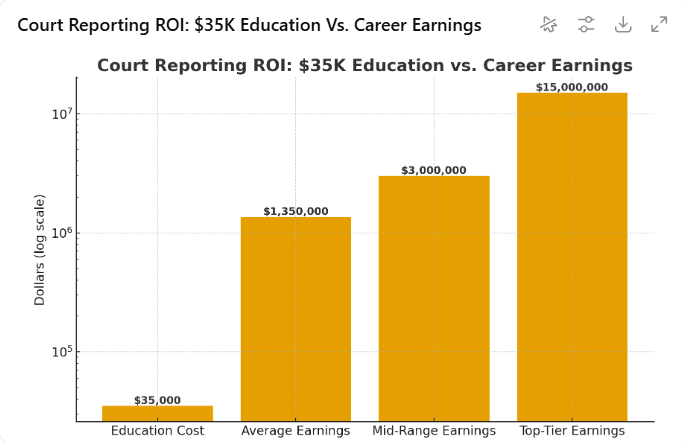
Court reporting may be the smartest career investment few people talk about. For about $35,000 in education, reporters can earn anywhere from $45,000 a year on average to $500,000+ at the top of the field. That’s a lifetime income range of $1.35 million to $15 million. Even at the low end, the ROI far outpaces most college degrees.
The Myth of Shortcuts in Court Reporting & Why Proper Training Matters

There are no shortcuts in court reporting. Learning how to “capture words” is only half the job. The real test is producing certified transcripts, understanding court procedures, and carrying the responsibility of the record. Quick-fix programs promise speed, but they leave students unprepared and the profession vulnerable. Proper training isn’t optional—it’s the only path to excellence.
The Digital Court Reporting Scam – How Aspiring Court Reporters Are Being Duped

Digital court reporting programs are misleading aspiring court reporters, especially in states like California, where digital recording of legal proceedings is illegal. Many students invest time and money in these courses, only to find out they do not lead to licensure. Universities continue to offer these programs for profit, despite their lack of credibility. Prospective students must research and choose accredited stenographic training instead.
Success in Court Reporting – The Grind, The Grit, and The Breakthrough

Success in court reporting demands perseverance, skill, and mental endurance. The journey is grueling, filled with long hours of practice, frustration, and doubt. But it’s the struggle that proves you’re on the right path. Every setback is an opportunity to grow, and breakthroughs come when you least expect them. Embrace the grind, push through the exhaustion, and remember—success is earned by those who refuse to quit. Keep going, your breakthrough is near.
The Best Teacher? Your Mistakes.

Mistakes are powerful teachers in court reporting. They highlight weaknesses, build resilience, and improve muscle memory. Instead of fearing errors, students should embrace them as learning opportunities. Keeping a mistake log, seeking feedback, and prioritizing accuracy over speed can accelerate growth. Even seasoned professionals make mistakes, but handling them with professionalism, continuous learning, and technology ensures progress. Every misstep is a stepping stone to mastery.
Unlock Your Full Potential with Strategic Rest: A Guide for Steno Students

Mastering stenography is a marathon, not a sprint. The best stenographers don’t just work hard; they rest smart. Strategic rest isn’t a weakness—it’s a competitive advantage. By integrating mental, physical, emotional, social, sensory, creative, and spiritual rest into your routine, you can boost focus, stamina, and success. Which type of rest do you need today? Small changes can make a big impact.
 STENOIMPERIUM