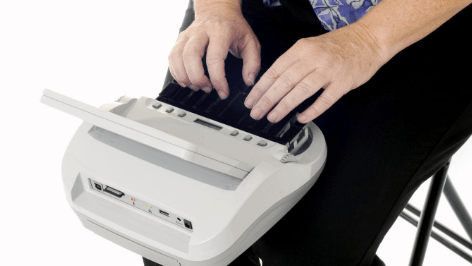
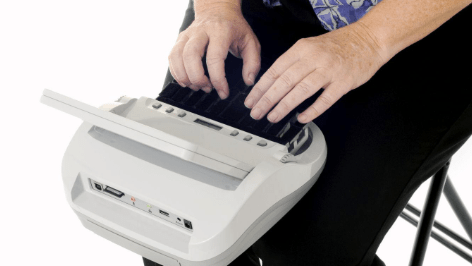
The New York Times article about pianist Nicolas Namoradze describes how brain imaging shows multiple neural networks activating during piano performance. These include motor control, auditory processing, and pattern recognition systems working simultaneously.
But pianists are generally doing something fundamentally different from court reporters:
They are executing music that already exists.
A pianist reads or memorizes a musical score and converts it into finger movements. The brain coordinates:
- which notes to play
- which fingers strike them
- timing and expression
Researchers describe the brain planning what note comes next and how it will be played.
In other words:
music → motor execution
Court reporters perform a much more complicated transformation.
The Real Cognitive Pipeline of Realtime Court Reporting
When a court reporter writes realtime shorthand, the brain processes a continuous cascade of information that looks more like simultaneous interpretation than musical performance.
The pipeline is closer to this:
sound → language comprehension → meaning → phonetic translation → shorthand encoding → motor execution → realtime English output
Each step requires a different cognitive system.
1. Auditory decoding
The reporter hears speech that is often:
- rapid
- overlapping
- accented
- interrupted
The brain must identify words from sound.
2. Language comprehension
Unlike a pianist, the reporter must understand the sentence.
Grammar matters. Context matters. Meaning matters.
The brain must determine:
- where clauses begin and end
- whether a phrase is a question
- whether a speaker misspoke
- what punctuation belongs
3. Translation into stenographic code
This is where the profession becomes unique.
The reporter converts spoken language into phonetic shorthand chords, which represent sounds rather than letters.
This translation occurs instantly.
4. Motor execution
Only after the translation occurs do the fingers move across the steno keyboard.
5. Continuous monitoring
The brain simultaneously monitors:
- accuracy
- context
- speaker identification
- formatting decisions
And it does this while continuing to listen to the next sentence.
The Key Difference: Meaning
The crucial difference between piano and stenography is semantic processing.
Music contains structure and emotion, but it does not require the performer to analyze grammar or meaning.
Language does.
Neuroscience research shows that while music and speech share some neural systems, they also activate distinct networks related to semantic meaning and syntax.
That means a realtime court reporter is activating additional cognitive systems that a pianist typically does not need during performance.
A reporter must decide, in milliseconds:
- Is this a statement or a question?
- Where does punctuation belong?
- Did the witness correct themselves?
- Is this a proper noun or common word?
Those are language-analysis decisions, not motor decisions.
Improvisation vs Translation
There is one area where piano and stenography overlap strongly: prediction.
Musicians anticipate musical phrases.
Court reporters anticipate linguistic ones.
But again, the reporter’s task is broader.
A pianist predicts notes.
A reporter predicts meaning and grammar.
For example, when a lawyer begins:
“Doctor, within a reasonable degree of medical probability…”
An experienced reporter’s brain already anticipates the rest of the phrase before it finishes.
But that anticipation is based on language patterns, not musical ones.
A Better Analogy Than Piano
If we were looking for the closest neurological comparison, realtime court reporting is actually more similar to:
simultaneous interpreters at the United Nations.
Those professionals must:
- hear speech
- understand it
- translate it into another language
- speak it immediately
Court reporters perform the same type of real-time transformation—but into stenographic code instead of another language.
The Steno Machine as a Cognitive Instrument
This is why the stenotype machine is so often misunderstood.
People assume it is a typing device.
In reality, it is more like a translation instrument.
The machine does not create the record.
The reporter’s brain does.
The machine merely captures the output.
Just as a piano converts finger motion into sound, the steno machine converts cognitive translation into written language.
What the Neuroscience Really Shows
The research on musicians like Namoradze highlights something important: highly trained performers develop brain networks that coordinate many systems simultaneously.
But realtime court reporters add another layer.
They are not simply performing learned patterns.
They are interpreting human language as it unfolds in real time.
That requires:
- linguistic analysis
- phonetic translation
- predictive processing
- high-speed motor control
All operating simultaneously.
The Quiet Virtuosity of the Courtroom
In the concert hall, the pianist sits under a spotlight.
In the courtroom, the court reporter sits quietly at the side.
Yet both are performing highly specialized cognitive feats.
The difference is that one performance produces music.
The other produces the permanent record of justice.
And unlike the pianist, the court reporter is not playing from a score.
The score is being written as it happens.
The comparison to piano performance is illuminating—but it also reveals something even more remarkable about realtime court reporting. A pianist typically performs from a written score, translating notes that already exist into motion and sound. A court reporter has no such script. The “score” arrives as unpredictable human speech—hesitations, accents, interruptions, half-finished sentences—and must be understood, interpreted, translated into stenographic code, and written in real time. Meaning, grammar, pronunciation, punctuation, and speaker context all have to be processed simultaneously while the next sentence is already arriving. If the pianist performs music, the court reporter composes the written score of language itself as it unfolds.
 STENOIMPERIUM