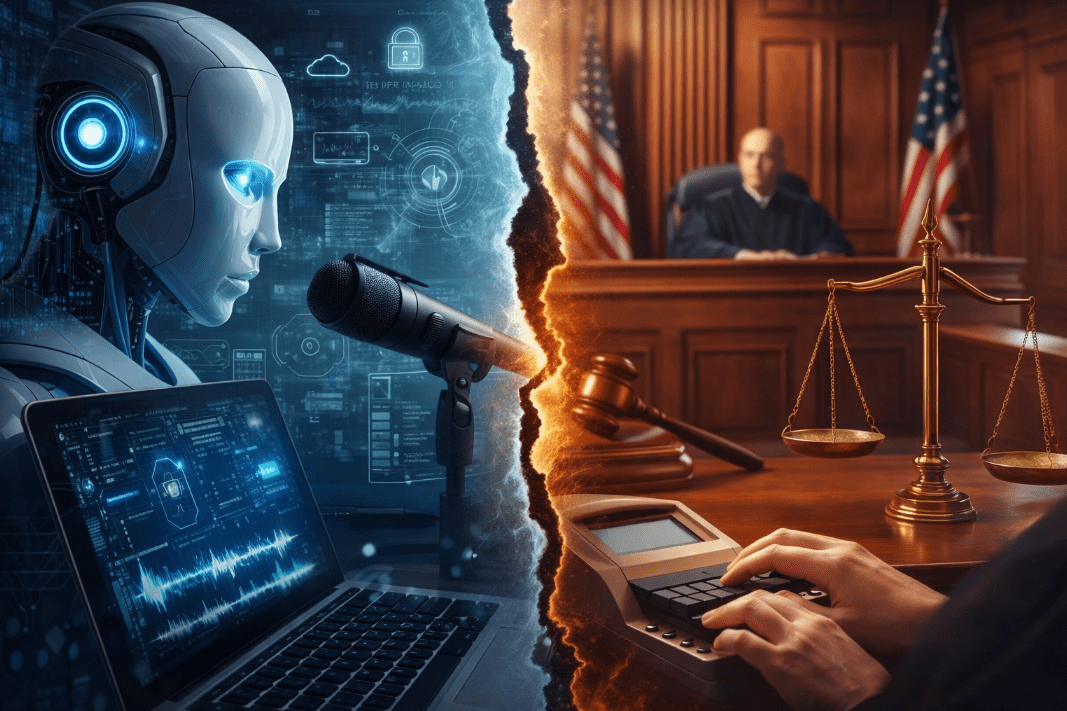
In a recent legal proceeding, an attorney made a brief announcement that captured a growing tension inside the legal profession. Due to concerns about artificial-intelligence notetaking software potentially violating confidentiality agreements, the attorney said, no AI notetakers would be permitted.
The statement was short and procedural. But the reasoning behind it reflected a deeper shift that is beginning to ripple through courtrooms, deposition suites, and law offices across the country.
For months, legal technology companies have promoted AI meeting assistants that promise to capture every word of a conversation, generate instant transcripts, and summarize discussions within seconds. The tools have spread rapidly in corporate environments and increasingly among lawyers. Yet the legal profession, governed by strict rules of confidentiality, privilege, and evidentiary control, is beginning to confront a difficult question: what happens when artificial intelligence quietly records the room?
Some attorneys now believe the answer is simple. It cannot.
The Legal Risk Beneath the Convenience
AI notetaking software functions by recording audio from conversations, converting speech into text, and processing the content through machine-learning systems. In many cases, that audio is uploaded to remote servers where the software performs its analysis.
In ordinary business meetings, this process raises few alarms. In legal proceedings, however, the implications are far more serious.
Courtrooms and depositions are governed by rules that carefully control how the record of a proceeding is created. Unauthorized recordings are often prohibited outright. Attorneys and parties operate under confidentiality agreements, protective orders, and attorney-client privilege that require sensitive discussions to remain secure.
When an AI notetaker records audio, the technology may capture far more than formal testimony. Off-the-record conversations, litigation strategy discussions, and privileged communications can all be swept into the recording stream and transmitted to third-party systems outside the courtroom’s control.
For lawyers trained to anticipate risk, that possibility has become increasingly difficult to ignore.
The Shadow Record Problem
Beyond confidentiality concerns lies another issue troubling many legal professionals: the creation of what some have begun calling a “shadow record.”
In formal proceedings, the official record is carefully maintained by licensed court reporters and governed by procedural rules. That record becomes the authoritative account of what occurred. Appeals, evidentiary rulings, and judicial decisions often depend on its accuracy.
AI notetaking systems, however, generate their own transcripts and summaries. These outputs are not certified, not subject to the same professional oversight, and not necessarily accurate. Yet they may circulate among attorneys, clients, or litigation teams.
The result is the potential for competing versions of events.
If an AI-generated summary differs from the official transcript, which version should be trusted? Could a party attempt to introduce an AI transcript as evidence? Could the existence of unofficial recordings create disputes about what was actually said?
The law has not yet fully answered these questions. But many attorneys see the risk and are choosing to avoid it altogether.
The Influence of the Heppner Decision
Legal caution around recording technology is not new. Courts have long recognized that unauthorized recordings can undermine confidentiality and the integrity of proceedings. One decision frequently cited in discussions about electronic recording in legal settings is Heppner v. United States.
In Heppner, the court addressed concerns about unauthorized recordings and the risks they pose to confidential communications and the administration of justice. The case underscored the principle that legal proceedings require controlled methods of documentation and that unauthorized recording devices can threaten both privacy and evidentiary reliability.
While the case predated modern artificial-intelligence tools, its reasoning resonates today. AI notetakers, after all, function as recording devices first and analytical tools second.
For attorneys aware of the Heppner decision, the legal implications are clear. Introducing software that secretly records proceedings may violate not only courtroom rules but also long-standing legal principles governing confidentiality and evidence.
The Ethical Dimension
Lawyers are also bound by professional ethics rules that require them to safeguard client confidences and supervise the technologies they use in practice.
Bar associations across the United States have increasingly warned attorneys to exercise caution when adopting new technologies. Ethical opinions emphasize that lawyers must understand how software handles client data and must ensure that confidential information is not exposed to unauthorized parties.
AI notetaking software presents a unique challenge in this regard. Many platforms rely on complex networks of cloud servers, data processors, and machine-learning models. Even the developers of these systems may not fully control how training data is handled or stored.
For attorneys, the ethical question becomes unavoidable: can they guarantee that privileged communications remain protected once an AI tool begins recording?
If the answer is uncertain, many lawyers conclude the safest course is to prohibit the technology entirely.
Judges Are Noticing
In courtrooms across the country, judges are beginning to confront these issues as well.
Some have already issued orders banning unauthorized recording devices during proceedings. Others have instructed attorneys to disable laptops or internet connections when concerns arise about hidden recording functions.
As AI notetaking tools become more common, judges may increasingly face situations where attorneys attempt to use software that silently records and processes conversations.
The legal system, which moves deliberately and cautiously, will likely address these questions through a combination of judicial rulings, local rules, and professional guidance.
For now, many judges appear inclined toward the simplest solution: if a device records audio, it may not belong in the room.
Rediscovering the Human Record
The debate over AI notetakers has also prompted renewed attention to the role of the official record.
For generations, courts have relied on trained professionals to capture proceedings accurately and impartially. Court reporters operate under strict licensing requirements and professional codes of conduct. Their transcripts are certified documents that courts trust when making decisions.
Unlike automated systems, human reporters are accountable. Their work is subject to oversight, ethical obligations, and professional discipline.
In an era increasingly fascinated with automation, the legal system may be rediscovering the value of that human responsibility.
A Turning Point
The attorney who recently banned AI notetakers from a proceeding may have viewed the decision as routine risk management. Yet moments like this often mark the beginning of broader change.
When one lawyer raises a concern, others begin asking questions. Law firms review their policies. Judges take notice. Professional organizations begin drafting guidance.
Gradually, what begins as an isolated decision can reshape professional norms.
Artificial intelligence will undoubtedly play a role in the future of law. But the legal system has always demanded that new tools meet the profession’s fundamental requirements: confidentiality, reliability, and trust.
If AI notetakers cannot satisfy those standards, they may find themselves excluded from the very rooms they were designed to assist.
For now, the message emerging from at least one courtroom is clear.
The technology may be powerful. But in the practice of law, power alone is not enough.
Sometimes, protecting the integrity of the record means simply refusing to press “record.”
 STENOIMPERIUM