The Illusion of a Weightless Technology
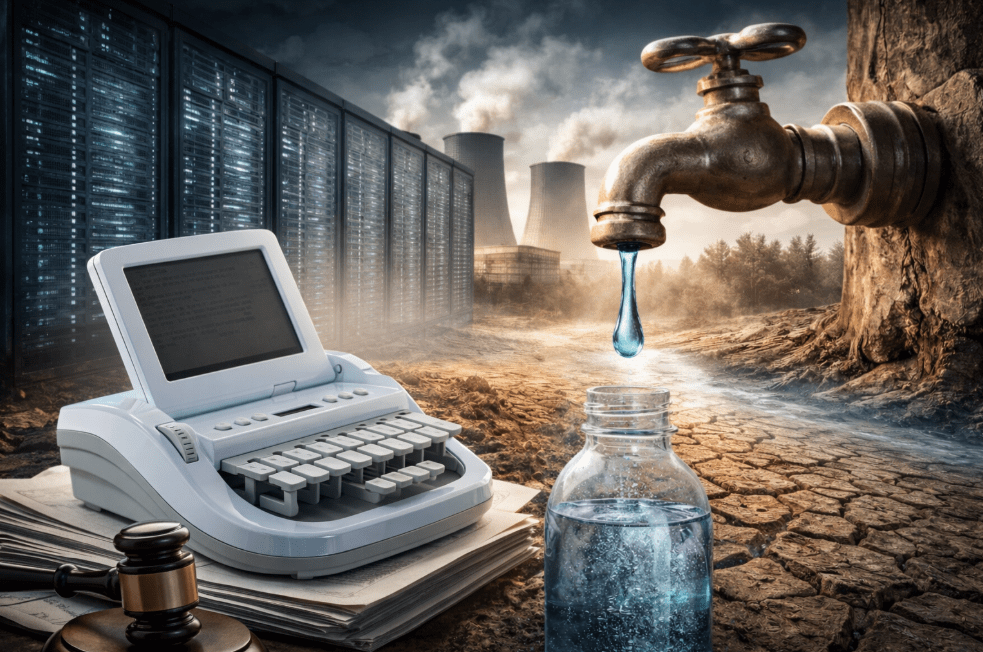
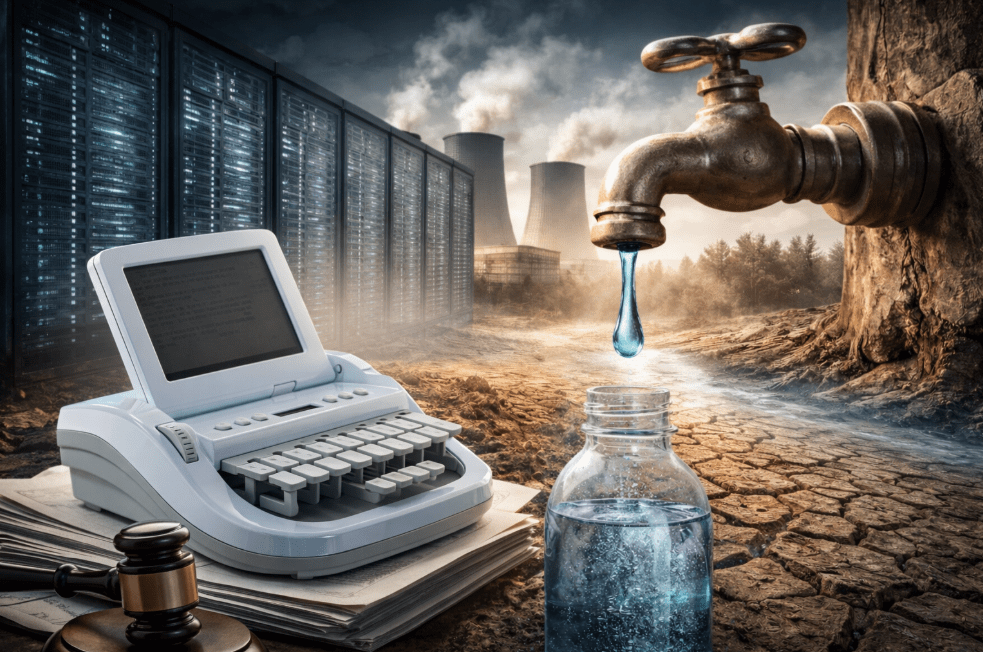
Artificial intelligence is often described as “the cloud,” a frictionless digital layer that floats above the physical world. In reality, the infrastructure powering modern AI is deeply rooted in concrete, steel, and—critically—water. Every automated transcript, every AI-generated summary, and every voice-to-text conversion is processed in massive data centers that must be continuously cooled to avoid overheating. The result is a resource footprint that is neither virtual nor abstract. It is physical, measurable, and increasingly difficult to justify in industries that depend on large volumes of text generation, such as law.
A growing body of environmental research has begun to quantify this hidden cost. Analysts now estimate that every 20 to 50 prompts to a large language model may consume roughly the equivalent of a 500-milliliter bottle of water, largely for cooling the servers that produce the response. This translates to approximately 10 to 25 milliliters per individual query. The numbers appear trivial until they are placed in context. A typical professional using AI throughout a workday can easily generate dozens or even hundreds of prompts, quietly consuming liters of water through invisible infrastructure.
For the legal industry—where transcript generation, discovery review, deposition summaries, and real-time speech recognition could require thousands of AI interactions per case—the cumulative footprint becomes impossible to ignore.
Why AI Systems Consume Water in the First Place
The primary reason AI requires water is not the algorithm itself but the hardware running it. Data centers generate enormous heat while processing large computational workloads. Without cooling, servers would fail. Water—used either directly or indirectly—is one of the most efficient methods for dissipating that heat.
Cooling systems can consume between 1.8 and 12 liters of water per kilowatt-hour of electricity used, meaning that the energy demand of AI workloads is inseparable from their water demand. Even when water is not used directly inside the facility, additional water is often consumed upstream in power generation and semiconductor manufacturing, meaning many official estimates undercount the true footprint.
This dependence on water is structural rather than incidental. Without continuous cooling, data-center hardware would overheat and shut down. In other words, the environmental cost is not a temporary inefficiency that can be eliminated with software updates; it is a built-in requirement of the computational architecture that powers modern AI.
The Scale Problem: Small Drops, Massive Volumes
Per-query estimates vary widely depending on methodology and infrastructure. Some recent efficiency-based calculations suggest roughly 0.32 milliliters of water per prompt under optimized conditions. Other studies treat earlier figures—10 to 25 milliliters per prompt—as upper-bound scenarios reflecting less efficient systems or broader lifecycle accounting.
The discrepancy does not eliminate the concern; it highlights how sensitive the footprint is to location, cooling method, and energy source. Even at the lowest estimates, large-scale usage quickly becomes significant. One billion daily AI queries could require hundreds of thousands of liters of water per day.
At the infrastructure level, the impact is far more dramatic. Global projections suggest AI-related data centers could consume more than one trillion liters of water annually within a few years. Separate analyses warn that total AI demand could reach hundreds of billions of liters per year, rivaling the volume of bottled water consumed globally.
These figures reveal the core sustainability dilemma: AI’s environmental impact is driven not by any single interaction but by aggregate demand.
The Legal Industry’s Unique Exposure
Few professions generate more text per hour than the legal system. Depositions, hearings, arbitrations, trials, and appellate proceedings produce enormous volumes of spoken language that must be converted into accurate, permanent records. Historically, this work has been performed by human stenographers using specialized equipment with minimal environmental overhead.
AI-driven transcription systems fundamentally change that equation. Real-time speech recognition, automated transcript generation, and AI-assisted document review rely on continuous computational processing, rather than localized mechanical input. Each proceeding may require thousands of inference requests as audio is streamed, segmented, interpreted, and formatted.
Research suggests that inference—the stage where users interact with AI—can exceed the environmental cost of training by a factor of up to twenty-five times annually due to constant usage. In the legal sector, where proceedings run for hours or days and transcripts must be revisited repeatedly, the operational footprint becomes persistent, rather than episodic.
A single medium-length AI-generated email may consume several liters of water, depending on the model and region, while larger document generation tasks can require substantially more. Multiply those demands across thousands of cases nationwide, and the shift from human stenography to cloud-based transcription becomes an environmental scaling problem, rather than a technological upgrade.
Data Centers and Water Stress
The sustainability issue is intensified by geography. Nearly half of the world’s data centers are already located in regions experiencing high water stress. Facilities in drought-prone areas of the American Southwest, Spain, and Chile have faced public criticism for consuming millions of liters of water daily for cooling.
This creates a troubling ethical tension. The same freshwater resources needed by agriculture, ecosystems, and local communities are being redirected to support computational workloads. UNESCO has emphasized that access to water is a fundamental human right, raising questions about whether high-consumption digital infrastructure should expand in water-scarce regions.
For the legal system—an institution grounded in public trust—the optics are particularly problematic. Replacing human professionals with technology that draws heavily from already-strained water supplies risks creating a perception that efficiency is being prioritized over stewardship.
Hidden Lifecycle Costs
Most public discussions focus on real-time AI usage, but the environmental footprint begins long before the first transcript is generated. Training large language models can consume millions of liters of water, even in highly efficient facilities. Hardware manufacturing, semiconductor fabrication, and electricity generation add additional layers of water consumption that are rarely disclosed in detail.
Lifecycle analyses show that model development itself can account for roughly half the environmental impact of training, illustrating how deeply embedded resource use is within the AI supply chain.
In practical terms, this means that every automated transcript produced in the future carries a portion of water consumption that occurred years earlier during model creation. The resource cost is cumulative, not transactional.
Rising Demand and Limited Transparency
Despite growing concern, comprehensive reporting on AI-related water use remains inconsistent. Policy experts have called for mandatory disclosure of data-center energy and water consumption because the rapid expansion of AI infrastructure is straining critical resources.
Even where companies have released partial figures, the data is often fragmented. Some facilities report direct cooling usage but exclude indirect water used in electricity production. Without full lifecycle accounting, regulators and industries adopting AI—including the legal sector—cannot accurately assess environmental trade-offs.
This lack of transparency creates a risk of institutional dependency on technology whose long-term sustainability profile remains uncertain.
Efficiency Gains—and the Rebound Effect
Technology companies are actively pursuing solutions such as liquid cooling, recycled water systems, and geographic optimization of data-center locations. Advanced cooling methods can reduce water use by up to 90 percent compared with older systems.
However, efficiency improvements often trigger what economists call the Jevons Paradox: as systems become more efficient, usage increases, offsetting environmental gains. AI adoption is accelerating across nearly every industry, suggesting that total water consumption may continue rising even as per-query efficiency improves.
For legal workflows, this dynamic is particularly relevant. As AI transcription becomes cheaper and faster, it is likely to be used more frequently—expanding overall resource demand, rather than reducing it.
Comparing Human and Machine Footprints
Traditional stenographic reporting relies primarily on human labor and mechanical equipment, with minimal ongoing resource consumption beyond electricity for lighting and devices. AI transcription shifts that burden to centralized infrastructure requiring continuous cooling, energy generation, and hardware replacement.
From a sustainability perspective, the comparison is not between two digital tools but between a human-centered system and an industrial computing network. When scaled across thousands of daily proceedings, the environmental difference becomes substantial.
In an era when courts are under pressure to demonstrate responsible stewardship of public resources, adopting a technology that quietly consumes large volumes of freshwater raises policy questions that extend beyond cost or convenience.
The Ethical Dimension of Water Allocation
Globally, more than two billion people still lack reliable access to safe drinking water. Against that backdrop, allocating billions of liters annually to AI infrastructure introduces a moral dilemma about priorities.
Is it justifiable for routine administrative tasks—such as generating transcripts—to rely on resource-intensive systems when lower-impact alternatives exist? The question is not whether AI has value, but whether every use case warrants its environmental cost.
The legal system, which routinely adjudicates questions of equity and public interest, may eventually be forced to confront its own role in this allocation of scarce resources.
A Sustainability Threshold for Legal Technology
AI offers undeniable advantages in speed and scalability. Yet sustainability is not measured solely by efficiency; it is measured by long-term resource viability.
If AI-driven transcription requires continuous expansion of water-intensive data centers, the model may prove incompatible with regions already facing drought, infrastructure strain, and climate volatility. Projections suggest AI servers alone could drive hundreds of billions of gallons of additional water consumption in the United States within the decade.
At that scale, the environmental cost is no longer marginal. It becomes systemic.
Toward Responsible Adoption
The path forward is not necessarily to abandon AI but to apply stricter standards for when and how it is used. Experts increasingly argue that sustainability reporting, geographic planning, and right-sizing models for specific tasks are essential to reducing environmental harm.
For the legal industry, this may mean reserving AI for functions where it delivers clear public benefit—such as accessibility tools—while maintaining lower-impact methods for routine record creation.
Absent such guardrails, the shift toward automated transcripts risks embedding a hidden environmental liability into the core infrastructure of the justice system.
The Cost Behind the Convenience
AI-generated transcripts promise speed, scalability, and lower apparent labor costs. Yet beneath that convenience lies a resource footprint measured not just in kilowatt-hours, but in liters of freshwater drawn from finite supplies.
Each interaction may consume only drops or milliliters, but billions of interactions translate into reservoirs of water diverted toward computation. The legal industry, with its uniquely text-heavy workflow, stands to become one of the most intensive users of this infrastructure.
Sustainability is ultimately a question of proportionality. When a technology designed to produce words on a screen requires industrial-scale water consumption to function, its long-term viability must be examined with the same rigor applied to any other public utility.
The record—ironically—may show that the most environmentally responsible transcript is still the one created by a human, using skill, rather than servers, and leaving behind no invisible trail of evaporated water.
Disclaimer
This article is an opinion and analysis based on publicly available research regarding AI infrastructure, environmental impact, and water consumption estimates. Figures vary by methodology, location, and technology. The discussion is intended to encourage informed policy dialogue within the legal community and should not be interpreted as a claim about any specific company, product, or courtroom system.
 STENOIMPERIUM