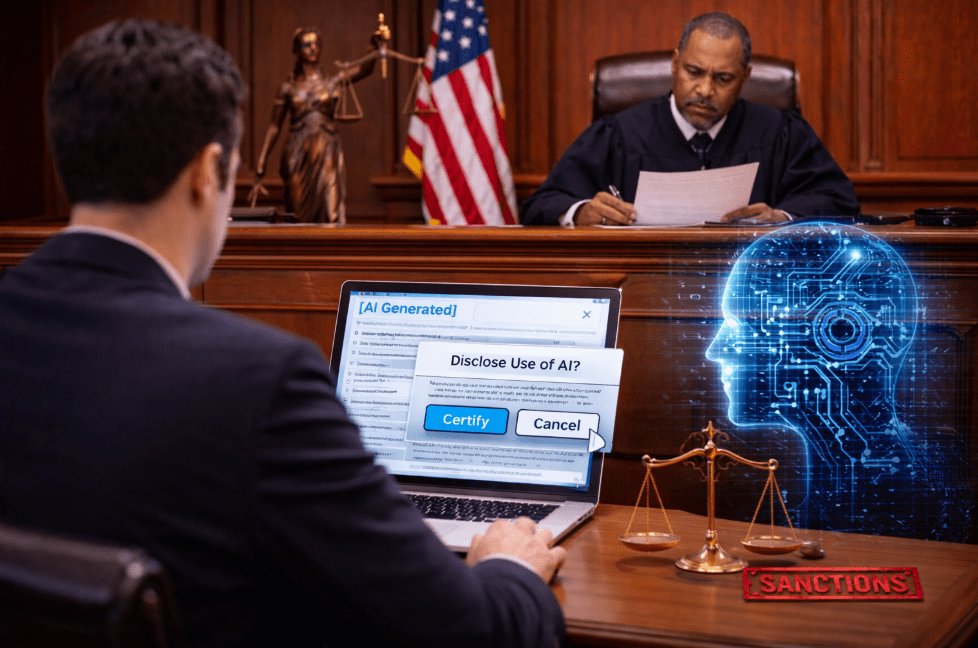
In a significant development reflecting the judiciary’s growing concern about the rapid adoption of artificial intelligence in legal work, two of Florida’s largest judicial circuits have issued orders requiring lawyers and self-represented litigants to disclose and certify the use of generative AI in court filings. The policy shift represents one of the clearest signals yet that courts intend to preserve the integrity of the judicial record while adapting to emerging technologies that are already reshaping how legal documents are created. The move is not a prohibition on AI, but rather a structured attempt to impose transparency, reinforce professional responsibility, and prevent the submission of inaccurate or fabricated legal authority.
At the heart of these new requirements is a simple but consequential premise: the use of artificial intelligence does not diminish an attorney’s duty to the court. Courts have increasingly recognized that generative AI tools can produce persuasive language, but they can also generate incorrect or entirely fictitious citations—a phenomenon widely referred to as “hallucinations.” Because the legal system depends on accurate authority and reliable factual assertions, even a single fabricated citation can undermine judicial decision-making and public trust. The Florida orders respond to this risk by requiring disclosure, verification, and certification of responsibility whenever AI contributes to a filing.
The Eleventh Judicial Circuit, which includes Miami-Dade County, issued an administrative order applying to both attorneys and self-represented litigants appearing before its circuit and county courts. The order requires that anyone who uses a generative AI tool in preparing a pleading, motion, memorandum, response, proposed order, or other court record must disclose that use “on the face of the filing.” The required disclosure is paired with a certification affirming that all factual assertions, legal authorities, and citations have been independently reviewed and verified for accuracy. This language underscores that AI may assist in drafting, but responsibility for the final product remains squarely with the filing party.
The Eleventh Circuit’s order goes further by emphasizing that the use of generative AI does not relieve attorneys or litigants of their duty of candor to the tribunal or their obligation to comply with statutes, procedural rules, and professional conduct requirements. In practical terms, the court is reinforcing a foundational ethical principle: technology may change the tools lawyers use, but it does not change the standard of professional accountability. The order also explicitly prohibits submitting fictitious or fabricated legal authority or relying on AI-generated citations without independent verification.
The Seventeenth Judicial Circuit, which covers Broward County, adopted a similar framework through amendments to its case management orders and administrative directives. Under those provisions, any filing that contains AI-generated content must disclose that fact and include a certification that the attorney or pro se party has personally reviewed and verified the accuracy of the material. The requirement applies broadly to documents drafted with AI assistance, reinforcing that technological convenience cannot replace traditional legal diligence.
The Seventeenth Circuit also makes clear that sanctions may follow noncompliance. Potential consequences include striking pleadings, imposing fines, awarding attorney’s fees, or referring the matter for disciplinary proceedings. This enforcement mechanism reflects the judiciary’s concern that undisclosed or unchecked AI use could compromise the integrity of the court record. By attaching real consequences, the courts signal that disclosure is not a formality but a substantive obligation tied to professional responsibility.
These orders do not ban the use of artificial intelligence. Instead, they acknowledge that AI tools are already embedded in modern legal workflows. Many platforms now assist attorneys with research, drafting, document organization, and case analysis. Courts recognize that such tools can increase efficiency and reduce costs, but they also insist that innovation must be paired with oversight. As one analysis of the new requirements explains, the rules emphasize that lawyers remain fully responsible for verifying facts, citations, and legal arguments, and that ethical and procedural rules continue to apply regardless of technology used.
The rationale behind the disclosure requirement is rooted in both practical experience and recent cautionary examples. Courts across the country have encountered filings containing nonexistent cases or misquoted authority generated by AI tools. These incidents have highlighted the danger of relying on automated outputs without independent verification. The Florida orders explicitly reference the possibility that AI can produce inaccurate or fabricated information and emphasize the need for human oversight before such material enters the judicial record.
Another notable feature of the orders is that they apply equally to attorneys and self-represented litigants. This reflects the judiciary’s recognition that AI tools are widely accessible and increasingly used by individuals without formal legal training. By imposing the same disclosure and certification requirements on all filing parties, the courts aim to create a uniform standard of reliability for submissions. The message is clear: regardless of who drafts a document—or what technology assists—the responsibility for accuracy belongs to the person who signs it.
The certification language itself is significant because it transforms what might otherwise be an informal workflow into a documented professional representation to the court. When an attorney certifies that AI-generated content has been independently verified, that statement becomes part of the official record and may be scrutinized if inaccuracies later emerge. In effect, the certification requirement functions as both a deterrent against careless reliance on AI and a mechanism for accountability if errors occur.
These developments also intersect with broader ethical guidance within the legal profession. The Florida Bar has recognized that lawyers may ethically use generative AI, but only if they adhere to their existing obligations of competence, diligence, and candor. The new court orders operationalize that principle at the procedural level, translating ethical expectations into concrete filing requirements. By doing so, the judiciary is not creating entirely new duties but rather reinforcing long-standing ones in the context of emerging technology.
The implications for law firms and legal departments are substantial. Firms must now evaluate their internal workflows to ensure compliance with court-specific disclosure rules. This may involve implementing review protocols, training attorneys on the risks of AI-generated content, and developing standardized certification language for filings. The orders effectively push legal organizations to adopt governance structures around AI use, similar to the quality-control processes that already exist for research and citation verification.
From a broader perspective, the Florida directives illustrate a national trend toward regulating AI in the courtroom through procedural safeguards rather than outright restrictions. Courts are attempting to strike a balance between embracing innovation and preserving the reliability of judicial proceedings. By requiring disclosure instead of banning AI, the judiciary acknowledges that the technology offers legitimate benefits while insisting that those benefits cannot come at the expense of accuracy or ethical compliance.
The emphasis on transparency also has implications for judicial efficiency. When courts know that AI was used in preparing a filing, they can evaluate the document with an understanding of the potential risks associated with automated drafting. This does not mean that AI-assisted filings are inherently suspect, but it provides context that may be relevant if unusual or questionable citations appear. In this sense, disclosure serves as a form of procedural honesty that supports more informed judicial review.
For litigants, these policies reinforce the idea that the credibility of a legal argument depends not only on its substance but also on the reliability of its sources. Courts rely heavily on cited authority when making decisions, and any erosion of confidence in those citations can have systemic consequences. By requiring verification and certification, the Florida circuits are attempting to safeguard the evidentiary and precedential foundations of judicial decision-making.
The new requirements may also influence how legal education and continuing professional development address technology competence. As AI tools become more common, attorneys must understand both their capabilities and their limitations. Training will likely shift toward teaching lawyers how to use AI responsibly—verifying outputs, cross-checking citations, and recognizing when automated suggestions may be unreliable. The disclosure mandates effectively institutionalize that expectation within day-to-day litigation practice.
Ultimately, the Florida orders represent an early but important step in defining how artificial intelligence will coexist with the traditional responsibilities of the legal profession. They acknowledge that AI is not a passing trend but a permanent feature of modern practice. At the same time, they reaffirm that the core principles of candor, diligence, and accountability remain unchanged. Technology may assist in drafting a motion, but it cannot assume ethical responsibility for what is filed in court.
As other jurisdictions watch these developments, similar disclosure and certification requirements are likely to spread. The legal system has historically adapted to new technologies—from electronic filing to digital evidence—by creating procedural safeguards that preserve trust in the record. The current wave of AI regulation appears to follow that same pattern. Rather than resisting innovation, courts are setting boundaries designed to ensure that efficiency gains do not compromise accuracy.
In the end, the message from Florida’s largest judicial circuits is unmistakable: artificial intelligence can be a powerful tool, but it is not a substitute for professional judgment. Lawyers and litigants remain the guardians of the record, responsible for every fact, citation, and argument they present to the court. By mandating disclosure and certification of AI use, the judiciary is reinforcing a simple but essential principle—that the integrity of the justice system depends on human accountability, even in an era increasingly shaped by machines.
Disclaimer
This article is provided for informational and educational purposes only and does not constitute legal advice. Court rules and administrative orders may change, and application varies by jurisdiction and case. Attorneys and parties should review the relevant administrative orders and consult qualified counsel or local court guidance before relying on AI-assisted drafting in any filing.
 STENOIMPERIUM