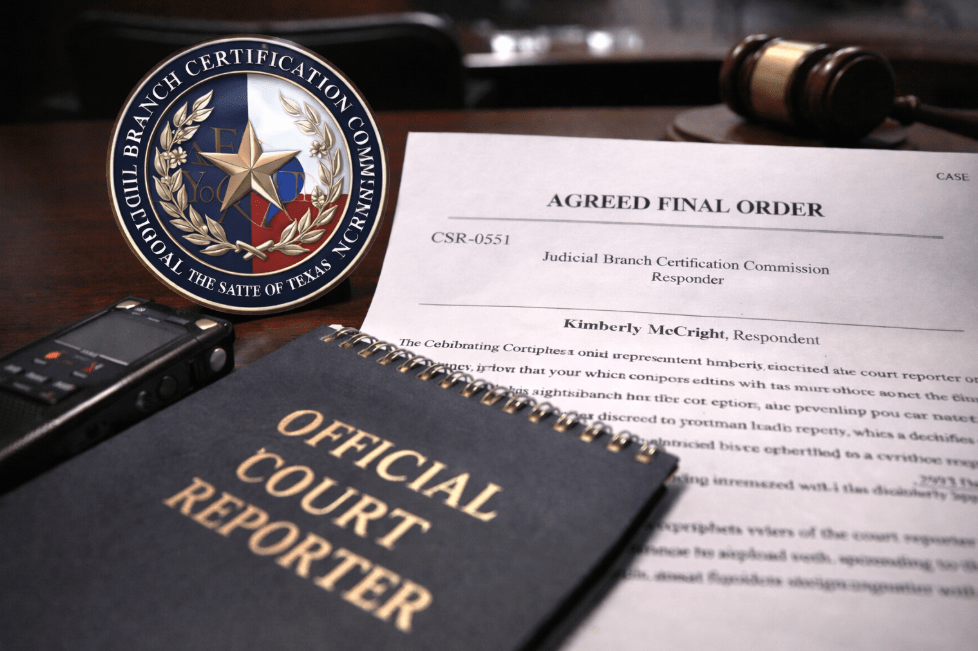
On November 7, 2025, a regulatory action by the Judicial Branch Certification Commission (JBCC) in Texas drew attention within segments of the court reporting community because it addressed an issue that has become increasingly central to the national debate over record-making: who may present themselves to the public as a court reporter, and under what terminology. The matter involved Kimberly McCright and resulted in a formal agreed order tied to the Commission’s authority over court reporter certification.
Although the case did not arise from a fully litigated hearing, and was instead resolved through a negotiated settlement, the documents associated with the proceeding provide a useful window into how at least one state regulator is approaching questions of professional title usage and consumer perception in a rapidly changing reporting landscape.
The Regulatory Framework Behind the Action
The JBCC is the Texas regulatory body responsible for certifying court reporters, registering court reporting firms, and enforcing compliance with statutes and administrative rules governing the profession. Like many licensing agencies, its authority is grounded in the principle that certain professional titles carry legal meaning because the public relies on them to signal training, credentialing, and accountability.
Texas law restricts the use of the title “court reporter,” or similar representations, to individuals who hold the appropriate certification. The policy rationale is straightforward: when attorneys, judges, or members of the public see the phrase “court reporting,” they are entitled to assume that the individual or service provider meets the state’s established competency and ethical standards.
This is not unique to Texas. Licensing systems across the country—from medicine to engineering to accounting—operate on the same premise. Titles are not merely descriptive; they function as consumer-protection mechanisms.
What the Official Record Indicates
According to the JBCC’s publicly available disciplinary materials, the matter involving Kimberly McCright was docketed under a court reporter certification cause number and ultimately resolved through a final agreed order. The Commission’s records indicate that Ms. McCright had never been certified as a court reporter by the state authority.
The underlying complaint centered on how services were described to the public on a company website. The materials referenced language such as:
- “Digital Court Reporting/Recording”
- Personnel described as “digital reporters”
The Commission’s position, as reflected in the order, was that such terminology could create the impression that certified court reporting services were being offered when, in fact, the individuals performing the work were not licensed shorthand reporters under Texas law.
The agreed resolution avoided a contested hearing. As is typical in administrative enforcement, the settlement language notes that the respondent entered into the agreement to resolve the matter without the expense and uncertainty of litigation, while the agency would otherwise bear the burden of proving a violation at hearing.
This procedural posture is important. An agreed order is not the same as a judicial finding after trial. It is, however, an official regulatory action that reflects the agency’s interpretation of its governing statutes and rules.
Why Terminology Became the Central Issue
At the heart of the JBCC’s action was not the existence of digital recording technology itself. Courts and litigants have used audio capture tools in various contexts for decades. Instead, the focus was on how the service was presented to the public.
Licensing boards routinely evaluate whether marketing language could mislead consumers into believing they are receiving services from a credentialed professional when that is not the case. In this instance, the Commission viewed the phrase “digital court reporting” and the label “digital reporter” as potentially implying equivalency with the licensed role of a certified court reporter.
From a regulatory standpoint, this distinction matters because the official record in legal proceedings carries evidentiary consequences. Attorneys rely on the accuracy, neutrality, and procedural compliance associated with certified reporters. If terminology blurs those distinctions, the risk is not merely semantic—it affects expectations about reliability and accountability.
The Broader Context – A Profession in Transition
The JBCC’s action did not occur in a vacuum. Over the past decade, the court reporting field has experienced significant change driven by:
- Expansion of digital recording vendors
- Growth of remote proceedings
- Increased marketing of “method-agnostic” record-making solutions
- Ongoing shortages of trained stenographic reporters in some regions
As new service models emerge, terminology has become contested territory. Companies frequently adopt language that signals familiarity to attorneys—terms like “reporting,” “record,” or “official transcript”—even when the underlying workflow differs from traditional stenographic practice.
Regulators are therefore faced with a recurring question: At what point does marketing language cross from descriptive into potentially misleading?
The McCright matter illustrates one instance in which a state authority concluded that the line had been crossed, or at minimum, that the risk of public confusion warranted enforcement action.
Why Title Protection Exists in Licensed Professions
Title protection is sometimes misunderstood as protectionism. In reality, its legal purpose is consumer clarity. When a profession is licensed, the state is effectively telling the public: “If someone uses this title, they have met defined standards.”
In the court reporting context, those standards typically include:
- Demonstrated speed and accuracy benchmarks
- Knowledge of legal procedure
- Ethical obligations regarding neutrality and record preservation
- Accountability through disciplinary oversight
If unlicensed providers can use substantially similar titles, the signal to the consumer becomes diluted. That dilution is precisely what licensing boards are designed to prevent.
The JBCC’s action suggests that Texas views certain phrasing—particularly when paired with the words “court reporting”—as sufficiently close to the protected designation that it could mislead a reasonable consumer.
What the Order Does—and Does Not—Establish
It is important to read the regulatory outcome with precision.
The action does not establish that:
- Digital recording technology is prohibited in Texas
- Alternative record-making methods are unlawful
- The phrase “digital reporter” is banned in all contexts
What it does demonstrate is that:
- The state may intervene when marketing language implies certified status
- Public-facing descriptions of services fall within regulatory scrutiny
- The title “court reporter” retains protected meaning under Texas law
This is a narrower, but still significant, conclusion.
Why This Matters Beyond Texas
Although the JBCC’s jurisdiction is limited to Texas, regulatory trends often influence national conversations. When one state enforces title protection, it signals that at least some licensing authorities remain attentive to how evolving technologies are presented to the public.
For attorneys and court administrators, the takeaway is practical, rather than ideological: terminology on a vendor’s website may have legal implications. For service providers, the message is equally clear—marketing language should be carefully aligned with actual credentialing status.
Other states may reach different conclusions or apply their statutes differently. But the existence of enforcement in a large jurisdiction underscores that the issue is not merely theoretical.
The Role of Agreed Orders in Professional Regulation
Agreed orders are a common tool used by licensing boards to resolve disputes efficiently. They allow regulators to address potential violations without the time and expense of formal hearings, while giving respondents an opportunity to resolve the matter without admitting liability beyond the negotiated terms.
From a public-policy perspective, these orders serve two purposes:
- They correct or clarify conduct in the specific case.
- They communicate the agency’s interpretation of its rules to the broader marketplace.
The McCright order functions in both ways. It resolves the immediate dispute and signals how the Commission views certain representations about court reporting services.
Optics, Trust, and the Integrity of the Record
Ultimately, the significance of the JBCC’s action lies in the intersection of language and trust. Legal proceedings depend on a reliable record. That reliability is not only technical; it is institutional. Participants must understand who is creating the record, under what authority, and with what qualifications.
When terminology becomes ambiguous, confidence can erode—even if the underlying technology is capable. Regulators therefore tend to prioritize clarity over marketing flexibility.
The Texas action suggests that, at least in this instance, the Commission concluded that clearer distinctions were necessary to protect the public’s understanding of who is—and is not—a certified court reporter.
A Signal About the Continuing Importance of Professional Designations
The debate over record-making methods will likely continue as technology evolves. Yet one constant across licensed professions is the enduring importance of accurate titles. Whether the field is medicine, law, engineering, or court reporting, the public relies on professional designations to navigate complex services.
The JBCC’s action involving Kimberly McCright does not settle the broader national discussion. It does, however, provide a concrete example of a regulator stepping in when terminology was perceived to blur the boundary between licensed and unlicensed roles.
In that sense, the case is less about any single individual and more about a structural principle: when a title carries legal meaning, how it is used matters.
As courts, vendors, and practitioners continue to adapt to new technologies, the balance between innovation and clarity will remain a central challenge. The Texas proceeding is one data point in that evolving landscape—an illustration that even as methods change, the legal weight attached to professional titles has not disappeared.
Disclaimer:
This article is based on publicly available regulatory documents and is intended for informational and professional analysis purposes only. It summarizes the existence and general nature of an agreed administrative order and does not assert additional facts, motives, or misconduct beyond what is reflected in the official records. It is not legal advice.
 STENOIMPERIUM