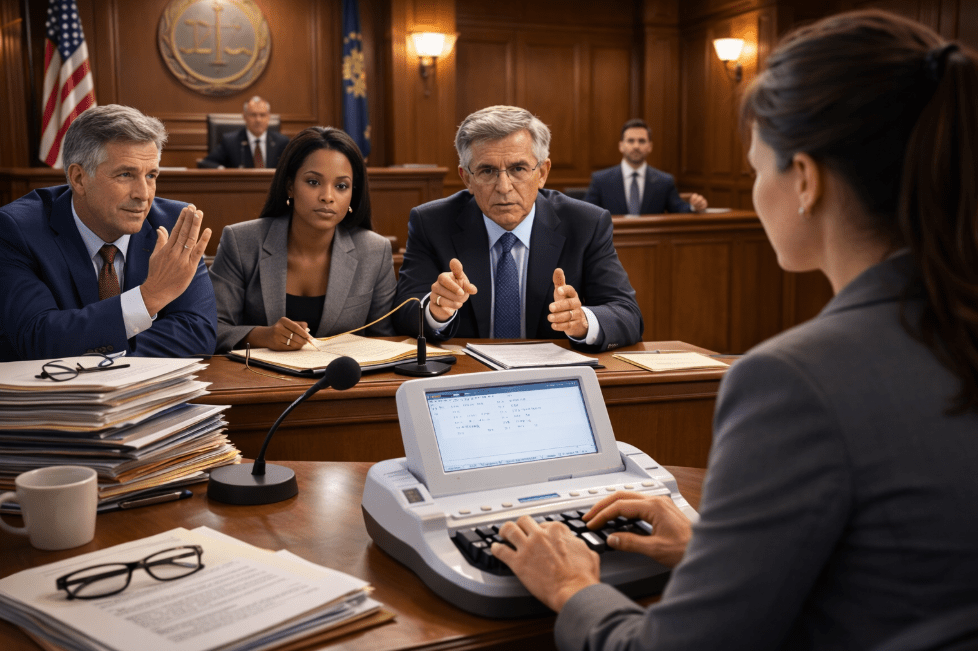
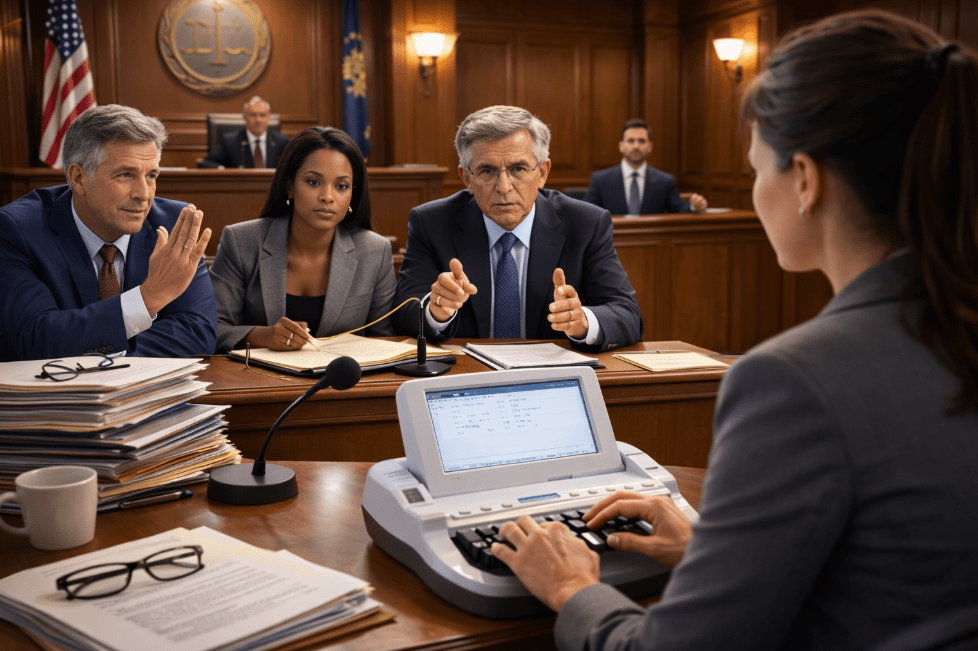
In a recent online discussion within a professional forum, an anonymous court reporter described a level of fatigue and discouragement that should give every practicing attorney pause. The reporter wrote of “constant disrespect” and of proceedings conducted at speeds in the 400-words-per-minute range with little apparent concern for whether the record could be captured accurately. The post ended with a stark admission: a desire to leave the profession altogether.
The identity of the individual and the forum in which the comment appeared are not the point. What matters is what the sentiment reveals about a growing strain inside courtrooms, conference rooms, and remote proceedings across the country. When the professionals charged with preserving the official record feel ignored, rushed, or treated as an afterthought, the integrity of that record—and the interests it protects—are placed at risk.
For attorneys, this is not a peripheral issue. It is a core litigation concern.
The official record is not merely a transcript. It is the evidentiary backbone of motion practice, appellate review, settlement leverage, impeachment, and ultimately the legitimacy of the adjudicative process itself. Every objection, every ruling, every clarification lives or dies based on what is preserved accurately and completely. When proceedings are conducted at speeds that exceed what can reasonably be captured, the risk is not simply reporter frustration—it is the creation of gaps, ambiguities, or errors that may surface months or years later when the case is no longer in your control.
In many litigation settings, attorneys understandably operate under intense time pressure. Trial days are short. Judges run tight calendars. Clients are paying by the hour. Witnesses are difficult to schedule. The instinct to move quickly is real and often justified. But speed without regard for the record is not efficiency. It is deferred risk.
Consider the practical consequences. When testimony is delivered too quickly for accurate capture, the likelihood of read-back disputes increases. When multiple attorneys speak over one another, the record becomes muddled. When side conversations occur on the record, clarity is lost. When participants ignore a reporter’s request to slow down or repeat, the proceeding may continue, but the transcript may not reflect what anyone believes actually occurred.
That is not merely inconvenient. It can be case-altering.
Appellate courts do not review memories. They review transcripts. If a key exchange is unintelligible, if overlapping speech renders a ruling unclear, or if a critical objection is missing or misheard, the downstream consequences can include waiver arguments, credibility challenges, or an inability to demonstrate error. In extreme cases, the absence of a reliable record can become grounds for retrial or sanction.
Attorneys are trained—correctly—to guard the record when it comes to objections and offers of proof. Yet the mechanics of how that record is created are often treated as background noise. The assumption is that the transcript will simply exist, clean and complete, regardless of the conditions under which it was produced.
That assumption is increasingly fragile.
Modern proceedings often involve multiple speakers, remote connections, poor audio quality, rapid-fire questioning, and frequent interruptions. Add heightened caseloads and shortened hearing windows, and the environment becomes one where the margin for error narrows dramatically. When a reporter signals that the pace is exceeding what can be reliably captured, that moment is not a nuisance—it is an early warning.
Ignoring that warning is functionally equivalent to proceeding with a defective exhibit or an inaudible recording and hoping the problem never surfaces later.
Professionalism in the courtroom has always included managing the pace and clarity of proceedings. Judges routinely instruct witnesses to speak one at a time. They admonish attorneys not to interrupt. They remind participants that a clear record is essential. These are not ceremonial habits. They are structural safeguards designed to ensure that what happens in the room can be reconstructed accurately after the fact.
Yet in high-pressure environments, those safeguards can erode. Attorneys may talk over one another in an effort to preserve advantage. Rapid questioning may be used strategically. Frustration may lead to sharper tones or dismissive responses when a reporter requests repetition. Each individual moment may feel minor. Collectively, they create conditions under which the official record becomes less reliable.
The anonymous post referenced earlier is notable not because it contains harsh language—professionals vent in private spaces across every field—but because it reflects a threshold moment. When trained record guardians begin to feel that accuracy is secondary to speed, the system is signaling strain.
Attorneys have both the authority and the incentive to address that strain.
First, counsel set the tone. When lead attorneys model disciplined pacing—waiting for answers to finish, allowing objections to be stated fully, pausing when asked—the room follows. Younger attorneys, witnesses, and even opposing counsel often mirror the tempo that experienced litigators establish. A deliberate pace does not weaken advocacy; it strengthens clarity.
Second, attorneys control structure. Depositions can include ground rules that reinforce one-speaker-at-a-time protocols. Trial teams can coordinate questioning to avoid overlapping dialogue. Remote proceedings can include audio checks and microphone discipline. These are small procedural choices with outsized impact on transcript quality.
Third, attorneys can treat reporter interventions as procedural safeguards rather than interruptions. When a reporter asks for repetition or a slower pace, the appropriate response is not impatience but recognition that the request exists to protect the accuracy of the very record attorneys rely upon. A five-second pause in the moment can prevent hours of dispute later.
Fourth, firms and litigation departments can incorporate record-integrity awareness into training. Just as associates are taught how to mark exhibits and preserve objections, they can be taught how speech speed, crosstalk, and microphone habits affect the reliability of the transcript. This is not etiquette for its own sake; it is risk management.
Finally, professionalism requires recognizing the shared mission inside any proceeding. Attorneys advocate. Judges adjudicate. Court reporters preserve. These roles are interdependent. When one function is degraded, the others are compromised.
The frustration expressed in that anonymous online comment should not be dismissed as burnout or oversensitivity. It should be read as field feedback from the professionals closest to the creation of the official record. When those professionals say that speeds are exceeding what can reasonably be captured, the prudent response is not skepticism—it is adjustment.
The legal system depends on a simple premise: that what happened can be proven by what was recorded. That premise is only as strong as the conditions under which the record is made.
For attorneys, the call to action is straightforward.
Slow down when necessary, even when the clock is running. Insist on one speaker at a time. Support reasonable requests to repeat or clarify. Treat the presence of a skilled record guardian as an asset, not an obstacle. Build procedures that prioritize clarity over theatrics.
Professionalism is not merely about civility; it is about safeguarding the reliability of the process. Respect for the record is respect for your client’s rights, your own advocacy, and the legitimacy of the outcome.
If even one experienced reporter feels driven to consider leaving because accuracy is being sacrificed to speed, the profession should treat that as a warning signal. The solution does not require sweeping reform. It requires daily, practical choices inside each proceeding—choices that attorneys are uniquely positioned to lead.
The record is the memory of the case. Protect it with the same urgency you bring to every other element of your advocacy.
There is also a constructive opportunity here for the reporting profession itself. Court reporters and their professional associations are uniquely positioned to bridge this gap by offering practical, attorney-focused trainings on how the record is created and how it can be unintentionally compromised. Presentations at local and specialty bar associations, litigation sections, and trial-lawyer groups—particularly those eligible for MCLE credit—can provide a concise, real-world education on pacing, one-speaker protocols, remote-proceeding pitfalls, and the downstream appellate consequences of an unclear record. When attorneys understand not only that accuracy matters but how their everyday courtroom habits directly affect transcript reliability, the dynamic shifts from friction to partnership. Proactive outreach, continuing education programs, and collaborative bar-reporter initiatives can transform what is currently a point of tension into a shared professional standard that benefits the bench, the bar, and the integrity of the record itself.
Disclaimer
This article is intended for educational and professional-development purposes only and does not constitute legal advice. It reflects general observations about courtroom and deposition practices and is not directed at any specific individual, case, court, or organization. Attorneys should consult applicable rules, local procedures, and professional-conduct obligations within their jurisdiction.
 STENOIMPERIUM