After twenty years of sitting in trial courtrooms, you learn that some of the most reliable truths are the ones that never appear in the transcript.
They are not marked as exhibits. They are not preserved for appeal. They are not argued in motions or highlighted in closing. But they happen anyway—quietly, persistently, with a consistency that borders on uncanny. One of those truths is this: in long trials, people begin to dress alike.
Not intentionally. Not by agreement. Not because anyone sent a memo.
It happens anyway.
Today was one of those days where the pattern stopped whispering and started announcing itself.
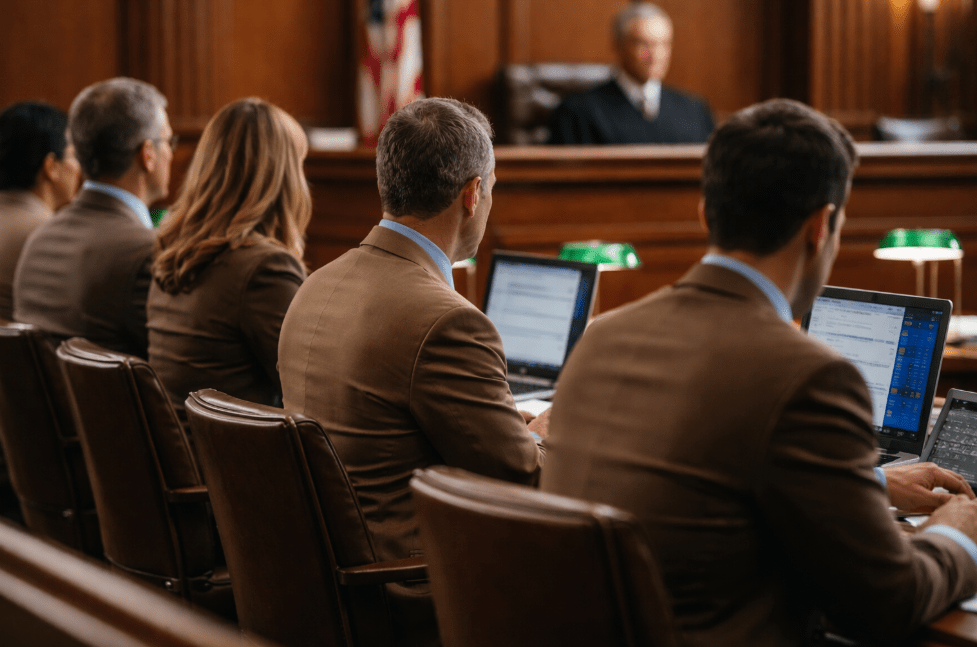
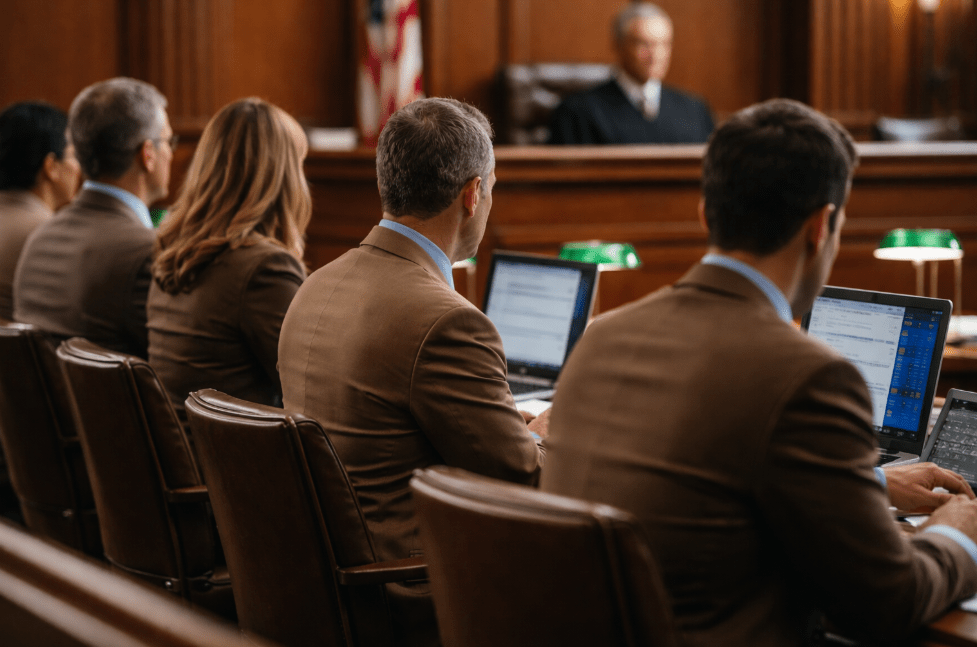
Every defense attorney walked into the courtroom wearing brown. Actual brown suits—jackets and pants, head to toe. Brown ties. Brown shirts. Their paralegals matched the tone as well, all in pant suits, all in variations of brown that were distinct enough to rule out coordination, yet close enough to feel unmistakably unified. Light brown, warm brown, deeper brown. A palette rather than a uniform.
Then the plaintiff attorney’s father entered the courtroom to observe proceedings, entirely outside the mechanics of trial strategy, wearing a brown suit.
That alone would have been notable. But long trials rarely stop at one data point.
Mid-trial, the judge scanned the room, paused, and said, “Best dressed, best coordinated trial of all time.” The comment landed because everyone already felt it. And then the realization followed: the judge himself was wearing a brown tie.
Not navy. Not gray. Brown.
Shortly afterward, plaintiff’s second chair arrived in a dark brown suit. Then another woman entered wearing a brown jacket. And then, as if to remove any remaining doubt, the trial technology specialist—someone whose role is purely functional, whose wardrobe has nothing to do with advocacy or optics—sat down in a brown suit, brown tie, and a blue shirt.
At that point, coincidence officially lost standing.
What made the moment even more striking was that brown was not acting alone. Running beneath it, threading through the room, was blue. Blue shirts under brown jackets. Blue suits at counsel table. Blue appearing again and again, not dominant, but consistent. No skirts. No color-coordinated heels. No ornamental signaling. Every attorney, male and female, was in a pant suit. Clean lines. Controlled silhouettes. Muted tones. The coordination wasn’t decorative—it was structural.
This is what long trials do.
They create convergence.
If you have never spent weeks or months inside the same courtroom, this may sound like over-interpretation. But long trials are not simply legal proceedings. They are ecosystems. They develop rhythms and moods. Everyone inside them is constantly calibrating—to the judge’s temperament, to the jury’s patience, to the emotional weight of testimony, to the posture of the opposing side. Over time, that calibration stops being conscious.
People begin to mirror one another.
Most people recognize this phenomenon in another context: women who live together often find their menstrual cycles synchronizing. Families of teenage girls. College roommates. Long-term housemates. No one plans it. No one tracks it until it’s already happened. Biology quietly falls into rhythm through proximity.
Courtrooms do the same thing—psychologically, socially, and visually.
Clothing becomes one of the clearest outward signs of that synchronization. Brown shows up on days that feel grounded and heavy, when testimony carries weight and restraint feels appropriate. Blue appears when steadiness, control, and professionalism are unconsciously prioritized. These are not fashion choices; they are responses to atmosphere.
I am not suggesting mysticism. I am suggesting human behavior under sustained pressure.
Trial lawyers like to believe they operate independently—strategic, rational, insulated from influence. But long trials erode that illusion. Fatigue lowers defenses. Hyper-awareness becomes ambient. Everyone absorbs the same emotional weather day after day. At a certain point, the courtroom stops behaving like a collection of individuals and starts acting like a single organism.
As a court reporter, I sit still. I am not performing for the room. I am observing it. Over decades, these observations accumulate. Patterns repeat across different judges, different lawyers, different courthouses, different cases. Once you have seen the same phenomenon unfold often enough, you stop questioning whether it is real.
You start expecting it.
What made today remarkable was not just the coordination—it was the awareness of it. The judge noticed. The attorneys noticed. Even the tech staff, unwittingly, joined the palette. There was a brief, shared recognition that something quietly human was happening beneath the formal machinery of trial.
The transcript will never capture the brown suits or the blue shirts. No appellate record will preserve the judge’s comment. But the people who were there will remember it, because it marked the moment the trial fully synchronized.
After twenty years, I have learned that trials are not only about evidence and law. They are about proximity, endurance, and the subtle ways people begin to move together when they share space long enough. Some truths live outside the record, but they are no less real for it.
Sometimes, the story is not in the testimony.
Sometimes, it is in the color of the room.
Disclaimer
This article reflects personal observations drawn from long-term courtroom experience. It is not intended as a scientific analysis, psychological study, or assertion of intent by any individual referenced. All observations are anecdotal, generalized, and offered as commentary on human behavior in shared professional environments. No inference should be made regarding strategy, coordination, or motive. The views expressed are solely those of the author and do not represent any court, party, attorney, or proceeding.
 STENOIMPERIUM