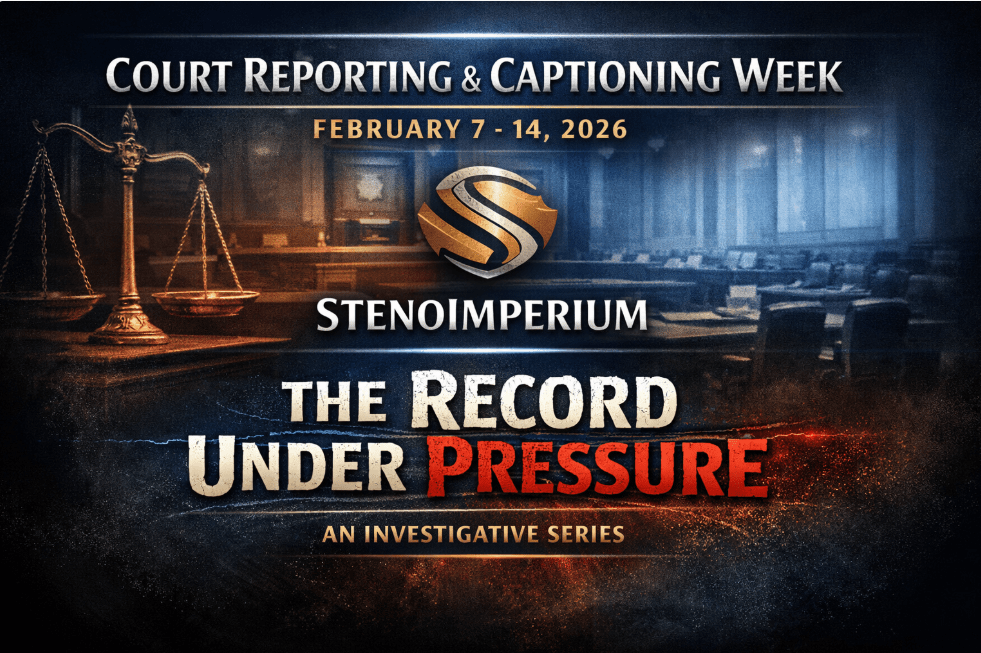
“The Record Under Pressure” Series
This week, while much of the profession marks Court Reporting & Captioning Week, I am launching a different kind of project.
Not a celebration.
An examination.
Beginning today, StenoImperium will publish a seven-part investigative and analytical series called “The Record Under Pressure.” Each article will focus on a different structural force now bearing down on the American legal record: technology, ethics, business models, courtroom practices, professional erosion, and the growing gap between what the justice system assumes the record is—and what it is rapidly becoming.
The legal record is not a convenience.
It is not a commodity.
It is not a software feature.
It is the evidentiary spine of the justice system. And right now, that spine is under strain.
Across the country, courts are quietly altering how records are created, who controls them, how they are stored, how they are financed, and what standards govern their reliability. These shifts are happening faster than the public, the bar, or even many judges fully realize. The consequences will not be abstract. They will surface in appeals, in evidentiary disputes, in due-process challenges, and in cases where no one can reconstruct what truly occurred.
This series is not written for reporters alone. It is written for attorneys, judges, policymakers, and anyone who depends on the integrity of the legal record without ever seeing the infrastructure that supports it.
Every article this week will:
• examine one pressure point on the modern court record
• translate courtroom realities into systemic analysis
• connect current trends to long-term legal risk
• and live permanently at StenoImperium, as a public archive of what is unfolding now
My social channels will serve as the broadcast system.
The full analysis will live on the site.
If the justice system is built on truth, the record is how truth is preserved. And if the record is destabilized, everything built on it becomes vulnerable.
Today’s first article launches the series and sets the framework for what follows.
StenoImperium presents: The Record Under Pressure.
The first installment is now live.
A Call to Court Reporters: This Week Is Not Just for Celebration. It Is for Circulation.
Court Reporting & Captioning Week should not only be a moment to congratulate ourselves. It should be a moment to step forward.
The legal record is under pressure. The forces reshaping it—technology, business consolidation, automation, and regulatory drift—are not being driven by court reporters. They are being driven by vendors, platforms, and institutions that do not carry the legal, ethical, or evidentiary responsibility we do.
That means the burden of education now falls to the people who actually understand the record.
This week, StenoImperium is publishing a seven-part investigative series, “The Record Under Pressure,” written not for reporters, but for attorneys, judges, policymakers, and the broader legal community. Its purpose is to explain—clearly, soberly, and with legal framing—what is happening to the court record and why it matters.
Here is the call to action:
Do not keep this conversation inside our profession.
Commit, during Court Reporting & Captioning Week, to deliberately sharing these articles outside it.
Send them to:
• attorneys you work with
• judges you appear before
• law firms and managing partners
• bar associations and listservs
• court administrators and clerks
• law schools and legal educators
Post them not with hashtags, but with context.
Forward them not as promotion, but as professional warning.
Frame them not as advocacy, but as infrastructure education.
Every person in the legal system relies on the record. Very few understand how it is built, safeguarded, financed, or now being quietly altered.
If we do not explain it, others will.
And they already are.
Court reporters are not merely service providers. We are custodians of the evidentiary layer of the justice system. That role carries a responsibility not just to produce records—but to defend the conditions under which records remain trustworthy.
This week, participate not only by celebrating the profession, but by circulating its analysis.
Because the future of the record will be decided by the people who understand it—or by those who redefine it first.
The Record Under Pressure series is live at StenoImperium.
Use it. Share it. Place it deliberately into the legal community.
Disclaimer
This series and call to action reflect the author’s professional analysis and opinion, informed by courtroom experience, industry research, and publicly available sources. It is published for educational and discussion purposes only. It does not constitute legal advice, regulatory guidance, or the position of any court, agency, or professional association.
 STENOIMPERIUM