In courtrooms across the United States, something foundational is shifting.
Not loudly.
Not dramatically.
Not through sweeping reform or public debate.
The change is happening quietly, through procedural substitutions, technological integrations, staffing adaptations, and administrative decisions that appear, on their own, to be minor. But taken together, they are reshaping one of the most consequential elements of the justice system: the legal record.
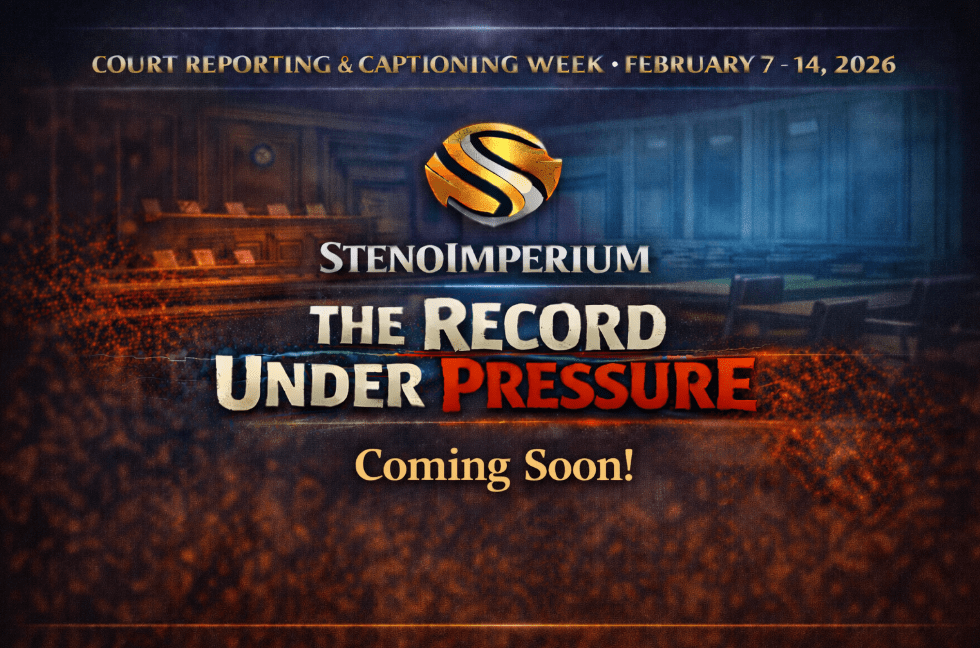
Beginning Court Reporting & Captioning Week Feb 6th, StenoImperium will publish a multi-part investigative and analytical series titled “The Record Under Pressure.” The series will examine the modern legal record as institutional infrastructure—how it is created, who controls it, what forces are altering it, and what the justice system risks inheriting if its transformation continues without deliberate governance.
The legal record is not a background feature of law. It is the mechanism through which law remembers. It is how appellate courts review decisions. It is how judicial conduct is examined. It is how rights are preserved beyond the moment they are asserted. Yet while courts, firms, and vendors modernize workflows at unprecedented speed, the evidentiary layer beneath those workflows is rarely examined as a system.
This series begins from a simple question: What is happening to the legal record right now?
Technology is entering courtrooms faster than evidentiary doctrine can absorb it. Automated transcription, remote capture platforms, centralized portals, and artificial intelligence are increasingly positioned not merely as tools, but as substitutes for processes that were historically anchored in sworn, neutral, human accountability. At the same time, private equity and corporate consolidation are reorganizing custody of transcripts and source materials into commercial structures optimized for scale rather than judicial design.
Inside courtrooms, the presence of a certified stenographic court reporter is no longer uniformly assumed. Proceedings move faster. Recording systems replace professional capture. The record is sometimes discouraged, delayed, or diminished. These shifts are not ideological. They are practical. And they are cumulative.
“The Record Under Pressure” will trace these developments across eight investigative essays. It will explain what a legal record actually is—and what it is not. It will examine the ethical consequences of delegating evidentiary trust to technical systems. It will follow the business transformation of the transcript. It will document what is already unfolding in real courtrooms. It will reframe the court reporter as a structural safeguard rather than a service. And it will look ahead to the constitutional risks of a justice system that can no longer reliably preserve its own proceedings.
This series is not written for court reporters alone. It is written for attorneys who build cases on transcripts. For judges who depend on records for review. For administrators shaping courtroom policy. For lawmakers drafting modernization initiatives. And for anyone who believes that due process survives only if it can be demonstrated.
Court Reporting & Captioning Week is often a moment of celebration. This year, StenoImperium is using it as a moment of examination.
Because institutions do not fail only when decisions are wrong. They fail when the systems that preserve and review those decisions quietly erode.
The legal record is one of those systems.
And right now, it is under pressure.
“The Record Under Pressure” launches during Court Reporting & Captioning Week.
✅ Disclaimer / Disclosure
This forthcoming series reflects the author’s professional analysis and opinion, informed by courtroom experience, industry research, and publicly available sources. It is published for educational and discussion purposes only. It does not constitute legal advice, and it does not represent the views of any court, government body, or professional association.
 STENOIMPERIUM