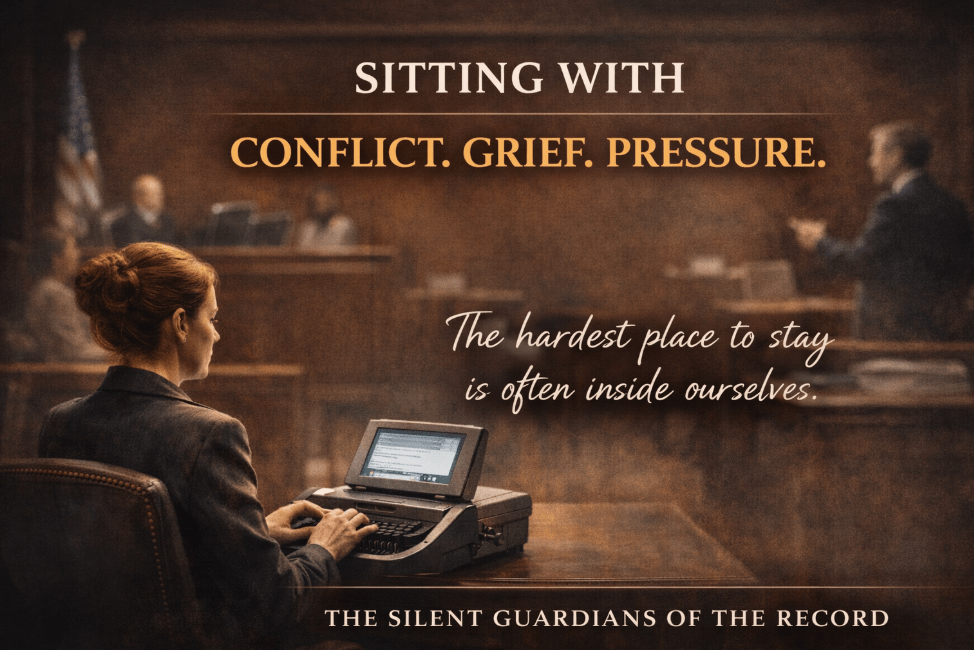
Court reporters are trained to be invisible.
We sit slightly outside the circle, physically close, but socially removed. We are present for everything, yet meant to disturb nothing. We listen without reacting. We capture without commenting. We absorb human conflict for a living and then quietly leave the room with it stored inside our machines, our software, and often our nervous systems.
Over time, that position does something to a person.
It teaches discipline. It builds skill. It sharpens perception. But it also exposes reporters, day after day, to an unfiltered stream of pressure, hostility, grief, dishonesty, anger, fear, arrogance, cruelty, boredom, and power. We hear what families say to each other when money is at stake. We hear what corporations say when liability is on the line. We hear what people sound like when they are terrified, or cornered, or trying to control a narrative. We hear the long pauses after a hard question. We hear the small voice that cracks before the objection is lodged.
And then, because the job requires it, we keep going.
Court reporting is not only a cognitive profession. It is a physiological one. The work lives in the shoulders, the jaw, the breath, the hands. It lives in the adrenaline spikes when testimony accelerates, in the shallow breathing during hostile cross, in the low-grade vigilance that never fully turns off. Many reporters come into the field believing the job is primarily technical. Most who stay long enough learn otherwise. The job is about managing the self in the presence of other people’s intensity.
What most reporters are not trained in is what to do with what accumulates.
Instead, the profession often teaches avoidance in subtle ways. Work faster. Stay booked. Fill the calendar. Upgrade the machine. Optimize the dictionary. Chase the next certification. Move on to the next job. When something feels heavy, the solution offered is usually external: a schedule change, a format change, a new market, a new role. Sometimes those changes help. Often, they merely rearrange the same internal weight.
So reporters, like most high-functioning professionals, develop their own quiet coping strategies.
Some become emotionally distant. Some become chronically busy. Some fill every silence with noise. Some normalize exhaustion. Some carry irritability like a second skin. Some look for chemical off-ramps, social off-ramps, digital off-ramps, anything that takes the edge off the constant requirement to be alert, accurate, neutral, and composed.
None of this makes someone weak. It makes them human in a profession that rarely acknowledges the human cost of precision.
Court reporters are not only recording the law. They are sitting inside unresolved human tension for hours at a time. They are paid to stay when most people would instinctively want to leave. That has consequences. And one of the quietest consequences is how easily discomfort becomes something to escape, instead of something to understand.
There is a moment many reporters recognize, though few name.
It happens before a difficult proceeding. Or after a brutal deposition. Or late at night when the house is finally quiet and the machine is put away. There is a subtle internal pressure to soften, to numb, to scroll, to pour, to distract, to collapse into something that makes the edges go away. Not because something dramatic has occurred. Not because of a singular trauma. But because the nervous system has been working without a true pause.
Discomfort does not always arrive with sirens. Often it arrives as restlessness. As irritability. As low-grade dissatisfaction. As the feeling that one more thing has been added to an already full internal shelf.
The instinct is to remove the feeling.
But court reporting, perhaps more than most professions, offers a different lesson, if one is willing to see it.
The job itself is an exercise in staying.
Reporters stay when testimony meanders. They stay when voices rise. They stay when silence stretches. They stay when emotions spill. They stay when the room turns hostile or absurd or painfully intimate. They stay without inserting themselves. They stay without fixing. They stay without leaving.
They are trained to remain present inside other people’s discomfort so that an accurate record can exist.
What often goes unrecognized is that this same capacity can be turned inward.
Pain, in professional life, is not only catastrophe. More often it is the slow burn of misalignment. The ache of not being seen. The fatigue of carrying responsibility without authority. The erosion of boundaries. The quiet grief of watching a profession change in ways that feel threatening or wrong. The sting of disrespect that never quite gets addressed. The tension of holding standards in environments that increasingly resist them.
When these experiences are rushed past, they do not disappear. They simply go underground. They emerge later as cynicism, resentment, disengagement, or burnout.
Avoidance feels productive. It looks like resilience. It looks like professionalism. It looks like “handling it.”
But the opposite of pain is not avoidance.
It is presence.
Presence does not mean indulging suffering or romanticizing difficulty. It means allowing experience to register instead of immediately muting it. It means noticing the physiological signals before they become symptoms. It means naming disappointment, instead of disguising it as annoyance. It means recognizing fear without immediately converting it into control. It means letting fatigue be fatigue, instead of calling it laziness or failure.
Presence is not passive. It is a form of accuracy.
Court reporters already understand the value of accuracy. They know the difference between what was said and what was meant. They know how small distortions change meaning. They know how omissions alter truth. That same principle applies internally. When experience is not accurately perceived, it is still recorded. Just poorly. And poorly recorded experiences, like poorly taken records, create problems downstream.
Staying with discomfort does not destroy most people. What often destroys them is the years spent trying not to feel it.
When reporters allow themselves to stay with what is actually happening inside, something subtle shifts. The sensation that once felt like a threat begins to reveal information. Fatigue speaks about limits. Irritation speaks about boundaries. Grief speaks about values. Fear speaks about attachment. Anger often speaks about injury.
None of these states are enemies. They are data.
And data, when properly received, allows adjustment.
Transformation in a profession does not start only with legislation, technology, or leadership. It also starts in individual nervous systems. In whether people feel permitted to acknowledge strain without immediately fixing it. In whether staying is valued as much internally as it is externally. In whether reporters are taught that their job has always required an unusual capacity for presence, and that this capacity can be used, not only for proceedings, but for themselves.
Court reporters are already practicing something rare. They are practicing sustained attention in environments built to provoke reaction. They are practicing neutrality in spaces full of agenda. They are practicing steadiness where volatility is common.
They are practicing staying.
The invitation is not to become monks, therapists, or philosophers. It is simpler. It is to recognize that the skill that preserves the legal record is the same skill that preserves the self. To notice discomfort before outsourcing it. To let certain feelings exist without immediately dragging them into productivity, commentary, or escape.
Not because pain is good.
But because presence is powerful.
And presence, quietly cultivated, changes what a person can carry, how long they can carry it, and whether what they carry hardens them or informs them.
Court reporters do not flee the room when proceedings become difficult. They adjust their posture, steady their breathing, and stay.
There is wisdom in that.
And perhaps the next evolution of professionalism is not only better software, faster machines, or stronger advocacy, but a deeper recognition that staying, when done consciously, is not endurance alone.
It is the beginning of transformation.
Disclaimer
This article is for educational and professional discussion purposes only. It is not medical, psychological, or legal advice. The experiences discussed reflect general observations within the court reporting profession and are not intended to diagnose, treat, or replace care from licensed health professionals.
 STENOIMPERIUM
Great Read!
LikeLike