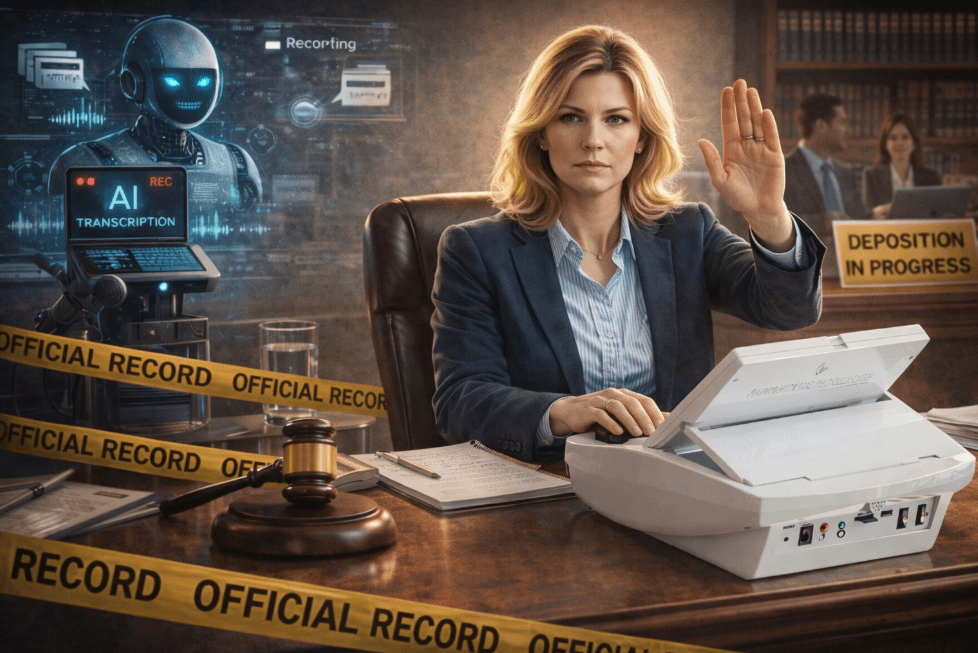
On a recent professional forum, a court reporter posed what she called a “dumb question,” though it was anything but. A deposition notice had arrived with unfamiliar language: the proceeding, it said, “may also be recorded by live notes.” The reporter, already bracing for an all-day deposition while juggling young children and a spouse with an unpredictable schedule, wanted to know what this meant. Was this simply realtime, as reporters had known it for decades? Or was it something new—something automated, algorithmic, unlicensed? In short, was artificial intelligence about to join the deposition room?
The responses came quickly. Some said it was harmless, just another way to describe realtime. Others worried it was code for AI. A few pointed to federal rules governing additional recording methods. Several advised stating firmly on the record that the stenographic transcript was the official record. What emerged from the thread was not a definitive answer, but something more revealing: a profession confronting the fact that familiar procedural language no longer carries a stable meaning.
This is increasingly the terrain of modern litigation. Words like “recording,” “capture,” “notes,” and “transcript” once had relatively settled definitions. A deposition was stenographically reported. If something else was used, it was a video camera or an audio recorder, disclosed in advance, visible in the room, and governed by long-standing rules. The court reporter’s role as the licensed guardian of the record was not in question, even when additional devices were present.
Artificial intelligence has unsettled that clarity. Today, “live notes” can refer not only to a realtime feed from a stenographic writer, but also to automated meeting bots, cloud-based speech-to-text systems, auto-summarization platforms, and litigation support tools that promise instant searchable transcripts and analytics. Some of these systems merely duplicate what the official record already provides. Others generate derivative products that look and feel like records, even though they are not subject to the same training requirements, ethical duties, or regulatory oversight.
The result is a growing ambiguity that neither court rules nor professional norms have yet fully resolved.
Under both federal and California procedure, parties are generally permitted to make additional recordings of a deposition if proper notice is given. The rules were written with audio and video in mind. They address when notice must be provided, how additional recordings must be disclosed, and the relationship between the stenographic transcript and any other medium. They do not mention artificial intelligence, machine learning, automated summarization, or cloud-based transcription services, because when these provisions were drafted, those tools were not part of legal practice.
This matters, because the rules regulate the act of recording, not the downstream uses of what is captured. A video camera records. An audio recorder records. An AI system records, but it also processes, stores, transforms, and redistributes. It can create unofficial transcripts in seconds. It can generate summaries that may circulate far beyond the litigation team. It can retain data indefinitely on servers outside the control of the parties. These functions raise questions not only about accuracy, but about confidentiality, privilege, data security, and the integrity of the evidentiary record.
For court reporters, the issue is not simply technological discomfort. It is structural. Reporters are licensed precisely because the legal system has determined that the creation of an official record is not a clerical task. It is a regulated professional function. Reporters are bound by statutes, court rules, and ethical codes. They are responsible for neutrality, completeness, and the proper handling of the record. They know what is on the record, what is off it, and when proceedings formally begin and end. They certify transcripts under penalty of professional discipline. They can be compelled to testify about their work. They can lose their licenses if they violate their obligations.
An automated system carries none of those duties. It cannot be cross-examined. It cannot be disciplined. It does not distinguish, in any legal sense, between an off-the-record discussion and sworn testimony. It captures sound, not procedure. When such a system is introduced under vague language like “live notes,” the risk is not only that it may be inaccurate. The deeper risk is that it may blur the boundaries of what a legal record is, who controls it, and who is accountable for it.
This is why the anxiety expressed in that online discussion resonated so strongly. The reporters were not merely asking whether AI was allowed. They were asking what protections still exist when unfamiliar technologies are introduced through boilerplate notice language that was never designed to encompass them.
Most experienced reporters know that they generally cannot prohibit a properly noticed additional recording method. If counsel has complied with procedural requirements, an audio or video device is typically permitted. The presence of an AI-based recorder may fall, technically, within that same category. But legal permissibility is not the same as professional endorsement. And participation is not the same as certification.
This distinction is critical. Even where additional recording is allowed, the court reporter remains responsible for only one thing: the stenographic record they create. They do not certify the accuracy of a video. They do not vouch for the fidelity of an audio file. And they certainly do not authenticate the output of an algorithm. The official record is the transcript prepared by the licensed reporter, and nothing in existing law converts an AI-generated document into a substitute for that record.
What reporters are now doing, increasingly, is drawing that boundary out loud. They are stating on the record that the stenographic transcript is the official record pursuant to applicable law. They are asking counsel to identify any additional recording methods being used. They are clarifying that they do not certify, verify, or authorize any non-stenographic capture or transcript. These statements are not obstructionist. They are preservative. They ensure that if disputes later arise over what was said, what was meant, or what may be relied upon, the legal system knows where accountability resides.
This practice reflects a broader shift underway in the courts. Judges, too, are beginning to confront the implications of AI-assisted lawyering, from fabricated citations to automated drafting tools that quietly insert errors into filings. The emerging consensus in judicial commentary is not that technology itself is the problem. It is that responsibility must remain traceable. When something goes wrong, there must be a human professional who can be held to account.
Depositions are no different. The legitimacy of the record depends on the existence of a clearly identified officer of the deposition who is responsible for its creation. That role has long been filled by court reporters. Introducing tools that generate parallel, unofficial “records” without regulatory grounding risks eroding that clarity.
The confusion around “live notes” illustrates how easily this erosion can occur. What was once shorthand for realtime stenographic feed now sits alongside products that promise automated transcription, sentiment analysis, and instant case summaries. Attorneys may not intend to displace the official record. Often, they are simply adopting new productivity tools. But intention does not control impact. When these systems enter the deposition space without precise disclosure and without a shared understanding of their limits, they introduce uncertainty into one of the most foundational processes of civil litigation.
There is also a human dimension to this moment that should not be overlooked. The reporter who raised the question did so from a place of professional care and personal strain. She was preparing for a demanding assignment, balancing family responsibilities, and confronting unfamiliar language that could have real implications for her role. That posture—conscientious, alert, and uneasy—is increasingly common. Court reporters are not resisting change for its own sake. They are trying to understand what, exactly, is changing, and whether the structures that protect the integrity of the record are keeping pace.
At present, the law lags the technology. Existing procedural rules can accommodate additional recording devices, but they do not address the downstream realities of AI systems that store, analyze, and repurpose captured speech. They do not specify how confidentiality obligations apply to third-party algorithms. They do not clarify whether automated summaries may be used in motion practice. They do not define the status of AI-generated transcripts when they inevitably conflict with the official one.
Until those questions are squarely confronted, the burden of boundary-setting will continue to fall on individual reporters and attorneys, one deposition at a time. That is not a sustainable regulatory posture. It places frontline professionals in the position of improvising safeguards for a system that depends on predictability.
What is needed is not panic, but precision. Notices should say what they mean. If an AI system will be used, it should be identified as such. Its function should be disclosed. Its role should be limited. Courts and rule-making bodies should examine whether existing recording provisions are adequate to govern tools that do far more than record. And the profession of court reporting should be formally recognized not merely as a legacy practice, but as a regulatory anchor in an environment of proliferating capture technologies.
The online discussion that began with a simple question ultimately points to a deeper truth: the future of the legal record is not being decided in abstract policy papers. It is being negotiated, line by line, in deposition notices and on-the-record statements, by professionals who understand what is at stake when the words spoken under oath become data.
The phrase “live notes” may seem innocuous. But in an era when speech can be instantly transformed into searchable, distributable, and mutable text, it is no longer enough to rely on inherited terminology. The justice system must decide, deliberately, what counts as a record, who is authorized to create it, and how accountability will be maintained when machines join the room.
Until it does, court reporters will continue to do what they have always done: preserve the record, clarify the process, and quietly hold the line between what is officially known and what is merely captured.
When “Live Notes,” AI, or Other Recording Tools Appear:
A Reporter’s Roadmap for Protecting the Record
We are entering a phase of litigation where court reporters are encountering unfamiliar notice language, silent software running in Zoom rooms, and vague references to “live notes,” “litigation support,” or “capture tools.” Some of these are harmless. Some are not. The problem is that they are increasingly indistinguishable.
Until statutes and court rules are updated, the profession’s protection does not come from technology bans. It comes from clarity, boundaries, and records.
Here is what reporters can — and should — be doing.
I. Before the deposition: Do not walk in blind
The first safeguard happens before anyone is sworn.
1. Read the notice like a lawyer would.
Highlight any reference to:
• additional recording
• live notes
• litigation support
• audio/video capture
• remote platform recording
• third-party services
Anything beyond “stenographically recorded” is a flag to clarify.
2. Ask the agency or noticing counsel one direct question.
Not confrontational. Not editorial. Just precise:
“Can you tell me what ‘live notes’ or ‘additional recording’ refers to for this deposition?”
You are not seeking permission. You are creating a paper trail and avoiding surprise.
3. Document the response.
If you are told it is realtime, note that.
If you are told it is a vendor, note that.
If no one knows, note that too.
Uncertainty is itself information.
II. At the beginning of the deposition: Establish the record
This is the most important moment. Once testimony begins, silence becomes acquiescence.
After swearing the witness and stating your CSR number, reporters should normalize a short, neutral record-protection statement.
A working template many California reporters are now using:
“This deposition is being stenographically reported. The certified stenographic transcript will be the official record of these proceedings pursuant to applicable law.
Before we proceed, counsel, are there any additional recording methods being used today, including audio, video, or third-party capture tools?”
Then stop. Make them answer.
This does three things:
• It anchors the official record.
• It forces disclosure.
• It timestamps whatever technology is present.
If counsel says yes, follow with:
“For the record, please identify the additional recording method.”
You are not approving it.
You are documenting it.
III. If AI or automated tools are disclosed
Do not argue technology.
Do not speculate about legality.
Do not debate innovation.
Your job is to define responsibility.
A second statement, if an automated or non-stenographic system is identified:
“Let the record reflect that any additional recording or capture method is not under my control. I do not certify, verify, or authorize any non-stenographic recording or any transcript, summary, or derivative product generated from it. My certification applies solely to the stenographic transcript I prepare.”
This is not drama.
This is jurisdiction.
You are drawing the line between:
• the legal record
• and everything else.
IV. If the tool interferes with reporting
Reporters are not required to tolerate interference.
If audio lag, feedback, platform instability, or software bots disrupt your ability to report accurately, you are on solid ground to say:
“The additional recording method appears to be interfering with the creation of the official record. We need to address this before proceeding.”
This reframes the issue from preference to process integrity.
The court reporter’s duty is to the accuracy of the record.
Anything that degrades that is not a convenience. It is a procedural problem.
V. What reporters should not do
Equally important is what to avoid.
• Do not integrate your feed into unvetted platforms.
• Do not provide realtime to unidentified software.
• Do not troubleshoot AI systems.
• Do not accept responsibility for outputs you do not control.
• Do not stay silent when additional capture is occurring.
Silence is the only thing that can later be characterized as consent.
VI. After the deposition: Preserve your boundaries
1. If the transcript is challenged using AI output
Your response is simple and consistent:
You certify only the stenographic transcript.
You do not reconcile against unofficial products.
2. If agencies or firms begin normalizing AI capture
Ask for written policies.
Ask how confidentiality is handled.
Ask whether clients are informed.
And document everything.
Systemic change does not happen through outrage.
It happens through records.
VII. The professional call to action
This moment requires coordination, not just individual vigilance.
Reporters should be pushing for:
• standardized on-the-record language
• updated deposition notice templates
• association-level guidance
• formal rulemaking petitions
• and continuing education focused on technology boundaries
Because if reporters do not define their role, vendors will.
VIII. The deeper responsibility
Court reporters are not merely service providers. They are the only participants in a deposition whose entire professional existence is tied to the integrity of the record itself.
Attorneys advocate.
Vendors sell.
Platforms optimize.
Reporters preserve.
That function becomes more—not less—important when speech is easily captured, transformed, and redistributed outside the procedural safeguards of the court system.
The presence of AI in deposition rooms is not, at its core, a technology issue.
It is a custody-of-the-record issue.
It is an accountability issue.
It is a legitimacy issue.
And until the rules catch up, the front line of that legitimacy is the working reporter, setting the terms of the record, one deposition at a time.
Disclaimer
This article reflects the author’s professional experience and analysis as a working court reporter. It is intended for educational and informational purposes only and does not constitute legal advice. Court reporters and legal professionals should consult applicable statutes, court rules, and qualified legal counsel when addressing recording methods, technology use, and procedural requirements in any specific proceeding.
 STENOIMPERIUM