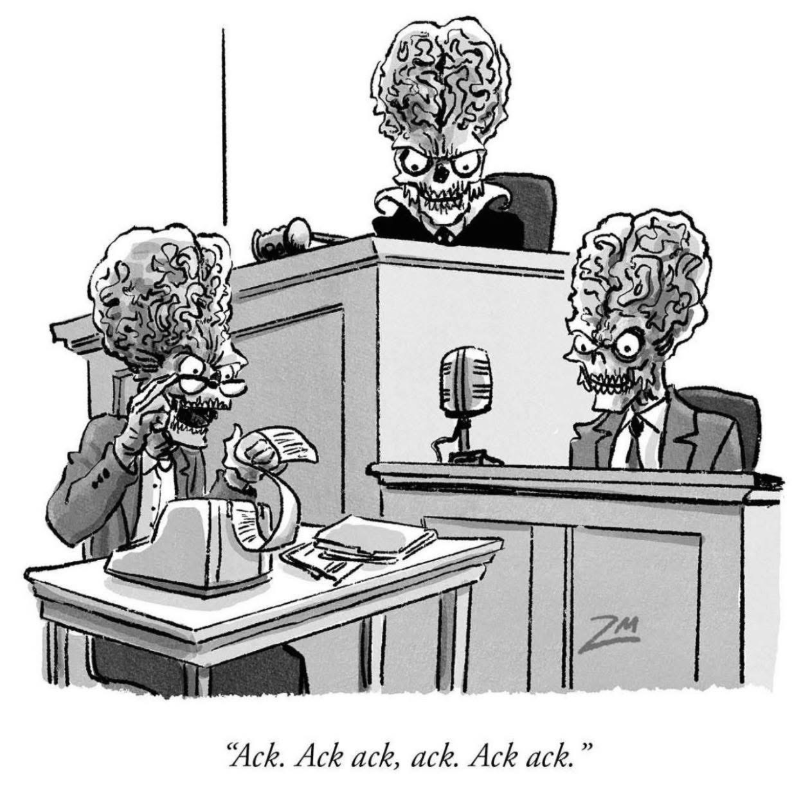
Picture this: the honorable Judge Zog presiding, a Martian witness nervously twitching its bulbous brain folds on the stand, and a stenographer at the corner machine, furiously tapping away as the witness blurts, “Ack. Ack ack, ack. Ack ack.”
The court reporter doesn’t flinch. After all, it’s not the strangest thing she’s ever heard in a courtroom. But she wonders: How on Mars am I supposed to punctuate that?
The cartoon is funny because it’s absurd—but the absurdity hides a truth. Every day, across America’s courtrooms, we are witnessing our own slow-motion alien invasion. Only this time, the invaders don’t have ray guns or flying saucers. They come disguised as “efficiency,” “innovation,” and “cost reduction.” They come with glowing promises of artificial intelligence, automated speech recognition, and digital “court reporting solutions.”
And like the Martians, they all speak a strange language—one that sounds convincing until you read the transcript back and realize it’s gibberish.
The Martians Have Landed — and They’re Called ASR
The courtroom used to be a sanctuary of precision. Every word mattered. A misplaced comma could change a verdict; a missing adjective could reverse an appeal. The human court reporter was the silent guardian ensuring every “objection,” every pause, every “strike that” was captured faithfully.
Then came the aliens—software that promises to “listen better than humans,” and executives who swear it “understands context.” You’ve seen the brochures: “AI-powered accuracy! Real-time legal transcription! Next-generation justice delivery!”
But if you’ve ever read one of their transcripts, you know the truth: it’s “Ack ack, ack. Ack ack.”
The problem isn’t just that automated systems mishear words. It’s that they misunderstand meaning. They don’t know when sarcasm is dripping from an attorney’s voice, when a witness is whispering, or when the courtroom erupts in laughter that drowns out a crucial word. Machines don’t listen. They record noise. And then they pretend it’s truth.
The Cost of Gibberish
In the movie Mars Attacks!, the aliens’ “ack ack” sounds almost comedic—until they vaporize Congress. That’s a little how digital reporting feels to real stenographers. It starts with small intrusions: a pilot program here, a “temporary coverage solution” there. Then one morning, you find your entire profession replaced by a system that can’t tell the difference between “not guilty” and “now guilty.”
Judges often assume it’s cheaper. Clerks assume it’s fine. Administrators assume that because it’s AI, it must be smart. But transcripts riddled with errors aren’t just embarrassing—they’re dangerous. They erode trust in the record, in the justice process itself.
One court in New York found ASR transcripts so inaccurate they had to hire humans to review every word—at triple the cost. A Florida judge had to declare a mistrial when a digital recording system failed. Attorneys spend hours fixing “ack ack” into coherent sentences. And all the while, the real professionals—the human reporters who’ve dedicated years to mastering language—are told they’re obsolete.
Meanwhile, the Real Court Reporter Keeps Typing
Back in our Martian courtroom, the reporter adjusts her headset. She’s not intimidated by the bulb-headed witness. She’s a stenographer—trained to handle chaos with precision.
She writes at 225 words per minute, punctuates on instinct, and can repeat verbatim what was said five minutes ago because her brain is wired for recall. When the judge interrupts, she marks it cleanly. When the attorney stammers, she captures it faithfully.
She doesn’t just record. She interprets the soundscape of justice.
That’s something no algorithm can do. Because stenography is more than typing fast—it’s human cognition, empathy, and context awareness compressed into keys and chords. Court reporters read people as much as they read words. They can tell when someone’s voice cracks from fear or deception. They understand nuance, tone, irony—things no neural net has ever truly grasped.
Lost in Translation
In the cartoon, we laugh because everyone in the courtroom seems to understand the “Ack ack.” The judge nods. The attorney objects. The witness continues. It’s a perfect parody of modern bureaucracy—systems functioning flawlessly on nonsense.
That’s where we’re headed if we keep replacing skilled humans with machines that merely approximate comprehension.
Imagine appealing a conviction where the transcript reads:
“ACK (indiscernible) objection sustain—(inaudible)—jury laughter.”
That’s not a record. That’s a liability.
And yet, these garbled transcripts are quietly being filed every day across states experimenting with digital recording. Behind each “ack ack” is a witness whose story may never be understood as intended, an attorney whose arguments are misrepresented, a judge whose words are twisted by acoustic distortion.
Justice isn’t supposed to sound like static.
The Language of Truth Is Human
What makes language meaningful isn’t sound—it’s intention. When a human court reporter takes down testimony, they’re not just converting phonemes into text; they’re preserving intentionality. They can distinguish between “yes” (defiant) and “yes” (defeated). They can clarify if someone said “I didn’t shoot him” or “I didn’t shoot him.”
Machines can’t.
That’s why stenography has survived every technological “revolution” for over a century. From shorthand pads to tape recorders to voice recognition, the human element remains irreplaceable. Because language isn’t binary—it’s emotional, contextual, alive.
And yet, courts are being seduced by the illusion that “good enough” is good enough. That accuracy can be sacrificed for convenience. That the sacred record of justice can be entrusted to the same technology that still autocorrects “its” and “it’s” incorrectly.
What Happens When the Record Becomes a Joke
If you zoom out, that cartoon isn’t just a courtroom gag—it’s a warning. The Martians aren’t foreign invaders. They’re us, when we stop caring about meaning.
When we let bureaucratic efficiency replace human understanding, we become the aliens—talking in nonsense, nodding in agreement, pretending it all makes sense.
The courtroom is supposed to be the temple of truth. Every word uttered there carries the weight of law, precedent, and consequence. And yet, in too many courtrooms today, truth is being filtered through microphones, cloud servers, and proprietary software that no one can audit.
It’s not just a matter of technology—it’s a matter of democracy. The record is the foundation of appeal, accountability, and public trust. When that record becomes “ack ack,” so does justice.
Final Transcript
As the Martian witness finishes, the attorney smirks, the judge bangs the gavel, and the reporter pauses, fingers poised above the keys.
She sighs and writes:
“Witness: unintelligible.”
Because sometimes, even the best reporter can’t make sense of nonsense.
But we can still laugh—because cartoons let us. They let us process our collective anxiety about where the world is heading. Yet beneath the laughter lies a serious question: When the language of justice becomes unintelligible, who will translate truth back into words?
Hopefully, not an alien.
 STENOIMPERIUM