
When a photo of two surgeons collapsed on the operating room floor went viral, the world was moved.
After performing a 32-hour brain surgery to save a patient’s life, Dr. Dai and Dr. Tian of the First Affiliated Hospital of Fujian Medical University in China finally let themselves rest — right where they had stood for over a day. They had fought exhaustion, hunger, and sleep deprivation to repair a life-threatening aneurysm. When the operation succeeded, they stabilized the patient and then simply… collapsed.
That image — two heroes in scrubs lying motionless on the cold floor — became a symbol of human perseverance and sacrifice. No applause, no spotlight, no luxury of rest. Just duty.
But What About the Professions That Never Get to Collapse?
For those of us in the world of stenographic court reporting, that image resonated on a deeply personal level. Not because we’ve performed surgery, but because we’ve lived our own version of 32-hour marathons — only ours don’t end in a single heroic moment.
For court reporters, the long hours are not an exception. They’re the rhythm of our profession.
I’ve just finished a week of 16-hour days — transcribing complex trials, preparing same-day and next-day transcripts, operating under relentless deadlines with two-minute “breaks” during recesses (if that), sometimes skipping meals entirely. After a 10-hour day in court, I often work until 2:00, even 4:00 a.m., formatting, proofing, and certifying transcripts.
Then, at sunrise, it starts all over again.
The surgeons fought through 32 hours once. We do it every week.
The Invisible Marathon
Doctors like Dr. Dai and Dr. Tian save lives. Court reporters protect truth — one word, one comma, one inflection at a time.
We capture every syllable that shapes justice, preserving the official record that can decide a person’s freedom, a company’s future, or a family’s fate.
We are the quiet witnesses to history, working in real time, knowing there are no redos and no room for error.
There’s a kind of endurance that doesn’t end with collapse — it just resets with the morning alarm. No one photographs us dozing off at the keyboard, or grabbing five hours of sleep before another day of testimony. But our commitment is every bit as real.
No one viralizes the exhaustion of a stenographer who hasn’t seen daylight in three days because discovery deadlines and daily trials collided.
And yet, we keep showing up — every single day — to protect the record.
We don’t wear scrubs.
We don’t wear capes.
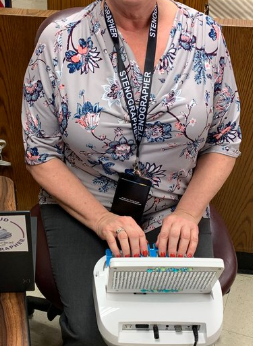
We wear stenographer lanyards — the quiet badge of our oath to accuracy, integrity, and resilience.
Our stenographer lanyards may not look like much to the outside world — just a badge, a credential, a strip of nylon we throw over our neck each morning. But to us, it represents access, trust, and responsibility. It’s our unspoken uniform, our silent credential that says: I am the keeper of the record. Every time we walk into a courtroom, that lanyard is our cape — a symbol not of status, but of service. We wear it with pride, not because it grants authority, but because it reminds us of the weight of every word we capture.
Respect Where It’s Due
This isn’t to diminish what those surgeons did. Their 32-hour feat was extraordinary — a testament to human willpower. But for court reporters, that intensity is our baseline.
It’s not one heroic operation; it’s a career built on stamina, precision, and total accountability.
Because while we may not save a life, we preserve truth — and truth, too, has the power to save lives.
So yes, not all heroes wear capes.
Some wear scrubs.
And some wear “Stenographer” lanyards, typing 300 words per minute while carrying the weight of the legal world in their hands — and never missing a beat.
StenoImperium
Court Reporting. Unfiltered. Unafraid.
Disclaimer
“This article includes analysis and commentary based on observed events, public records, and legal statutes.”
The content of this post is intended for informational and discussion purposes only. All opinions expressed herein are those of the author and are based on publicly available information, industry standards, and good-faith concerns about nonprofit governance and professional ethics. No part of this article is intended to defame, accuse, or misrepresent any individual or organization. Readers are encouraged to verify facts independently and to engage constructively in dialogue about leadership, transparency, and accountability in the court reporting profession.
- The content on this blog represents the personal opinions, observations, and commentary of the author. It is intended for editorial and journalistic purposes and is protected under the First Amendment of the United States Constitution.
- Nothing here constitutes legal advice. Readers are encouraged to review the facts and form independent conclusions.
***To unsubscribe, just smash that UNSUBSCRIBE button below — yes, the one that’s universally glued to the bottom of every newsletter ever created. It’s basically the “Exit” sign of the email world. You can’t miss it. It looks like this (brace yourself for the excitement):

 STENOIMPERIUM
Wow, that sounds like an intense week!! I don’t know how you can get by on such little sleep. You are a hero!!
April D. Gedney, RPR, CLR California CSR No. 11756 Hawaii CSR No. 470
LikeLike