
Court reporting students have long benefited from attending professional association events like those hosted by the Deposition Reporters Association (DRA) and the California Court Reporters Association (CCRA). These gatherings connect students with mentors, provide industry insight, and cultivate professional identity. But recent developments have caused several California schools to rethink whether their students should be attending.
The Trigger – Recruitment Masquerading as Mentorship
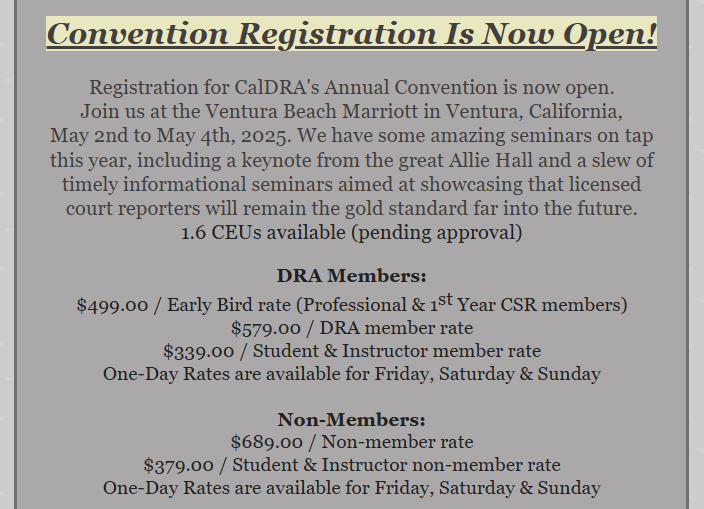
At a recent DRA event (CalDRA’s Annual Convention in Ventura, CA, from May 2nd to May 4th, 2025), Allie Hall — who has been active in various training programs, and is a licensed California CSR, No. 14556, on 9/19/2023, under Allison Hall, but with an address in Oklahoma — was invited as a keynote speaker. According to multiple schools, what should have been an educational opportunity quickly turned into a recruitment drive. Students were reportedly approached directly, encouraged to abandon their programs, and solicited to enroll in Hall’s offerings instead.
One school confirmed that a student—already writing at 200 words per minute and on the cusp of sitting for the CSR exam—was persuaded to walk away from their program. In the view of that school, this was not mentorship; it was poaching.


Digital Overreach – Accessing Student Networks
The concerns didn’t stop there. In a June 10, 2025 text message, a school president told me:
“She actually recruited in our Teams. She had two students at 180 wpm create a list of our students and is still trying to recruit them with lies.”
That same president added:
“After losing students to Allie Hall after the DRA conference, I am not excited about our students going to any conventions!”
These educators told me that Allie Hall allegedly gained access to a school-managed Teams account through students and used it to identify and solicit other students. Educators I’ve spoken to view this as crossing an ethical line.
The Fallout – Schools Drawing the Line
The immediate effect has been schools closing ranks. Two schools with strong ties to DRA and CCRA say they lost multiple students directly after the event. Both have since agreed: their students will no longer be permitted to attend these association gatherings.
This is not a decision made lightly. Associations rely on student attendance for vitality and future membership. But when a professional space becomes an open market for recruitment, schools feel they must prioritize protecting their students.
A Troubled Track Record
Hall’s professional record has also raised questions. She has taught at multiple programs, many of which ultimately closed. To date, I have not seen evidence that a student has completed her program from start to finish and then passed the CSR. If a student has reached licensure, it has typically been after beginning at another school.
One student who had started in Hall’s program later reported that when she left, Hall allegedly confronted her and said:
“You will never make it as a CSR if you leave my program.”
That student, according to a prominent court reporter guiding the student, later went on to thrive under different instruction.
The Larger Concern – Associations Caught in the Middle
The fallout has put DRA and CCRA in an uncomfortable position. These organizations depend on volunteer speakers and diverse programming, but they also bear responsibility for ensuring students are not targeted as sales leads. Schools, meanwhile, have the power to deny access—leaving students stuck between professional isolation and potential exploitation.
The situation has sparked a broader debate: Should associations more carefully vet who is given a platform? And at what point does recruitment at professional events become predatory rather than opportunistic?
On September 19, CCRA even announced with pride that they now have 500 student members. That figure shows just how much associations rely on student participation for their vitality and future membership. But if schools begin pulling their students out of these spaces, those numbers will quickly shrink — and with them, the associations’ credibility as student advocates.

Protecting Students, Protecting the Profession
Court reporting students represent the fragile future of the profession. They invest years of training, financial resources, and mental grit to chase the elusive CSR license. To have that journey disrupted by recruitment tactics or questionable encouragement does lasting damage—not only to the student but to the schools and the profession’s pipeline as a whole.
For schools, the decision to shield students from association events may feel drastic, but many see it as necessary. For associations, the message is clear: if you want students in the room, you must make sure the room is safe for them.
~ The truth is the best defense.
* Editor’s Note (Sept. 19, 2025, 8:44 a.m.): An earlier version of this article incorrectly stated that Allie Hall is not a licensed California CSR. She is licensed (CSR No. 14556, issued Sept. 19, 2023, under Allison Hall, with an address in Oklahoma). This article was corrected within 23 minutes of posting. In addition, an earlier version mistakenly mixed up the names of Kimberly D’Urso and Kelly Bryce Shainline. We regret these errors. These corrections do not change the substance of the article, which reflects concerns raised by schools about student recruitment at professional events. The correction does not change the concerns raised by schools about recruitment practices.
StenoImperium
Court Reporting. Unfiltered. Unafraid.
Disclaimer
“This article includes analysis and commentary based on observed events, public records, and legal statutes.”
The content of this post is intended for informational and discussion purposes only. All opinions expressed herein are those of the author and are based on publicly available information, industry standards, and good-faith concerns about nonprofit governance and professional ethics. No part of this article is intended to defame, accuse, or misrepresent any individual or organization. Readers are encouraged to verify facts independently and to engage constructively in dialogue about leadership, transparency, and accountability in the court reporting profession.
- The content on this blog represents the personal opinions, observations, and commentary of the author. It is intended for editorial and journalistic purposes and is protected under the First Amendment of the United States Constitution.
- Nothing here constitutes legal advice. Readers are encouraged to review the facts and form independent conclusions.
***To unsubscribe, just smash that UNSUBSCRIBE button below — yes, the one that’s universally glued to the bottom of every newsletter ever created. It’s basically the “Exit” sign of the email world. You can’t miss it. It looks like this (brace yourself for the excitement):

 STENOIMPERIUM
The real story here is that students are talking to each other and realizing what a scam some of these “schools” are. Allie doesn’t need to recruit, her students do it for her. Her program has a wait-list due to the high volume of referrals. Students are objectively comparing options and concluding Allie has a better program. It’s the other schools’ responsibility to examine what they’re doing and change if they aren’t retaining students. Also the idea of students not going to conventions and gaining all the benefits from them just because they might learn about better options is insane. We have the Internet now. These programs can’t keep students in the dark. This article is also accusing students of not being able to think for themselves which is rude.
LikeLiked by 1 person
Also how dare you attack Allie. All she does is help people. She travels around sharing her advice at conventions not to benefit her full program, but to share her knowledge with others. She has a non-profit that helps students financially. She could just make a ton of money doing depos but instead dedicates her time to helping others advance in the profession. This is truly a despicable article.
LikeLike
How dare you?’ No — how dare anyone recruit a near-exit student and access a school’s private Teams platform. Schools themselves said it happened, and that’s what the article reported.
This isn’t a popularity contest. It’s not about who people ‘like’ more, or who’s good at putting on a show at conventions. It’s about ethics and protecting students, schools, and the profession from conduct that crosses lines. Competing California schools don’t poach each other’s near-exit students — they respect the boundary.
And even the non-profit people cite as proof of “helping” students raises serious questions. Donations were being collected before 501(c)(3) status was approved, despite warnings it was an IRS violation. Instead of partnering with an existing nonprofit like Project Steno to ensure transparency, she refused — because she wanted the credit for herself. Others did the heavy lifting on the busy work, yet the spotlight and accolades stayed with her. That’s not the selfless service it’s being sold as.
Helping the profession means building responsibly, with transparency and respect for the rules. What schools reported here — and what the nonprofit track record suggests — reflects a pattern of putting self-promotion above the profession.
The Pay It Forward program is often cited as proof of ‘helping students.’ But here’s a question: is that support going to students across all schools, or mainly to her own? If it’s not being distributed equitably, then it functions more like a recruitment tool than a profession-wide resource. Transparency on that point matters.
LikeLike
This wasn’t a case of a prospective student exploring options. The student who was poached was already near exit speeds, on the verge of taking the CSR. That’s a world of difference. Even competing schools in California respect that line — they don’t pull students away from each other’s programs once they’re that close to finishing.
That’s why this crossed an ethical boundary.
LikeLike
Good morning,
I don’t know who you are, but I want to tell you I appreciate every single one of your very thorough emails. I can only imagine the hard work and time spent on research and writing. You are doing the entire profession a service by not sugarcoating anything. I have always tried to stay in tune by listening to a variety of sources for reporting information, but sometimes it’s very difficult to stay abreast of what’s going on in this industry during very challenging times.
Bravo and thank you.
Renée
Renée Bencich
Stenographic Court Reporter
License No. 11946, RPR
Will your transcript be admissible in court?
http://www.risksofdigitalrecording.com/ http://www.risksofdigitalrecording.com
LikeLiked by 1 person
Thank you, Renée, so much for your kind words. They mean more than you know. Writing these pieces takes time and energy, but it’s worth it when I hear from colleagues who find value in the work. I believe our profession deserves honesty, even when the truths are difficult to hear.
I’m grateful you’re part of the conversation and that my writing helps keep you informed during such challenging times. Knowing there are reporters like you who care deeply about staying engaged gives me hope for the future of our field.
LikeLiked by 1 person