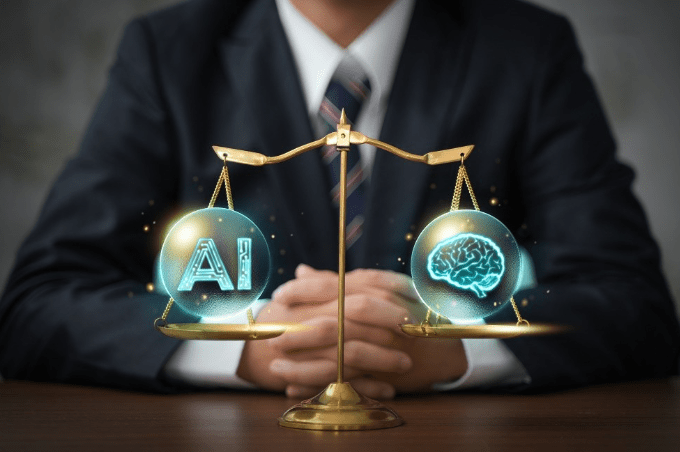
In courthouses across California and beyond, judges are experimenting with new technologies to streamline their work. With AI-powered captioning tools now available at the click of a button, some have been tempted to use automatic speech recognition (ASR) to follow testimony in real time.
The promise is alluring: an instant feed of words without having to order realtime from the reporter. But while AI captions may look efficient, the risks are profound. Legally, ethically, and practically, AI cannot substitute for a certified realtime record from a stenographic reporter.
California statutes, evidentiary rules, judicial ethics, and national bar guidance all converge on the same conclusion: AI captions have no lawful standing in the courtroom. Fortunately, modern realtime solutions like Advantage Software’s Bridge and Boost provide courts with accuracy, security, and efficiency — without undermining the integrity of the record or jeopardizing appellate review.
Legal & Ethical Reasons Judges Should Not Use AI/Voice Recognition for Court Proceedings
1. California Statutes
- Gov. Code § 69941.1 & CCP § 269: In California, an official court reporter’s transcript is the only legally recognized verbatim record. AI captions have no statutory authority, are uncertified, and cannot substitute for an official transcript.
- Gov. Code § 69942: When a transcript is ordered, it must be prepared by the official reporter (or pro tem). If a judge relies on AI captions to make rulings or decisions, those captions carry no legal weight. They cannot be certified, authenticated, or admitted for appellate purposes.
- CCP § 2093(a): Only certain officers — including court reporters — are authorized to administer oaths and create an official record. AI software is not on that list. This means an ASR-generated “record” is not a lawful record at all.
2. Evidentiary Integrity
- Evidence Code §§ 702 & 703: Testimony must be based on admissible evidence, and the transcript is central for appellate review. AI-generated captions, with their 15–30% error rates, introduce the risk of omissions, misidentifications, and distortions that could prejudice a party.
- Consider the simple phrase: “I did not sign the contract.” If AI drops “not,” the entire meaning flips — and judicial rulings based on that faulty captioning would rest on sand.
3. Judicial Ethics
- Canon 3(B)(7), California Code of Judicial Ethics: Judges must “require court officials subject to their direction and control to be faithful to the law and maintain professional competence.” By relying on uncertified AI captions, judges effectively authorize the use of technology that is neither faithful to statute nor professionally competent.
- Canon 2(A): A judge must “act at all times in a manner that promotes public confidence in the integrity and impartiality of the judiciary.” When the public learns that judges are ruling based on error-prone AI captions instead of certified realtime, confidence in the system erodes.
4. Confidentiality & Privacy
- Gov. Code § 69944: Transcripts must remain in the reporter’s custody until certified. AI captions often run on remote servers outside the court’s control, breaking this custody chain.
- California Rules of Court 2.400 & 2.506: Court records and exhibits are tightly regulated. Streaming live proceedings to third-party AI platforms risks unauthorized disclosures of privileged or sensitive information.
- In criminal, family, or trade secret cases, that exposure could be catastrophic. Confidential data flowing through AI servers could lead to mistrials, sanctions, or even liability for the court.
5. Appellate Risk
- If a judge relies on AI captions instead of certified realtime, any ruling influenced by those captions is vulnerable to challenge on appeal.
- Appellate courts could find that a trial judge relied on an unauthorized, inaccurate record, opening the door to reversals and retrials — wasting judicial resources and eroding litigant trust.
6. ABA & National Guidance
- ABA Formal Opinion 498 (2021): Courts must use technology that preserves confidentiality, security, and the integrity of the record during remote proceedings. AI captions, prone to error and often cloud-based, do not meet this threshold.
- NCRA Position Papers (2020–2024): The National Court Reporters Association has declared unequivocally that AI-generated transcripts are “inherently unreliable” and cannot serve as official court records.
Judges Are Not Above the Law
Judges are not above the law, and they cannot legislate from the bench. As highlighted in the StenoImperium article “Judges in Los Angeles County are Breaking the Law,” there have been instances where judges have effectively replaced certified court reporters with electronic recording systems — even in unlimited civil courtrooms — despite clear legislative and judicial precedent forbidding such substitution. This is not just a matter of convenience or efficiency; it is a violation of the law when judges act unilaterally to adopt practices that the legislature has considered and rejected. A judge’s role is to apply the law, not make it.
Patrick Henry once warned: “The Constitution is not an instrument for the government to restrain the people. It is an instrument for the people to restrain the government.” That warning is still debated today — and it applies with equal force to judges who must operate within the boundaries set by law, not beyond them.
The Appellate Risk in Detail
Appellate courts review the certified transcript to determine whether a trial court made reversible error. If a judge based a ruling on AI captions — a record with no legal recognition — the appellate court could declare the ruling void.
In criminal cases, this threatens constitutional rights to due process and confrontation. In civil cases, it risks mistrials, retrials, and costly delays. In both contexts, judicial reliance on uncertified captions undermines the administration of justice.
A Real-World Illustration
The dangers of AI captioning are not hypothetical. I have personally had judges stop proceedings and ask for a readback because their ASR software produced an inaccurate version of testimony. In one instance, the automatic captions mistranslated a witness’s words, and the judge’s “notes” based on that feed diverged from what was actually said. When I read back from my realtime feed and my stenographic notes, the attorneys immediately validated that my record was correct — and the AI-generated captions were not.
That single moment encapsulates the problem: judges cannot rely on AI captions without risking fundamental misunderstandings of the evidence. In the heat of a trial, where a single word can shift the meaning of testimony, those inaccuracies are not just inconvenient — they are dangerous. And if a ruling had been made based on the faulty captions, it could have been challenged on appeal as a decision based on an unauthorized and unreliable record.
Bridge + Boost is The Only Profession-Saving Alternative
The issue is not whether judges want realtime access — they do, and rightly so. Realtime improves efficiency, reduces interruptions, and ensures rulings are based on the most accurate information available. The issue is how realtime is delivered.
Ancient software like Livenote is obsolete, expensive, and riddled with licensing hurdles. That vacuum has tempted some courts to dabble with AI captions. But there is a superior path: Advantage Software’s Bridge and Boost.
- Bridge: A free realtime viewer for judges, clerks, and attorneys. It removes the licensing bottlenecks of Livenote and allows unlimited realtime connections without additional cost. Reporters stream their certified record directly to the bench and bar.
- Boost: Eclipse’s AI-assist engine that runs entirely offline, helping reporters improve their realtime output by suggesting translations — without ever touching the cloud. Importantly, Boost is under the reporter’s control at all times.
Together, Bridge and Boost marry certified accuracy with cutting-edge efficiency. Judges get the realtime they need. Reporters deliver stronger translation rates. And confidentiality remains fully intact.
This combination could very well save the court reporting profession by making realtime ubiquitous, affordable, and indispensable — while keeping control of the record firmly in reporters’ hands.
The Cost-Cutting Motivation & Why Courts Are Tempted by AI
Another reason some judges have turned to AI captions or resisted realtime feeds is cost. In California’s civil courts, many proceedings have effectively been privatized — court reporters are not always provided by the court, and litigants must retain them privately. When that happens, attorneys bear the expense not just of transcripts but also of realtime access, which is billed per page.
Judges, seeing the financial strain on parties, sometimes attempt to “ease the burden” by declining to order realtime feeds for the bench or by experimenting with AI/ASR captioning instead. The reasoning is that if realtime is optional and privately funded, why not let a judge quietly use AI captions for free and avoid passing additional costs on to litigants?
But this is a dangerous shortcut. The legislature has already spoken: realtime is the lawful province of certified reporters. Courts cannot sidestep those requirements by invoking cost savings. As with the electronic recording controversies in Los Angeles County, judges are not free to legislate from the bench by substituting AI for statutorily mandated reporters. Saving money is not a legal justification for compromising the record.
It also ignores a critical economic reality: reporters are entitled to be compensated for realtime. Realtime feeds are not a free perk; they are professional work product. When courts cut realtime out of the process, they cut into reporters’ incomes. And that has consequences. Reduced realtime demand creates a ripple effect that destabilizes the profession. Reporters may be forced to raise transcript rates, decline court coverage, or leave the field entirely. What begins as a cost-saving measure for litigants ultimately increases costs for everyone and threatens access to justice.
Ironically, tools like Bridge solve this very problem. Bridge itself is free, meaning the only cost is the realtime feed — which judges typically pay at a reduced bench rate while attorneys cover the market rate. This system keeps costs transparent, lawful, and fair. By contrast, AI captions shift costs in a hidden way, at the expense of accuracy, confidentiality, and appellate integrity.
A Practical Rollout Strategy
For courts considering a shift away from Livenote or flirting with AI, here’s how to transition safely:
- Pilot Program: Launch Bridge in a handful of receptive courtrooms.
- Demonstration: Show judges how Bridge connects in seconds, with realtime streaming directly from the reporter.
- Training Guides: Provide one-page setup instructions for judicial officers and clerks.
- Bench Rate Proposal: Clarify billing — judges receive realtime at a reduced bench rate (e.g., $2.00/page), attorneys at market realtime rates (e.g., $2.50/page).
- IT Collaboration: Partner with court IT staff to stress Bridge’s security advantage — no cloud exposure, no licensing headaches.
Accuracy Is Non-Negotiable
Judges face pressure to do more with less, but expedience cannot trump legality. California statutes, evidentiary rules, judicial canons, and national bar guidance are unanimous: AI captions cannot lawfully serve as realtime in courtrooms.
The only recognized realtime record is that created by a certified reporter. With Bridge and Boost, courts can modernize beyond Livenote, safeguard confidentiality, respect reporter compensation, and ensure judicial accuracy.
The message is clear: if judges want realtime, they must get it from the reporter — not from AI. Anything else jeopardizes the integrity of justice itself.
StenoImperium
Court Reporting. Unfiltered. Unafraid.
Disclaimer
This article reflects my perspective and analysis as a court reporter and eyewitness. It is not legal advice, nor is it intended to substitute for the advice of an attorney.
This article includes analysis and commentary based on observed events, public records, and legal statutes.
The content of this post is intended for informational and discussion purposes only. All opinions expressed herein are those of the author and are based on publicly available information, industry standards, and good-faith concerns about nonprofit governance and professional ethics. No part of this article is intended to defame, accuse, or misrepresent any individual or organization. Readers are encouraged to verify facts independently and to engage constructively in dialogue about leadership, transparency, and accountability in the court reporting profession.
- The content on this blog represents the personal opinions, observations, and commentary of the author. It is intended for editorial and journalistic purposes and is protected under the First Amendment of the United States Constitution.
- Nothing here constitutes legal advice. Readers are encouraged to review the facts and form independent conclusions.
***To unsubscribe, just smash that UNSUBSCRIBE button below — yes, the one that’s universally glued to the bottom of every newsletter ever created. It’s basically the “Exit” sign of the email world. You can’t miss it. It looks like this (brace yourself for the excitement):

 STENOIMPERIUM