
When most people think about career choices, they focus on passion, job security, or work-life balance. Few take the time to run the numbers the way an investor would. But in today’s world, where education costs have skyrocketed and student loan debt cripples entire generations, it’s worth asking: What is the true return on investment of a career path?
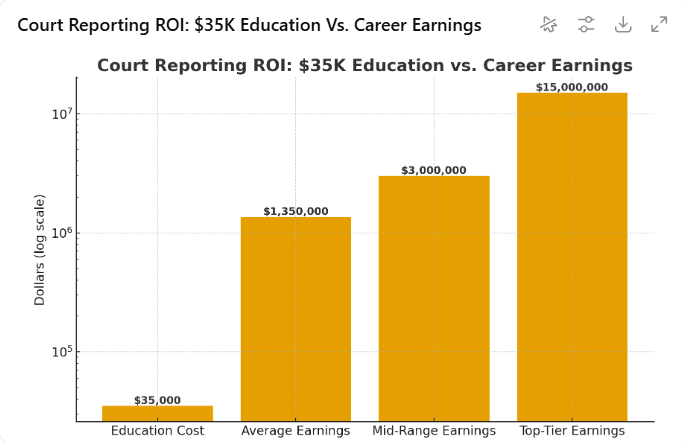
In that light, court reporting stands out as one of the most overlooked yet extraordinary opportunities. For an investment of about $35,000 in education and training, a reporter can earn anywhere from the average of $45,000 per year to as much as $500,000 annually at the top of the profession. Over a 30-year career, that’s a range of $1.35 million to $15 million in gross income.
Even on the low end, court reporting offers a strong return compared to the cost of education. On the high end, it delivers one of the best ROI opportunities of any professional path.
Breaking Down the Numbers
The Cost of Education
Becoming a court reporter doesn’t require a four-year degree. Instead, the typical path involves attending a specialized program through a community college, private school, or online academy.
Tuition, equipment (steno machine or voice mask, computer, CAT software), books, and exam fees generally total $30,000 to $40,000 depending on the program. For this analysis, we’ll use $35,000 as the benchmark.
That’s the “initial investment.”
The Earnings Spectrum
Earnings vary widely in court reporting, depending on geography, specialization, and work style.
- National average: About $45,000 per year, based on U.S. Bureau of Labor Statistics data. Many entry-level reporters or those working part-time fall within this bracket.
- Mid-range: Many full-time freelance and official reporters regularly earn between $80,000 and $120,000 annually.
- Top tier: Reporters who specialize in realtime, expedites, high-volume depositions, or trial work can earn $250,000 to $500,000+ per year.
Over a 30-year career, this creates a wide but clear range of potential:
- Low end (average): $45,000 × 30 = $1.35 million
- Mid-range: $100,000 × 30 = $3 million
- High end: $500,000 × 30 = $15 million
ROI in Financial Terms
Return on investment (ROI) is calculated as: ROI=Gain from Investment – Cost of InvestmentCost of InvestmentROI = \frac{\text{Gain from Investment – Cost of Investment}}{\text{Cost of Investment}}ROI=Cost of InvestmentGain from Investment – Cost of Investment
- Low end: $1.35 million – $35,000 = $1,315,000 gain. ROI = 3,757%.
- Mid-range: $3 million – $35,000 = $2,965,000 gain. ROI = 8,471%.
- High end: $15 million – $35,000 = $14,965,000 gain. ROI = 42,757%.
Even for those earning the average salary, court reporting delivers nearly a 4,000% return on the cost of schooling. And for those who build a thriving freelance or official career, the numbers become extraordinary.
The Payback Period
Another way to look at value is the “payback period” — how long it takes to recover the original investment.
- Average reporter ($45k/year): $3,750/month → education paid off in less than a year.
- Mid-range reporter ($100k/year): $8,333/month → education paid off in about 4 months.
- Top-tier reporter ($500k/year): $41,667/month → education paid off in less than one month.
By comparison, traditional college graduates often spend 10 to 20 years repaying student loans.
Comparison to Other Professions
Traditional College Degrees
- Cost: Average four-year degree = $120,000–$250,000.
- Salary: Median salary for bachelor’s holders = ~$65,000/year.
- Payback: 5–10 years, often longer with debt.
Law School
- Cost: $200,000+.
- Salary: Median lawyer salary = $135,000.
- Payback: Often decades.
Medical School
- Cost: $250,000–$400,000.
- Salary: Median physician = $220,000.
- Payback: Long training pipeline + years of debt repayment.
Court Reporting
- Cost: $35,000.
- Salary: $45,000 (average) → $500,000+ (top).
- Payback: From less than a year to less than a month.
Court reporting may not guarantee $500,000 to everyone, but even average salaries generate ROI that outpaces most careers.
Why Court Reporting Offers Such Strong ROI
1. High Demand, Low Supply
The shortage of certified reporters nationwide creates upward pressure on wages. Courts, law firms, and agencies compete for talent, ensuring strong earning potential.
2. Multiple Revenue Streams
Unlike flat-salary jobs, reporters can stack income through:
- Appearance fees
- Per-page transcript rates
- Realtime hookups
- Expedites
This creates significant earning potential for those willing to maximize workload.
3. Career Longevity
Reporters can often work 30 to 40 years with the right ergonomic practices. This stability compounds the ROI.
4. Professional Barrier to Entry
The difficulty of mastering stenography or voice writing ensures that those who do succeed hold a valuable, defensible skill.
The Risks of Shortcuts
Some students look for “fast tracks”: bare-bones certificates, on-the-job learning promises, or skipping transcript training altogether. While tempting, these shortcuts almost always backfire.
Half-trained reporters may capture words but lack the knowledge to produce certified transcripts. Courts and law firms need professionals who can deliver from day one. Skipping training may save money upfront, but it costs credibility — and career longevity.
Beyond the Dollars – Intangible Returns
While the financial ROI is undeniable, court reporting also delivers:
- Job security: The justice system requires accurate records.
- Professional respect: Reporters are officers of the court.
- Flexibility: Freelance reporters set schedules and workloads.
- Intellectual stimulation: Exposure to law, medicine, business, and more.
Court reporting may be one of the best-kept secrets in the career world. With an initial investment of about $35,000, professionals can earn from $45,000 to $500,000+ annually — translating into lifetime earnings of $1.35 million to $15 million.
Even at the average level, the ROI is stronger than most traditional degrees. At the top of the profession, it becomes extraordinary.
In an era where students are saddled with debt chasing uncertain job prospects, court reporting proves that sometimes the smartest investment is not the most obvious one. For those willing to put in the work, the numbers — and the opportunities — speak for themselves.
StenoImperium
Court Reporting. Unfiltered. Unafraid.
Disclaimer
The content of this post is intended for informational and discussion purposes only. All opinions expressed herein are those of the author and are based on publicly available information, industry standards, and good-faith concerns about nonprofit governance and professional ethics. No part of this article is intended to defame, accuse, or misrepresent any individual or organization. Readers are encouraged to verify facts independently and to engage constructively in dialogue about leadership, transparency, and accountability in the court reporting profession.
- The content on this blog represents the personal opinions, observations, and commentary of the author. It is intended for editorial and journalistic purposes and is protected under the First Amendment of the United States Constitution.
- Nothing here constitutes legal advice. Readers are encouraged to review the facts and form independent conclusions.
***To unsubscribe, just smash that UNSUBSCRIBE button below — yes, the one that’s universally glued to the bottom of every newsletter ever created. It’s basically the “Exit” sign of the email world. You can’t miss it. It looks like this (brace yourself for the excitement):

 STENOIMPERIUM
I never signed up for any paid subscription!
~ Doreen
Sent from my iPhone
LikeLike
Hi Doreen, thanks for your note. Just to clarify:
There are no paid subscriptions connected with my platform — all content is free.
Your email is not on my subscriber list.
Industry-related updates are sent to reporters through public sources such as professional directories or past sign-ups for resources I’ve shared.
That said, if you’d prefer not to receive any future communications, I’m happy to make sure your address is excluded. However, the email you mentioned is not on my subscriber list — so you’ll either need to provide the address where you received the message so I can remove it, or you can simply unsubscribe directly with one click.
________________________________________________________________________________________________________________________
Clarification for Subscribers
I’ve seen some chatter suggesting these updates are “paid subscriptions” or even grounds for lawsuits. Let’s set the record straight:
✅ There are no paid subscriptions — everything I share is free.
✅ Emails come from either past sign-ups or publicly available professional directories (NCRA, CRB lists, etc.).
✅ Sharing industry news with professionals is not spam — it’s community.
If you’d prefer not to receive updates, simply let me know and I’ll remove your address.
This profession faces enough outside threats. Let’s not let misinformation divide us. If you do want to stay connected, more resources are coming soon for reporters and students who care about protecting our future.
LikeLike
Your analysis is spot on. I feel very fortunate to have gotten my court reporting education for a little over $4000 on the GI bill.
P.S. I find your articles to be well-reasoned and thought out. Look forward to continue reading your stuff.
LikeLike
Thank you so much for sharing that! You were very fortunate to have the GI Bill cover your training—it’s an incredible benefit. The cost barrier today is much higher, and that’s why I try to unpack the perception versus reality for students. I truly appreciate your encouragement and kind words—it keeps me motivated to keep writing and advocating for our profession. 🙏✍️
LikeLike