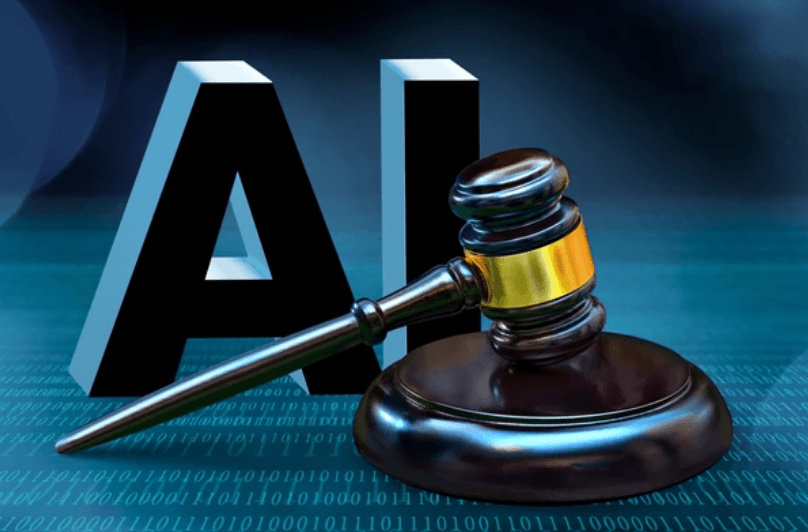
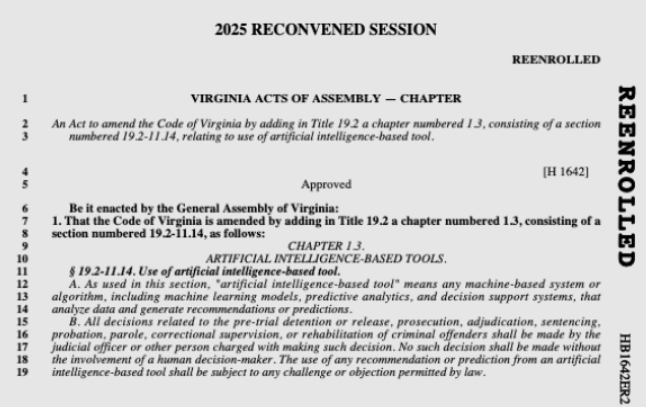
On July 1, 2025, a historic law took effect in Virginia that represents one of the most forward-thinking moves in judicial history—particularly for the future of court reporting. House Bill 1642 (HB 1642) mandates that any artificial intelligence (AI) used in the judicial process must be overseen by a qualified human. In short, AI cannot be the sole basis for judicial decisions, including the creation or certification of legal transcripts. This watershed moment not only validates the irreplaceable role of human court reporters—it also secures the integrity of the official record in an increasingly tech-driven world.
Why This Law Matters to Court Reporters—and the Public
At a time when digital recording companies and AI transcription platforms are lobbying for a larger presence in courtrooms across the country, Virginia’s bold legislation delivers a clear message: Justice must remain human-centered. The law doesn’t ban AI. Rather, it establishes that a real person—a qualified professional—must be responsible for overseeing and validating any output that AI generates.
This protection is vital. Transcripts created solely by AI remain uncertifiable. They are riddled with errors, unable to distinguish legal nuance, speaker identification, or overlapping dialogue. By requiring a human in the loop, Virginia ensures that every transcript, every sentencing algorithm, and every AI-derived suggestion is filtered through the lens of professional judgment and ethics.
For court reporters, this law is more than policy—it’s a precedent. It affirms that the profession will not be replaced, but rather elevated through thoughtful integration of technology. With proper oversight, AI can become a tool—not a threat.
The Champions Behind the Law
Credit for this groundbreaking piece of legislation begins with two names: Delegate Cliff Hayes Jr. (D–Chesapeake) and Delegate Michelle Lopes Maldonado (D–Manassas). Del. Hayes introduced the core concept—that AI should never be used in the legal system without human supervision—while Del. Maldonado served as the bill’s primary sponsor. Together, they built bipartisan support in both chambers of the General Assembly.
Del. Maldonado emphasized that HB 1642 was the result of over a year of collaboration among legislators, legal professionals, and technologists. Her leadership was crucial in bridging the gap between innovation and responsibility. “We must protect the dignity and fairness of our legal process,” she stated during floor debates, noting that human oversight ensures accountability in decisions that profoundly affect people’s lives.
Governor Glenn Youngkin signed the bill into law in April 2025. Although he proposed minor technical amendments, his support helped cement the law’s place as a national model.
The Role of the NCRA
Much of the advocacy work behind the scenes came from the National Court Reporters Association (NCRA). Led by President Keith Lemons and Executive Director Dave Wenhold, the NCRA recognized early that HB 1642 could become a landmark moment—not just for Virginia, but for the entire nation.
Colin Brehm, NCRA’s State Government Relations Manager, was instrumental in coordinating meetings with lawmakers, submitting public comment, and educating policy stakeholders about the consequences of AI-only transcription. When an earlier version of the bill failed in 2024, NCRA’s team returned to the table stronger, crafting language that balanced innovation with judicial integrity.
The NCRA’s advocacy helped drive home a critical point: While AI can enhance efficiency, it must never compromise accuracy or due process. Their efforts helped lawmakers understand that human court reporters are not obsolete—they are essential.
Virginia Court Reporters in Quiet Solidarity
Though not as publicly visible as their national counterparts, court reporters across Virginia supported the bill through grassroots outreach, coordinated efforts via the Virginia Court Reporters Association (VCRA), and letters to local representatives. Their lived experiences—transcribing chaotic hearings, preserving delicate testimony, and ensuring accurate legal records—provided the human stories behind the policy.
While no individual Virginia reporter has been publicly credited as the sole driving force, their collective impact was felt through the associations and professionals who lent their credibility, expertise, and resolve to the movement. This was a community effort—proof that advocacy doesn’t always have to be loud to be powerful.
What the Law Actually Says
HB 1642 specifically requires human oversight of any artificial intelligence tools used in the judicial decision-making process. This includes:
- Algorithms used in pretrial release decisions
- Risk assessments for sentencing and parole
- AI-generated court transcripts
In all such applications, a qualified human must supervise, interpret, and ultimately certify the information before it can be relied upon. This makes clear that AI is not an autonomous authority in Virginia courts—it is an aid to the human professional.
Why This Sets a National Standard
As other states weigh legislation involving AI in the courtroom, Virginia’s model stands out for its clarity and ethical grounding. Rather than rush toward full automation, lawmakers in Richmond took a step back to ask a fundamental question: What role should humans continue to play in our systems of justice?
The answer—enshrined in law—is that no algorithm, however advanced, can replace the judgment, contextual understanding, and ethical responsibility of a trained human being.
For stenographers nationwide, this is a beacon. If one state can recognize the danger of unchecked automation and choose instead to strengthen the role of professionals, others can follow. California, Texas, New York, Illinois—each could adopt similar protections with enough advocacy and legislative courage.
Where We Go from Here
Virginia’s HB 1642 is not the end of the fight—it’s the beginning of a new chapter. It challenges court reporters, legal professionals, and technologists to work together toward a future where AI supports—not supplants—human intelligence. It reminds us that ethical use of technology must always serve the public interest, not corporate convenience.
And it proves that progress doesn’t mean leaving people behind. It means bringing them forward.
To every lawmaker who voted yes, to every court reporter who made calls and shared stories, and to the NCRA for its fearless leadership—thank you. You have secured not only the record, but the integrity of justice itself.
Let this be the moment that stenographers stop playing defense—and start shaping the future.
Sources:
- National Court Reporters Association (NCRA), http://www.ncra.org
- Virginia General Assembly Legislative Information System, lis.virginia.gov
- Delegate Michelle Maldonado’s official press releases
- VPM News, March 2025: “Human Oversight in Judicial AI Use”
- The Journal of Court Reporting, April 2025: “Virginia Law Sets National AI Standard”
Disclaimer
The content of this post is intended for informational and discussion purposes only. All opinions expressed herein are those of the author and are based on publicly available information, industry standards, and good-faith concerns about nonprofit governance and professional ethics. No part of this article is intended to defame, accuse, or misrepresent any individual or organization. Readers are encouraged to verify facts independently and to engage constructively in dialogue about leadership, transparency, and accountability in the court reporting profession.
- The content on this blog represents the personal opinions, observations, and commentary of the author. It is intended for editorial and journalistic purposes and is protected under the First Amendment of the United States Constitution.
- Nothing here constitutes legal advice. Readers are encouraged to review the facts and form independent conclusions.
***To unsubscribe, just smash that UNSUBSCRIBE button below — yes, the one that’s universally glued to the bottom of every newsletter ever created. It’s basically the “Exit” sign of the email world. You can’t miss it. It looks like this (brace yourself for the excitement):

 STENOIMPERIUM
Bravo to the author of this well-written newsletter!! Thank you for the encouraging and empowering news!
Hipolita
Houston, Texas
LikeLike
Honestly, I don’t see how this helps anything. Virginia is still a voluntary licensing state. All this means, as I read it, is that you need a human, be it a steno, a voice writer, or a digital, to oversee the record. A WIN would have been to take out the digital prospect from being able to oversee and produce a certified record.
I believe this industry is going all digital soon. I’m making as much money as I can and then moving on to another profession once the majority is digital. Let’s face it, this would have NEVER happened to this profession if there had been a strong, legitimate, “rent-seeking” national mandatory RPR certification for ALL STATES for federal and civil transcripts.
The NCRA has had plenty of opportunities in the past to set that requirement in stone, but instead, the NCRA didn’t do crap. They just made their money off tests, memberships, and CEUs and sold us out to the big box digital firms of “the future” every chance they got.
LikeLike
I hear you—and I won’t sugarcoat it. You’re right that Virginia is still a voluntary licensing state and that this bill doesn’t eliminate digital from the equation. But I see it differently: requiring any human oversight at all is a public, legislative acknowledgment that AI and digital alone are not enough. That’s not nothing. It’s a crack in the façade we can wedge open.
This wasn’t the win we wanted—but it was a win in the bigger war. It sets precedent. And it gives us language we can build on in other states to demand certified oversight, not just “human” oversight.
You’re also absolutely right that if we had national mandatory credentialing, we wouldn’t be in this mess. But let’s be honest—the NCRA wasn’t equipped, willing, or aggressive enough to fight for that when it mattered most. They played defense when the profession needed offense. And yes, the CEU/test revenue model didn’t help.
That said, I’m not giving up on this profession—or handing it over to Big Digital—without a fight. If you’re exiting, I respect that. But if you’ve got even a little fight left, there’s still time to make an impact. We don’t need 10,000 people. We need 1,000 determined ones who know what’s at stake.
Let’s stop expecting institutions to save us and start acting like the professionals we wish they’d defend. This is our moment to lead—before the last microphone clicks on.
LikeLike
Such a wise decision. Hopefully all states follow suit.
Rhona Spurgeon Reddix, CSR, RPR, CRR, RMR Official Reporter Pro Tem LASC Approved** since 2005 626.703.7903
LikeLiked by 1 person
ASR from its inception was designed as a tool, not a standalone.
“AI” is you as the computer, y-o-u. And you will either take the mark of the beast or you will not eat. That’s when you will have “AI.” You will not be permitted to outlaw “communistic technocracy.” Now would be a good time to: Draw near to God, and He will draw near to you.
Steno is as much AI as ASR. If you want to avoid AI, you have to revert to using steno with ink and paper.
“AI” is a universal threat because it’s going to be weaponized.
– it’s serious and important to everyone.
LikeLike
I appreciate the passion in your response—and you’re right about one key thing: AI is serious, and it will be weaponized if we don’t stay vigilant. That’s exactly why this fight matters so much.
The difference, though, is who’s in control of the tool. ASR and other automated systems operate without real-time human intervention, judgment, or certification. That’s where the danger lies—especially in a legal setting where even one misunderstood word can change the outcome of a case or cost someone their rights.
Steno, even with modern software, is still a human-controlled process. It’s not artificial intelligence—it’s augmented intelligence, powered by training, experience, and ethical responsibility. A steno reporter can clarify, intervene, and ultimately certify the record. No ASR can do that. And no AI ever should.
I also hear your deeper message about society and faith. We’re at a crossroads—technologically, ethically, and spiritually. That’s why it’s more important than ever to fight for professions that preserve truth, not dilute it.
This isn’t just about jobs. It’s about protecting human oversight in systems that govern people’s lives. And that’s a cause I think we both care deeply about.
LikeLike
Where is standalone ASR being used as a court reporter? I don’t find your claims credible.
LikeLike