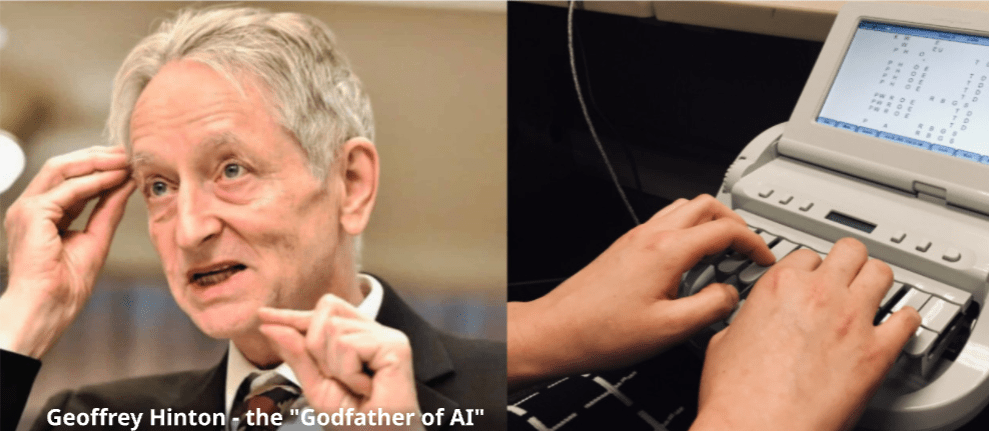
In a world increasingly dominated by artificial intelligence (AI), automated speech recognition (ASR), and digital recording, many traditional professions face an existential threat. Court reporting — once considered the gold standard of legal recordkeeping — is among them. However, recent reflections from one of AI’s most influential pioneers, Geoffrey Hinton, the so-called “Godfather of AI,” suggest a way forward. His insights not only reaffirm the enduring value of human skill and accountability but also illuminate a survival strategy for stenographic court reporters in an increasingly automated landscape.
The Existential Risk — and Opportunity — in AI
Geoffrey Hinton, a cognitive psychologist and one of the original architects of deep learning, has recently become one of the most vocal critics of the technology he helped create. He warns that unregulated and rapidly advancing AI poses a significant existential threat to humanity. In an interview on The Diary of a CEO podcast, Hinton didn’t mince words: “We should recognize that this stuff is an existential threat and we have to face the possibility that unless we do something soon we’re near the end.”
But amid his ominous predictions, Hinton made an unexpected observation: some jobs will endure — not because they resist automation ideologically, but because they involve uniquely human traits. He specifically mentioned plumbing as one such profession — a job that combines cognitive skills with physical dexterity, problem-solving, and real-time decision-making in dynamic environments.
That description might sound surprisingly familiar to stenographic court reporters.
What Is a Stenographer — Really?
Too many outside the profession — and some decision-makers inside it — see court reporting as mere transcription. That misconception is one of the greatest threats to its survival. But in reality, a court reporter’s job is multidimensional: it combines realtime speech capture, legal knowledge, ethical judgment, formatting and producing official records, working with complex software, and serving as the officer of the court in charge of the integrity of the record.
And it’s time we clarify this once and for all:
Stenographers are professionals who capture the spoken word in real time to create a verbatim record.
They can use a steno machine (keyboard) or a steno mask (voice). Both modalities — machine writing and voice writing — are forms of stenography. Both rely on a trained human, real-time input, a specialized dictionary, CAT software, and rigorous standards for producing the official transcript.
Both are stenographers.
What sets us apart — and secures our professional identity — is our role as the Responsible Charge. Like licensed engineers in the 1980s who fought to preserve their standing when the title “engineer” was being diluted, we too must define our function. The Society of Professional Engineers published Responsible Charge statements to distinguish credentialed professionals from unqualified imitators. Similarly, many regulated professions — from engineering to architecture — have a Responsible Charge: someone who ensures oversight, accountability, and coordination of all subcontracted work.
Court reporters are that for the legal record. We ensure the integrity of the transcript from start to finish. We don’t just input data; we verify, certify, and take responsibility for the final product. That duty is not automatable. It requires a human, licensed professional with training, ethics, and a sworn obligation to accuracy.
Becoming the Plumber of the Legal Industry
If Hinton is right, then we must stop framing court reporting as an analog job in a digital world. Instead, we should reframe it as the plumbing of the legal system — essential, physical, and difficult to automate. Like plumbing, court reporting isn’t just about tools or technology. It’s about skill. It’s about judgment. It’s about the trust society places in you to ensure everything flows properly — and that nothing gets lost, misdirected, or contaminated in the process.
Just as plumbers crawl under sinks and troubleshoot complex systems in real time, court reporters operate in high-pressure situations: criminal trials, depositions, motion hearings, arbitrations, and more. And just as a leaky pipe can flood a house, a corrupted record can ruin a trial, jeopardize due process, or cost someone their freedom.
Adaptation and Innovation & The Dual Path Forward
To survive, court reporting must embrace a twofold strategy: adaptation and education.
1. Embrace Technology as a Tool, Not a Threat
Court reporters must integrate smart tools like AI, ASR, and machine learning — not to replace their job, but to augment it. Use AI to clean audio files before scoping. Use ChatGPT to summarize transcripts or prepare indexes. Embrace digital exhibit platforms and cloud backup solutions. These are not threats to our job — they are enhancements to our performance.
Imagine a doctor refusing to use robotic assistance during surgery or a pilot rejecting autopilot. The tools don’t replace them — they make them better. Court reporters deserve the same innovation.
2. Educate Judges, Attorneys, and Lawmakers
We must spearhead efforts to educate the legal community about what court reporters actually do — and what’s at stake when we’re replaced by unverified digital methods. That includes advocating for legislation that requires a certified human stenographer (machine or voice) to oversee any legal transcript used in court.
The public doesn’t know that many ASR “transcripts” used in courts are uncertified, error-ridden, and unauditable. It’s up to us to expose the truth, provide examples, and offer a professional standard that technology alone cannot meet.
Unity in Stenography – Steno Machine + Steno Voice
It’s time to end the artificial division between machine writers and voice writers. We must recognize that both use sophisticated software and produce certified, verbatim records under oath. What sets both groups apart from AI and ASR is human accountability. As our numbers dwindle, and demand surges, our ability to stand united becomes a core survival tactic.
Voice writers aren’t our competitors — they are our colleagues. If we fail to ally, AI and digital will fill the gap, and neither of us will survive. Together, we can reinforce the foundation of the profession, widen the pipeline, and fulfill the demand.
Messaging Matters – Rebranding the Profession
To thrive, court reporting must rebrand itself as a skilled, elite, and resilient profession, not an outdated relic. That means:
- Telling stories of courtroom drama where only the reporter caught the key phrase.
- Publishing transcripts of AI errors that could have derailed justice.
- Highlighting moments when a court reporter saved a record — and a case.
- Rebranding ourselves as the Responsible Charge — emphasizing our unique accountability and oversight role in the creation of the legal record.
Hinton said, “Someone like a legal assistant, a paralegal – they’re not going to be needed for very long.” If we act like data entry clerks, that’ll be our fate too. But if we act like the plumbers of the court — indispensable, vigilant, human — we will endure.
The Path to Resilience – What We Must Do Now
- Invest in training — not just in steno schools, but in legislative advocacy, tech tools, and courtroom confidence.
- Mentor the next generation — because if we don’t pass down our knowledge, no one else will.
- Unite under a national identity — a coalition of stenographers using voice and machine alike.
- Spearhead legislative reform — that mandates human oversight of legal transcripts.
- Market ourselves boldly — because silence is a vacuum that AI vendors will happily fill.
The Future Is Ours — If We Claim It
Geoffrey Hinton has spent decades building the machines that now threaten to displace millions. And even he, at the peak of technological knowledge, believes that some jobs — like plumbing — will remain. Court reporting is one of those jobs. But only if we fight for it, modernize it, and redefine it as indispensable.
We are the stewards of the record. No machine can replace our presence, our discernment, or our oath. If we lean into that — not away from it — we won’t just survive the age of AI.
We will outlast it.
#SavingSteno #CourtReportingMatters #HumansOverAI #RealtimeHeroes #StenoSurvivors #VoiceAndMachineTogether #TheRecordMatters #UnitedWeSteno #AIWontReplaceUs
Disclaimer
The content of this post is intended for informational and discussion purposes only. All opinions expressed herein are those of the author and are based on publicly available information, industry standards, and good-faith concerns about nonprofit governance and professional ethics. No part of this article is intended to defame, accuse, or misrepresent any individual or organization. Readers are encouraged to verify facts independently and to engage constructively in dialogue about leadership, transparency, and accountability in the court reporting profession.
- The content on this blog represents the personal opinions, observations, and commentary of the author. It is intended for editorial and journalistic purposes and is protected under the First Amendment of the United States Constitution.
- Nothing here constitutes legal advice. Readers are encouraged to review the facts and form independent conclusions.
***To unsubscribe, just smash that UNSUBSCRIBE button below — yes, the one that’s universally glued to the bottom of every newsletter ever created. It’s basically the “Exit” sign of the email world. You can’t miss it. It looks like this (brace yourself for the excitement):

 STENOIMPERIUM
Who’s actually producing these? And why are SO MANY emails sent? I think sending so many has the opposite effect that you intent.
LikeLike
Thanks for your honest message—I appreciate you taking the time.
Yes, these are written by me personally. I understand the curiosity about who I am, and I don’t mean to be evasive. The truth is, I’ve chosen to remain anonymous for now—not because I’m hiding, but because I want the focus to stay on the issues, not the individual behind them.
That said, I’m a working professional in the field, and I write when I can carve out time. So occasionally, messages come out in clusters. I realize that can feel like a lot, and I truly appreciate your feedback. I’ll try to be more intentional about pacing.
If you’d prefer to opt out of future messages, just let me know—no hard feelings at all.
Warmly,
StenoImperium
LikeLike