
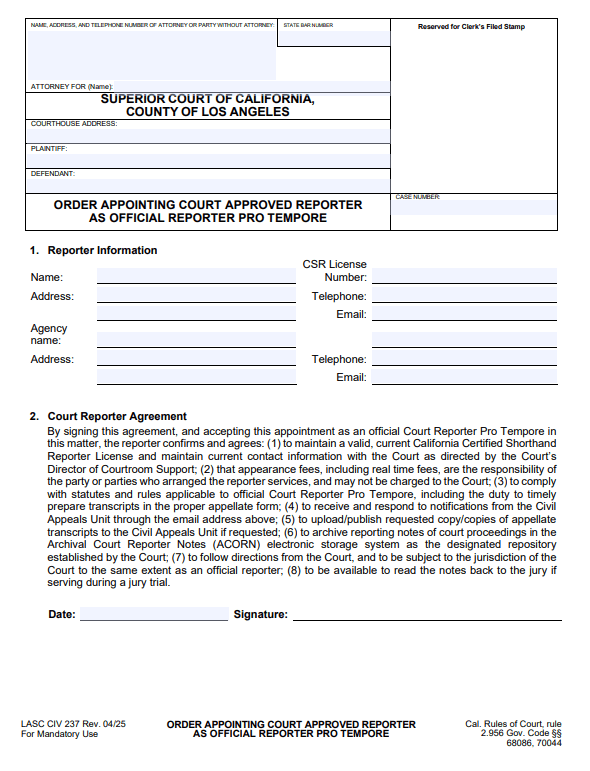
In April 2025, the Los Angeles Superior Court introduced a revised form titled “Order Appointing Court Approved Reporter As Official Reporter Pro Tempore.” This form, as the name suggests, formalizes the appointment of a court-approved reporter as a temporary official reporter for proceedings. But the revised form has sparked confusion and concern among court reporters, particularly because it now includes a section asking for agency information—even when the reporter is already on the court’s approved list.
This change has raised an important question within the court reporting community: If the court reporter is the official responsible for the record, why is the agency’s information even being requested?
To understand why this issue matters, we first need to unpack the role of a court reporter, the purpose of agencies, and why the concept of responsible charge is so central to the integrity of the court record.
The Role of the Court Reporter: More Than a Scribe
Court reporters serve a critical function in the judicial system. They are not mere transcribers or passive observers—they are officers of the court charged with creating and maintaining the official verbatim record of proceedings. This includes not only capturing every spoken word but also noting nonverbal cues, interruptions, and other essential details that could impact the record.
Importantly, the reporter’s duties are not limited to what happens inside the courtroom. They are also responsible for the timely preparation of transcripts, responding to appellate deadlines, certifying the accuracy of the record, and ensuring that the record can withstand legal scrutiny. The reporter holds the ultimate responsibility and liability for the integrity of that record.
This is why the concept of responsible charge matters so much. When we say the reporter is the “responsible charge,” we mean that the reporter—not any third party—is accountable for the accuracy, timeliness, and reliability of the record.
The Role of the Agency: Administrative, Not Legal
Court reporting agencies, on the other hand, provide critical—but fundamentally different—services. Agencies typically handle the business side of reporting: scheduling, marketing, billing, and producing copies of the reporter’s work. They are administrative intermediaries, not legal authorities.
An agency might help facilitate communications between a reporter and a law firm, or between the reporter and a client who needs a transcript. But the agency does not create or control the official record. It does not sign the certification page of the transcript. It does not bear responsibility if a record is incomplete or defective. That burden falls squarely on the court reporter.
The New Form: A Misstep?
Given this clear distinction, the new “Order Appointing Court Approved Reporter As Official Reporter Pro Tempore” form raises concerns. Specifically, why does the form now require agency information for reporters who are already vetted and included on the court’s approved list?
If a reporter is on the court’s approved list, it means they have already met the qualifications, licensing, and experience requirements set by the court. They have been deemed competent to handle official proceedings. In theory, once appointed as a reporter pro tempore, they are stepping into the shoes of an official court reporter, taking on full responsibility for the record.
Asking for agency details on the same form creates a troubling implication: that the agency has some role in the official record. This is not only inaccurate but potentially misleading. It muddies the chain of accountability and raises the risk of confusion if issues arise later in the appellate process or if questions come up about transcript production.
Why This Matters for the Integrity of the Record
Legal records are only as trustworthy as the systems that produce them. One of the key strengths of the U.S. court system is that it maintains clear lines of accountability: judges, clerks, attorneys, and court reporters all have distinct duties. Blurring these lines, even unintentionally, can have serious consequences.
If agencies are perceived—incorrectly—as having a role in maintaining or certifying the official record, it could:
- Undermine confidence in the record’s accuracy.
- Confuse attorneys or litigants about where to direct inquiries.
- Lead to delays if appellate deadlines are missed because communications were sent to an agency instead of the responsible reporter.
- Expose agencies to potential legal claims they were never intended to shoulder.
A Better Approach: Focus on Reporter Accessibility
If the court’s goal in requesting agency information is simply to improve communication—particularly in urgent cases like appeals—there’s a simpler and more appropriate solution: make the court reporters themselves more reachable.
Some practical options include:
- Require reporters to provide a direct phone number or email address when they join the approved list.
- Maintain an up-to-date public directory of approved reporters with their contact details.
- Establish a court-managed messaging system where attorneys and parties can reach the reporter directly in time-sensitive cases.
If a reporter repeatedly ignores deadlines or becomes unreachable, the solution is not to involve agencies—it is to remove that reporter from the approved list until they can meet their obligations.
The Real Role of Agencies—and Why It Shouldn’t Expand
Agencies play an important and legitimate role in the court reporting ecosystem. They help reporters manage their businesses, provide valuable logistical support, and make sure transcripts get into the hands of those who need them. But their function is commercial, not legal.
Expanding their footprint on official court forms risks:
- Confusing their role.
- Diluting the reporter’s legal responsibility.
- Introducing new points of failure in the legal process.
Agencies are not the “responsible charge,” and the system works best when that line remains clear.
Conclusion: Keep the Record Clear
The revised “Order Appointing Court Approved Reporter As Official Reporter Pro Tempore” form should reflect the reality of court operations: the reporter is the custodian of the record, and the agency is a logistical partner, not a legal actor.
If the court is struggling to get timely responses from reporters, the solution lies in improving the court’s directory, enhancing communication protocols, or tightening oversight of the approved list—not in putting agencies on official forms where they don’t belong.
At a time when public trust in the legal system is under pressure, clarity and accountability have never been more important. We should not let administrative convenience blur the bright line between those who create the official record and those who simply help deliver it.
 STENOIMPERIUM
If an agent is to be on a form to track reporters, the form should read “scheduling entity.”
LikeLike