
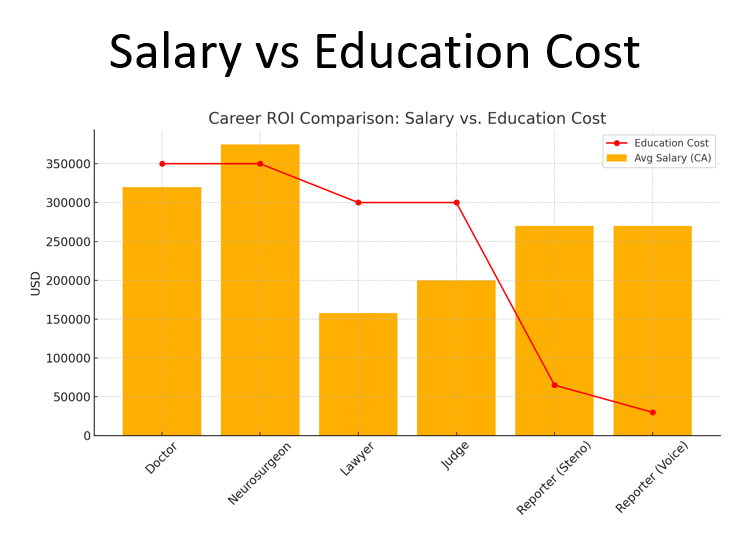
The cost of attending court reporting school can be a major hurdle for many prospective students. With tuition and associated expenses sometimes reaching well over $60,000, it’s natural to question whether the investment is justified. Is it worth spending that much to enter a specialized field like court reporting? While the upfront price tag may seem steep, understanding what the job entails, the certification requirements, long-term career prospects, and potential earnings can help put that cost into perspective.
What Does “Realtime” Mean in Court Reporting?
Realtime reporting is a specialized skill within court reporting where the words written on the stenography machine appear immediately—in real time—on a computer screen. This is essential in legal settings, especially during trials, where judges rely on realtime feeds to instantly review questions, answers, and objections.
For instance, if an attorney makes an objection during a trial, the judge doesn’t need to rely solely on memory or ask the attorney to repeat themselves. The judge can glance at their monitor and see exactly what was said, thanks to the realtime transcription provided by the court reporter. It’s like closed captioning for the courtroom—only faster and more precise.
Attorneys also rely on realtime feeds during high-stakes depositions—where millions of dollars may be at stake and they have only one opportunity to question a witness—to instantly review testimony, catch inconsistencies, and adjust their strategy on the fly.
How Fast and Accurate Do You Need to Be for Certification?
Speed and accuracy are critical in this profession. In California, to earn the Certified Shorthand Reporter (CSR) license—the credential required to work as a court reporter in the state—you must demonstrate the ability to transcribe at 200 words per minute (wpm) for four voices, with a minimum accuracy rate of 97.5%. This is tested in a live dictation environment, simulating real courtroom conditions. Realtime certification standards are even more rigorous at the national level.
The National Court Reporters Association (NCRA) offers the Registered Professional Reporter (RPR) credential, which is commonly required for federal positions or to boost one’s freelance credentials. The RPR test includes:
- 225 wpm Q&A
- 200 wpm Jury Charge
- 180 wpm Literary
Each leg must be passed individually, and the pass rate is roughly 95% accuracy for each section. These higher standards reflect the demands of realtime captioning and complex legal work.
Is the California CSR License Enough to Land a Job?
In California, the CSR license is non-negotiable. Whether you’re working as a freelancer (handling depositions and hearings) or applying for a full-time position in Superior Court, you must hold the California CSR. However, for certain official roles—especially in federal court—additional credentials like the RPR are preferred or required.
California Superior Courts often have their own hiring criteria, but most will not even interview you without a CSR. Some higher-paying roles, especially in federal court, seek candidates with both the CSR and RPR, given the high standards and complex caseloads.
Currently, 24 states have their own licensing or credentialing requirements for court reporters, similar to the California CSR, while 8 states either allow or require the nationally recognized RPR (Registered Professional Reporter) certification as the sole credential needed to work in the field.
How Long Until Your Pension is Vested?
Pension vesting is another key factor when considering a long-term career in official court reporting. Here’s how it works:
- Superior Court (State-level): Pension vests after 5 years of continuous service.
- Federal Court: Similarly, pension benefits begin vesting after 5 years.
Once vested, you’re eligible for a defined benefit pension plan based on your years of service and highest earning years—an increasingly rare benefit in today’s job market.
What Kind of Health Insurance Do California Court Reporters Get?
While this can vary by county or agency, California court reporters working for the government typically enjoy excellent health benefits, including:
- Comprehensive medical coverage
- Dental and vision insurance
- Access to flexible spending accounts (FSAs)
One major caveat: you lose these benefits upon leaving government employment, unless you’ve worked for 25 years, in which case you’re eligible for lifetime medical benefits.
In federal court, the benefits are even more generous. After just five years of service, you become eligible for lifetime health insurance coverage, provided you retire from federal service.
Is Freelance Work Worth the Higher Pay, Despite Lack of Benefits?
Many new court reporters are tempted by freelance work, which often comes with a higher per-job pay rate and greater flexibility. However, freelancers must manage their own:
- Health insurance
- Retirement savings
- Business expenses (e.g., parking, equipment, software)
While the gross income may be higher, the net take-home pay can be significantly reduced once these costs are accounted for. For instance, government-employed reporters often receive:
- Free parking
- Paid vacation and sick time
- Employer-funded pension contributions
As one seasoned reporter advises: Work for Superior Court for at least five years to vest your pension, gain experience, and enjoy stable benefits. Then, consider moving to Federal Court, where compensation and benefits increase further.
Why Are Court Reporters Being Laid Off if There’s a Shortage?
This is one of the most puzzling contradictions in the field. With the well-documented national shortage of court reporters, many wonder how layoffs could even happen.
Here’s the backstory:
In 2012, California faced a *huge judicial budget shortfall. Courts were ordered to slash costs, and they looked at the highest-salaried employees—which included court reporters. During union negotiations, SEIU (Service Employees International Union), which represented both court reporters and social workers, had to prioritize. According to reports from that time, SEIU decided to back social workers, leaving court reporters vulnerable to layoffs.
The following year, in 2013, the Ducker Report was published, highlighting a looming national shortage of qualified court reporters. Unfortunately, this study came after the layoffs. Had the union made court reporters a priority, the layoffs might never have occurred.
It was a case of bad timing, political decisions, and fiscal austerity—all colliding before the true value of court reporters was widely recognized again.
Final Thoughts: Is It All Worth It?
So, back to the original question: Is $65,000 for court reporting school a crazy investment?
Not necessarily—if you finish and pass the CSR. Court reporting is one of the few careers where you can earn a six-figure income without a traditional four-year degree. Once certified, your skills are in high demand, especially in California. But the path is rigorous. It demands discipline, accuracy, and speed. The investment pays off—but only if you’re all in.
For those willing to put in the time, court reporting offers a rare combination of job security, strong benefits, and professional satisfaction in a field that truly matters to the justice system.
**In 2012, California’s judicial branch faced cumulative ongoing budget reductions totaling $653 million, including a $350 million reduction enacted in the 2011–12 fiscal year. These cuts led to significant operational changes across the state’s court system, including furlough days, courtroom closures, and layoffs of court personnel.
Los Angeles Superior Court, the largest trial court in the nation, announced budget cuts affecting 431 employees in June 2012, citing a need to reduce spending by $30 million due to reductions in state financial support. The court had already implemented various cost-saving measures since 2010, including layoffs, hiring freezes, and cuts in supplies, to address the ongoing budget crisis.
Overall, the state’s budget shortfall for the 2012–13 fiscal year was estimated to be $15.7 billion, prompting Governor Jerry Brown to propose a combination of spending cuts and tax increases to close the gap. The judicial branch bore a significant portion of these reductions, impacting access to justice and court operations throughout California.
In the 2012–2013 fiscal year, California’s trial courts reported total expenditures of approximately $25.5 million for court reporter services. This amount was remitted to the Trial Court Trust Fund as mandated by Government Code sections 68086 and 70313.
Additionally, the 2012 Budget Act introduced a new $30 fee for civil proceedings lasting less than one hour, aimed at offsetting the costs of providing official court reporters. This fee was intended to be collected from litigants and deposited into the Trial Court Trust Fund, with the funds subsequently returned to the courts where they were collected.
Despite these measures, the judicial branch faced significant financial challenges. The Budget Act of 2012 required the Judicial Council to allocate a $385 million reduction to trial courts’ Trial Court Trust Fund allocations. This substantial budget cut impacted various court operations, including the provision of court reporter services.
These financial constraints contributed to operational changes across the state’s court system, such as furlough days, courtroom closures, and layoffs of court personnel, including court reporters. The reductions underscored the challenges faced by the judicial system in maintaining essential services amid budgetary pressures.
 STENOIMPERIUM
After FINALLY getting my license (three attempts), someone relayed to me that only 4% of the students ever qualify to take the State exam. It’s that difficult. I think that’s critical information for students to know before enrolling in the program.
Can you confirm that figure?
LikeLike
I believe the pass rate on the CSR exam is 25%, on average, but the pass rate of those who start school is notoriously 10%, even when I started school 20 years ago. That’s for the steno machine. The voice writing program has a shorter school program of 1 year and I believe a much higher pass rate. But the exam is not only the machine portion, it’s spelling, grammar, punctuation, medical and legal terminology, and the code of law that we have to follow. If you compare that with the other industries, their exams and schooling is also quite challenging.
LikeLike
I’ve revised that number and added the pass rate information for ALL of the professions listed in the article, including court reporting.
LikeLike