
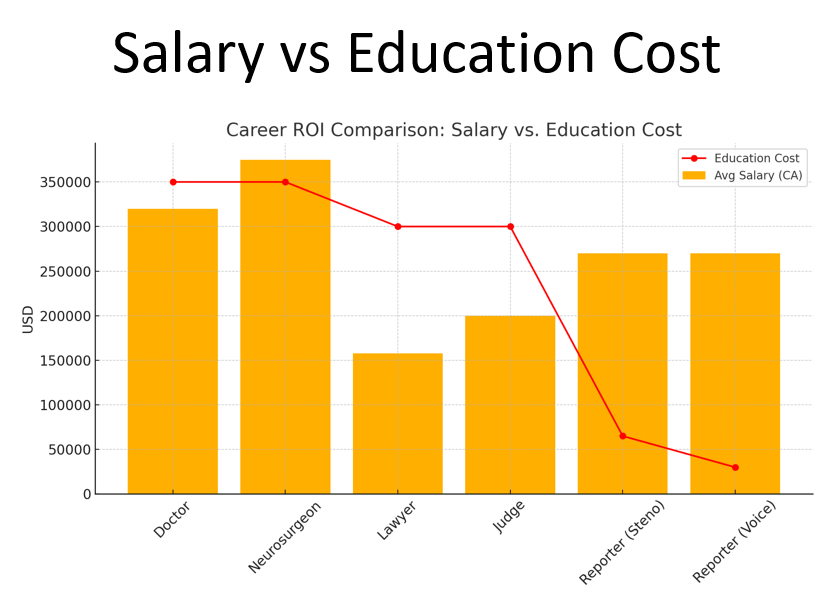
When students begin exploring their career paths, questions about income, education, and cost are front and center. It’s common to wonder, “How much does it cost to become a doctor, lawyer, or judge?” or “How long does it take to earn six figures in those fields?” Yet one career often overlooked in these conversations is court reporting—a profession that, once fully understood, challenges many assumptions about career value, income potential, and education investment.
Let’s break it down honestly and directly: for students evaluating their futures, especially in California, court reporting offers one of the highest returns on investment (ROI) of any skilled career.
What It Takes to Become a Doctor, Lawyer, Judge, or Neurosurgeon
Let’s look at some of the most respected and sought-after careers:
- Doctor (MD/DO)
- Time in school: 8 years (plus 3–7 years residency)
- Education cost: $260,000–$440,000
- Average salary: $320,000
- Top earners: $500,000+
- Pass rate (MCAT to MD): ~41%
- USMLE Step 1 pass rate: ~96%
- Neurosurgeon
- Time in school: 8 years (plus 7 years residency)
- Education cost: $260,000–$440,000
- Salary range: $300,000–450,000 (some reach $1M+)
- Match rate for neurosurgery residency: ~75%
- Lawyer
- Time in school: 7 years
- Education cost: $190,000–$410,000
- Average salary: $135,000–180,000 (Big Law can exceed $300,000)
- Bar exam pass rate (first-time, CA): ~50%
- Judge (usually former lawyers)
- Time in school: 7+ years plus legal experience
- Education cost: $190,000–$410,000
- Salary: $200,000 (up to $285,000 for federal judges)
- Competitive judicial appointment rate: Low (<5% of lawyers become judges)
- %
- Court Reporter (Steno or Voice Writing)
- Time in school: 1–3 years
- Education cost: $20,000–$65,000
- Average salary (CA): $360,000
- Top earners: $500,000 to $1M+
- CSR exam pass rate (CA): ~25%
- Graduation-to-career entry rate: ~10%
These careers are prestigious and well-compensated, but they also come with significant barriers to entry. Medicine and law may have higher academic entry rates, but court reporting has far higher performance and persistence barriers, particularly due to skill mastery and speed-building.
What About Court Reporting?
Now consider this:
- Court Reporter (Steno or Voice Writing)
- Time in school: 1–3 years
- Steno: ~3 years
- Voice Writing (licensed in CA): ~1 year
- Education cost: $20,000–$65,000
- Average full-time salary in California: $360,000
- Top earners: $500,000 to $1M+
- CSR exam pass rate (CA): ~25%
- Graduation-to-career entry rate: ~10%
- Time in school: 1–3 years
That’s not a typo. Top court reporters, especially those working in high-demand markets like Los Angeles and San Francisco, earn more than many doctors and lawyers. Even average full-time reporters in California earn well over six figures when transcript income is included.
The catch? The general public doesn’t know this.
Why? Because national salary averages (“$60K–$100K”) include part-timers, retirees, and lower-cost regions. But full-time, certified professionals in California regularly earn $200K, $300K, or more.
The pass rate also contributes to court reporting’s exclusivity. Mastery takes time and mental discipline, not unlike mastering a musical instrument. It’s why those who make it into the profession are highly valued—and well-compensated.
That said, Court Reporting is not a casual career choice. Prospective students should consider whether they:
- Are able to sit for long hours with intense focus
- Have strong grammar, vocabulary, and attention to detail
- Thrive under deadlines and pressure
- Can remain quiet and neutral in high-stress environments
- Are comfortable working alone for long stretches
- Have the discipline to spend weeknights, weekends, and holidays editing transcripts
Court reporting is a service profession. It’s about accuracy, speed, organization, and reliability. If you love language, enjoy solving word puzzles, and feel energized by delivering precise results in high-stakes settings, maybe every played the piano or other musican instrument, you might be a natural fit.
But if you’re just here for the income, think carefully—because only the students who love the work and live the discipline make it through.

Takeaway
✅ Court Reporting, especially in California, offers:
- The fastest path to six-figure earnings
- One of the lowest education costs
- Equal or better top-end earning potential than doctors and lawyers
- Multiple pathways (steno or voice) depending on skillset and learning preference
| Metric | Court Reporter (Steno machine or Voice) | Doctor (MD) | Lawyer |
|---|---|---|---|
| Education Time | 1 year | 8 years | 7 years |
| Education Cost | $20K–$40K | $260K–$440K | $190K–$410K |
| Time to Enter Workforce | 1–1.5 years | 10–12 years | 7 years |
| Avg Salary (CA) | ~$360K | ~$320K | ~$150K |
| Top Earners | $400k – 1M+ | $500K–$1M+ | $300K+ |
| Payback Time on Education | <1 year | 3–6 years (after res.) | 5–10 years |
The ROI Advantage: A Real Investment
Some students balk at the idea of paying $65,000 to attend a private court reporting school like South Coast College. But that reaction is often based on sticker shock, not strategic thinking.
Let’s flip the question: why do pre-med students eagerly take out $400,000 in student loans to attend medical school? Why do future lawyers aim for Ivy League law schools, where tuition exceeds $70,000 per year?
Because they see it as an investment. They understand the long-term value of a high-income profession. And they know the prestige of their school can influence future earnings.
Here’s the difference: court reporters often earn more than lawyers, and many earn as much or more than doctors — but with far less debt, faster entry into the workforce, and less competition for jobs.
So when a court reporting student sees a $65,000 price tag and thinks it’s “kooky,” that’s a failure of industry messaging, not a failure of the math.
Real-World Examples
- A court reporter in San Francisco working on patent litigation cases publicly earned $800,000+ per year in 2018. Adjusted for 2024, that income likely exceeds $1 million today.
- Many Los Angeles-based freelancers regularly earn $400,000 to $500,000+, working full-time in high-volume deposition work.
- Entry-level court reporters in California courts start at $130,000 base salary, with transcript income adding $50,000–$230,000+ annually.
Meanwhile, a neurosurgeon testified under oath that he earned $300,000/year — and that’s after 15+ years of education and training.
Final Thoughts: Think Like an Investor
Students need to think about education the way an investor thinks about startups:
- How much capital do I need to put in?
- How long before I see a return?
- What are my long-term earning prospects?
- What’s the risk of not getting a job or burning out?
When viewed this way, court reporting stands out as one of the most financially efficient and highly compensated skilled professions available today.
Sure, $65,000 isn’t cheap. But neither is wasting 7 years and $200,000 on a degree that doesn’t pay off.
Court reporting is a hidden gem. It deserves serious consideration from any student aiming to build a high-income, low-debt, future-ready career. The math speaks for itself.
If you’re a student who hesitates at the idea of spending $65,000 on a private court reporting school, take a second look at what you’re really investing in. South Coast College is the only NCRA-approved school in California, with the highest California CSR pass rates and a track record of producing the top earners in the industry. Even Judge Judy’s court reporter is a proud graduate. This isn’t just a school—it’s a launchpad. Don’t cut corners on the quality of your education when that education can place you among the best writers in the nation. I personally endorse South Coast College as that is my alma mater and I have first-hand experience of the value of the theory and personal network they provide.
That’s why students from across the country move to California just to attend South Coast College. They understand the ROI. They value the exceptional quality of instruction. And once they graduate, many return home equipped with the best credentials in the industry. If you’re serious about success, choose the institution that consistently turns students into stars.
(**This blog represents my personal views, experience, and expertise as a professional in the field of court reporting. I personally endorse South Coast College as it is my alma mater, and I have first-hand experience of the value of its theory-based curriculum and the professional network it provides. The information provided here is based on real-world knowledge and industry insight gathered over years of working alongside top reporters, educators, and legal professionals and research and personal knowledge of these other fields. )
 STENOIMPERIUM
I beg to differ. It took me 3 years college and I only made over 100 K twice in 46 years. This isn’t the norm that you have on here.
Sent from AOL on Android
LikeLike
$100k is the national average, which sounds like you fall within that. And the national average for steno machine is 3 years, which sounds like you also fall within. It does depend on lots of factors – geographic market, skill level, hustle, niche, full time or part time, what kind of work you choose to take. If you just do normal depos or workers comp cases, you’ll fit into that average number range.
LikeLike
Yes, I know all this, being that I’ve been a reporter for 46 years in Texas. But only firm owners make 500k, not us. None that I know of anyway.
Sent from AOL on Android
LikeLike
You also need to include in your statistics the pass/fail rates for students taking certifications exams, as well as the percentage of students who start court reporting programs and actually complete them. I think it’s important that prospective students have a full picture of those harsh realities!
Edwin Walker, Texas CSR
LikeLike