

In the evolving world of court reporting, the convergence of tradition and technology has reached a pivotal point. At the center of this transformation is Eclipse RSR—a voice-to-text software by Advantage that’s rapidly redefining what it means to be a modern court reporter.
For years, the field has been primarily dominated by stenographers and voice writers, with digital reporting often viewed as the lesser sibling. But RSR (RealSpeak Realtime) is changing that narrative. Designed as the next iteration of Eclipse software, RSR builds on familiar platforms and integrates automatic speech recognition (ASR) to allow users—stenos, voice writers, and even newcomers—to produce real-time transcripts with remarkable accuracy and speed.
While RSR isn’t generative AI in the typical sense, it is an advanced ASR tool that transforms spoken words into editable text in real time. For traditional stenographers, it might sound like heresy, but many are quietly experimenting with RSR—and some are already using it in their daily workflow. The benefits are hard to ignore: streamlined real-time transcripts, quicker rough drafts, and powerful collaborative features like “team editing,” where scopists or editors can join a live deposition and assist in real-time editing. This drastically reduces turnaround times and enhances transcript quality.
The Resistance and the Shift
Not everyone is thrilled. Some highly skilled realtime stenographers express concern over training digital reporters to use these tools, fearing it may erode their hard-earned market share. After all, helping someone new master RSR might just equip them to compete for the same realtime jobs. But many within the community also see the inevitability of change. Instead of resisting, they advocate for owning the transition—helping train others, shaping ethical standards, and ensuring quality remains high.
This shift is not just about technology; it’s about labor, economics, and professional identity. Many digitals, once relegated to low-paying roles with little autonomy, are seizing the opportunity RSR offers. It empowers them to produce and certify their own work, assuming they have the necessary skills in grammar, punctuation, and transcript editing. For some, it’s a lifeline out of exploitative agency structures where they log notes while someone else gets paid to finalize their work.
The Skills Gap
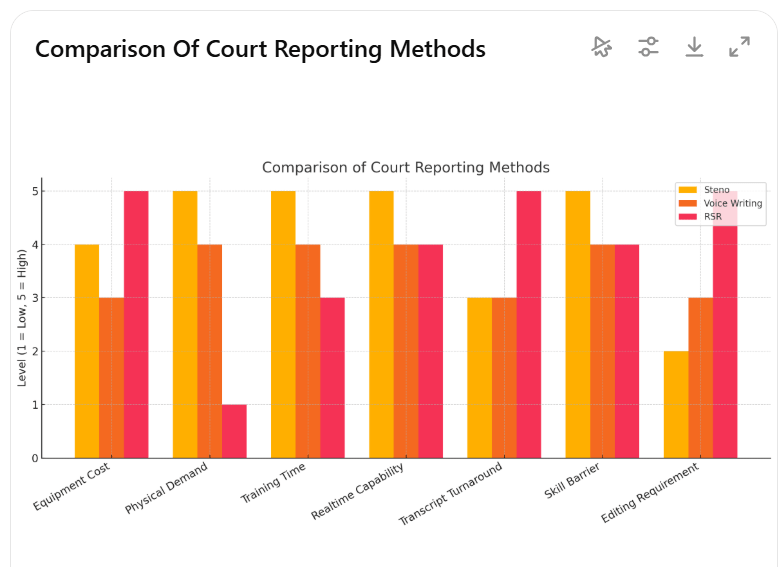
Despite RSR’s promise, it’s not a magic button. It demands competence. Knowing how to edit effectively in Eclipse, maintain transcript integrity, and manage the demands of realtime work is critical. Those who assume the software alone will do the job are in for a wake-up call. Professionals—regardless of background—must still meet the same high standards.
And that’s why some stenos don’t see RSR as a threat, but as a tool—especially valuable for those dealing with physical strain, career burnout, or a lack of retirement savings. With RSR, they can continue working without the physical toll of machine writing.
The Economics of Access
There is, however, a significant barrier to entry: cost. RSR is expensive, and many digital reporters earning hourly wages struggle to afford it. Agencies, which often control the software, are slow to provide access or support. As a result, even as the technology becomes more widespread, many digitals remain on the fringes—locked out of opportunities that could elevate them to full reporting professionals.
This has sparked frustration. Many aspiring reporters feel left behind—not for lack of skill, but due to institutional reluctance to invest in them. Meanwhile, some experienced reporters, disheartened by industry gatekeeping and gossip, are taking matters into their own hands: investing in RSR independently, training others, and pushing for a more equitable system.
The Future of Reporting
The world of court reporting is evolving rapidly. With RSR, we are witnessing not the end of steno, but a diversification of pathways into the profession. Whether you’re a steno veteran, a digital reporter, or a language-savvy newcomer, the same message rings true: adapt, learn, and evolve.
RSR isn’t perfect. It won’t replace the best realtime reporters overnight. But it’s here. It’s powerful. And it’s leveling the playing field for those willing to master it.
The question is no longer if this technology will reshape the industry, but how we, as a community, choose to shape it.
 STENOIMPERIUM