In today’s fast-paced tech landscape, software end-of-life (EOL) events are increasingly common—and often disruptive. From operating systems to cloud platforms, companies regularly sunset older versions of software, pushing users to adopt newer iterations whether they’re ready or not. While the logic often revolves around security, performance, and modernization, the reality on the ground can be chaotic—especially when the new version isn’t quite ready for prime time.
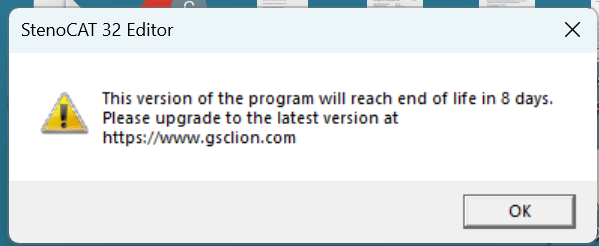
That’s the situation facing court reporters across the country with the recent EOL of StenoCat32, a long-trusted software by Gigatron Software Corporation that has served as a cornerstone in the court reporting world for decades.
Forced Upgrades in Mission-Critical Fields
Gigatron officially announced the end-of-life for StenoCat32 in early 2025, with support and updates ceasing shortly thereafter. Users were informed they’d need to migrate to the company’s newer platform, which comes with a modernized interface, cloud capabilities, and enhanced integration options.
However, this transition has not been smooth for everyone.
Court reporters—who rely on real-time stability and precision—have reported numerous bugs and performance issues with the new version. Some cite crashes during live depositions, incomplete file exports, and issues syncing with essential CAT hardware. Others worry that their workflow is being dictated by a software schedule rather than practical readiness.
The Bigger Picture: EOL as a Business Model
StenoCat32’s retirement is not an isolated case. Major players like Microsoft, Adobe, and Salesforce routinely phase out legacy products to streamline operations and encourage adoption of newer, often subscription-based models. While this strategy makes sense from a maintenance and revenue standpoint, it often leaves end users scrambling to adapt—especially in niche or highly specialized industries.
“In fields like court reporting, reliability isn’t optional—it’s everything,” said one California-based court reporter, who requested anonymity. “When the tool you rely on every day gets replaced with something half-baked, it’s not just inconvenient. It can be damaging to your career.”
A Tough Balancing Act
To be fair, Gigatron has emphasized that the new version is actively being patched and improved based on user feedback. The company has hosted webinars and support sessions to help ease the migration. Still, critics argue that a grace period or dual-support window would have allowed professionals more breathing room to transition.
“The rollout felt abrupt,” said another user. “We were given a deadline, and that was it. No fallback, no rollback.”
What Can Be Done?
For now, the best advice for affected users is to:
- Stay current on updates and patches.
- Participate in beta feedback if possible.
- Keep open communication with Gigatron support and user communities.
But perhaps more broadly, the StenoCat32 situation underscores a critical lesson in the age of cloud-driven software lifecycles: not every upgrade is an improvement—at least not at first.
As more industries find themselves tethered to subscription timelines and mandatory migrations, it may be time to revisit how software companies approach the concept of “sunsetting.” Because for users, it’s not just about innovation—it’s about trust.
Published by stenoimperium
We exist to facilitate the fortifying of the Stenography profession and ensure its survival for the next hundred years!
As court reporters, we've handed the relationship role with our customers, or attorneys, over to the agencies and their sales reps. This has done a lot of damage to our industry. It has taken away our ability to have those relationships, the ability to be humanized and valued. We've become a replaceable commodity.
Merely saying we are the “Gold Standard” tells them that we’re the best, but there are alternatives. Who we are though, is much, much more powerful than that! We are the Responsible Charge. “Responsible Charge” means responsibility for the direction, control, supervision, and possession of stenographic & transcription work, as the case may be, to assure that the work product has been critically examined and evaluated for compliance with appropriate professional standards by a licensee in the profession, and by sealing and signing the documents, the professional stenographer accepts responsibility for the stenographic or transcription work, respectively, represented by the documents and that applicable stenographic and professional standards have been met.
This designation exists in other professions, such as engineering, land surveying, public water works, landscape architects, land surveyors, fire preventionists, geologists, architects, and more. In the case of professional engineers, the engineering association adopted a Responsible Charge position statement that says, “A professional engineer is only considered to be in responsible charge of an engineering work if the professional engineer makes independent professional decisions regarding the engineering work without requiring instruction or approval from another authority and maintains control over those decisions by the professional engineer’s physical presence at the location where the engineering work is performed or by electronic communication with the individual executing the engineering work.”
If we were to adopt a Responsible Charge position statement for our industry, we could start with a draft that looks something like this: "A professional court reporter, or stenographer, is only considered to be in responsible charge of court reporting work if the professional court reporter makes independent professional decisions regarding the court reporting work without requiring instruction or approval from another authority and maintains control over those decisions by the professional court reporter’s physical presence at the location where the court reporting work is performed or by electronic communication with the individual executing the court reporting work.”
Shared purpose
The cornerstone of a strategic narrative is a shared purpose. This shared purpose is the outcome that you and your customer are working toward together. It’s more than a value proposition of what you deliver to them. Or a mission of what you do for the world. It’s the journey that you are on with them. By having a shared purpose, the relationship shifts from consumer to co-creator.
In court reporting, our mission is “to bring justice to every litigant in the U.S.” That purpose is shared by all involved in the litigation process – judges, attorneys, everyone. Who we are is the Responsible Charge. How we do that is by Protecting the Record.
View more posts
 STENOIMPERIUM