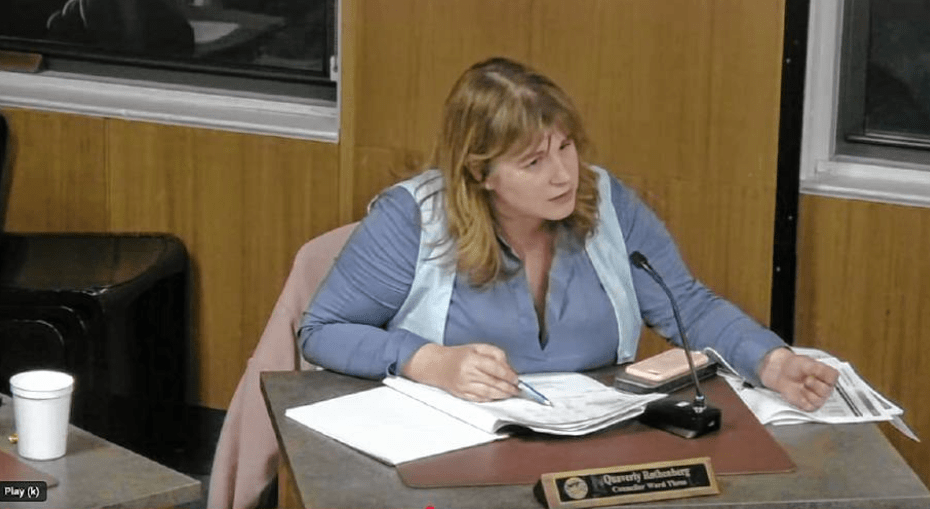
Quaverly Rothenberg, a City Councilor from Northampton, Massachusetts, has long positioned herself as a progressive voice in local government—but outside of City Hall, she’s made a name for herself in an entirely different and controversial domain: the court reporting world.
Recently, Rothenberg didn’t make headlines—but she did raise suspicions—not for her political activity, but for an unusual social media move. According to a concerned parent and court reporter, Rothenberg attempted to follow their daughter’s Instagram account, raising eyebrows and prompting discomfort. The incident, which is seen by some as “creepy,” adds to a growing list of unconventional behavior associated with Rothenberg.
Beyond politics, Rothenberg identifies as a “QWERTY transcriptionist,” claiming an almost mythical ability to type 300 words per minute on a typewriter—yes, a typewriter—using Word macros. She is said to have commissioned a specially-built “quiet” typewriter for use during legal depositions, and has reportedly used it while working as a pseudo wannabe court reporter. The image of a manual typewriter clacking away during a deposition is jarring in a world dominated by steno machines and voice writing technology—but Rothenberg insists she’s not only keeping up, she’s thriving.
Rothenberg has made waves—and enemies—among traditional court reporters. She’s been a fixture in court reporting forums and communities for nearly a decade, often infiltrating stenographic groups despite openly refusing to learn steno or voice writing. Instead, she champions her old-school approach, claiming that she earns a solid income using her unorthodox setup.
What’s more, she allegedly has court reporters from New Hampshire and Colorado who support her approach, amplifying her presence and influence. Critics argue that her persistence undermines professional standards and could mislead newcomers about what’s required to succeed in the field. Supporters, on the other hand, the few that are out there, admire her audacity and DIY ethic.
Politically, Rothenberg is no stranger to controversy either. In early 2025, she was formally censured by the Northampton City Council for misusing a non-emergency dispatch line during a winter storm. During the call, she attempted to access emergency contact information for city workers, claimed that City Council “outranks the mayor,” and made false statements about department leadership. Her behavior was deemed “unbecoming” by her peers.
Rothenberg has defended her approach in both government and transcription, framing herself as an outsider challenging the status quo. Whether she’s pioneering a new kind of typing revolution—or simply refusing to evolve—is a matter of debate.
Whether Rothenberg is a quirky innovator or a chaotic distraction depends on whom you ask. But with her presence spanning local government, obscure internet forums, and now stalking a real court reporter and her daughter on social media, one thing is clear: she’s not your average politician—or court reporter.
Published by stenoimperium
We exist to facilitate the fortifying of the Stenography profession and ensure its survival for the next hundred years!
As court reporters, we've handed the relationship role with our customers, or attorneys, over to the agencies and their sales reps. This has done a lot of damage to our industry. It has taken away our ability to have those relationships, the ability to be humanized and valued. We've become a replaceable commodity.
Merely saying we are the “Gold Standard” tells them that we’re the best, but there are alternatives. Who we are though, is much, much more powerful than that! We are the Responsible Charge. “Responsible Charge” means responsibility for the direction, control, supervision, and possession of stenographic & transcription work, as the case may be, to assure that the work product has been critically examined and evaluated for compliance with appropriate professional standards by a licensee in the profession, and by sealing and signing the documents, the professional stenographer accepts responsibility for the stenographic or transcription work, respectively, represented by the documents and that applicable stenographic and professional standards have been met.
This designation exists in other professions, such as engineering, land surveying, public water works, landscape architects, land surveyors, fire preventionists, geologists, architects, and more. In the case of professional engineers, the engineering association adopted a Responsible Charge position statement that says, “A professional engineer is only considered to be in responsible charge of an engineering work if the professional engineer makes independent professional decisions regarding the engineering work without requiring instruction or approval from another authority and maintains control over those decisions by the professional engineer’s physical presence at the location where the engineering work is performed or by electronic communication with the individual executing the engineering work.”
If we were to adopt a Responsible Charge position statement for our industry, we could start with a draft that looks something like this: "A professional court reporter, or stenographer, is only considered to be in responsible charge of court reporting work if the professional court reporter makes independent professional decisions regarding the court reporting work without requiring instruction or approval from another authority and maintains control over those decisions by the professional court reporter’s physical presence at the location where the court reporting work is performed or by electronic communication with the individual executing the court reporting work.”
Shared purpose
The cornerstone of a strategic narrative is a shared purpose. This shared purpose is the outcome that you and your customer are working toward together. It’s more than a value proposition of what you deliver to them. Or a mission of what you do for the world. It’s the journey that you are on with them. By having a shared purpose, the relationship shifts from consumer to co-creator.
In court reporting, our mission is “to bring justice to every litigant in the U.S.” That purpose is shared by all involved in the litigation process – judges, attorneys, everyone. Who we are is the Responsible Charge. How we do that is by Protecting the Record.
View more posts

 STENOIMPERIUM