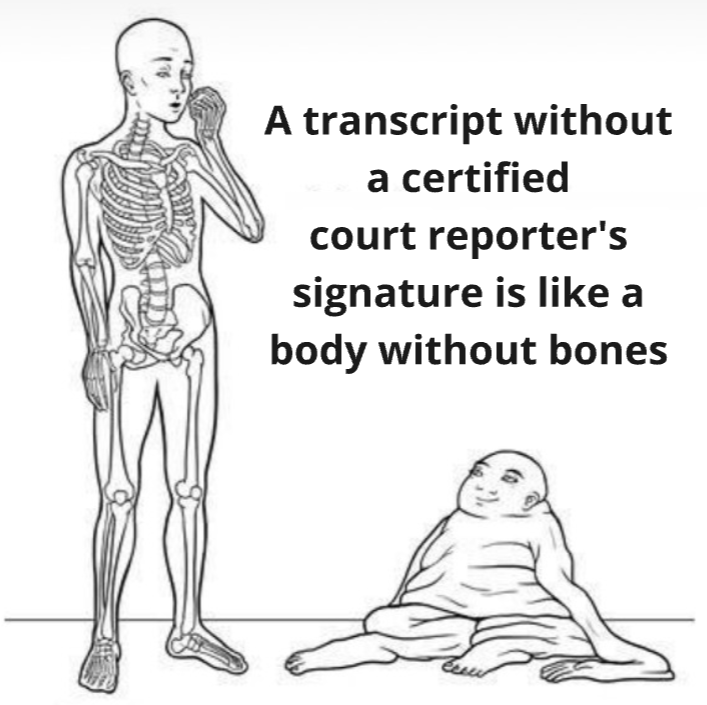
In the legal field, the accuracy and integrity of court transcripts are paramount. A certified court reporter’s signature serves as a fundamental guarantee that the transcript is an authentic, complete, and unaltered record of the proceedings. Without such certification, a transcript is akin to a body without bones—lacking the structural integrity necessary to stand up to scrutiny in court. The recent rise of digital reporting services has brought significant challenges to legal professionals, particularly when uncertified or improperly identified transcripts find their way into the courtroom.
The Case of the “Deposition Officer” Transcript
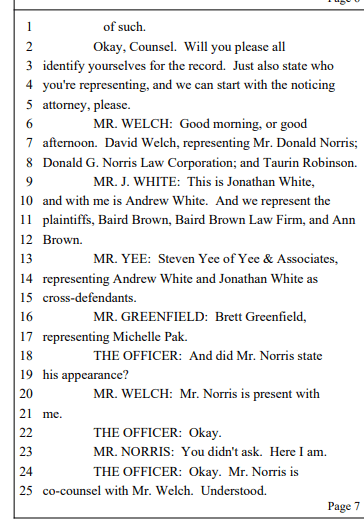
Recently, while engaged in a trial, I encountered a troubling situation. The plaintiff’s counsel read from a deposition transcript ordered by the defendant. However, upon reviewing the document, I noticed a glaring red flag: instead of a certified court reporter’s identification, the transcript referenced “The Deposition Officer.” This immediately raised concerns regarding its authenticity and legal admissibility. (screenshots of deposition taken by a notary is at the end of this article.)
Upon further investigation, it became clear that the transcript had been produced by a digital reporter, rather than a certified stenographic court reporter. Unlike certified reporters who undergo rigorous training, adhere to strict ethical guidelines, and operate under sworn duties, digital reporters often lack the same level of accountability and expertise. The absence of a certification by a licensed professional meant that the transcript could not be considered a true and verifiable record of the deposition.
Legal and Ethical Implications
- Admissibility in Court The rules of evidence demand that deposition transcripts must be certified to ensure their reliability. Without certification, a transcript may not meet the legal standards for admissibility. Presenting an uncertified transcript to the court could mislead the judge and jury, leading to potentially unjust rulings based on an unreliable record.
- Ethical Responsibilities of Attorneys Attorneys have a duty to uphold the integrity of the legal process. Presenting a transcript from an uncertified source raises serious ethical concerns, as it suggests either a lack of due diligence or an intentional attempt to use unreliable evidence. In this case, the plaintiff’s counsel was aware of the issue but chose to proceed regardless, which could be seen as a breach of professional ethics.
- Judicial and Clerical Oversight When I alerted the court clerk to the issue, the response was dismissive—he claimed it was not his concern. However, ensuring that only legally admissible evidence is presented in court should be of paramount concern to all officers of the court, including clerks and judges. The failure to scrutinize such records weakens the judicial system’s commitment to fairness and due process.
California Law on Transcript Certification
California law mandates that deposition transcripts be certified by a licensed court reporter to be legally admissible. Under California Code of Civil Procedure § 2025.340(m), only transcripts prepared stenographically by a Certified Shorthand Reporter (CSR) are automatically admissible in court. Additionally, Business and Professions Code § 8017 requires that all shorthand reporters practicing in the state be licensed by the Court Reporters Board of California. These legal provisions ensure that court transcripts are reliable, accurate, and produced by qualified professionals.
The Dilemma: Speaking Up vs. Remaining Silent
As a legal professional, I found myself in an ethical predicament. Should I alert the court that the transcript was illegal and inadmissible, or would doing so make me appear biased? By allowing the transcript to go unchallenged, I might be complicit in an error that could impact the trial’s outcome. On the other hand, raising the issue could create tensions with both parties, particularly if neither side wanted to acknowledge the mistake.
Ultimately, my duty to the court and the legal system required that I take action. Legal ethics dictate that attorneys must act in good faith and strive to ensure the integrity of the judicial process. Allowing an uncertified transcript to be used without objection would undermine this obligation.
Attorneys Cannot Stipulate Away the Law
Attorneys cannot simply agree to disregard or override established laws, including those that govern the admissibility of court transcripts. Legal statutes exist to maintain fairness, accuracy, and due process in judicial proceedings, and private agreements between attorneys cannot supersede these requirements. In the case of deposition transcripts, the law explicitly mandates certification by a licensed court reporter. Even if both parties were to stipulate to using an uncertified transcript, the court is not bound by such an agreement if it contradicts statutory law. Ignoring these legal safeguards not only jeopardizes the integrity of the case, but could also lead to sanctions and legal challenges that undermine the credibility of the attorneys involved.
Moreover, attorneys cannot stipulate away a law absent a court order, and even a judge cannot disobey the law. Such an act would be unconstitutional and a violation of due process rights. The legal system is built upon the principle that laws must be followed, and no agreement or judicial discretion can override fundamental legal protections. If a court were to accept an uncertified transcript in direct violation of statutory requirements, it would constitute a failure of due process and could provide grounds for appeal or reversal of a decision. This would be a direct violation of the Due Process Clause of the U.S. Constitution—specifically, the Fifth Amendment (for federal cases) and the Fourteenth Amendment (for state cases). These amendments guarantee that no person shall be deprived of life, liberty, or property without due process of law. Allowing uncertified transcripts to be used in court undermines the fairness and integrity of judicial proceedings, thus violating these constitutional protections.
The Irony of Attorneys Engaging in Illegal Conduct
It is deeply ironic that attorneys—whose very profession is built upon upholding the law—would knowingly engage in conduct that is so grossly illegal. These are individuals who have sworn an oath to support the Constitution and adhere to the rules of professional conduct, yet they are actively participating in or turning a blind eye to legal violations. The hypocrisy is glaring: they argue cases demanding justice, fairness, and strict adherence to legal standards, yet when it suits them, they are willing to ignore fundamental legal requirements for convenience or strategy. This undermines not only their credibility but the public’s trust in the legal system as a whole.
Holding All Parties Accountable
Both the plaintiff and defendant shared responsibility in this situation:
- Defendant’s Error: The defendant’s decision to use a digital, reporter rather than a certified court reporter, introduced the issue in the first place. Whether this was due to cost-cutting measures or ignorance of legal requirements, it created a significant problem that could have been avoided by hiring a certified professional.
- Plaintiff’s Counsel’s Oversight: By knowingly reading from the uncertified transcript, the plaintiff’s attorney engaged in questionable conduct. Even if the attorney did not order the transcript, the duty to ensure the admissibility and integrity of the evidence presented remains.
Potential Consequences of Uncertified Transcripts
- Mistrials and Appeals: If a court ruling is based on an uncertified transcript, it could provide grounds for appeal or even a mistrial, prolonging litigation and increasing costs for all parties involved.
- Sanctions for Attorneys: Lawyers who knowingly introduce unreliable evidence may face disciplinary action from their state bar associations.
- Erosion of Public Trust: If courts fail to enforce rules regarding transcript certification, it may undermine confidence in the judicial system’s fairness and reliability.
Proposed Solutions and Best Practices
- Mandatory Certification Checks: Courts should implement stricter verification processes to ensure that all transcripts submitted as evidence are certified by a licensed court reporter.
- Attorney Training and Awareness: Legal professionals must be educated on the risks of using digital reporters and the necessity of certification.
- Legislative Action: States should consider enacting laws to clarify the legal standing of digital reporting and reinforce certification requirements for official transcripts.
Conclusion
A transcript without a certified court reporter’s signature is, indeed, like a body without bones—lacking the support and credibility necessary to uphold justice. The reliance on uncertified digital reporters poses serious risks to the integrity of legal proceedings. It is imperative that legal professionals, court staff, and lawmakers work together to address this growing issue and safeguard the reliability of our judicial system. By insisting on proper certification and ethical accountability, we can prevent similar problems from compromising the administration of justice in the future.



CRB Complaint # 2425308.
The following is essentially a Responsible Charge statement from Veritext, claiming to hold the Responsible Charge instead of the Deposition Officer. The Deposition Officer, who is not a licensed court reporter and likely did not transcribe the proceedings, only holds a notary license to swear in the witness. This statement appears on the last two pages of the transcript above. This highlights why the NCRA and state associations should adopt a Responsible Charge statement, establishing as an industry standard that the licensed court reporter, not the agency, is the Responsible Charge.


 STENOIMPERIUM