The judicial system in Los Angeles County is facing a crisis—but not by accident. The ongoing court reporter shortage is not merely an unfortunate staffing issue; it is a deliberate and calculated move by judges to manipulate the legal system. This manufactured crisis benefits the courts at the expense of the public, effectively stripping individuals of their constitutional rights while allowing the judiciary to operate outside the law.
A Manufactured Shortage with a Hidden Agenda
A Manufactured Shortage with a Hidden Agenda
For years, judges in Los Angeles County have been systematically reducing the number of court reporters, despite knowing their indispensable role in ensuring accurate trial records. Court reporters are essential to maintaining transparency and accountability in court proceedings. Their transcripts serve as the official record, crucial for appeals and legal challenges. Without them, there is no legitimate way to challenge judicial rulings or provide judicial oversight.
However, instead of preserving this fundamental aspect of justice, Los Angeles County courts have quietly worked to phase out court reporters. Rather than replacing those who retired or left, judges and court administrators allowed vacancies to pile up. The result? A self-inflicted shortage, which they then used to justify replacing human court reporters with electronic recording systems.

The truth is, over a dozen qualified court reporters applied for positions in 2023, only to be denied employment by Los Angeles County. This was not due to a lack of available professionals, but rather a deliberate effort to create the illusion of a shortage. The county has been actively eliminating court reporters for over a decade. In 2012, Los Angeles County laid off 80 court reporters, setting the stage for the current crisis. Despite laws prohibiting the use of electronic recording in unlimited civil courtrooms, LA County installed recording devices in all unlimited courtrooms as early as 2022. Court clerks were trained to operate these devices, ensuring that electronic recording would replace human reporters, regardless of the law.
Judges Defying the Law to Remove Court Reporters
The law does not mandate that judges provide court reporters in unlimited civil proceedings, but it also does not permit them to issue an order replacing them with electronic recording devices in direct defiance of legislative authority. By doing so, judges are bypassing the legal process and unlawfully implementing their own policies.
Judge Patrick T. Madden, Long Beach Superior Court:
“So a little civics lesson here. The legislature in Sacramento passes laws. Those laws are what I have to follow when I prepare jury instructions that tell you what law applies to the case. The attorneys help me put together the jury instructions, but for the most part, they’re pretty cut and dry. And if I give you an instruction, will you promise me you’ll follow the instruction, even if you disagree with them? Your job is not to make the law. That’s Sacramento, where it takes place with the assembly people and our state senators. Do you promise me you’ll follow the law, even if you disagree with the law?”
Judge Patrick T. Madden, a judge at the Long Beach Superior Court, has emphasized that laws set by the legislature must be followed. Yet, the very institution that demands obedience to the law is itself breaking it by imposing electronic recording where it was explicitly rejected. The hypocrisy is staggering.
A Wave of Courts Acting Illegally
Los Angeles County is not alone in this unlawful move. In 2021, Shasta County was the first county in CA to implement electronic recording measures in defiance of state law. This growing pattern suggests a coordinated effort among California courts to circumvent the legal requirement for certified court reporters. If left unchecked, more courts will likely follow suit, further eroding the integrity of the justice system. The judiciary’s blatant disregard for the law sets a dangerous precedent—one where judges, rather than upholding the law, actively work to undermine it for their own convenience.
Electronic Recording: A Defiance of Legislative Authority
The so-called solution to this crisis—electronic recording—is deeply flawed and legally questionable. The courts claim that recording devices will serve as a substitute for human court reporters, but this move conveniently benefits judges, rather than the public. Unlike human-generated transcripts, electronic recordings can be lost, distorted, or manipulated. Moreover, electronic records make it harder for litigants to obtain accurate, certified transcripts, creating a significant barrier to appeals and due process.
Judges attempted to legitimize this practice through Senate Bill 662 (SB 662), introduced last year, which sought to expand the use of electronic recordings in civil cases. However, lawmakers rejected SB 662 in January 2024, recognizing its dangers to the integrity of the judicial system. But instead of respecting the legislature’s decision, judges took matters into their own hands. In blatant defiance of the law, Judge Jessner issued an order to electronically record unlimited civil proceedings, despite the legislature’s explicit rejection of this approach. It’s a violation of CA Government Code 69957.
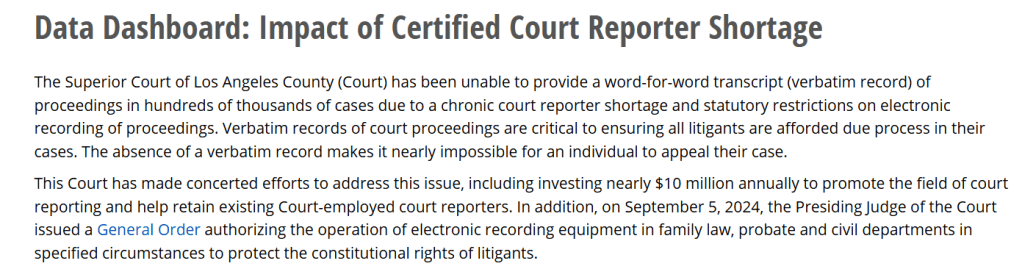
The data dashboard also outlines multimillion-dollar investments to recruit and retain court reporters, including signing bonuses, relocation reimbursements, and finder’s fees. However, the same courts pushing these incentives are also actively replacing certified court reporters with electronic recording systems in direct violation of the law. If these investments were truly meant to solve the crisis, why did the courts proceed with electronic recording despite SB 662 being rejected? The numbers clearly expose the judiciary’s ulterior motives—this crisis was engineered to justify breaking the law.
The CCRA’s Legal Victory: County of Los Angeles v. Superior Court (Kusar) (1993)
The legal struggle surrounding electronic recording in California’s courts is not new. In 1993, the CCRA filed a lawsuit against the County of Los Angeles, arguing that the county had violated the law by using electronic recording equipment in courtrooms where court reporters were required. The case, County of Los Angeles v. Superior Court (Kusar), ultimately resulted in a victory for the CCRA, with the California Court of Appeal upholding the ruling that the county was in violation of existing laws.
The ruling in Kusar was based on Government Code § 69957, which prohibits the use of electronic recording in certain types of cases, including unlimited civil, probate, and family law cases, unless the parties involved agree to the use of such technology. The law explicitly requires that court reporters transcribe these proceedings to ensure an accurate record. Despite this clear legal mandate, the issue of electronic recording has continued to surface in various courtrooms across California, raising questions about whether the law is being followed.
The CCRA’s legal victory in Kusar established a precedent that reinforced the requirement for court reporters in cases that were not exempt under the law. However, recent developments, particularly the actions of LASC, have called this precedent into question. The ongoing legal battles and the potential for further litigation suggest that the issue of electronic recording in the courts is far from settled.
Judges Acting Above the Law
By proceeding with electronic recording after the failure of SB 662, judges in Los Angeles County have demonstrated a clear disregard for legal boundaries. They have usurped the authority of the legislature and imposed their own policies in direct violation of state law. This is not just judicial overreach—it is outright lawlessness.

The ramifications of this unlawful order are profound. By deliberately eliminating court reporters and pushing an alternative that weakens the integrity of court records, judges in Los Angeles County are actively eroding the justice system. Without accurate transcripts, appeals become nearly impossible, and wrongful convictions or unjust rulings go unchallenged.
This is not just negligence—it is a deliberate attack on the rights of litigants. Judges are knowingly breaking the law, manipulating the legal system for their own convenience, and leaving the public with no recourse.
Jury Nullification: A Looming Constitutional Crisis
The growing perception that judges themselves are not following the law could have a significant impact on jury trials. If judges ask jurors whether they will follow the law, jurors may respond, “You, judge, are not following the law, so why should I?” This introduces the possibility of widespread jury nullification, where jurors refuse to convict defendants or follow legal instructions due to their belief that the judicial system itself is corrupt.
Such a breakdown in trust could create a constitutional crisis, undermining the legitimacy of the courts. If jurors no longer feel bound to apply the law because they see judges openly defying it, the entire judicial system risks collapse. Furthermore, potential jurors may increasingly refuse to serve, seeing their role as meaningless in a system where judges operate with impunity. This would further erode the justice system, leading to delayed trials, dismissed cases, and an overall failure to uphold the rule of law.
Holding the Judiciary Accountable
The people of Los Angeles County must demand accountability. Judges must be held responsible for violating the law by failing to provide certified court reporters and for deliberately orchestrating a crisis to serve their own interests. The push for electronic recording must be stopped, and the courts must be forced to reinstate and properly staff human court reporters.
Justice should never be sacrificed for convenience or judicial control. The actions of these judges are not just unethical—they are illegal. If we do not challenge them now, we risk losing the integrity of our legal system entirely.

 STENOIMPERIUM
One thought on “Judges in Los Angeles County are Breaking the Law!”