
Los Angeles Superior Court judges have made a controversial decision to abandon real-time court reporters in favor of automated speech recognition (ASR) software for their personal notetaking on the bench, a move that seemingly violates existing laws prohibiting unauthorized recordings of court proceedings.
In a recent hearing, a presiding judge in Los Angeles Superior Court paused mid-sentence to address a technological issue interfering with her discussion with attorneys.
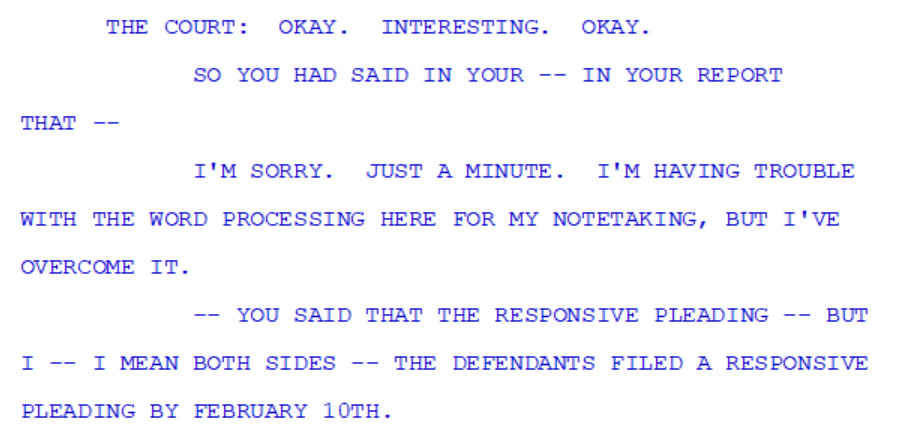
Notably, this Judge appeared on the CourtConnect screen with her chin resting on her hand, supported by her elbow, resuming this position immediately after referencing the “word processing… notetaking” software glitch. This strongly suggests she was not manually taking notes, but instead relying on ASR software to transcribe the proceedings in real-time.
Historically, judges have taken notes either by typing on a keyboard using programs like Microsoft Word or by handwriting notes. Some, like one judge formerly trained as a shorthand reporter, have even employed Gregg shorthand for quick notetaking. Additionally, certified shorthand reporters have long been employed to provide real-time verbatim transcripts, which judges can view through LiveNote software, mirrored monitors, or internet-connected proprietary programs. Immediate transcripts—both rough and certified—have always been readily available.
However, a new and legally questionable method has infiltrated the bench: ASR-based notetaking. A quick online search for notetaking programs reveals a flood of AI-powered transcription software capable of capturing and converting spoken words into text.

According to the Superior Court’s own published rules for audio/video court hearings, recording court proceedings “in any way” is explicitly prohibited for all participants. This raises an obvious issue: ASR software fundamentally relies on audio capture. It records spoken words via a microphone, processes the audio data into a transcript, and saves a .wav file in the process. Any ASR provider will confirm that this is how their software functions, meaning that by using ASR software, the court is—by its own definition—recording the proceedings.

It’s kind of a no-brainer that ASR, automated speech recognition, requires a microphone to capture the spoken words, and then records the audio that it captures to then be analyzed by the software. A wav file is created and saved in the software. Just check with any number of these ASR companies to verify that’s how it works. So, in essence, it is RECORDING the court proceeding.

Let’s break down the Superior Court’s official admonition, which warns against unauthorized recordings. Nowhere does it state that recording can be permitted at the court’s discretion. Instead, it specifies that sanctions may be imposed for violations. But what happens when a judge is the one violating the law? Apparently, nothing.
Besides the court’s own admonition, what law is being broken?
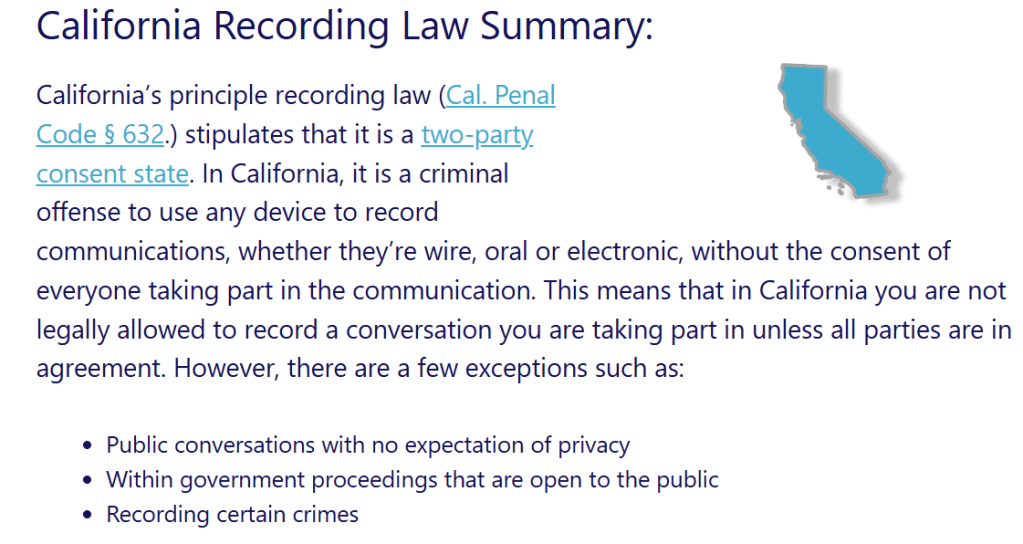
This raises an even bigger question: If public government proceedings are legally allowed to be recorded, why does the court explicitly prohibit it for others while seemingly engaging in the practice themselves? The double standard is glaring, and the implications for transparency and legal accountability are profound.

Judges are not explicitly exempt from Penal Code 632, as subsection (b) defines “person” to include individuals acting on behalf of the government. However, subsection (c) states that communications in judicial proceedings open to the public are not considered confidential, meaning court proceedings may not fall under this law’s protection. This raises concerns about whether ASR software, which inherently records audio, conflicts with legal and ethical standards.
When judges violate the law, it creates serious legal and ethical conflicts that undermine the judiciary’s integrity. Legally, judges are bound by the same laws as citizens, and violating Penal Code 632 or court regulations on recording raises concerns about selective enforcement and accountability. Ethically, judges are expected to uphold impartiality and fairness, yet disregarding rules they enforce on others erodes public trust. Moreover, their actions set dangerous precedents, suggesting that judicial figures operate above the law, which contradicts the foundational principle of equal justice.
 STENOIMPERIUM