
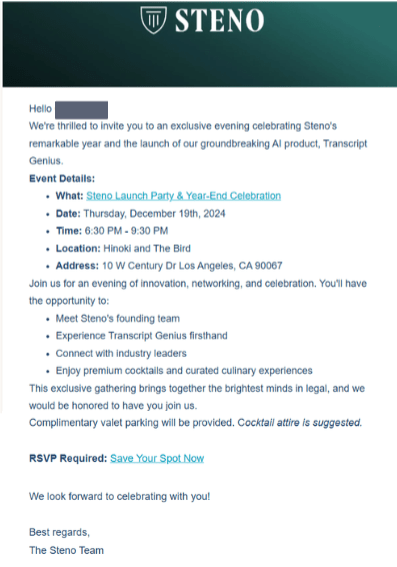
Stenographers in Los Angeles received this in their email inbox today, November 20, 2024, at 11:20 a.m.
If you go to their website, they have an explainer video that shows the product in action. It looks to be nothing more than a search filter to help find words amongs all of an attorneys’ depo transcripts.

It provides you with only three search filters, which doesn’t seem very sophisticated, but maybe it’s better than anything they have available to them now to search for something among multiple proceedings.

But does this really add something to the industry that didn’t exist? Is it “innovative,” as they claim? If you go to the Veritext portal, there’s one search field that let’s you do all three searches in that one box – attorney, witness, case. So do we really need three designated boxes for searches, when one box does the trick for all 3? Well, I guess Steno didn’t know that because they’re not a Veritext client and can’t see what their portal does for attorneys.

I believe they made a huge mistake in naming the product how they did, because my first assumption was that they came out with a product that will CREATE an AI-generated Transcript. I was relieved to learn that my initial reaction to their new product announcement was all wrong. Sometimes I’m very happy to be wrong.
It’s definitely creating a buzz in the industry today!
In response to my inquiry, Steno explained how their new product could help increase demand for our certified transcripts.

Summarizing and analyzing deposition content has been something that court reporters and agencies have steered away from intentionally for over 150 years. It crosses the ethical line of remaining neutral and unbiased for court reporters to participate in something like this. I’m sure the Big Box agencies would have done something like this a decade ago, if there wasn’t a hesitation about crossing that ethical line that defines the very core of their business.
Had Steno Agency spun off another company that handles tech software tools for attorneys and not have it attached to court reporting, I think that may have been a safer play. But they have to decide who and what they are. Are they a court reporting agency? Or are they a software innovator? As a software provider for the legal industry, are they really that innovative? I mean, CoverCrow launched in April 2019 with a full dashboard for freelancers, six years before Steno Agency launched a dashboard for their freelancers, and it has only a fraction of the tools that CoverCrow offers.
Looking at AI tools for attorneys, there’s a glut of software on the market now offering this. Steno Agency made the top of the search list. Kuddos for the great SEO strategy!
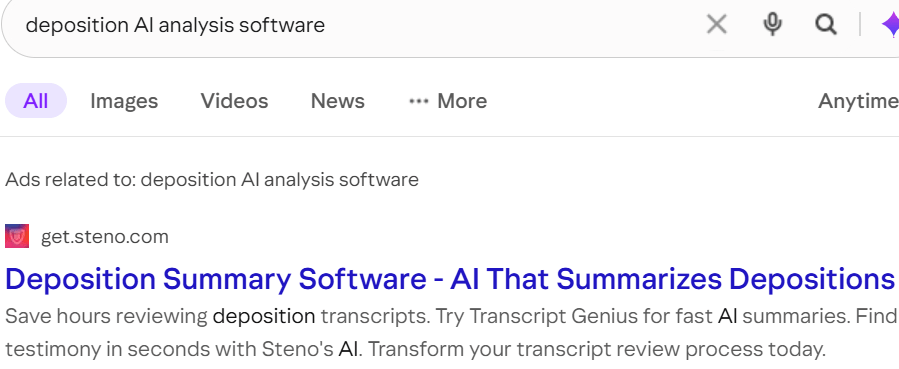





I mean, that’s just the first two pages in Google search results. The list goes on and on and on. What makes one so different than another or more innovative? They’re all using the same generative AI engine.
And who are using these software tools to summarize legal proceedings? Attorneys, who then give it to their Insurance companies. And what does it look like in a court trial where insurance companies heavily rely on AI summary services and are not reading transcripts or interrogatories? Well, I just finished a bad faith trial that was a result of an insurance company who relied on summaries to value a case. The valuation was wrong because it missed critical pieces of information of injuries that were revealed in interrogatories and the deposition that never made it into the summaries. The insurance company had a $100,000 policy limit that they failed to negotiate a settlement on, the case went to trial, and the injured driver (not the insured) was awarded $3 million. So who is responsible to pay the $3 million? The insured driver who was only insured up to $100k? Or the insurance company who read AI summaries, instead of reading the interrogatories or the court reporters transcripts of the depositions of the injured? Or the law firm who used the AI software tools to produce the summaries for the insurance company that was used to value the case? Well, the jury said the insurance company and the law firm have to pay the $3 million, and not the insureds.
Here’s what the expert witness had to say about using summaries in litigation at the jury trial. (names have been changed to protect all involved.)
Q Were you able to determine if Tanya Rory ever reviewed the medical records that had been gathered by Bando and Terry in response to their subpoenas?
A She did not.
Q And were you able to determine if Tanya Rory ever looked at the — Ms. Merry’s responses to interrogatories that she had provided to the Bando and Terry firm?
A I don’t think so.
Q And were you able to determine if the adjuster, Ms. Rory, ever looked at the responses to the request of production of documents that Ms. Merry provided to Bando and Terry?
A No.
Q So just taking those items that I just mentioned, five, do you have any — do you have an opinion as to whether or not Ms. Rory was acting reasonably in performing her job as a claim adjuster?
A Honestly, when I reviewed this, I was shocked. An adjuster’s job is to review all of these things. The only thing I saw in this file were summaries that were written by Mr. Bando, who I’m sure everybody knows was the attorney that was hired that was working with — with Ms. Rory in defending the Ferraris. And she never requested or was given the medical records to look and see what was in them. She did not look at the responses to discovery to make her own determinations. One of the most important parts of certainly the deposition of your client, and that was not read. She did summarize these things, but she summarized them from a summary. She received the summary from Mr. Bando’s office and she summarized on a few different dates — I think it was March 4th and September 17th were the two bigger dates of the summaries.
Q Why, in your view, is it insufficient for her to have just relied upon the summaries that were provided to her by Bando and Terry?
A Sure. Because she has the job to evaluate the case. Mr. Bando can evaluate it, if — if they ask him, but it’s the insurance company that has the money. Mr. Bando doesn’t have any money. It’s up to the adjuster to review the case, look at everything possible, and make a determination as to the value of that case.
And if you simply rely on someone else’s opinion, without looking at them yourself, I don’t think you’re doing a proper job, not just for Ms. Merry, but for the Franklins, and, frankly, for — for your own company.
You’re hired to, not just write things down and ask questions, you need to be proactive. I think that’s one of the things that was missing mostly in this file. There was nothing proactive that I saw of — of how the adjustment was attempted.
I wonder if the next step for the law firm and the insurance company could be to sue the sofware provider of these summaries because they missed a critical piece of information needed to valuate the claim – – the injuries. And possibly, by extension, the court reporter who was working for the company that provided the summary using those transcripts, who was hired by them? I dunno? It’s a possibility. I’ve seen fringe companies get sued in cases like asbestos, medical malpractice, etc. They use a blanket approach and sue everybody and let them all settle out or litigate out of it, which are equally costly. As a court reporter, I don’t want to be drawn into this fight with AI transcript summaries in any way. This has me concerned. So concerned, in fact, that I choose not to do any freelance work with agencies that have chosen to cross that questionably ethical line of providing AI summaries of deposition transcripts to attorneys and ultimately insurance companies.
Luckily, for the AI Software provider of the summaries, it was never asked in this trial how the summaries were made – by human or AI software. So they’re safe for now. But as AI summaries continue to propagate the legal landscape, it’s only a matter of time before the finger of blame gets pointed in that direction.
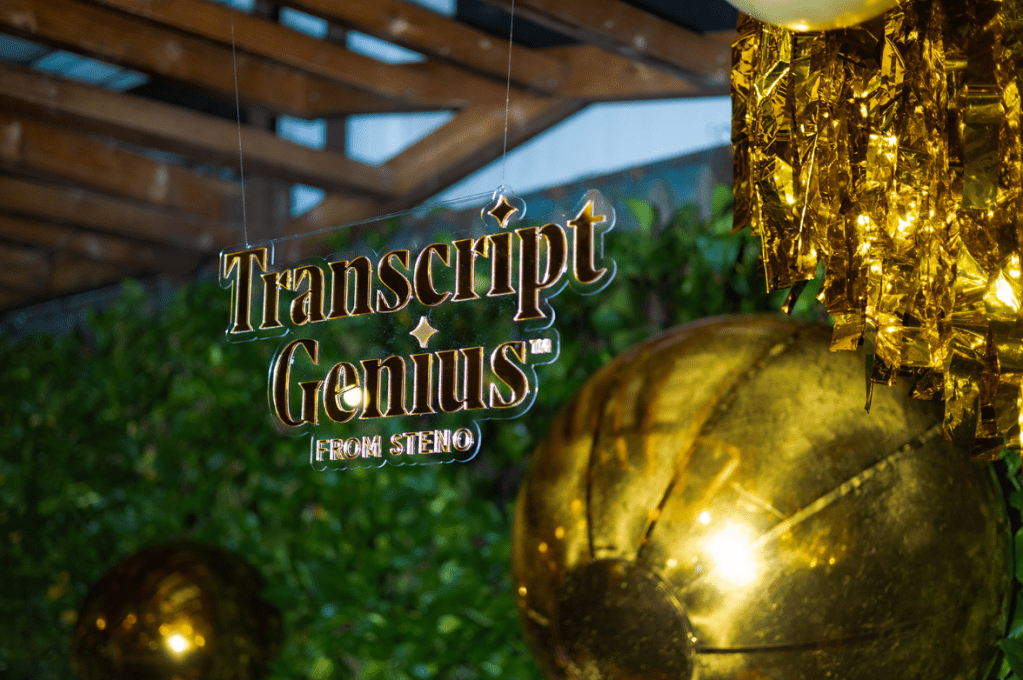
Watch the Sizzle Reel of their Launch Party here.
View pictures of their launch party here.
 STENOIMPERIUM
One thought on “AI Transcript Genius – a Steno product”