
I received a great question in a comment earlier this morning and I’ve been thinking about it a lot as I went about my busy day. I wanted to give it its own post and then expand on it as well.
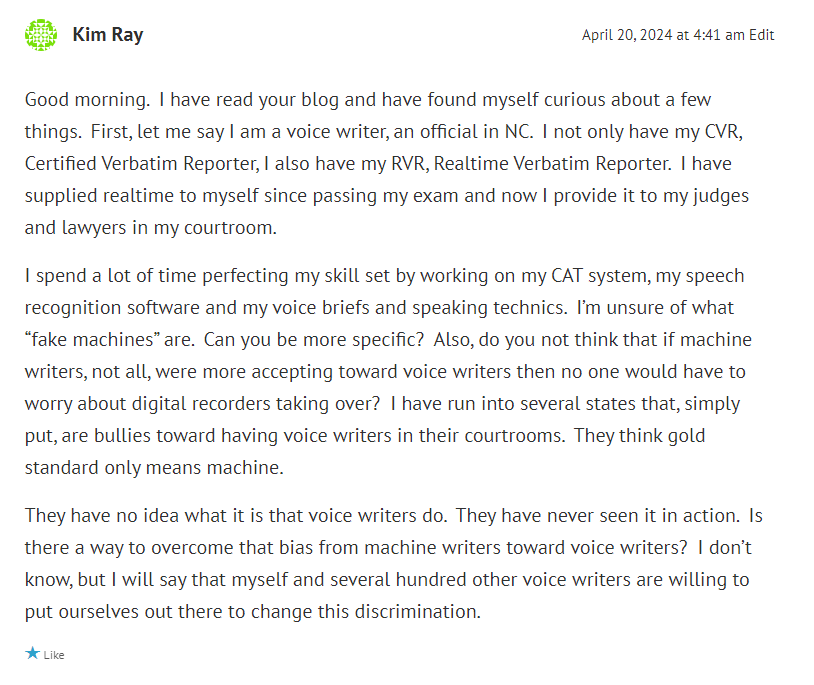
Kim,
Thank you for your GREAT question! And congratulations and welcome to the wonderful court reporting profession. Webster’s defines “stenography” as using shorthand to make a verbatim record. Voice writers use verbal shorthand cues that translate into the same Eclipse CAT software that machine writers use to make an instant verbatim record. The term “stenography” would encompass both methods of making a verbatim record, machine and voice. And there would be a third method of making a verbatim record, pen writers, but it’s my understanding that there aren’t any more pen writers working, I’d love to know if there still is one or two if anyone has any information about it, please share.
When I wrote about “fake machines,” I was referring to the fact that digital workers were given real stenograph machines to bring with them on the job by their agencies and then they pretended to type on them to make themselves look like real court reporters. So the machine isn’t fake. It’s a real machine. But the fake part was that these imposters were using them a props. So “fake” referred to the fact that they were merely a prop in the hands of someone unskilled to use it.
I believe that voice writers had a big win when the California CRB decided to allow them in CA. The decision was made years ago, but voice writers just started receiving their CSR certifications after passing the test late last year, in 2023. Good things take time.
Backstory. In September of 2017, Tori Pittman posted in my “Why I Love Court” Reporting Facebook group about voice writing and how it should be accepted everywhere. At the time, I didn’t know anything about voice writing and CA didn’t allow it, so I never bothered to research more about it. It was irrelevant to me, and reporters are busy enough pumping transcripts out. She continued to debate the merits on my group, and I just asked her politely to bring that debate to a bigger stage where she could actually impact the change that she was seeking. My group was small and the focus was different. The WILC group was created because my alma mater school told me they lost 3 students because they went to a FB vent site for court reporters. We couldn’t have our prospective students dropping out because of all the negative gripes from working reporters. We love our career, but every career has legitimate gripes. So I created a positive FB group that the schools could send their students where they weren’t in danger of dropping out, so the last thing I needed was a debate or controversy. The schools were watching. I told her that my group wasn’t the place and that I had no opinion one way or another. But I advised her that if she really wanted to change the laws in CA, she needed to start at the top, not the bottom. I openly admitted I was just a working reporter on the front lines with no power, no control, no influence, nothing. She was barking up the wrong tree. I told her the DRA and CCRA would NEVER let her idea get passed them, the gatekeepers. She should go above them to the CRB, the arbiter, pitch it to them, and let them decide. Months later, she was on the agenda, flew to CA, made her pitch and it was approved. A day later, the DRA and CCRA were on it and at the next CRB meeting it was tabled indefinitely, with all their excuses about how their voices would be distracting during a machine test, making the logistics impossible and they’d have to work out the details, which meant never. You can thank people like Stephanie Whitehead, a San Diego reporter (machine), who spent the next almost decade educating reporters up and down the state on the merits of voice writing. She helped get the first school in CA to start a voice writing program. Today, 2024, all 7 reporting schools in CA offer voice writing. She has turned the state into a fan of voice writers, and anyone who speaks a negative word is immediately shot down, and educated. I’ve had two voice writers sit out with me in court recently and we’ve educated the attorneys and judges about voice writing and how it’s just as good as machine writing (with one big difference, which I’ll get into later). Now, Los Angeles Superior Court, the largest court in the United States (and probably the word), has voice writers. I don’t know the exact amount. Since California’s population of court reporters is about 2/3 of the country’s total reporters, I can envision the entire country being accepting of voice writing in the very near future!
There were three major things that impacted my opinion of voice writers. First, Tori Pittman told me that they had saved the jobs of machine officials in Georgia! They could not find enough machine stenographers to fill the positions and the plan was to eliminate all of their jobs and replace them with electronic recording devices. By accepting and then allowing voice writers, they were able to come in and fill the jobs that were open, and they worked harmoniously together. There’s still a mix of voice and machine in Georgia, and voice has not overtaken machine. Second, I traveled the country speaking and being a vendor at 7 state conventions for the past couple of years and I would see Jennifer Thomas with her Eclipse booth at so many of them. She had her mask and was demonstrating voice writing. I’ve had numerous conversations with her over the time, always learning something new, watching her demonstrations and listening to her conversations and picking her brain with my own questions. She is an amazing voice writer and trainer. I watched her do exactly what I do to make a verbatim record on the same CAT software and I could not hear a word through her mask – not a sound. And finally, the Navy has used voice writers exclusively for over 60 years. That needs no further elaboration.
But I will say that with the shorter amount of time that it takes to get reporters working using voice versus machine (one year vs. three, on average), it’s appealing. And a lot of voice students are also learning steno with the goal to use voice to start working and then continue with their steno machine skills until they pass the CSR again using a steno machine. I also know several stenographers who went back to school to learn voice and now how a CSR for voice and machine. I think it’s a good backup in case your hands or back give out on you. You’d be able to continue working without the retraining time.
Your last point, you’re absolutely right! People need to see it! I was lucky enough to travel out of my small world to see it firsthand. I’m trying to help overcome the bias with educating others in everyday conversations, bringing in voice writers to sit out with me and then letting the other official and freelance reporters know I’ve got a voice writer with me that day so drop in – and they have! I think voice writing students are doing a lot on social media right now to help showcase the method. I think machine stenographers could do more to help talk about welcoming you into our profession and dispel the fears that you will take over and we’ll lose a job. That’s still their concern. I think that because you have California reporters almost all accepting of voice writing now, you will start to see some big changes in the perception of voice writers all over the country soon. The bias will be eliminated soon. Just keep being part of bolstering the image of voice writers and keeping professional standards high.
***And full disclosure, these women – Jennifer Thompson, Tori Pittman, and Stephanie Whitehead – are pure professional acquaintances who I met and spoke to in my professional capacity. They are not friends. I’ve never had lunch with them. I don’t have their cell phone numbers. And I have never shared a phone call with them. I have the utmost respect for all 3 of these remarkable women, powerhouses in our Steno profession.
Outside of our profession-focused conversations at conventions or a passing hello, I have no contact with them.

 STENOIMPERIUM
One thought on “Voice Writers are Stenographers Too!”