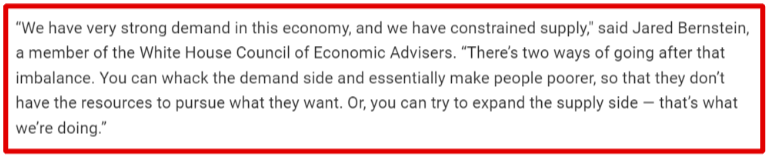
President Biden gave us all a rather crude lesson in supply & demand economics in his Presidential speech on January 7th, one that dropped my jaw.
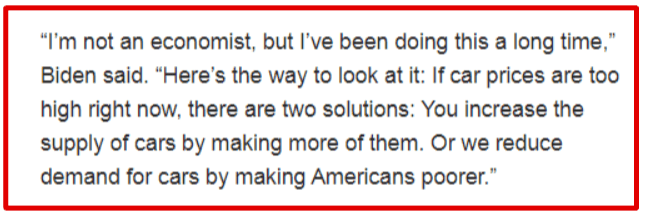
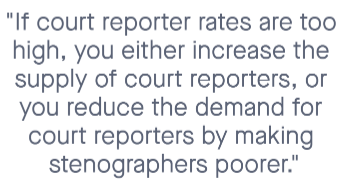
Replace the words “car prices” with “court reporter rates” and “cars” with “court reporters,” and then replace the word “Americans” with “stenographers.” Now you’ll understand why I was stupefied.
In 2014, the National Court Reporters Association commissioned a study conducted by market analyst Ducker Worldwide, which predicted that the demand for court reporters would exceed the supply within five years (2018), yielding a nationwide shortage. The report said 5,500 new court reporter jobs will be available by 2018 as older workers retire and leave the field. Seventy percent of the nation’s 32,000 court reporters are older than 45, the report said.

On the heels of the 2014 Ducker study, there were three camps that formed: 1) those that sought to meet the demand more efficiently to overcome a shortage; 2) those that sought to increase the supply; 3) and those that sought to “whack” the demand, and stomp it out altogether, with their own profit-driven, inferior service (digital recording and unlicensed transcriptionists) and making the backbone of the profession (the stenographers) in our country poorer with 50-year-old stale rates.
Two notable SaaS (Software as a Service) platforms began development in 2018, Stenovate and CoverCrow, both aimed at helping to increase efficiency in order to meet demand for our services as the shortage grew more dire. Stenovate helps court reporters connect with scopists and proofreaders, allowing them to take more jobs per week and increase productivity. CoverCrow helps court reporters connect with agencies, allowing them to accept more jobs and more efficiently, and reducing the noise by setting advanced job alert filters. In June of 2021, CoverCrow launched their first integration with a CAT vendor, ProCat, to allow court reporters to get job alerts right in their Winner CAT software and automated their live check-in availability status when they open or close a CAT file and went live at the NCRA convention in July in Las Vegas. In August, 2021, NCRA launched ProLink to make it easier to find court reporters, borrowing from the CoverCrow concept. And in August, 2021, Stenograph launched Apex for their users to get agency job alerts in their CASECatalyst CAT software and other workforce features for court reporters.
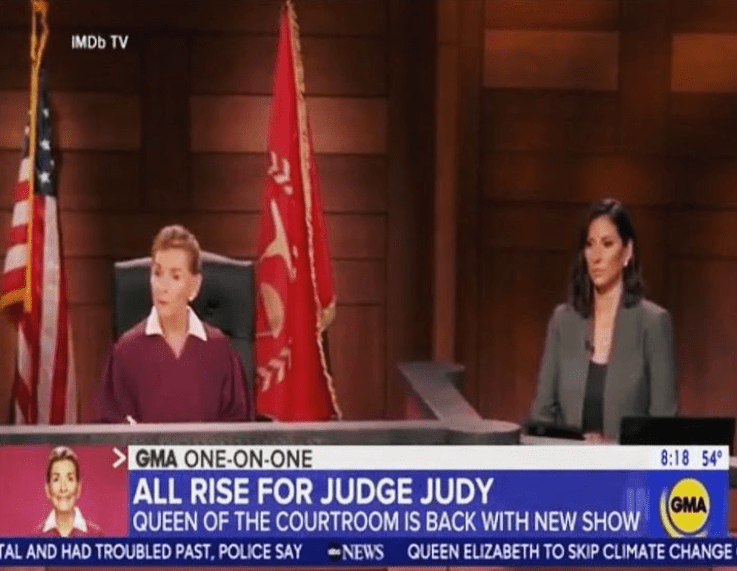
Those in the camp that sought to increase our supply were non-profit organizations, such as Project Steno and NCRA’s AtoZ program. These organizations were able to garner some sizeable donations from industry partners, such as agencies and vendors and stenographers. Court Reporting schools all across the country increased their recruiting efforts as well and Mark Kislingbury opened up several new court reporting schools. Stenographers all across the globe took to social media telling their stories and sharing their positive career stories and advice. The number of Facebook groups grew. The number of reporters signing up for Instagram, TikTok, Facebook, LinkedIn, Twitter, and others grew exponentially. Stenographers picked up their digital pens and published articles outside our profession, such as Lifehacker, Monster, and more. Whitney Kumar signed on as Judy Justice’s new on-show stenographer, instantly becoming the most popular courtroom role model and first court reporter with a name (besides Madam Court Reporter) in TV history!
There’s always going to be sharks in the water, especially when there is money to be made, whether it’s legal and ethical or not. Court reporting is a $3 billion industry, so the stakes are high. A feeding frenzy of bottom-feeders was unleashed when DRA’s Lobbyist Ed Howard clarified a loophole in the law that allowed anyone with a CA notary to act as a deposition officer. Videographers all over began to get their notary certificates. It spread like wildfire throughout the nation, with opportunistic agencies instructed their videographers to put their cameras on the ground and just record the deposition proceedings, and then eventually instructed the videographers to identify themselves as the “court reporter,” not just merely a deposition officer anymore. It evolved into hiring another button pusher to record the proceedings so that the videographer could hide the fact that they were serving in dual roles.
Are you following so far? It gets even more nefarious. In order to get past the laws in 23 states that explicitly require that transcripts be produced by stenographic means, these agencies instructed law firms to change the notice language to stipulate to break the law and have a digital recorder audio record the deposition testimony and later have it typed up by a transcriptionist. This in in violation of the 5th and 14th Amendments to the U.S. Constitution, which protects the due process rights of litigants. Such a stipulation of the attorneys needs to be ruled upon by the judge in their case. Judges in CA are refusing to admit depo transcripts attached to motions or in trial that have not been certified by a CA licensed Certified Shorthand Reporter. But since only 5% of all cases get to the trial stage, they’re taking their chances. The legal negligence cases may start against those playing Russian Roulette with their litigants’ lawsuits.
Eight years post-Ducker study, we have no idea what the actual number of active court reporters there are across the country. STTI and those in camp 3 would have you believe there’s a shortage of 33,000 reporters, a made-up number. But schools across the country have seen an influx of students. It turns out COVID has had a lot of people out of work and turning to the career they always wanted to try: court reporting. We need the NCRA to do another industry outlook study. We need the NCRA to publicly admit that the Ducker study they commissioned in 2013/14, predicting the shortage in 2018 was wrong. Those numbers were never realized. We need the NCRA to give us hope. Otherwise, greedy opportunists will continue to weaponize an outdated and inaccurate study.
“Hope is the thing with feathers / That perches in the soul,” wrote Emily Dickinson. “And sore must be the storm / That could abash the little Bird / That kept so many warm.”
Staring ahead on New Year’s Eve, at what appear to be the coming storms of 2022, this once-hopeful profession is going to have to fall back on its reserves.
 STENOIMPERIUM