There was a time when most court reporters didn’t “freelance” in the modern sense. They were staff reporters. They belonged to an agency. They worked out of a physical office. They knew the schedulers by name. They had predictable calendars, reliable income, shared clients, and a sense that they were part of something stable. Agencies, in turn, invested in their reporters because reporters were not interchangeable labor. They were the agency.
That world didn’t disappear overnight. It eroded slowly. Consolidation. Venture capital. National call centers. Digital platforms. Remote proceedings. Cost-cutting. Margin pressure. A shift from relationship-based scheduling to volume-based fulfillment. Somewhere along the way, the agency–reporter bond quietly broke.
Today, agencies across the country all say the same thing: “We can’t keep reporters.” Reporters say something different: “I don’t feel loyal to any agency anymore.”
Retention is not a mystery problem. It is a structural one.
Reporters did not suddenly become flaky, entitled, or difficult. The environment changed. The incentives changed. The protections changed. The meaning of “working with an agency” changed. And when meaning disappears, loyalty goes with it.
If agencies want reporters to stay again, they have to rebuild what once existed — not nostalgically, but intentionally.
Here is what actually keeps reporters with agencies.
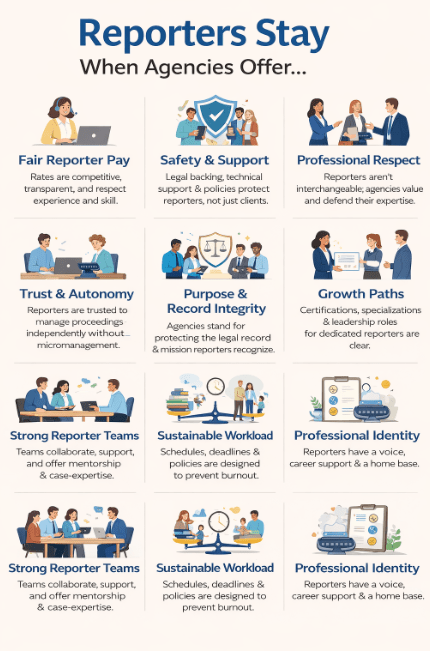
1. Fair Pay That Respects Skill, Not Just Coverage
Staff reporters stayed because they could build a life. They could plan. They could predict income. They weren’t constantly renegotiating their own worth.
Today, many agencies treat reporters like fluctuating expenses instead of revenue-generating professionals. Rates are opaque. Splits are inconsistent. Expedites become leverage instead of bonuses. New platforms introduce new “fees” that quietly reduce reporter pay without reducing reporter responsibility.
If an agency’s business model only works when reporter compensation is squeezed, reporters will never stay. They will diversify, detach, or leave.
Retention begins when pay structures are transparent, competitive, and aligned with the real value of certified skill, realtime ability, subject-matter competence, and professional risk.
2. Safety — Legal, Technical, and Professional
Staff reporters once had something freelancers rarely feel today: cover.
Agencies handled billing battles. Client disputes. Collection problems. Equipment logistics. Many even provided backup, mentoring, and problem-solving in real time. Reporters were not alone in the system.
Now, many reporters feel simultaneously controlled and unsupported. They are monitored, rated, and restricted — yet left exposed when something goes wrong.
Safety today means:
• Clear legal backing when transcript issues arise
• Real technical support, not ticket numbers
• Policies that protect reporters, not just clients
• A refusal to scapegoat reporters for systemic failures
When reporters don’t feel safe, they don’t stay. They hedge. They multi-agency. They emotionally disengage. Or they exit.
3. Respect for the Record and the Reporter
Staff agencies once marketed their reporters. They introduced them. They protected their reputations. They sold quality.
Many modern agencies sell speed, volume, and “solutions.” The reporter becomes invisible. Sometimes even interchangeable. Sometimes not even named.
But reporters do not experience themselves as interchangeable. They experience years of training, thousands of pages of writing, continuing education, certification risk, equipment investment, and legal exposure.
Agencies that retain reporters speak about them differently. They acknowledge the craft. They defer to professional judgment. They involve reporters in policy decisions that affect the record. They do not undermine the very expertise their business depends on.
Respect is not a slogan. It is operational.
4. Purpose Beyond Filling Slots
Staff reporters once knew the clients. They knew the judges. They knew the cases. They understood where they fit in the legal ecosystem.
Many reporters today feel like floating utility workers in a scheduling grid.
Purpose returns when agencies stop positioning themselves as “coverage companies” and start positioning themselves as record companies — organizations whose central mission is the integrity, reliability, and professionalism of the legal record.
When agencies articulate a mission reporters actually recognize, they stop being replaceable vendors and start being professional homes again.
5. Growth Paths That Are Real
Staff agencies trained reporters. They promoted reporters. They created seniority. They built specialties.
Many agencies today have no professional ladder. Just more work.
Growth does not always mean management. It means:
• Advanced certifications supported
• Realtime and CART pathways
• Complex-case teams
• mentorship roles
• leadership in quality control
• education stipends
• emerging-technology advisory roles
When reporters cannot see a future inside an agency, they build one outside it.
6. Strong Teams, Not Isolated Contractors
Staff reporters had colleagues. They had peers. They had identity.
Modern reporters often never speak to another reporter in their agency ecosystem. They are functionally alone.
Agencies that retain reporters intentionally build community: case teams, specialty groups, shared standards, collaborative problem-solving, peer mentorship, and professional forums that are not just marketing fronts.
People do not stay for logos. They stay for human systems.
7. Trust and Autonomy
Staff reporters were trusted. They were dispatched because of competence, not micromanaged through software.
Many agencies now impose layered controls: required platforms, restricted communication, automated policies that override professional judgment.
Trust is rebuilt when agencies stop designing systems around the assumption that reporters are liabilities — and start designing them around the reality that reporters are the product.
8. Balance That Acknowledges Human Limits
Staff reporting models were not perfect, but they were built around human capacity. Today’s always-on scheduling culture is not.
Agencies that retain reporters design with sustainability in mind: realistic turnarounds, voluntary expedites, backup coverage, and policies that acknowledge family, health, and cognitive load.
Burnout is not a reporter problem. It is a systems design problem.
Why This Matters Now
There is no future agency model that does not depend on skilled human reporters. Technology has not removed that need. It has increased it.
Agencies can chase new tools. New platforms. New revenue streams.
But none of them function without reporters who choose to stay.
Retention is not about perks. It is about rebuilding the conditions that once made agency affiliation make sense.
Not nostalgia.
Structure.
Disclaimer
This article reflects professional observations and industry analysis and is not intended as legal, financial, or business advice. It represents commentary on trends within the court reporting profession and is written for educational and discussion purposes only.
 STENOIMPERIUM